The Resume Objective: When It Still Earns Its Line
Published · 11 min read
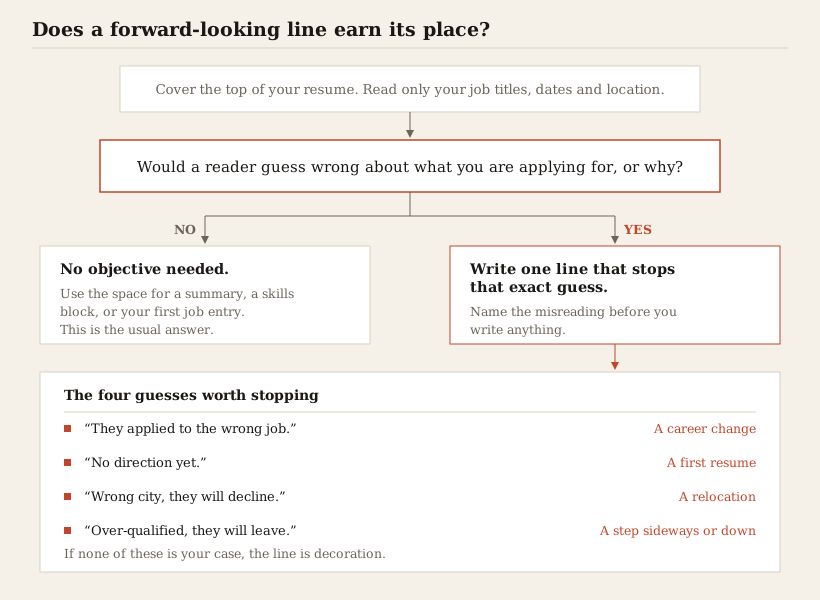
A resume objective is one or two lines at the top of the page naming the role you are aiming for. Most people do not need one. It earns its line only when a reader would otherwise guess wrong about your application, and that happens in four specific situations.
That is a narrower claim than the version you usually hear, which is that the objective is dead, and a narrower claim than the version resume sites prefer, which is that you should always write a summary instead. Whether you want a summary or an objective is a question with a settled answer, and it is answered in /blog/professional-summary-for-a-resume. This page is about the leftover: the cases where the summary is not the right tool and one forward-looking line genuinely is.
Why did the objective stop working?
Because the job it was invented to do no longer exists.
The objective was a routing label. It belongs to an era when a resume arrived as an unsolicited document addressed to a company rather than to a vacancy: posted, faxed, handed in at a desk, dropped into a general applications tray. Something at the top of the page had to say what the document was for, because nothing else did. "Objective: an entry-level position in accounting" told a clerk which pile the paper belonged in.
Now you apply through a posting. Your file arrives attached to a specific requisition, in a system that already knows which advertisement you clicked, often with the job title printed above your name on the reviewer's screen. The routing happens before anyone opens the document. The sentence that used to do the routing is still there, and it is now announcing something the reader already knows.
What survived the loss of function was the grammar. People kept writing the shape of the sentence without its purpose, which is how a whole generation of resumes came to open with "Seeking a challenging position with a growth-oriented company where I can utilise my skills and grow professionally." That line routes nothing, names nobody, and sits in the single most valuable position on the page.
There is a second reason, and it is about direction. An objective is a sentence about what you want, placed in a document whose reader is deciding what they get. That is not automatically wrong, because an employer does care whether you want this particular job. It is wrong when your wanting it is not in question, which for most applicants it is not, because you applied.
What test decides whether you need one?
One question, and it takes about ten seconds.
Cover the top of your resume with your hand so that all you can see is your job titles, your dates and your location. Now read it as a stranger. Would that stranger guess wrong about what you are applying for, or about why?
If the answer is no, you do not need an objective, and no amount of rewriting will make one worth the space. If the answer is yes, then you have found the objective's remaining job, and it is more specific than people expect: it is not a statement of ambition, it is a pre-emptive answer to one particular misreading. Name the wrong guess first. Then write the shortest line that stops it.
This reframing is what makes the rest of the decisions easy. Every line in a good objective is doing defensive work. If a clause is not stopping the wrong guess, it is decoration, and decoration in the top two lines of a resume is expensive.
Case one: the reader thinks you applied to the wrong job
This is the career change, and it is the strongest surviving case. Your titles say one field, the vacancy is in another, and the fastest explanation available to a reader with forty files to get through is that you applied by mistake or you are applying to everything.
Here is the pair. Everything in it is invented for the example, including the candidate, the employers and the dates.
Weak: "Objective: To obtain a challenging position in clinical research where I can utilise my healthcare background and grow professionally."
It names no role, no evidence and no bridge. It does not stop the wrong guess, because the wrong guess is about whether she can do the work, and this line contains no information about that. It also spends its only two clauses on what she gets.
Rewritten: "Clinical Data Coordinator. Six years as a pharmacy technician maintaining controlled-drug records and preparing dispensing audits for inspection, now moving into clinical research. Certificate in clinical research administration completed March 2026. The record-keeping standard is the same one, applied to trial data instead of stock."
Four things changed. It names the target role in the words the advertisement uses. It names the bridge, which is auditable record-keeping under inspection, not a general claim about transferable skills. It dates the retraining, so the reader knows the move is current rather than aspirational. And the final sentence is an argument rather than a wish.
Tip: The strongest evidence for a career change nearly always comes from the old job, not from the new certificate. The certificate proves you meant it. The old job proves you can do it. An objective that leads with the course and buries the six years has the two the wrong way round.
Case two: the reader thinks you have no direction yet
This is the first resume. There are no job titles to read, so the stranger's guess is built from whatever else is on the page, and a page of coursework and a summer job supports almost any guess at all.
Weak: "Objective: Recent graduate seeking an entry-level engineering position to begin my career and gain valuable experience."
Every graduate in the pile could have written it without changing a word, which means it distinguishes nobody. The phrase "gain valuable experience" is the specific problem: it states, accurately, that the benefit of hiring him flows to him.
Rewritten: "Graduate Civil Engineer, Drainage and Flood Risk. BEng Civil Engineering, 2:1. Final-year project modelled surface water drainage for a 40-hectare development in InfoWorks ICM. Eleven weeks on site with a groundworks contractor across two summers. CSCS card held."
Notice that it has stopped being an objective in the old sense. It is a target line followed by three facts, and it never says the word seeking. That is the correct direction of travel: as soon as you have anything concrete, the concrete thing outperforms the statement of intent, and the statement of intent shrinks to a title.
The sub-case worth naming: if you have any real work history at all, even in an unrelated field, you are usually better served by a short summary than by an objective. Two years behind a bar is evidence of something. The objective is for the case where the honest answer is that your direction genuinely is the most useful thing on the page.
Case three: the reader thinks you are in the wrong city
This is the case almost nobody writes about, and it is the clearest surviving use of the format.
A location that does not match the vacancy is one of the very few things on a resume that can close an application before it is read. The reader is not being unfair. They are managing a queue, and a candidate three time zones away looks like a phone call that ends in a no. The mechanism is worth understanding, because it explains what the line has to contain: the reader's objection is practical, so your answer has to be practical too.
Three versions, for three different situations:
- Already committed to the move: "Relocating to Austin in March 2027. Available for interview in person from January, at my own expense."
- Already have the right to work, moving country: "Systems Administrator, Dublin. Irish citizen relocating from Toronto, no sponsorship required, available from 1 February 2027."
- Already living there but your resume says otherwise: do not write a line at all. Fix the location field in your header. This is the version people get wrong most often, because a line explaining your address is weaker than an address that needs no explanation.
Two rules govern all of them. Give a date rather than an intention, because "willing to relocate" is a hypothetical and a hiring manager cannot schedule a hypothetical. And answer the sponsorship question explicitly if it could possibly arise, because an unanswered work-authorisation question is read as a yes. What belongs in the header rather than the objective is covered in /blog/resume-header.
Case four: the reader thinks you will not stay
Here the wrong guess is not about your field. It is about fit. You are applying for something that is a step down, a step sideways, a much smaller organisation, a fixed-term contract, or a return to hands-on work after years of managing. Your titles read as more senior than the vacancy, and the reader's guess is one of three: we cannot afford them, they will be bored in six months, or they are using us as a bridge.
The weak version of this case is usually not a bad objective. It is no objective at all. The resume opens with a director title, the reader draws the obvious conclusion, and nothing on the page contradicts it.
Rewritten, as an example: "Warehouse Operations Manager. Fourteen years in logistics, the last four as operations director for a 300-person distributor. Moving deliberately back to a single-site, hands-on role. Applying at the advertised band."
The last four words are doing most of the work. They answer, in advance and without being asked, the objection that was going to end the application, and they cost you nothing you were not going to disclose anyway. The rest of the line establishes that the move is a choice rather than a landing.
Two related sub-cases run on the same mechanism. For a fixed-term role: "Available for the six-month contract as advertised. Not seeking permanent conversion." For a return to work after time away, the line names the gap in one clause and then moves past it, which is a topic with its own mechanics in /blog/employment-gaps.
What is a bad objective actually doing wrong?
The failure patterns are worth naming individually, because each one fails for a different reason and knowing the reason lets you diagnose a line this page does not cover.
- "Seeking a challenging position" fails because it cannot be false. No candidate has ever sought an unchallenging one, so the words carry no information and the reader learns only that you filled a space.
- "...where I can utilise my skills" fails because it names no skill. If you can name it, name it and delete the clause. If you cannot name it, the clause is the reason you could not.
- "...with a growth-oriented company that values hard work" fails because it describes the employer to themselves. They have met their company. They are reading to learn about you.
- "...to gain experience and develop professionally" fails on direction. It is a sentence about what the job does for you, in a document about what you do for the job.
- An objective that does not name the role fails at the only task the format ever had.
- An objective you could paste into a different application without editing a word is not an objective. It is a heading with ambitions.
There is a general test that applies to any opening block, and it is set out in /blog/professional-summary-for-a-resume: cross out every phrase a weaker candidate could also have written, and see what survives. Applied to objectives it is unusually destructive. Most of them do not survive it at all, which is the honest reason this article recommends deleting more of them than it recommends fixing.
How long should it be, and where does it go?
One line, two at the outside, and under about thirty words. Directly beneath your contact details, above everything else. It replaces the summary rather than joining it: two opening blocks is one too many, and a reader who meets a summary and an objective in the same header learns that you could not decide.
The word "Objective" as a heading is optional and slightly dated. A target-role line with no label reads better and takes less vertical space, which matters more than the label ever did.
This is also the place to notice something deflating. For a large share of the people who search for how to write an objective, the whole remaining function is served by a single line in the header: the job title you are applying for, written the way the advertisement writes it. Three words, no sentence, no label. If that line stops the wrong guess on its own, you are finished, and /blog/resume-header covers how to write it.
What should go there if you fail the test?
Then you have found something useful, which is that the top of your resume is free. There are three good uses for it and all of them beat a generic objective.
- A professional summary, if your record needs compressing or your titles undersell you. That decision, and how to write one that says something a list of jobs cannot, is in /blog/professional-summary-for-a-resume.
- A skills block, if the role is defined by a toolset and the reader is scanning for named tools. /blog/skills-to-put-on-a-resume covers which ones belong there and which are costing you space.
- Nothing at all. Header, then straight into your most recent job. This is a perfectly respectable resume and for a candidate with a straight career line it is frequently the strongest one available, because the first thing the reader meets is evidence rather than prose.
The check before you send it
- You can name, in one sentence, the wrong guess this line exists to stop. If you cannot, delete the line.
- It names the target role in the advertisement's own words.
- It contains at least one fact a different candidate could not also claim.
- It does not contain the words seeking, challenging, utilise, dynamic, or the phrase grow professionally.
- It is one line, or two, and it is not sitting above or below a summary.
- It would need editing to be used for a different application. If it would not, it is not tailored, and the reader can tell.
That is the whole of it. The objective is not dead, it is just narrow, and the narrowness is the useful part: knowing that it has exactly one job makes it obvious both when to write one and what to put in it. If you are still weighing this against a summary, /blog/professional-summary-for-a-resume settles that question properly, and /blog/resume-review is the six-pass check to run over the finished document.