Accounting Clerk Resume Examples: the lines they read
Resume for Accounts Clerk Jobs: Accounting Clerk Samples
By Mustafa Tarabya, founder of CVBooster · Published · Updated
Resume samples for accounting clerk and accounts clerk jobs: two account clerk resume samples with invoice volumes, reconciliation bullets and keywords.
Sample resumes for a accounting clerk
The same accounting clerk content laid out in three CVBooster templates, so you can see what the finished document looks like before you write a word.
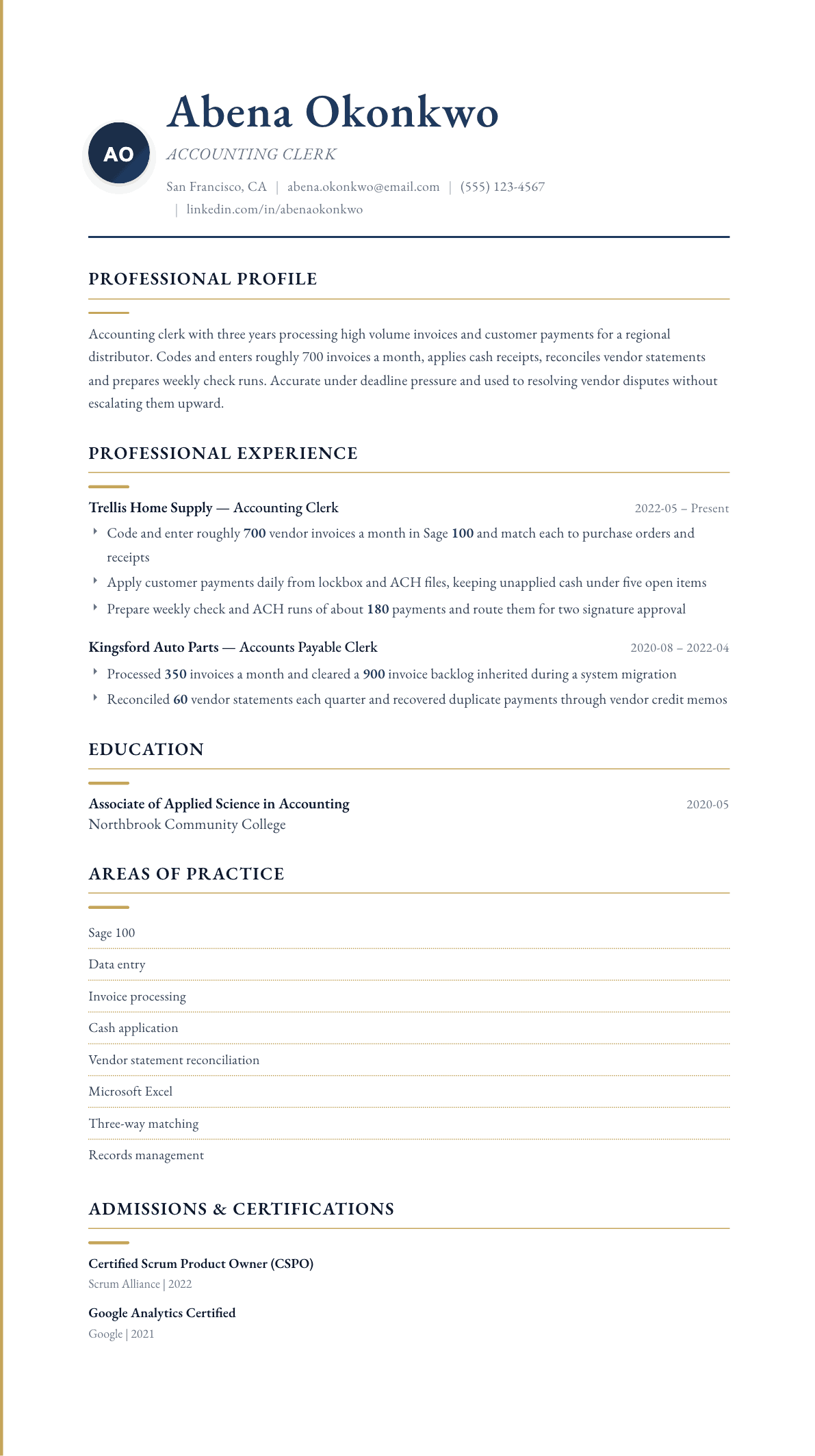
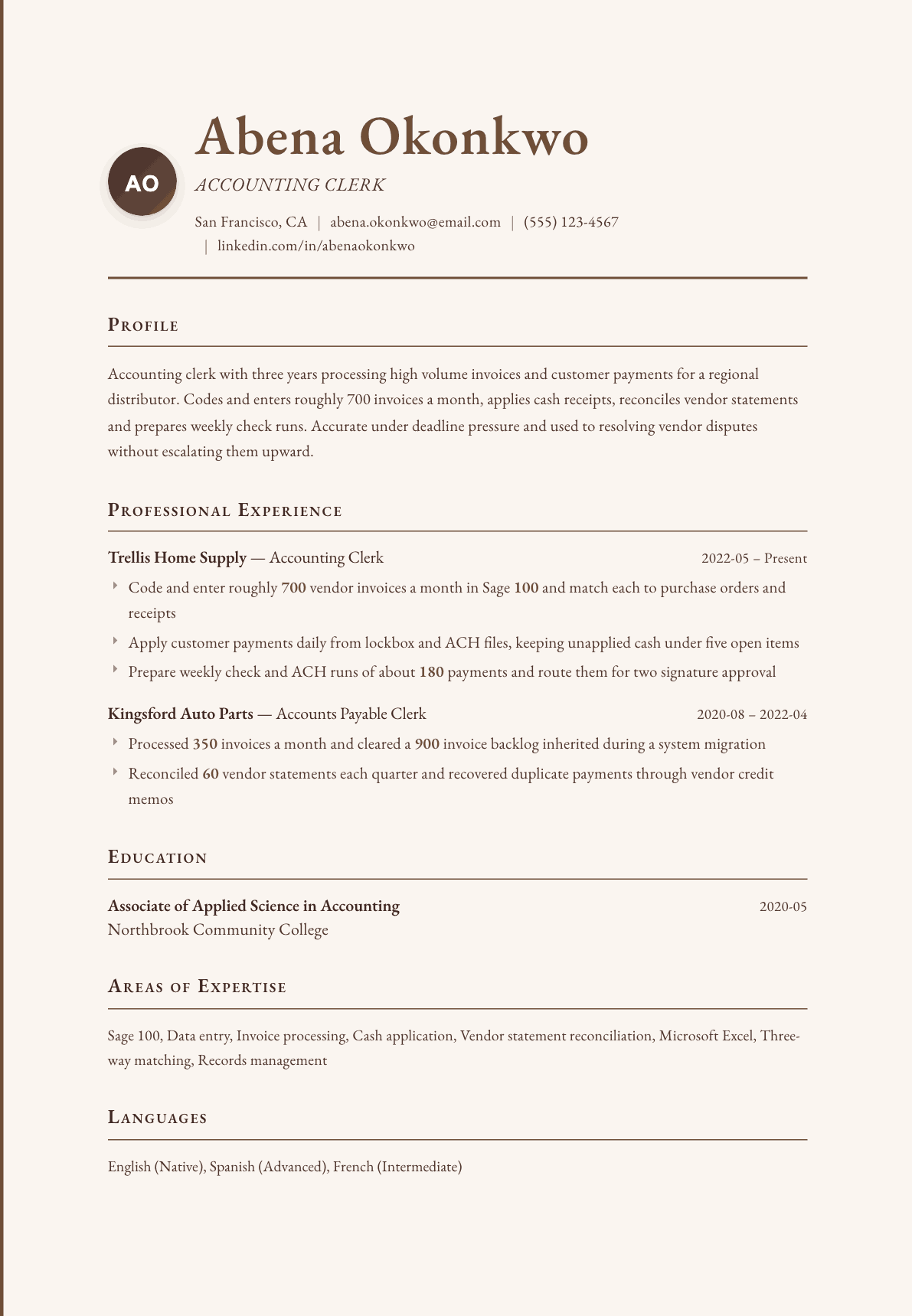
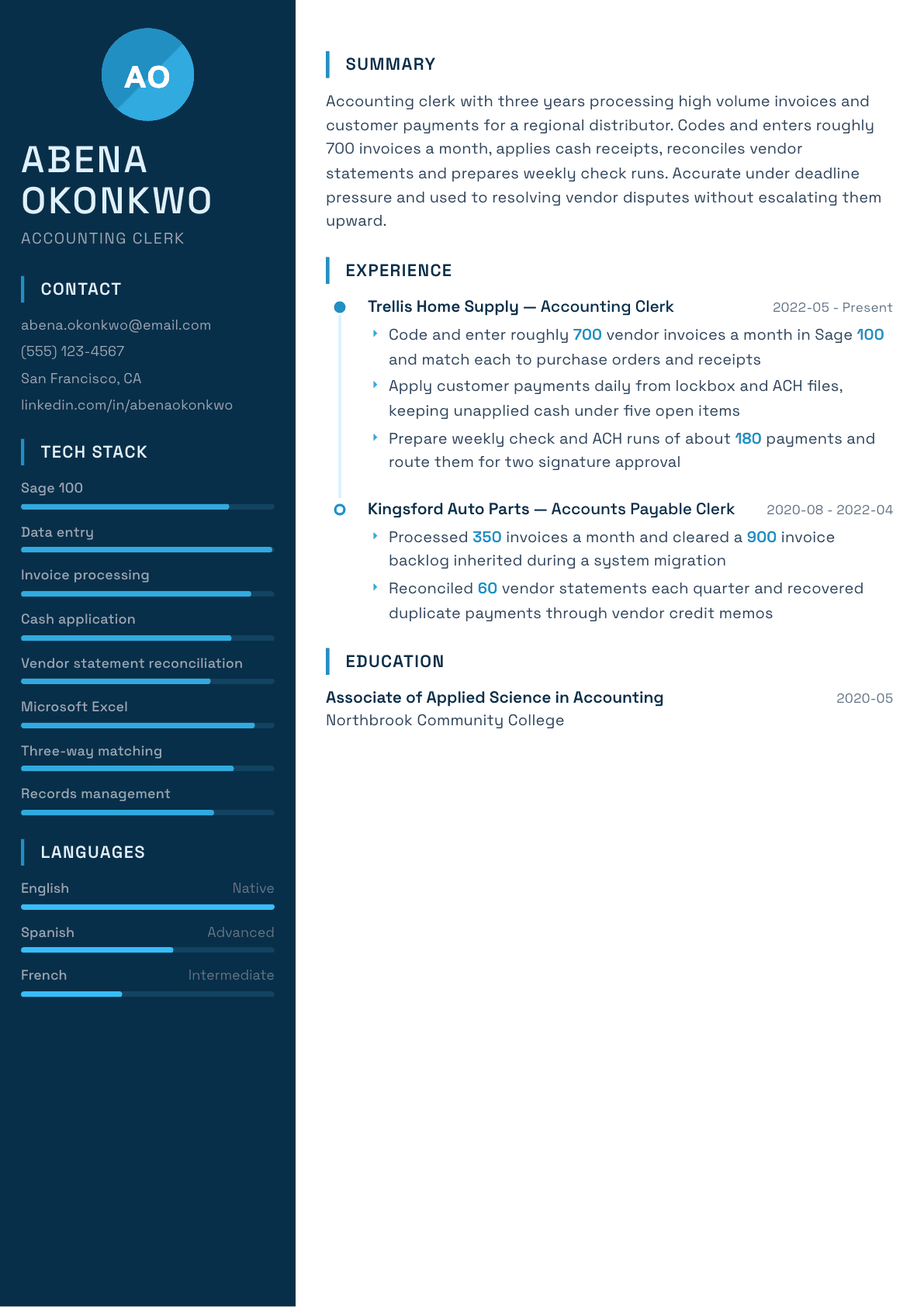
Example Accounting Clerk summary
Accounting clerk with three years in high volume payables and receivables for a distributor. Enters roughly 700 coded invoices a month in Sage 100, matches them to purchase orders and receipts, and applies lockbox and ACH receipts daily. Cleared a 900 invoice backlog during a system migration and keeps unapplied cash to a handful of items. Holds an associate degree in accounting.
Skills to list on a Accounting Clerk resume
- Invoice processing
- Data entry
- Three-way matching
- Cash application
- Accounts payable
- Accounts receivable
- Vendor statement reconciliation
- Check and ACH runs
- Sage 100
- QuickBooks
- Microsoft Excel
- Expense coding
- Document control
- Purchase order matching
What actually gets this resume read
- Give volumes: invoices entered per month, payments applied per day and the size of any backlog you cleared.
- Name the accounting system and any document imaging tool, since clerk postings screen on exact software.
- Explain three-way matching in your own bullets, because it proves you understand the control, not the task.
- Add the customer and vendor contact work you do, as employers value a clerk who resolves disputes directly.
- Show accuracy with a checkable detail such as error rate, audit findings or unapplied cash left open.
- List an associate degree or bookkeeping certificate near the top when you have no four-year degree.
How to write a accounting clerk resume
An accounting clerk resume is usually read fast by an office manager or an accounts payable supervisor with a stack of applications and a specific gap to fill: invoices piling up, a vendor statement backlog, cash sitting unapplied. They are not looking for potential. They are looking for someone who has done this exact volume of work in a system they recognize.
That makes volume and software the two things your file must show in the first six lines. An accounting clerk who enters seven hundred coded invoices a month in Sage 100 is a different hire from one who enters forty in QuickBooks, and no amount of careful wording will substitute for those numbers.
This guide covers how to structure a resume for accounts clerk jobs, how to write payables and receivables work so a supervisor can size you, which controls to mention, and the questions clerks ask most when they move from one employer to the next.
Keep it to one page and lead with volume
One page, single column, plain font. This role rarely justifies a second page, and a longer file usually means duties have been stretched. Put a two line summary at the top that carries the volume, the system and the type of work: payables, receivables, payroll support or a mix.
Underneath, a short systems line, then experience, then education or a bookkeeping certificate. If you hold an associate degree in accounting or a certificate, put it near the top when you have no four-year degree, because it answers the qualification question before the reader has to ask it.
- Summary: years, invoice or payment volume, the system name, and the areas you cover.
- Systems: accounting package, document imaging or workflow tool, banking portal, spreadsheet depth.
- Experience: employer, industry, then bullets that each carry a number.
Write payables work as a control, not as typing
Anyone can say they entered invoices. What distinguishes an experienced clerk is the matching and the exception handling. Describe three-way matching in your own words: invoice to purchase order to receiving document, and what you do when the three do not agree. That single detail tells a supervisor you understand why the step exists.
Then cover the payment cycle: how many checks or ACH payments you prepare, how they are approved, how you handle vendor setup and banking detail changes, and how you catch duplicates. Fraud prevention around vendor changes is a live concern for every accounts payable team, and mentioning it puts you ahead.
Write receivables work around cash and disputes
On the receivables side, the numbers are invoices issued, receipts applied per day, and how much cash you leave unapplied at the end of a week. Unapplied cash is the metric a controller notices, because it distorts the aging and hides real collection problems.
Add the customer contact you handle: chasing a purchase order number, researching a short payment against remittance detail, sending copy invoices, and escalating only when the account genuinely needs a credit decision. Clerks who resolve their own disputes save a supervisor hours a week and should say so.
Accuracy, filing and the audit trail
Accuracy claims need a check. Use a number a reader can imagine: invoices reprocessed for coding errors, duplicate payments recovered through credit memos, vendor statements reconciled per quarter, or an audit sample that came back clean. Saying highly accurate on its own is invisible.
Document handling matters more in clerk roles than people expect. Say whether you file physically, scan into a workflow tool, or maintain the approval trail for an auditor. When a business is audited, the clerk who kept the trail intact is the reason fieldwork ends on time.
Keywords in accounting clerk postings
The recurring terms are accounts payable, accounts receivable, invoice processing, three-way matching, purchase order matching, cash application, vendor statement reconciliation, general ledger coding, check runs and data entry accuracy. Use the exact system name too, since these postings are frequently filtered on one product, and a clerk who knows the employer package starts a week earlier.
Resume samples for accounting clerk jobs: two written out
These resume samples for accounting, each a complete account clerk resume sample, show the same one page structure at two levels: an entry level clerk with a certificate and a mid level accounts payable clerk. Copy the order, then replace the volumes, systems and employers with your own.
Sample one, entry level: Jordan Mills, Accounting Clerk. Bookkeeping certificate and one year of part time receivables work at a property management office, posting rent payments and following up on late accounts.
Sample two, mid level: Alicia Moreno, Accounts Payable Clerk. Four years of payables at a regional distributor, owning the weekly payment run and the vendor statement reconciliation, now applying for a senior clerk role with general ledger exposure.
- Sample one, current role, Accounts Receivable Assistant, property management office, one year part time: posts about 400 rent payments a month to tenant ledgers.
- Sample one: sends late notices on the fifth of each month and logs every tenant call in the ledger notes.
- Sample one, skills and education: QuickBooks Online, Excel lookups and filters, ten key by touch; bookkeeping certificate, community college.
- Sample two, current role, Accounts Payable Clerk, regional distributor, four years: processes 250 to 300 vendor invoices a week with three way matching against purchase orders and receiving.
- Sample two: reconciles the top 40 vendor statements monthly and caught two duplicate payments before they cleared.
- Sample two: prepares the weekly check and ACH run for controller approval and answers vendor payment questions.
- Sample two, skills and education: NetSuite, Excel pivot tables, 1099 preparation support; associate degree in accounting.
Accounting Clerk resume summary examples
First clerical accounting job
Bookkeeping certificate holder with a year of retail cash handling and daily till reconciliation, now coding and entering vendor invoices in QuickBooks for a small contractor. Comfortable with purchase order matching, filing an approval trail and chasing missing paperwork. Looking for a full-time accounting clerk position.
Three years in payables
Accounting clerk with three years processing roughly 700 vendor invoices a month in Sage 100, matched to purchase orders and receiving documents. Prepares weekly check and ACH runs of about 180 payments, reconciles vendor statements quarterly, and recovered duplicate payments through credit memos.
Senior clerk covering both ledgers
Senior accounting clerk covering payables and receivables for a distributor, entering coded invoices, applying lockbox and ACH receipts daily, and keeping unapplied cash to a handful of items. Trains two clerks on coding rules and prepares the payables schedules the external auditor samples.
Work experience bullets: before and after
Before: Entered invoices into the accounting system.
After: Coded and entered roughly 700 vendor invoices a month in Sage 100, matching each to a purchase order and receiving document before release.
The monthly volume and the matching step show both capacity and an understanding of the control.
Before: Handled accounts payable duties.
After: Prepared weekly check and ACH runs of about 180 payments and routed each batch for two signature approval before transmission.
Payment count and the approval route describe the cycle a supervisor needs covered.
Before: Applied customer payments.
After: Applied lockbox, ACH and card receipts daily against open invoices and kept unapplied cash under five items at every week close.
Unapplied cash is the receivable measure a controller checks, so it belongs in the bullet.
Before: Reduced a backlog of invoices.
After: Cleared a backlog of 900 unprocessed invoices inherited during a system migration while keeping current month entry on schedule.
The size of the backlog and the fact that current work continued make the achievement real.
Before: Reconciled vendor statements.
After: Reconciled 60 vendor statements each quarter and recovered duplicate payments by requesting credit memos rather than writing them off.
A quarterly count plus the recovery method shows initiative beyond the routine reconciliation.
Hard skills
- Invoice processing and coding
- Three-way matching
- Purchase order matching
- Cash application
- Vendor statement reconciliation
- Check and ACH payment runs
- Vendor master maintenance
- Sage 100
- QuickBooks
- Microsoft Excel
- Expense report auditing
- Document and approval trail control
Soft skills
- Steady accuracy at volume
- Direct vendor communication
- Chasing approvals politely
- Spotting an unusual invoice
- Keeping a filing routine
Certifications worth listing
- Certified Bookkeeper (CB) (American Institute of Professional Bookkeepers)
- QuickBooks Certified ProAdvisor (Intuit)
- Certified Accounts Payable Associate (CAPA) (Institute of Finance and Management)
- Xero Advisor Certification (Xero)
Mistakes that cost accounting clerk candidates the interview
- Writing duties with no volume, so a supervisor cannot tell a forty invoice month from a seven hundred invoice month.
- Omitting the accounting package name, which is often the single filter used to shortlist clerk applications.
- Describing data entry as the whole job and leaving out matching, exception handling and vendor contact.
- Claiming attention to detail without one checkable fact such as duplicates caught or a clean audit sample.
- Stretching a clerk role into two pages by repeating similar bullets across employers.
- Leaving off an associate degree or bookkeeping certificate that answers the qualification question immediately.
Accounting Clerk resume questions
What is the difference between an accounting clerk and a bookkeeper?
A clerk usually handles transaction processing inside one or two ledgers, while a bookkeeper carries the full set of books through to a trial balance. Say which you have done, because employers use the titles loosely and interview for the difference.
How do I show accuracy on an accounting clerk resume?
Attach it to something countable: duplicate payments recovered, coding errors returned by review, vendor statements reconciled without variance, or an audit sample that produced no findings. A number makes the claim checkable rather than decorative.
Do I need a degree to work as an accounting clerk?
Often not. Many employers accept an associate degree, a bookkeeping certificate or demonstrated experience with their accounting package. Put whichever of those you have near the top so the reader stops looking for a bachelor degree.
What do good accounting resume samples have in common?
One page, a two line profile naming the systems you use on real transactions, then bullets that count the work: invoices processed a week, payments posted a month, statements reconciled, errors caught. A degree or bookkeeping certificate sits near the top early in your career.
How do I move from accounting clerk to staff accountant?
Add general ledger work to the resume as you get it: reconciliations, journal entries, prepaid schedules and close support. Then rewrite the summary around those tasks rather than the transaction volume that defined the clerk role.
Related resume examples
- Bookkeeper Resume example
- Accounts Payable Specialist Resume example
- Junior Accountant Resume example
- Accounts Receivable Specialist Resume example
- Accounting Intern Resume example
- Accountant Resume example