Junior Accountant Resume Examples: the lines they read
Junior Accountant Resume: Accounting Assistant Examples Too
By Mustafa Tarabya, founder of CVBooster · Published · Updated
Junior accountant resume guide with the resume format for an accountant assistant: graduate, career changer and senior examples, bullets and keywords.
Sample resumes for a junior accountant
The same junior accountant content laid out in three CVBooster templates, so you can see what the finished document looks like before you write a word.
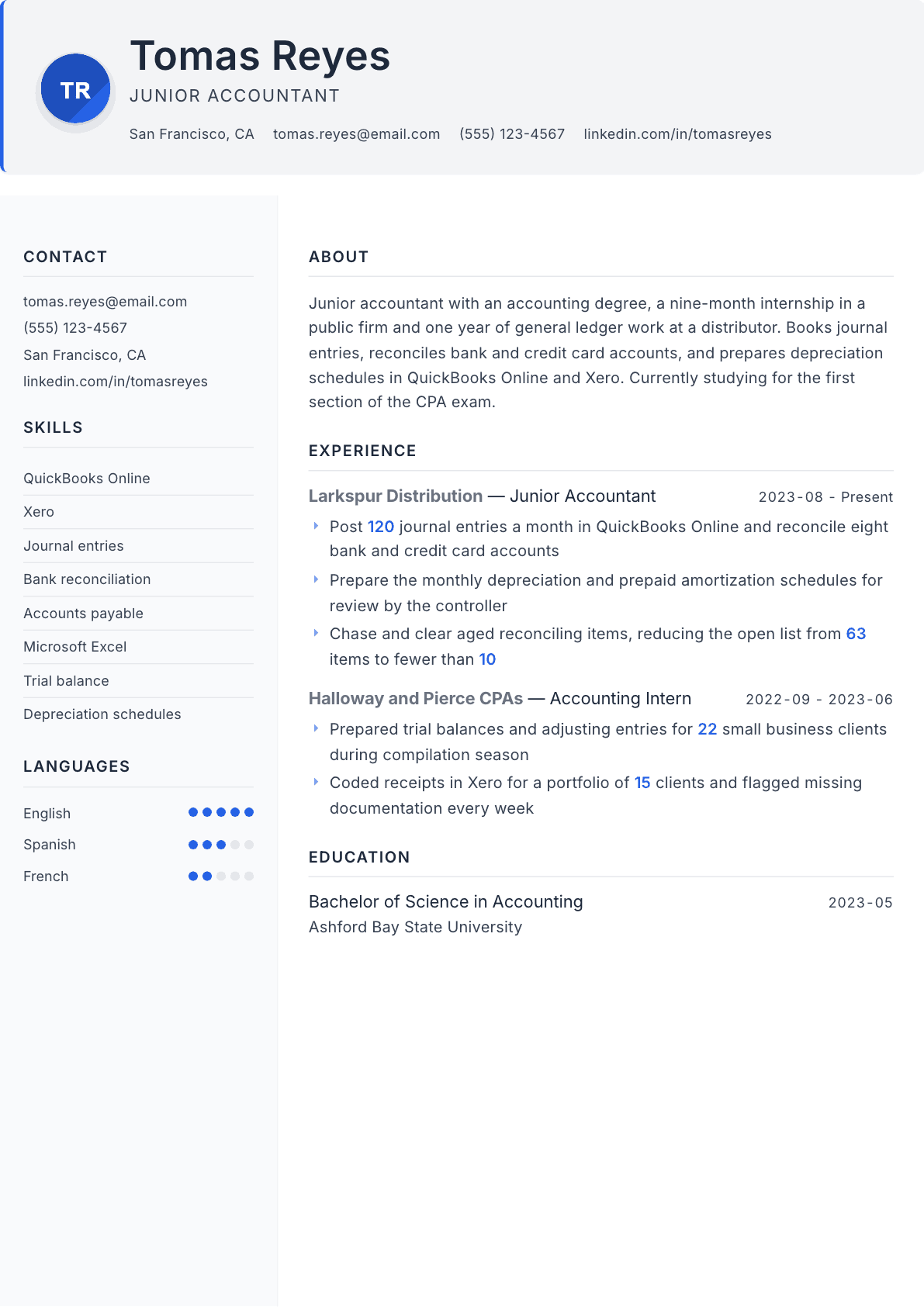
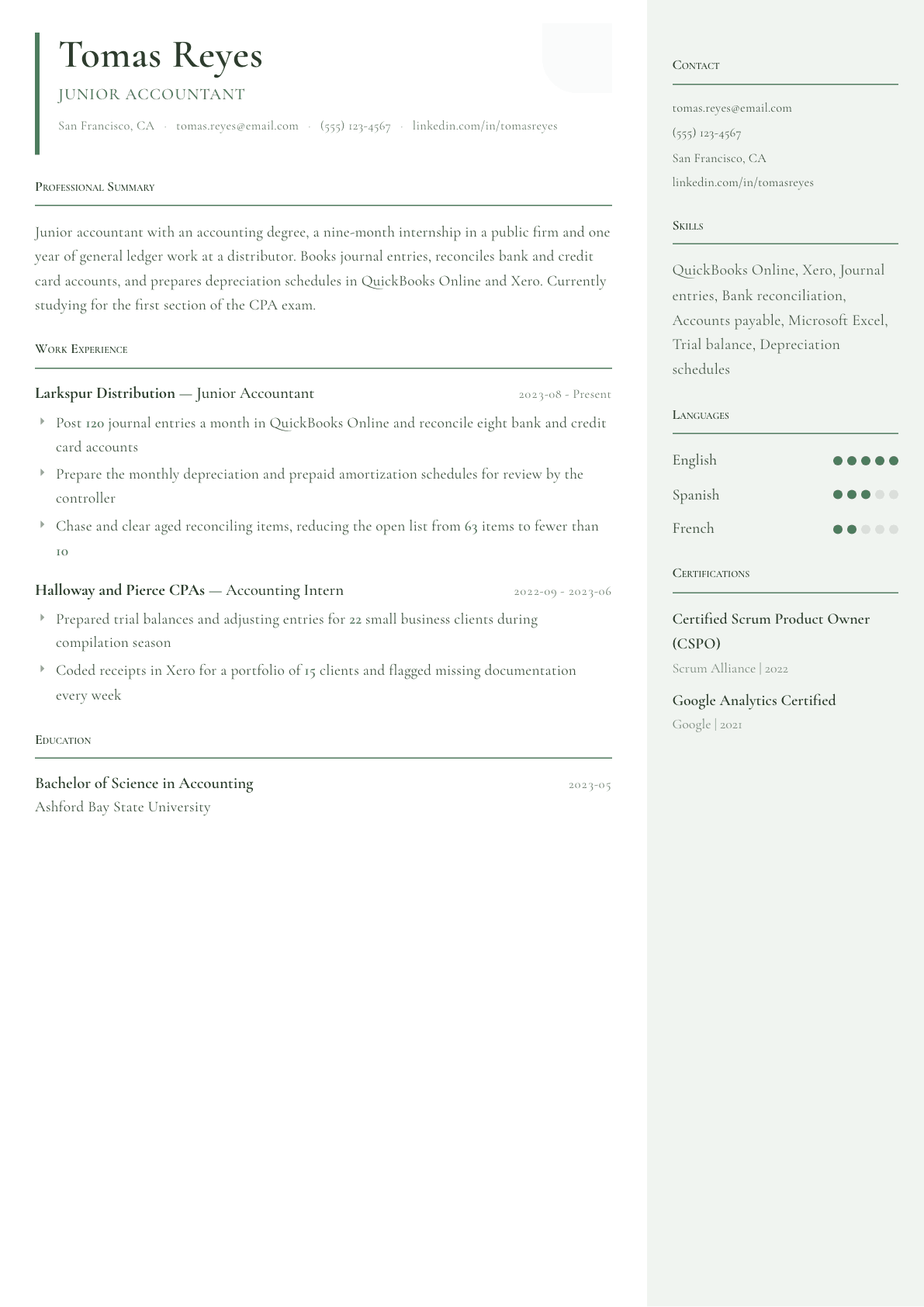
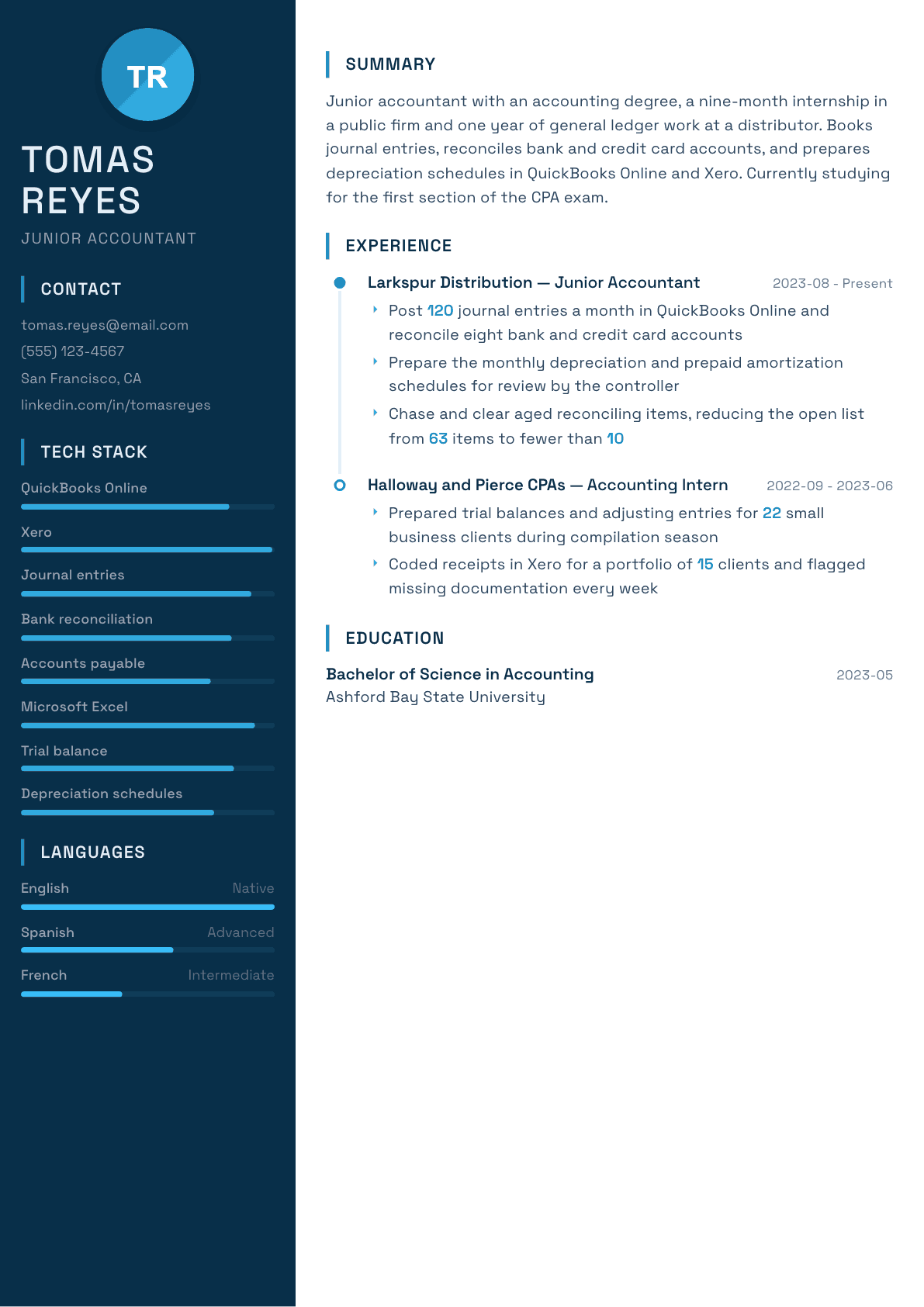
Example Junior Accountant summary
Junior accountant with one year of general ledger work and a nine-month public accounting internship. Posts journal entries, reconciles eight bank and card accounts, and prepares depreciation and prepaid schedules in QuickBooks Online and Xero. Cleared a backlog of aged reconciling items down to single digits. Holds a bachelor of science in accounting and has passed one section of the CPA exam.
Skills to list on a Junior Accountant resume
- Journal entries
- Bank reconciliation
- Accounts payable
- Accounts receivable
- QuickBooks Online
- Xero
- Microsoft Excel
- Trial balance preparation
- Depreciation schedules
- General ledger
- Expense coding
- Month-end close support
- Data entry accuracy
- US GAAP fundamentals
What actually gets this resume read
- Lead with your accounting degree and relevant coursework while your paid experience is under two years.
- Turn the internship into real bullets: name the software, the client count and the tasks you finished alone.
- List the accounting software you have actually touched rather than every package named in a textbook.
- Say where you are in the CPA exam process, including sections passed and your credit hour eligibility.
- Add campus roles such as student treasurer when they involved reconciling money and reporting balances.
- Keep the resume to one page and put education above experience until you pass two years of paid work.
How to write a junior accountant resume
A junior accountant resume has a harder job than a senior one. You are asking a hiring manager to bet on capacity rather than track record, and the only evidence you have is coursework, an internship, a part-time bookkeeping job and whatever software you have actually opened. The file has to make that thin material concrete instead of hiding it behind adjectives.
The people reading are usually a controller and an office manager who between them have a backlog of reconciliations and no time to teach debits and credits. They are looking for someone who already knows what a trial balance is, has touched a real accounting package, and will not need a second review on every entry by month three.
This guide walks through the resume format for an accountant assistant or junior accountant, what to put where when your work history is short, how to write an internship so it counts, and the questions that come up when an accounting graduate rewrites a resume for the first time.
Resume format for an accountant assistant or junior accountant
Put education above experience until you have two years of paid accounting work. Under the degree, add a short line of relevant coursework: intermediate accounting, cost accounting, auditing, accounting information systems, taxation. That line tells a controller which topics you can already discuss.
Then a systems line, then experience, then anything that shows money handled responsibly: a treasurer role in a student group, a cashiering job, a tax preparation volunteer program. Keep it to one page. A junior accountant resume that runs to two pages is padded, and the reader knows it.
The format itself should be boring on purpose: reverse chronological order, one column, plain section headings such as Summary, Education, Systems and Experience, dates on the right, and a PDF unless the posting asks for Word. An accountant assistant who has worked two years in payables flips the order and puts experience above education. A career changer from office administration can use the same layout with a short summary that names the accounting coursework and the transaction work already done.
- Header, education with graduation date and coursework, systems, experience, then activities.
- Add CPA exam progress or credit hour status directly under the degree where it is easy to find.
- Include GPA only when it is strong and you graduated recently, otherwise leave it off.
Write the internship as a job, not as a rotation
An internship written as gained exposure to accounting operations is worth nothing on the page. Write it the way you would write a job: the firm or company, the months, and bullets that name the client count, the software, the deliverable and what you finished without supervision.
Public accounting internships have the advantage of volume. If you prepared trial balances for twenty small business clients, coded a year of receipts in Xero, or built the depreciation schedules a partner reviewed, those are countable facts that put you ahead of a candidate with a vague summer.
Name the software honestly and specifically
List only what you have opened yourself: QuickBooks Online, Xero, Sage 50, FreshBooks, a campus SAP or Oracle teaching instance. Add the Excel functions you use rather than the phrase advanced Excel, because a hiring manager will test it. VLOOKUP or XLOOKUP, SUMIFS, PivotTables and basic text functions are the realistic set for this level.
If a package was covered in a course but never used on real data, say classroom exposure. That honesty survives the interview and often reads better than a claim you cannot support in the first week.
Bullets: show the routine and the moment you were trusted
Half your bullets should be the recurring work: entries posted, accounts reconciled, invoices coded, statements chased. Give the volume for each, because volume is the closest thing you have to seniority.
The other half should be the times something was handed to you. Cleaning an aged reconciling item list, catching a duplicate payment, rebuilding a schedule that was manual, or being the person who chases missing documentation from clients. Those bullets are what a controller quotes when she argues for your hire.
Keywords a junior accounting posting screens for
These postings are written from templates and repeat a narrow set of terms: journal entries, bank reconciliation, accounts payable, accounts receivable, general ledger, trial balance, month-end close support, data entry accuracy and the software name. Use the exact wording once in the systems block and once in a bullet where you actually did the work, then stop.
Entry level accounting resume examples and samples, three written out
These are entry level accounting resume examples for the three people who most often apply for a first accounting job. Accounting assistant is the title many employers use for the same first job, and these resume examples for an accounting assistant follow the order above: education and systems first if the history is short, then bullets with volumes. The assistant title usually leans more on accounts payable, data entry and filing than a junior accountant posting does, so the first bullets should show the transaction work.
The three accounting assistant resume examples below show a graduate with one internship, an office administrator moving into accounting and an assistant with three years who now runs part of the close. Each is written the way the summary and first two bullets read on the page. Use them as entry level accounting resume samples: keep the order of facts and swap in your own school, software and volumes.
- Example one, graduate: Accounting Assistant, BS in Accounting, one summer internship at a regional CPA firm. Coded and entered vendor invoices in QuickBooks Online for twelve small business clients and prepared bank reconciliations for partner review.
- Example one, second bullet: Matched receipts to credit card statements each month for three clients and flagged missing documentation to the client before the reconciliation was due.
- Example two, office administrator moving into accounting: Accounting Assistant, five years as office administrator at a building supply company, associate degree in accounting completed at night. Processes about sixty vendor invoices a week, runs the weekly check run and keeps the vendor files current.
- Example two, second bullet: Took over customer deposits and daily cash posting when the bookkeeper retired, and rebuilt the filing so every payment can be traced to its invoice.
- Example three, experienced assistant: Senior Accounting Assistant, three years at a nonprofit with a staff of forty. Handles accounts payable and receivable in Sage Intacct, prepares accrual and prepaid schedules and supports the month end close with the controller.
- Example three, second bullet: Cleared an aged list of unapplied payments in the first quarter and now reconciles the receivable subledger to the general ledger every month.
Junior Accountant resume summary examples
New graduate, no paid role yet
Accounting graduate with a nine-month public accounting internship covering compilations for 22 small business clients. Prepared trial balances, adjusting entries and depreciation schedules in Xero, and coded a full year of receipts for a client portfolio. Seeking a junior accountant position in a team that closes monthly.
One year in
Junior accountant with a year of general ledger work at a distributor. Posts 120 journal entries a month in QuickBooks Online, reconciles eight bank and card accounts, and prepares prepaid and depreciation schedules for the controller. Cleared an aged reconciling item list down to single digits.
Two years and moving up
Junior accountant with two years across payables, receivables and the general ledger for a services company. Closes cash and prepaid areas without review, prepares audit support schedules, and trained the newest hire on coding rules. Passed two CPA exam sections and targeting a staff accountant seat.
Work experience bullets: before and after
Before: Gained exposure to accounting software during my internship.
After: Coded a full year of receipts in Xero for a portfolio of 15 clients and flagged missing documentation to the manager every Friday.
A client count, the software and a weekly routine turn an exposure claim into evidence of real work.
Before: Responsible for data entry.
After: Entered and coded 340 vendor invoices a month against purchase orders and returned mismatched invoices to purchasing before payment.
Volume plus the control step shows you understand why the entry matters, not only that you did it.
Before: Did bank reconciliations.
After: Reconciled eight bank and credit card accounts monthly and reduced the open reconciling item list from 63 items to fewer than 10.
A starting number and an ending number make a routine task into an outcome someone can verify.
Before: Helped with month-end.
After: Prepared the prepaid amortization and depreciation schedules each month and delivered them to the controller by close day two.
Naming the schedules and the day they were delivered shows you already work to a close calendar.
Before: Good with Excel.
After: Rebuilt a fixed asset listing of 900 items into one workbook with SUMIFS roll-forwards, replacing two files that had to be matched by hand.
A named function and the manual process it retired prove the skill instead of asserting it.
Hard skills
- Journal entries
- Bank and credit card reconciliation
- Accounts payable coding
- Accounts receivable and invoicing
- Trial balance preparation
- Depreciation and prepaid schedules
- QuickBooks Online
- Xero
- Microsoft Excel
- General ledger review
- US GAAP fundamentals
Soft skills
- Following a coding standard
- Asking before guessing an entry
- Chasing missing documentation
- Meeting a close deadline
- Taking review notes without repeating them
Certifications worth listing
- Certified Bookkeeper (CB) (American Institute of Professional Bookkeepers)
- QuickBooks Certified ProAdvisor (Intuit)
- Xero Advisor Certification (Xero)
- Certified Public Accountant (CPA) (State Boards of Accountancy)
Mistakes that cost junior accountant candidates the interview
- Filling the page with adjectives because the work history is short, when a controller wants counts and software names.
- Writing the internship as a paragraph of responsibilities instead of bullets with client numbers and deliverables.
- Claiming SAP or Oracle after one classroom module, which falls apart in the first technical question.
- Leaving graduation date and credit hours off, forcing a recruiter to guess your CPA exam eligibility.
- Skipping unrelated jobs entirely when cashiering or a treasurer role proves you have handled money carefully.
- Running to two pages with coursework lists that no hiring manager for a junior accounting seat reads.
Junior Accountant resume questions
What goes first on a junior accountant resume, education or experience?
Education, until you have roughly two years of paid accounting work. The degree and the coursework line are the strongest signals you have, and a controller looks for them before anything else on the page.
Is an accounting assistant resume different from a junior accountant resume?
Mostly in emphasis. An accounting assistant posting leans on accounts payable, receivable, data entry and filing, so lead with transaction volumes and the system you use. A junior accountant posting asks more for reconciliations, journal entries and close support. Use the title from the posting at the top and keep the same order: education and systems first if your history is short.
What should entry level accounting resumes include?
Your degree or current program with relevant coursework, the accounting software and Excel functions you have used, then internships, part time bookkeeping or office work written with volumes, such as invoices a week or accounts reconciled each month. Add CPA exam progress if it is underway, explain any gap in one line, and keep everything on one page.
Should I mention CPA exam sections I have not passed yet?
Mention the sections you have passed and the date you are scheduled for the next one. Listing sections you have not attempted adds nothing, but a scheduled sitting tells an employer the process is genuinely underway.
What is the best resume format for an accountant assistant?
Reverse chronological, one page, one column, with standard headings a parser and a controller both recognize. Put education first if you have under two years of paid accounting work, experience first if you have more. Add a systems line near the top naming the accounting package and Excel functions you use, and send a PDF unless asked otherwise.
Related resume examples
- Bookkeeper Resume example
- Accountant Resume example
- Staff Accountant Resume example
- Accounting Clerk Resume example
- Accounting Intern Resume example
- Senior Accountant Resume example