Accounts Receivable Specialist Resume Examples: free
Accounts Receivable Resume Examples, Objectives and Skills
By Mustafa Tarabya, founder of CVBooster · Published · Updated
An accounts receivable resume example written out in full, with objectives for first roles, aging and cash application bullets, and the skills credit teams search.
Sample resumes for a accounts receivable specialist
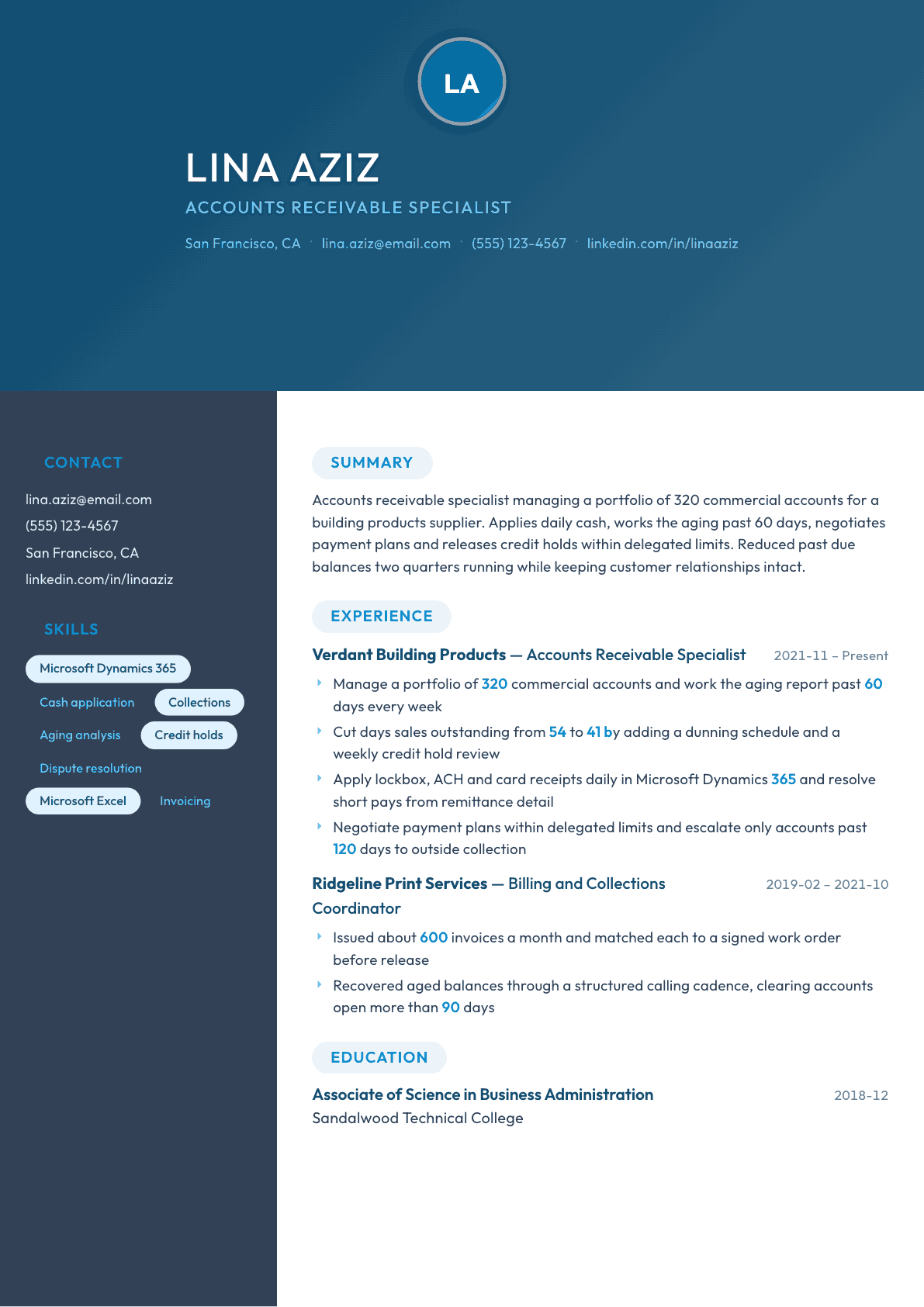
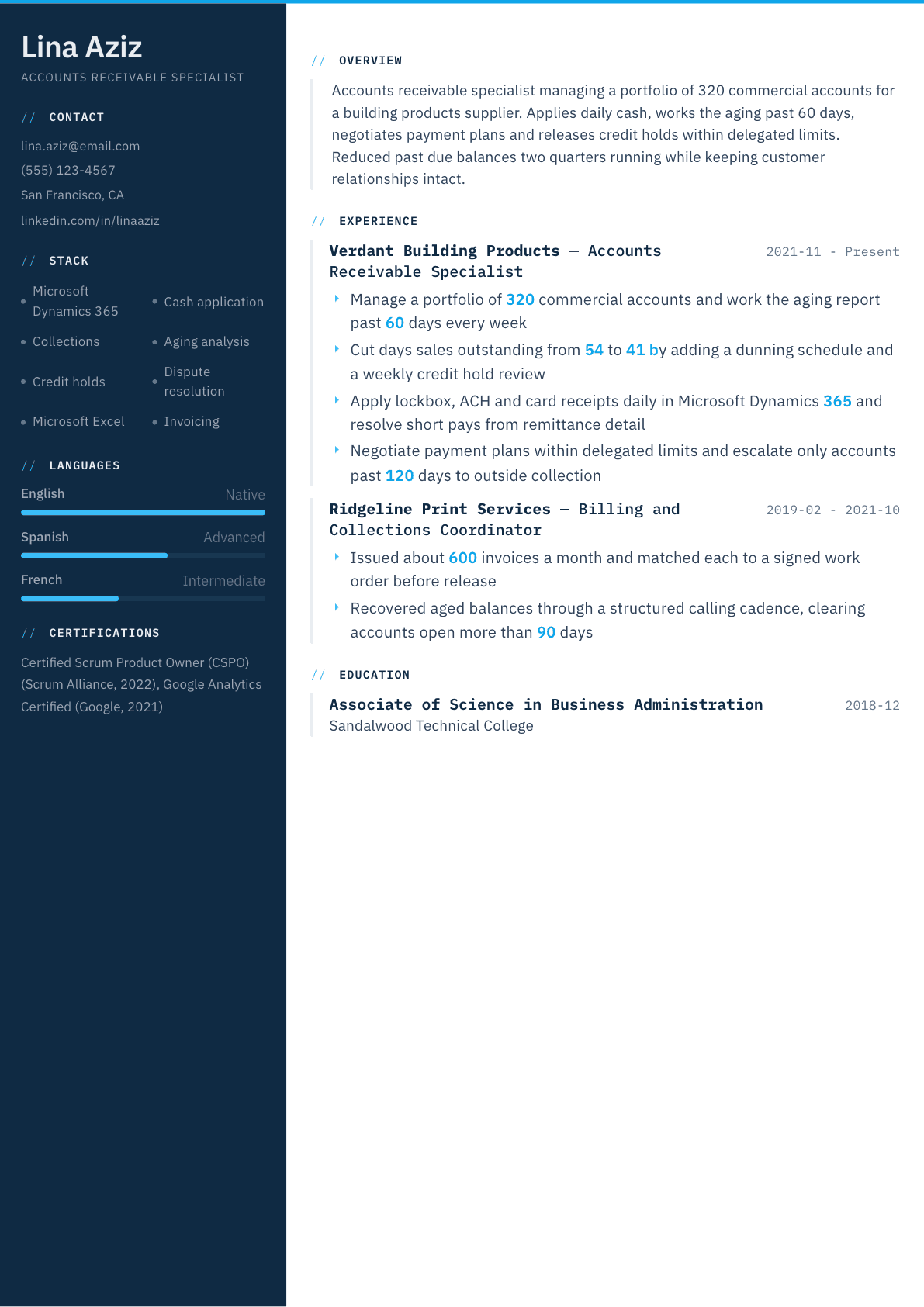
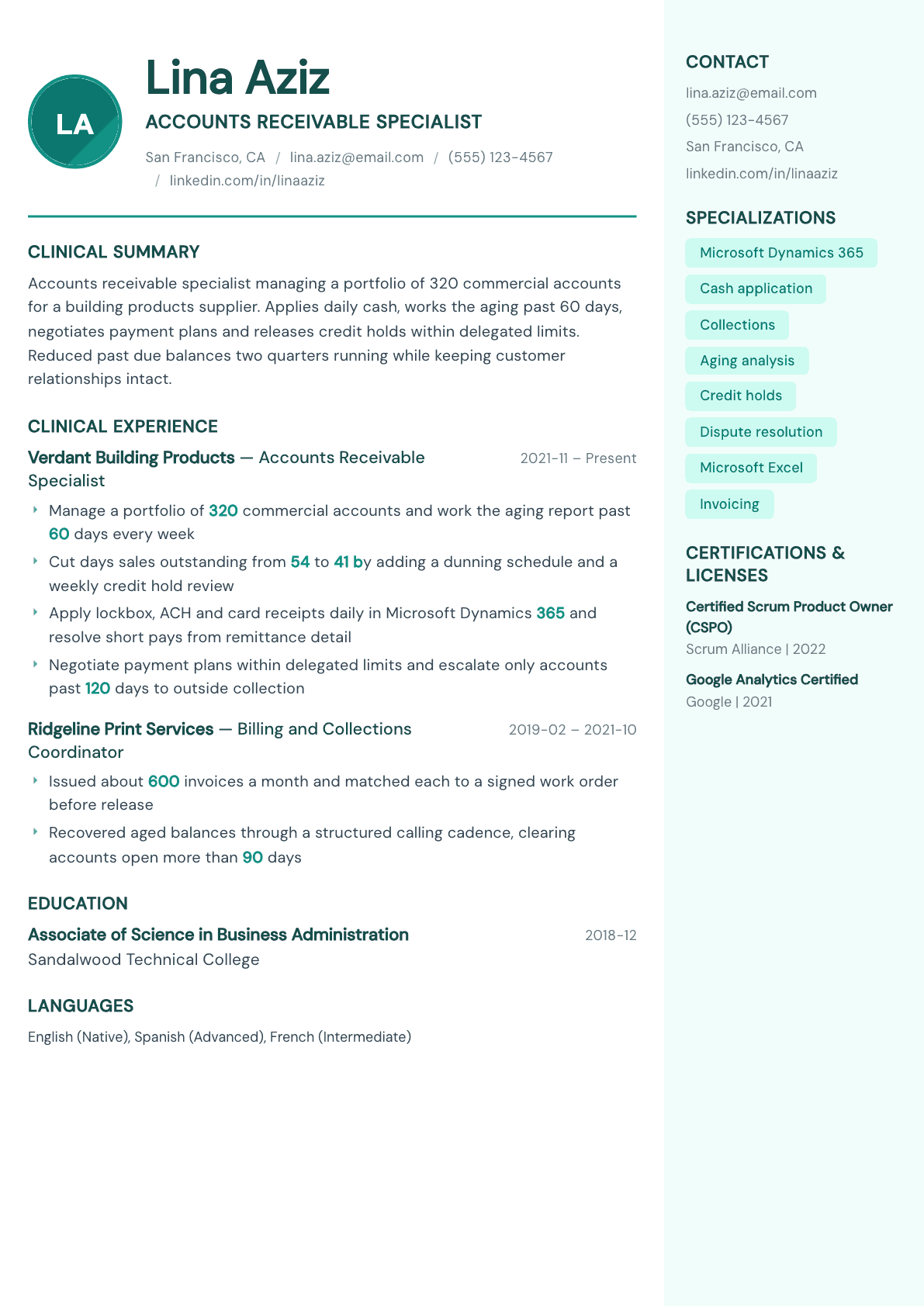
The same accounts receivable specialist content laid out in three CVBooster templates, so you can see what the finished document looks like before you write a word.
Example Accounts Receivable Specialist summary
Accounts receivable specialist with five years owning a portfolio of 320 commercial accounts in Microsoft Dynamics 365. Applies daily lockbox and ACH cash, works the aging past 60 days, negotiates payment plans and manages credit holds. Reduced days sales outstanding from 54 to 41 with a dunning schedule and a weekly hold review. Seeking a credit and collections lead role.
Skills to list on a Accounts Receivable Specialist resume
- Accounts receivable
- Cash application
- Collections calling
- Aging analysis
- Days sales outstanding
- Credit holds
- Short pay and deduction research
- Payment plan negotiation
- Invoicing and billing
- Microsoft Dynamics 365
- NetSuite
- Microsoft Excel
- Bad debt reserve support
- Customer account reconciliation
What actually gets this resume read
- Lead with portfolio size and the aging buckets you work, because that is how credit managers size the role.
- Report days sales outstanding before and after, since it is the number the finance leader is measured on.
- Show the collections method you use, from dunning cadence to payment plans and when you escalate a file.
- Name the billing system and any collections platform, as these tools rarely transfer without retraining.
- Describe dispute and short pay research, the part of the job most candidates leave off the resume.
- Mention credit decisions you make within delegated limits, because judgment matters more than call volume.
How to write a accounts receivable specialist resume
An accounts receivable specialist resume is judged by a credit manager who lives inside an aging report. Before reading a single bullet she wants to know the size of the portfolio you carried, how far past due you were expected to work, and whether the cash you brought in came from a system or from persistence. Those three answers decide the interview.
The role sits between accounting and customer relationships, which is why generic wording hurts here more than elsewhere. Contacted customers regarding outstanding balances says nothing about whether you ran a dunning schedule, negotiated payment plans, released credit holds or handed accounts to an outside agency.
People also search for an accounting receivable resume, and the document is the same one: an accounts receivable resume for a specialist, clerk or collector, judged on portfolio, cash and process. This guide shows how to structure the page around portfolio and cash outcomes, how to write collections work without sounding aggressive or passive, and the questions receivable specialists face when moving between industries.
Accounts receivable resume format: portfolio, cash, process
Open with a summary that names the portfolio: how many accounts, whether they are commercial or consumer, the industry, and the ledger balance in words rather than figures. A credit manager sizes you on that line alone, because working three hundred commercial accounts is a different discipline from working three thousand consumer ones.
Then a systems line, then experience. Certifications and education sit at the bottom unless you hold a credit credential, in which case move it up beside your name. One page is right until you have around eight years of receivable and credit work. The format that reads cleanly in an applicant tracking system is reverse chronological, one column, with plain headings (Summary, Systems, Experience, Education) and no tables or text boxes.
- Summary: portfolio size, customer type, industry, and the aging buckets you own.
- Systems: ERP or billing platform, collections or dispute tool, remittance and lockbox setup.
- Experience: each role with volumes, cash outcomes and the escalation path you followed.
Cash outcomes: days sales outstanding and past due balances
Days sales outstanding is the number your future manager reports upward, so give it a before and after wherever you honestly can, along with the mechanism that moved it. A reduction that came from a dunning schedule, a weekly credit hold review or faster invoice delivery is credible. A reduction with no mechanism reads as a coincidence you are claiming credit for.
Past due percentages, aging bucket movement and bad debt write-offs are the other outcomes worth stating. If your employer measured you on cash collected against a monthly target, say the target attainment rather than the raw amount, which avoids figures that mean nothing outside that company.
Collections method: cadence, tone and escalation
Describe the cadence you actually ran: reminder before due date, first call at a set number of days past due, escalation to the customer accounts payable manager, then to the sales owner, then a formal demand. A hiring manager reads a described cadence as evidence you can be handed a portfolio and left alone with it.
Cover the judgment side too. When you place an account on credit hold, when you release it, when you agree a payment plan and when a file goes to an outside agency or to legal. Receivable specialists who escalate everything create work, and those who escalate nothing create bad debt, so show where your line sits.
Disputes, short pays and deductions
The hidden half of the job is research. Short payments, unauthorized deductions, missing purchase order numbers, pricing differences and freight claims all arrive as unapplied cash and stay there until someone reconciles the remittance to the invoice. Write this work explicitly, naming the deduction types you handled and who you worked with to clear them.
This is also where you show cross-functional reach. Clearing a pricing deduction means talking to sales, a damaged goods claim means talking to the warehouse, and a missing purchase order means talking to the customer buyer. Employers value a specialist who can chase across departments without a supervisor doing it for them.
Accounts receivable resume objective, skills and keywords
The terms that recur are accounts receivable, cash application, collections, aging report, days sales outstanding, credit hold, dunning, deduction research, short pay, payment plans, bad debt reserve and customer account reconciliation. Add the billing system by name, because receivable teams screen hard on platform familiarity when the ledger is large.
An objective only earns its place when you have no receivable history yet: a first accounting job, a move from payables, or a move from customer service. Keep it to two sentences, name the ledger work you can already do and the role you want. The three objectives below are written for those three starting points.
- From accounts payable: Accounts payable clerk with two years matching invoices to purchase orders and running weekly payment batches in QuickBooks. Seeking an accounts receivable specialist role where that matching discipline goes into cash application and deduction research.
- From customer service: Customer service lead who resolved billing disputes by phone for a utility, about 40 calls a day. Seeking a collections or accounts receivable clerk role, bringing calm payment conversations and careful notes on every promise to pay.
- First accounting job: Accounting graduate with a bookkeeping course and an internship posting cash receipts in Sage. Seeking an entry level accounts receivable clerk role on a commercial ledger.
- Skills line to copy and trim: cash application, aging review, collections calls, payment plans, credit holds, deduction research, account reconciliation, Excel lookups and pivot tables, plus the ERP named in the posting.
Account receivable resume example, full page
Below is a complete account receivable resume example for a specialist with about five years on a commercial ledger. The name and employers are invented. Use it as a map: portfolio first, cash outcomes second, collections method third.
Profile: Dana Whitcomb, Accounts Receivable Specialist. Manages 420 commercial accounts for a building products distributor, from invoicing through collections and cash application. Brought days sales outstanding down by nine days in eighteen months with a written dunning cadence and a weekly dispute review.
- Current role, Accounts Receivable Specialist, Harlow Building Supply, three years: owns 420 accounts, posts daily cash from lockbox and card payments, and runs the weekly aging review with the credit manager.
- Reduced balances more than 90 days past due by a third by moving every account to a fixed contact schedule at 15, 30, 45 and 60 days.
- Cleared a backlog of 160 unapplied payments in the first quarter and kept unapplied cash under five items at every month end after that.
- Resolved short pays and pricing disputes with sales and customer service inside ten business days, and wrote the dispute code list the team still uses.
- Negotiated 23 payment plans and sent accounts to an outside agency only after a documented final notice.
- Previous role, Billing and Collections Clerk, Northgate Medical Supply, two years: prepared invoices, matched remittances and made first reminder calls.
- Education and systems: Associate degree in Accounting. NetSuite, Excel with pivot tables and lookups, a lockbox portal, and Salesforce for account notes.
Accounts Receivable Specialist resume summary examples
First receivables role
Billing coordinator with two years issuing about 600 invoices a month and matching each to a signed work order before release. Applies daily receipts, chases missing purchase order numbers and calls on accounts past thirty days. Seeking an accounts receivable specialist role with a commercial portfolio.
Five years on a commercial ledger
Accounts receivable specialist managing 320 commercial accounts in Microsoft Dynamics 365. Applies lockbox and ACH cash daily, works the aging past 60 days on a weekly cadence, negotiates payment plans within delegated limits, and cut days sales outstanding from 54 to 41 across two quarters.
Lead specialist
Lead accounts receivable specialist covering a national ledger of 900 accounts and supervising two collectors. Owns the credit hold review, sets the dunning calendar, approves payment plans to a delegated limit, and prepares the bad debt reserve analysis the controller reviews each quarter.
Work experience bullets: before and after
Before: Contacted customers about past due invoices.
After: Worked a portfolio of 320 commercial accounts on a weekly cadence, calling every balance past 60 days and documenting each promise to pay in the ledger.
Portfolio size, cadence and documentation turn a generic call into a repeatable collection process.
Before: Reduced days sales outstanding.
After: Cut days sales outstanding from 54 to 41 by introducing a dunning schedule and a weekly credit hold review with the sales managers.
Naming the two mechanisms makes the improvement believable instead of a number without a cause.
Before: Applied payments to customer accounts.
After: Applied lockbox, ACH and card receipts daily against open invoices and researched short payments against remittance detail before posting a deduction.
The research step separates a cash poster from a specialist who protects the aging report.
Before: Resolved customer billing issues.
After: Cleared pricing and freight deductions with sales and the warehouse, closing disputed items that had been open across multiple aging cycles.
Naming the deduction types and the departments involved shows the cross-functional work the job requires.
Before: Handled credit holds and escalations.
After: Released credit holds within a delegated limit after reviewing payment history, and escalated only accounts past 120 days to outside collection.
Stating the limit and the escalation threshold shows judgment rather than a habit of passing files upward.
Hard skills
- Accounts receivable ledger management
- Cash application
- Collections cadence and dunning
- Aging analysis
- Days sales outstanding reporting
- Credit hold administration
- Deduction and short pay research
- Payment plan negotiation
- Invoicing and billing
- Microsoft Dynamics 365
- NetSuite
- Bad debt reserve support
Soft skills
- Firmness without damaging the account
- Documenting every promise to pay
- Working across sales and operations
- Prioritizing by balance and risk
- Explaining an invoice clearly by phone
Certifications worth listing
- Credit Business Associate (CBA) (National Association of Credit Management)
- Credit Business Fellow (CBF) (National Association of Credit Management)
- Certified Bookkeeper (CB) (American Institute of Professional Bookkeepers)
Mistakes that cost accounts receivable specialist candidates the interview
- Leaving the portfolio size off, so a credit manager cannot judge whether you have carried a comparable ledger.
- Quoting a days sales outstanding improvement with no mechanism attached to explain how it happened.
- Skipping deduction and short pay research, which is the part of the job that separates specialists from cash posters.
- Describing collections as making calls, with no cadence, no escalation path and no delegated authority.
- Ignoring the billing platform, when receivable teams filter hard on system familiarity for large ledgers.
- Listing customer service phrases instead of the credit judgment that keeps bad debt off the books.
Accounts Receivable Specialist resume questions
Should I include collection amounts on the resume?
Prefer percentages, ratios and target attainment over raw sums, because a total collected means little without the ledger size behind it. Portfolio count, aging movement and days sales outstanding travel better between employers.
How do I write receivables experience if I also did payables?
Split the bullets by ledger and label them, so the reader can see the receivable half without hunting. Then set the summary to whichever side the posting wants, since a mixed clerk profile can read as thin on both.
Does industry experience matter for accounts receivable?
It matters where the payment behavior differs sharply, such as construction with lien rights and retainage, healthcare with payer remittances, or retail with heavy deductions. Name the industry so the reader can map your habits onto theirs.
What is an accounting receivable resume?
It is another name for an accounts receivable resume: the resume for specialist, clerk and collector roles that bill customers, apply payments and collect overdue balances. It leads with portfolio size and customer type, then cash outcomes such as days sales outstanding, then your collections method and systems. A credit certification goes beside your name.
How do I show I keep customers while collecting from them?
Give an example where a payment plan or a resolved dispute preserved an ongoing relationship. A specialist who collects and keeps the account is worth more than one who collects and loses the customer for sales.
Related resume examples
- Accounts Payable Specialist Resume example
- Credit Analyst Resume example
- Collections Specialist Resume example
- Accounting Clerk Resume example
- Credit Manager Resume example
- Staff Accountant Resume example