IT Auditor Resume Examples: free ATS score and gap list
Write an IT Auditor Resume That Shows Control Testing Depth
By Mustafa Tarabya, founder of CVBooster · Published · Updated
An IT auditor resume example with SOX, ITGC and control testing keywords, plus a guide to writing findings and scope on paper.
Sample resumes for a it auditor
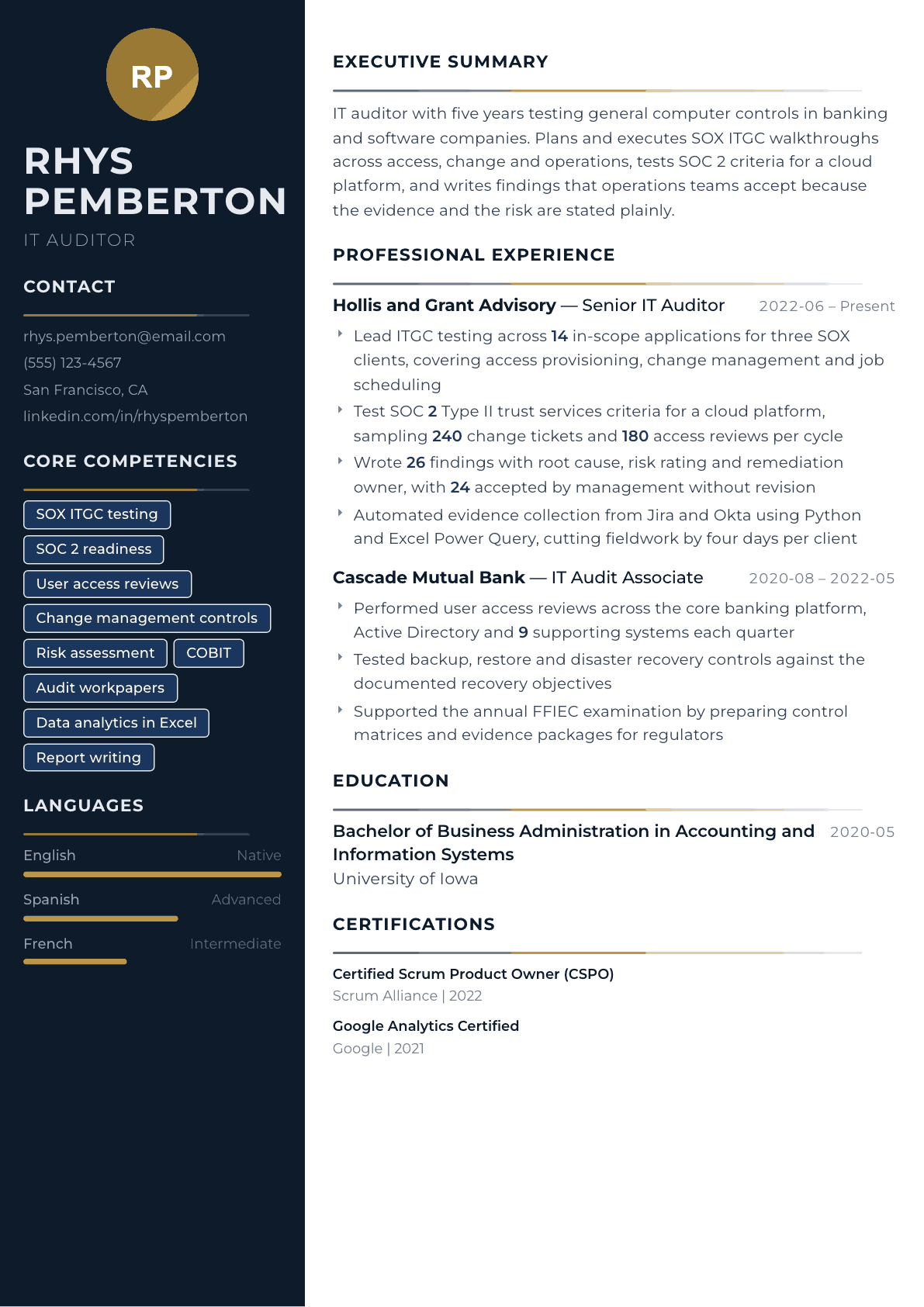
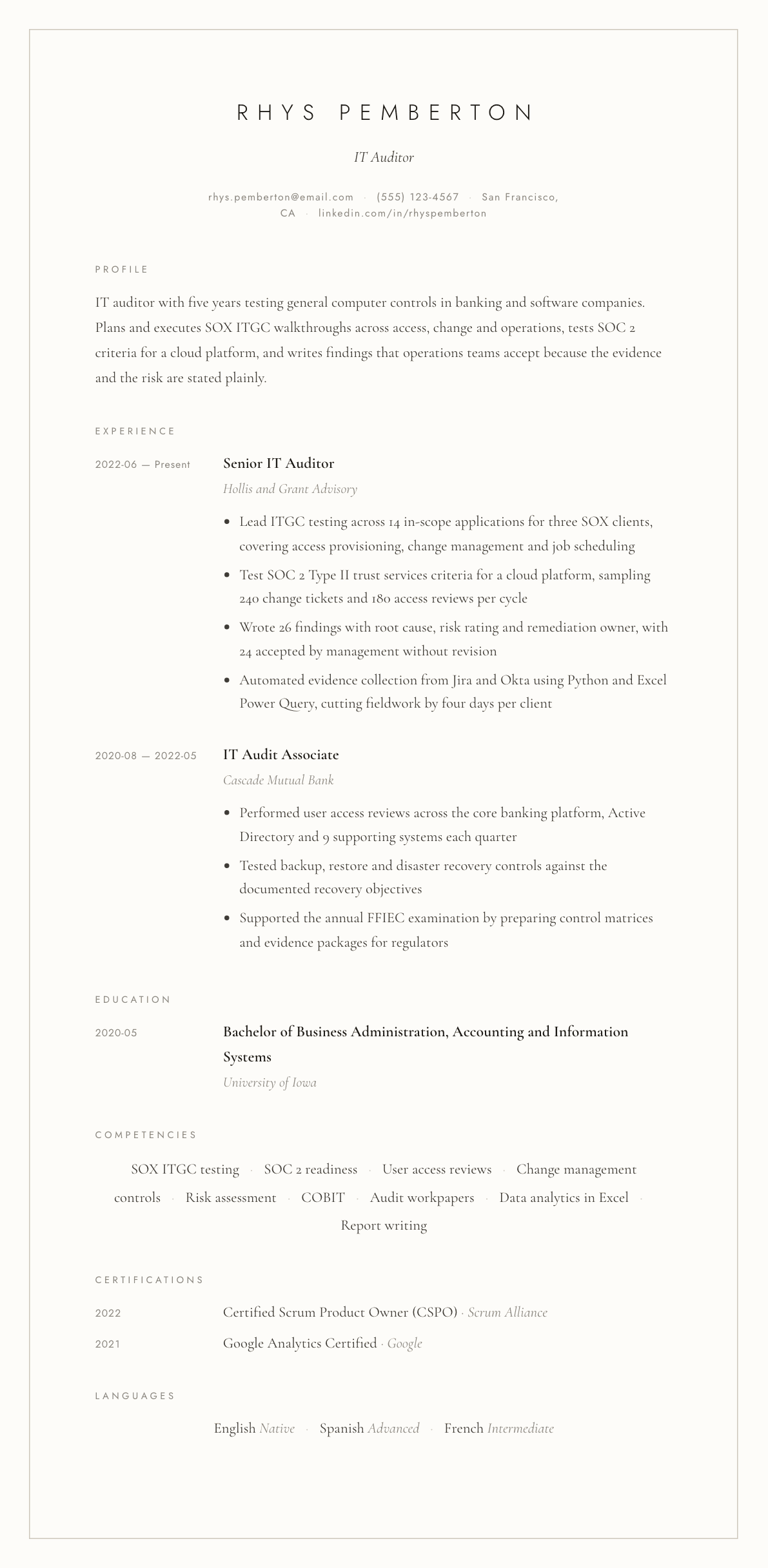
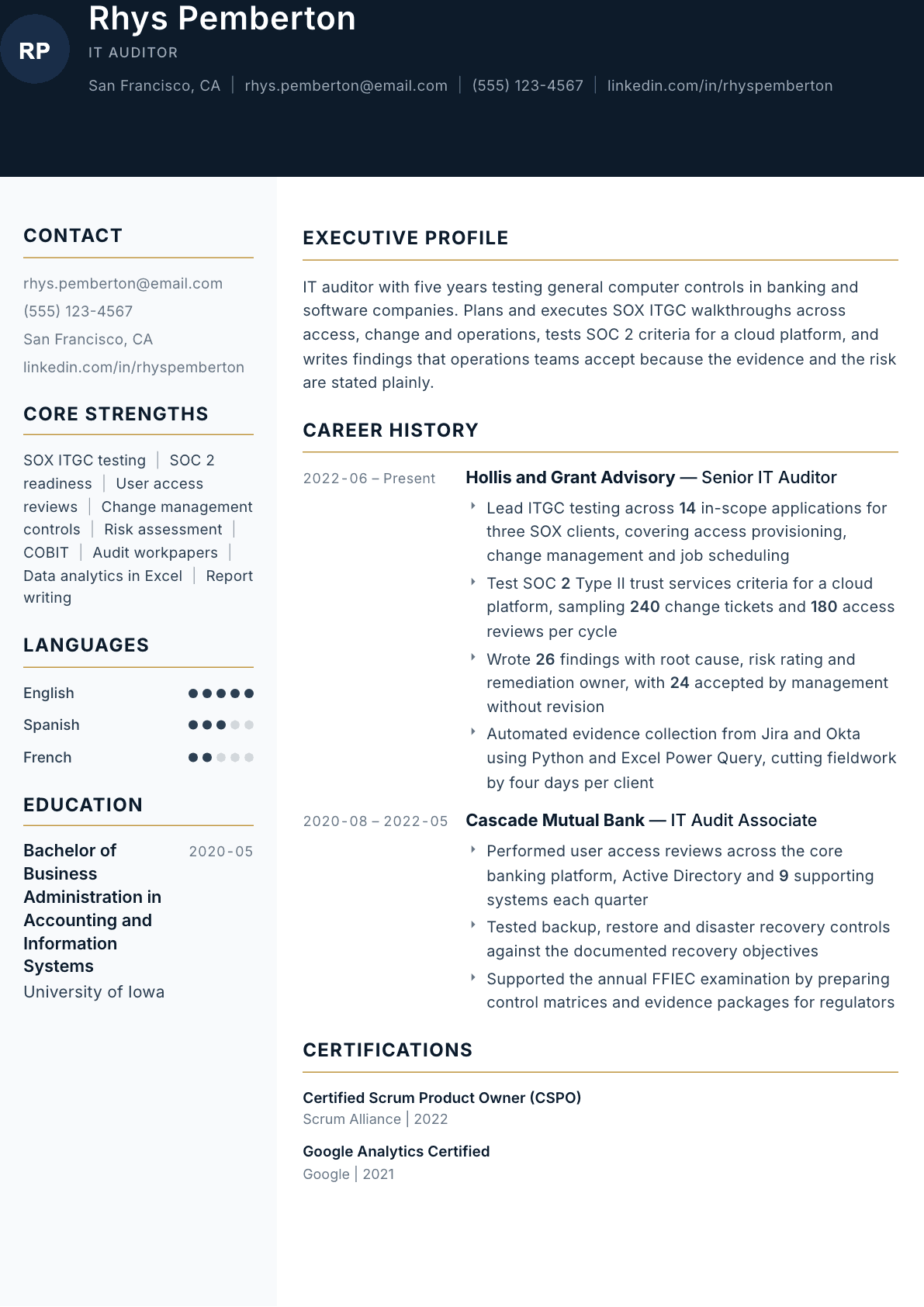
The same it auditor content laid out in three CVBooster templates, so you can see what the finished document looks like before you write a word.
Example IT Auditor summary
IT auditor with five years of ITGC and SOC 2 testing across banking and software clients. Leads access, change and operations testing for 14 in-scope applications, writes findings that management accepts without revision, and automated evidence pulls from Jira and Okta to cut four days of fieldwork per engagement. CISA certified and looking to move into an internal audit team with a technology focus.
Skills to list on a IT Auditor resume
- SOX ITGC testing
- SOC 2 Type II
- IT general controls
- User access reviews
- Change management control testing
- Risk and control matrices
- COBIT framework
- ISO 27001
- NIST Cybersecurity Framework
- Audit workpaper documentation
- Finding and remediation tracking
- Data analytics with Excel and SQL
- Third-party risk review
- Regulatory examination support
- Control walkthroughs
What actually gets this resume read
- Name the frameworks you tested against: SOX ITGC, SOC 2 trust services criteria, ISO 27001, NIST or PCI DSS.
- Give the scope of each engagement in applications, control counts and sample sizes, not just the client name.
- Show findings you wrote and whether management accepted them, because that is how audit quality is judged.
- Split control families out by name: access, change, operations and backup read very differently to a hiring manager.
- Put CISA prominently if you hold it, with the ISACA name, and note any progress toward it if you are studying.
- Add one bullet on data analytics or scripting, since audit teams now expect evidence work to be partly automated.
How to write a it auditor resume
An IT audit resume is read by someone who tests things for a living, so it gets tested. Vague claims about ensuring compliance draw the same reaction a vague control description draws in fieldwork: what was the population, what was the sample, what was the evidence, and what did you conclude. Write the resume the way you would want a control described.
The reader, usually an audit manager or a partner, is trying to place you on three axes. Which control families you have tested, how independently you can run fieldwork, and whether your findings survive contact with the operations teams who have to remediate them. A finding that management accepts without rewriting is the quiet mark of a good auditor and it belongs on the page.
This guide covers the section order audit hiring expects, how to describe scope and sampling without breaching client confidentiality, three example summaries from an associate to an audit lead, before and after bullets, and the questions IT auditors ask when they move between practice, internal audit and a first line assurance role.
Format: one to two pages, frameworks and scope high
One page as an associate, two once you lead engagements. Reverse chronological, with a summary, a frameworks block, then experience. The frameworks block names what you have actually tested against, such as general computer controls in a financial reporting audit, service organization criteria, an information security management standard, or a payment card standard. Recruiters filter on those names first.
Add an industries line. Testing controls at a bank, a hospital, a software provider and a manufacturer are different experiences because the systems, the regulators and the risk conversations differ. Naming your sectors saves the reader from guessing.
- Header: name, city and state, phone, email, and CISA or another credential after your name if you hold it.
- Order: summary, certifications, frameworks and standards, experience, education, technical tools.
- Never name clients under a confidentiality agreement. Describe them by sector and size instead.
Summary: control families, frameworks, sectors, independence
Three or four lines. Years in audit, the control families you own, the frameworks, the sectors, and whether you run fieldwork alone or lead a team. Independence level is the fact hiring managers most want and most rarely find, because it decides whether you can be put in front of a client unsupervised.
If you came from an operations background, say so. A former systems administrator who moved into audit tests access and change controls with an insight that a purely accounting-trained auditor lacks, and that is a selling point rather than something to hide.
Experience: scope, sampling, findings, remediation
Give each role a scope line: number of engagements or entities, the applications in scope, and your role in the team. Then bullets structured around how audit actually works. Planning and walkthroughs. Testing with populations and sample sizes. Findings written, rated and agreed. Remediation tracked to closure.
Be specific about the control families. Access provisioning and deprovisioning, periodic user access review, privileged access, change management from request to approval to migration, job scheduling and monitoring, backup and restore. Naming them individually shows the reader exactly which fieldwork you can be handed on day one.
Write findings as outcomes, not as counts alone. How many you raised, how many management accepted without revision, whether the root cause was identified rather than the symptom, and whether remediation closed on time. An auditor whose findings are argued down in every closing meeting is expensive, and the resume that quietly proves the opposite gets read twice.
- Scope: entities, in-scope applications, control counts, and the reporting cycle you supported.
- Testing: populations, sample sizes, evidence sources, and the tools you pulled evidence from.
- Outcome: findings raised, ratings, acceptance rate, and remediation closed within the agreed dates.
Analytics and automation: what raises your band
Audit teams now expect evidence work to be partly automated. If you have pulled populations directly from a ticketing system, an identity provider or a database rather than accepting a client extract, say so and name the method: a structured query, a scripted export, a spreadsheet transformation. Testing a full population instead of a sample is a materially stronger conclusion and reads that way.
Time saved is a legitimate metric here because audit is sold in hours. Cutting fieldwork days on a recurring engagement by automating an evidence pull is a result a manager can price, and it distinguishes you from a peer who does the same testing manually every cycle.
Certifications, report writing and the keywords the filter wants
CISA is the credential this market runs on and it belongs at the top with the issuing body. CISSP reads as technical depth, CIA reads as internal audit discipline, and cloud credentials matter once your scope includes hosted infrastructure. If you are studying for one, say which and be honest about the stage.
Report writing deserves a bullet of its own. A finding with a clear condition, criteria, cause, effect and recommendation is a skill managers hire for because they are tired of editing. Mirror the vocabulary of the postings: general computer controls, walkthrough, test of design, test of operating effectiveness, risk and control matrix, sampling, remediation, issue tracking, third-party assurance.
IT Auditor resume summary examples
Audit associate
IT audit associate with two years supporting general computer control testing at a mutual bank. Performs quarterly user access reviews across the core platform and nine supporting systems, tests backup and restore controls against documented recovery objectives, and prepares evidence packages for regulatory examinations.
Senior auditor running fieldwork
Senior IT auditor with five years across banking and software clients, leading control testing for 14 in-scope applications covering access, change and operations. Writes findings with root cause and remediation owner, and automated evidence collection from Jira and Okta to cut four days of fieldwork per engagement.
Audit lead or manager
IT audit manager leading a team of five across the annual plan for a healthcare group, owning scoping, risk assessment and the issue tracker reported to the audit committee. Rebuilt the risk and control matrix after a system replacement and holds a remediation closure rate above 90%.
Work experience bullets: before and after
Before: Performed IT general controls testing for clients.
After: Led general computer control testing across 14 in-scope applications for three financial reporting clients, covering access provisioning, change management and job scheduling from walkthrough through operating effectiveness.
Application count, client count and the named control families show exactly what fieldwork you can be handed.
Before: Tested user access controls.
After: Tested quarterly user access reviews across the core banking platform and nine supporting systems, sampling 180 reviewer sign-offs per cycle and confirming that every flagged account was removed within the stated window.
Naming the population, the sample and the removal check makes the test reproducible rather than asserted.
Before: Wrote audit findings and recommendations.
After: Raised 26 findings with condition, root cause, risk rating and a named remediation owner, of which 24 were accepted by management without revision at the closing meeting.
The acceptance rate is the clearest evidence that your findings are accurate and survive challenge.
Before: Used data analytics in audit work.
After: Pulled full change ticket and access populations directly from Jira and Okta using a scripted export and a spreadsheet transformation, replacing sample testing with full population testing on two recurring controls.
Moving from a sample to a full population is a real strengthening of the conclusion, and the method makes it credible.
Before: Helped with SOC 2 compliance.
After: Tested service organization trust services criteria across security and availability for a hosted platform, sampling 240 change tickets per period and validating that every emergency change carried retrospective approval.
The criteria tested, the sample size and the specific exception you looked for show genuine engagement work.
Hard skills
- IT general controls testing
- Service organization control engagements
- User access provisioning and review testing
- Change management control testing
- Privileged access review
- Backup, restore and continuity control testing
- Risk and control matrix development
- Sampling methodology and population testing
- Audit workpaper documentation
- Issue and remediation tracking
- Structured queries for evidence extraction
- Spreadsheet data transformation
- Third-party and vendor assurance review
Soft skills
- Professional skepticism
- Holding a finding under challenge
- Interviewing control owners
- Clear and concise report writing
- Working to a fixed fieldwork budget
- Building trust with operations teams
Certifications worth listing
- Certified Information Systems Auditor (CISA) (ISACA)
- Certified in Risk and Information Systems Control (CRISC) (ISACA)
- Certified Internal Auditor (CIA) (Institute of Internal Auditors)
- Certified Information Systems Security Professional (CISSP) (ISC2)
- Certified in Cybersecurity (CC) (ISC2)
- Certified Public Accountant (CPA) (State Boards of Accountancy)
Mistakes that cost it auditor candidates the interview
- Naming clients covered by a confidentiality agreement instead of describing them by sector and size.
- Claiming compliance experience without saying which control families you personally tested.
- Omitting sample sizes and populations, which is the first thing an audit manager would ask about any test.
- Listing every framework in existence when you have only ever worked under two of them.
- Writing findings as a count with no indication of whether management accepted them or argued them down.
- Leaving out analytics and scripting work, which is now the main differentiator between two similar auditors.
- Describing yourself as detail oriented rather than showing detail through a specific test you designed.
IT Auditor resume questions
How do I describe audit clients without breaching confidentiality?
Use sector, size and system landscape instead of names. A regional bank with a core platform and nine supporting systems tells the reader everything they need about complexity while disclosing nothing your engagement letter protects.
Is CISA required to work as an IT auditor?
It is not always required for an associate role, but it clears recruiter filters and is often expected before promotion to senior. If you are studying, say so and name the exam window rather than leaving the certification section empty.
How do I move from IT operations into IT audit?
Lead with the control work you already did: access reviews you ran, change approvals you administered, evidence you produced for auditors. Then add the audit vocabulary, test of design and operating effectiveness, and state the career move directly in the summary.
What is the difference between an external and an internal audit resume?
External work emphasizes engagement volume, client sectors and delivery within fixed fee budgets. Internal work emphasizes the annual plan, risk assessment, relationships with control owners and remediation tracked to closure with the audit committee watching.
Should I list the audit tools I have used?
Yes, in a short technical line at the end. Name the workpaper platform, the issue tracker and anything you used to extract evidence, since a team running the same platform will see onboarding time they do not have to spend.
Related resume examples
- Auditor Resume example
- Compliance Analyst Resume example
- Internal Auditor Resume example
- SOC Analyst Resume example
- CISO Resume example
- Cybersecurity Analyst Resume example