Internal Auditor Resume Examples: the lines they read
Build an Internal Auditor Resume That Shows Control Testing
By Mustafa Tarabya, founder of CVBooster · Published · Updated
Internal auditor resume example with SOX testing, risk assessment and finding remediation bullets, ATS keywords and a section by section guide.
Sample resumes for a internal auditor
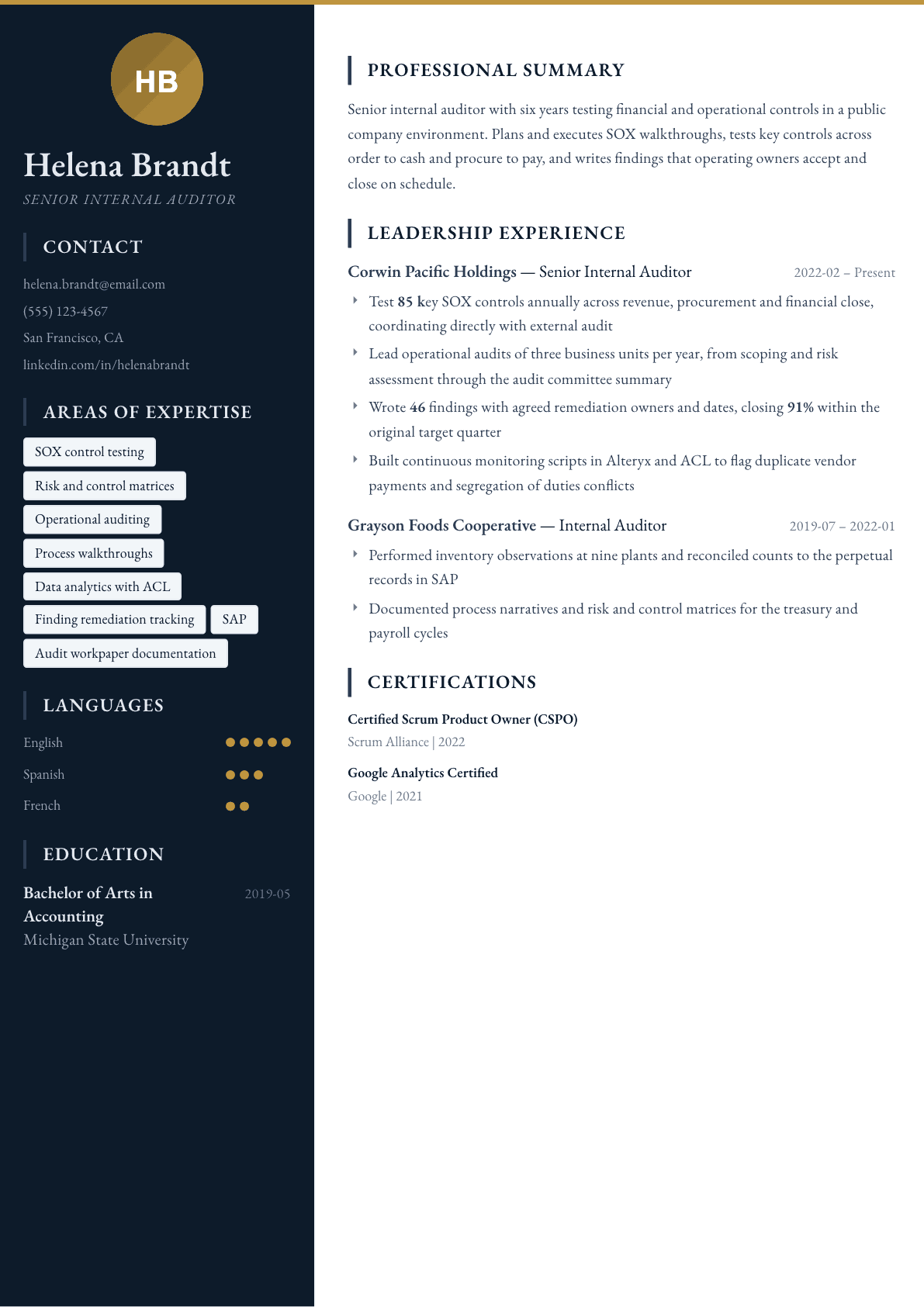
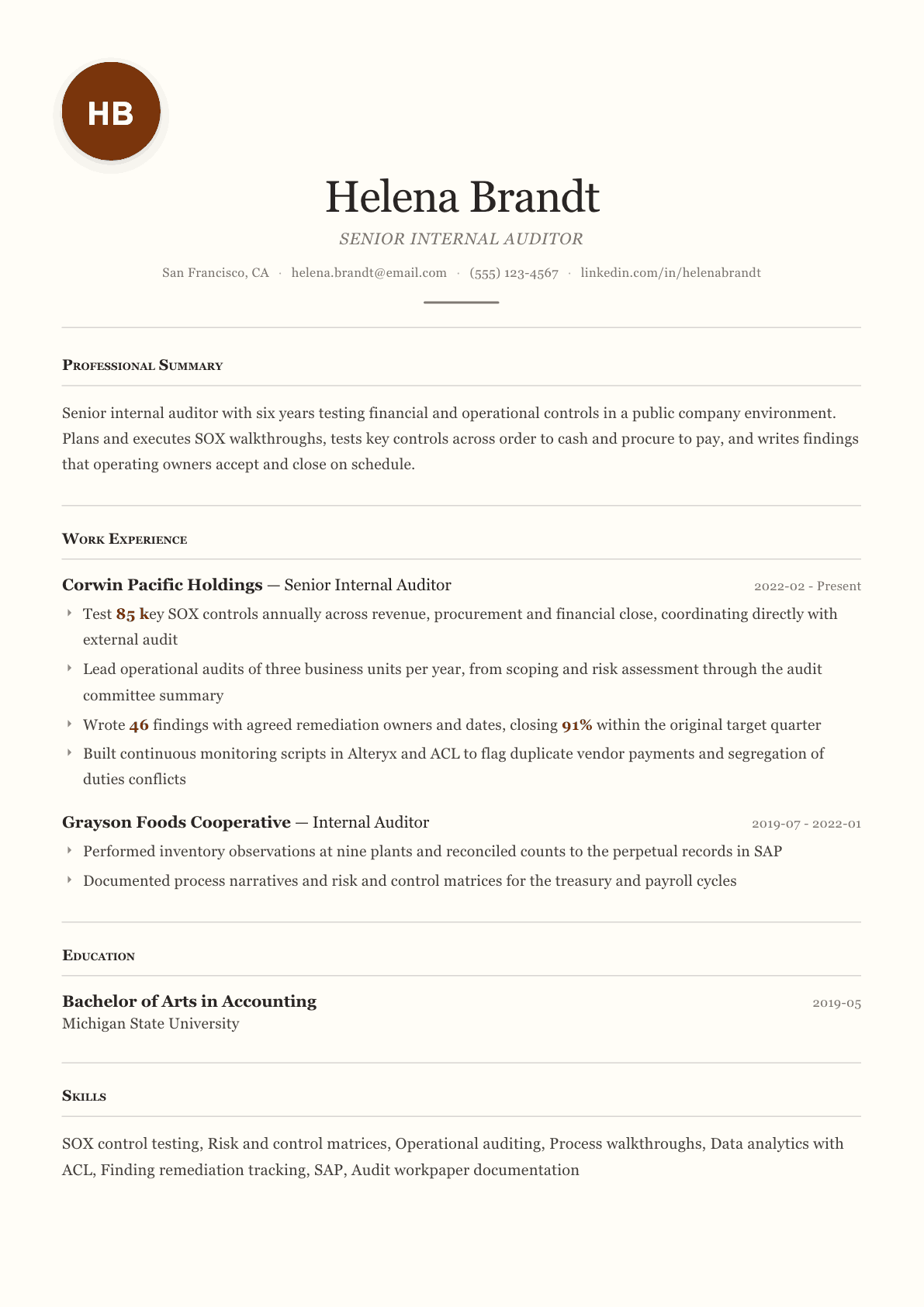
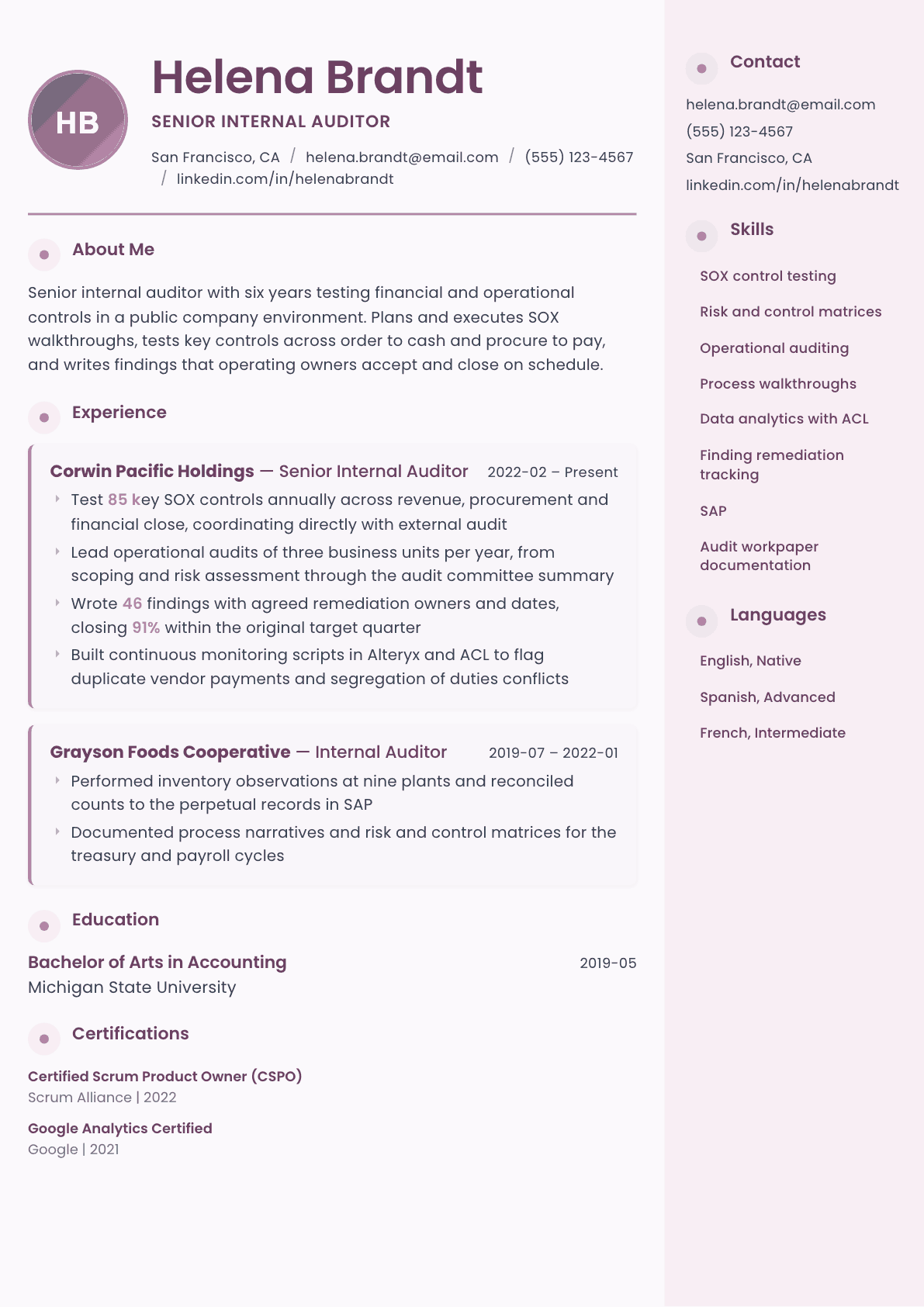
The same internal auditor content laid out in three CVBooster templates, so you can see what the finished document looks like before you write a word.
Example Internal Auditor summary
Senior internal auditor with six years testing financial and operational controls at a public company. Tests roughly eighty-five key SOX controls each year across revenue, procurement and financial close, and leads three full operational audits from scoping through the audit committee summary. Writes findings with named remediation owners and closes most within the original target quarter, supported by continuous monitoring scripts in ACL and Alteryx.
Skills to list on a Internal Auditor resume
- SOX 404 control testing
- COSO framework
- Risk assessment and audit planning
- Process walkthroughs and narratives
- Risk and control matrices
- Operational audits
- Sampling and testing methodology
- Finding write-up and remediation tracking
- Continuous monitoring analytics
- Segregation of duties review
- Workpaper documentation
- ACL and Alteryx
- SAP and Oracle ERP
- Audit committee reporting
What actually gets this resume read
- Say whether your work is financial, operational, compliance or IT auditing, and give the split, because departments hire for a specific gap.
- Quantify control testing: number of key controls, cycles covered, sample sizes and how many audits you led rather than supported.
- Show the outcome of findings, not just the count, including remediation owners, closure rate and anything escalated to the audit committee.
- Name the frameworks you work under, COSO, SOX 404, the IIA standards, and the ERP or GRC tools you tested inside.
- Add data analytics work explicitly, since continuous monitoring in ACL, Alteryx or Power BI is what separates modern audit resumes.
- List real credentials with the issuing body, such as CIA from the Institute of Internal Auditors or CPA with the state board.
How to write a internal auditor resume
An internal auditor is hired for judgment under two constraints: independence from the process owner and a limited testing budget. The audit director reading your resume wants to know which cycles you have tested, whether you can write a finding that a business leader accepts, and whether your work stood up when the external auditors relied on it.
The trap most internal audit resumes fall into is describing the methodology instead of the work. Walkthroughs, sampling and workpapers are the same at every company, so a page built around them says nothing. The differentiators are the cycles, the systems, the analytics you built and the findings that actually changed a control.
This guide covers the structure an audit department expects, how to write testing and findings without breaching confidentiality, three summaries at different levels, before and after bullets, and the questions auditors ask when they move between industry, public accounting and consulting.
Format: one page early, two once you lead audits
Single column, reverse chronological, no decorative elements. Audit teams screen for framework names, cycles and systems, so keep a competencies band under the summary carrying those terms.
Open each role with the environment: public or private company, industry, revenue band, department size, and whether the group reports to an audit committee. Testing controls in a regulated public company is a different discipline from advisory work in a private firm, and the reader must be able to tell them apart at a glance.
- Header: name, city and state, phone, email, credentials after your name.
- Order: summary, competencies, experience, systems and analytics, education, certifications.
- Give each role the cycle coverage: revenue, procurement, close, treasury, payroll, inventory.
Summary: audit type, cycles, and the outcome
Three or four lines naming the type of audit work, the cycles you cover, the annual volume and one result. An internal auditor who tests key controls across revenue, procurement and financial close, leads three operational audits a year and closes most findings inside the target quarter has described a whole job in two sentences.
Say plainly whether your work is financial control testing, operational auditing, compliance auditing or technology auditing. Departments recruit against a specific gap, and a candidate who is vague about their type gets passed over for one who is not.
Experience: scope, testing, findings, and closure
Build bullets around the audit lifecycle. Planning: the risk assessment, how the audit universe was scored, the scope you set and the hours budgeted. Fieldwork: the controls tested, sample sizes, the evidence obtained, the walkthroughs performed and the process narratives you wrote. Reporting: the findings, their rating, the agreed remediation owner and date. Follow-up: closure rate and anything escalated.
Findings are the deliverable, so treat them as such. Give the count, the rating mix and the closure rate rather than saying you identified control gaps. An auditor who wrote forty-six findings and closed most within the original target quarter has demonstrated both rigor and the ability to get a business owner to agree.
Describe the relationship with external audit if it existed. Testing that the external firm relied on, coordination on the scope of key controls, and reduced external hours are outcomes that carry weight with a controller.
Analytics: the fastest way to stand out
Most internal audit resumes still describe sample-based testing only. Naming the analytics you built moves you ahead of them. Duplicate vendor payment tests, segregation of duties conflict scans, journal entry population testing, purchase order splitting detection and continuous monitoring dashboards are all concrete, and each implies a tool.
Say which tool, whether ACL, Alteryx, Power BI, SQL or Python, and say what the test found. An analytic that flagged conflicts nobody had noticed is a stronger credential than a certification in the tool itself.
Frameworks, systems and keywords
Name the frameworks you work inside: the control framework used for financial reporting, the international standards for the professional practice of internal auditing, and any regulatory regime specific to your industry. List the enterprise systems you tested inside and any governance platform used to track issues. Then mirror the posting language once each: risk assessment, control testing, walkthrough, risk and control matrix, findings, remediation, segregation of duties and audit committee reporting.
Internal Auditor resume summary examples
First audit role
Staff internal auditor with two years performing inventory observations at nine plants and documenting process narratives for treasury and payroll. Reconciled counts to perpetual records and drafted risk and control matrices. Working toward the internal auditor certification and seeking a senior audit seat.
Six years, senior auditor
Senior internal auditor testing 85 key controls a year across revenue, procurement and financial close at a public company. Leads three operational audits annually from scoping to the audit committee summary, wrote 46 findings with agreed owners, and closed 91% within the target quarter.
Audit manager track
Lead internal auditor with ten years across manufacturing and financial services, owning the annual risk assessment and the audit plan for eleven business units. Supervises four auditors, built the continuous monitoring program, and presents quarterly to the audit committee on issue aging and remediation status.
Work experience bullets: before and after
Before: Performed SOX testing for the company.
After: Tested 85 key controls annually across revenue, procurement and financial close, coordinating scope and evidence directly with the external audit team so they could rely on the work.
The control count, the cycles and external reliance turn a generic claim into measurable coverage.
Before: Identified control weaknesses and reported them.
After: Wrote 46 findings with agreed remediation owners and target dates, rating each by residual risk, and closed 91% within the original target quarter through monthly follow-up.
Volume, rating discipline and closure rate show that the findings changed something rather than sitting open.
Before: Used data analytics in audits.
After: Built continuous monitoring scripts in Alteryx and ACL that scanned the full vendor payment population for duplicates and flagged 14 segregation of duties conflicts missed by sample-based testing.
Naming the tools, the population approach and what the tests found proves analytics capability rather than exposure.
Before: Led operational audits of different departments.
After: Led operational audits of three business units per year, setting scope from a risk assessment workshop with the unit leadership and delivering each report to the audit committee within six weeks of fieldwork close.
Scoping method and a delivery timeline show ownership of the whole audit, not participation in it.
Before: Documented processes and controls.
After: Documented process narratives and risk and control matrices for the treasury and payroll cycles, mapping 60 controls to their financial statement assertions and retiring 9 redundant ones.
Mapping to assertions and retiring redundant controls demonstrates judgment beyond documentation.
Hard skills
- Internal control testing over financial reporting
- Control framework application
- Risk assessment and audit planning
- Process walkthroughs and narratives
- Risk and control matrices
- Operational and compliance audits
- Sampling and testing methodology
- Finding write-up and issue rating
- Remediation tracking and validation
- Segregation of duties analysis
- ACL, Alteryx and SQL analytics
- SAP and Oracle ERP environments
Soft skills
- Independence and professional skepticism
- Interviewing process owners
- Persuading a business leader to accept a finding
- Concise written reporting
- Time budgeting across concurrent audits
- Presenting to senior committees
Certifications worth listing
- Certified Internal Auditor (CIA) (Institute of Internal Auditors)
- Certification in Risk Management Assurance (CRMA) (Institute of Internal Auditors)
- Certified Public Accountant (CPA) (State Board of Accountancy)
- Certified Information Systems Auditor (CISA) (ISACA)
- Certified Fraud Examiner (CFE) (Association of Certified Fraud Examiners)
Mistakes that cost internal auditor candidates the interview
- Describing audit methodology in general terms, which produces a page indistinguishable from every other applicant.
- Counting findings without closure, since an issue that never gets remediated is not an audit result.
- Omitting the cycles tested, leaving a director unable to match you against the gap on their plan.
- Ignoring analytics entirely, which now reads as a candidate who tests the way departments tested a decade ago.
- Naming confidential findings or identifiable business details, which raises a serious judgment concern.
- Failing to say whether the department reported to the audit committee, which defines the independence you worked under.
Internal Auditor resume questions
How do I describe audit findings without breaching confidentiality?
Describe the control area and the type of weakness rather than the specific incident or the entity. Saying you identified a segregation of duties conflict in vendor master maintenance conveys the work without exposing anything your employer would object to.
Is a Certified Internal Auditor credential worth the effort?
It is the credential most directly aligned with the role and is often listed as preferred or required in postings. Add it with the issuing body, and note the parts passed if you are still working through the examination series.
How do I move from external audit to internal audit?
Emphasize the control testing, walkthroughs and risk assessment you already performed, then show interest in the operational side. Departments value the discipline external audit teaches but want evidence you can advise a business owner, not only test them.
Should an internal auditor resume mention hours or budget?
Yes when you owned it. Hours budgeted against an audit, the number of concurrent audits you carried and any reduction in external audit hours from your testing all quantify capacity in a way that reads clearly to a director.
What analytics tools should I list if my department did not have any?
List what you genuinely used, even if it was advanced spreadsheet work or SQL queries against the ERP. Then describe a full-population test you built with it, because the thinking matters more to a hiring director than the brand of software.
Related resume examples
- Auditor Resume example
- Compliance Officer Resume example
- Audit Manager Resume example
- IT Auditor Resume example
- Compliance Manager Resume example
- CPA Resume example