Auditor Resume Examples: free score, then the gap list
Auditor Resume: Auditing Resume Sample and Examples
By Mustafa Tarabya, founder of CVBooster · Published · Updated
An auditing resume sample and audit resume examples for external, internal and government auditors, with engagement bullets, SOX work and keywords.
Sample resumes for a auditor
The same auditor content laid out in three CVBooster templates, so you can see what the finished document looks like before you write a word.
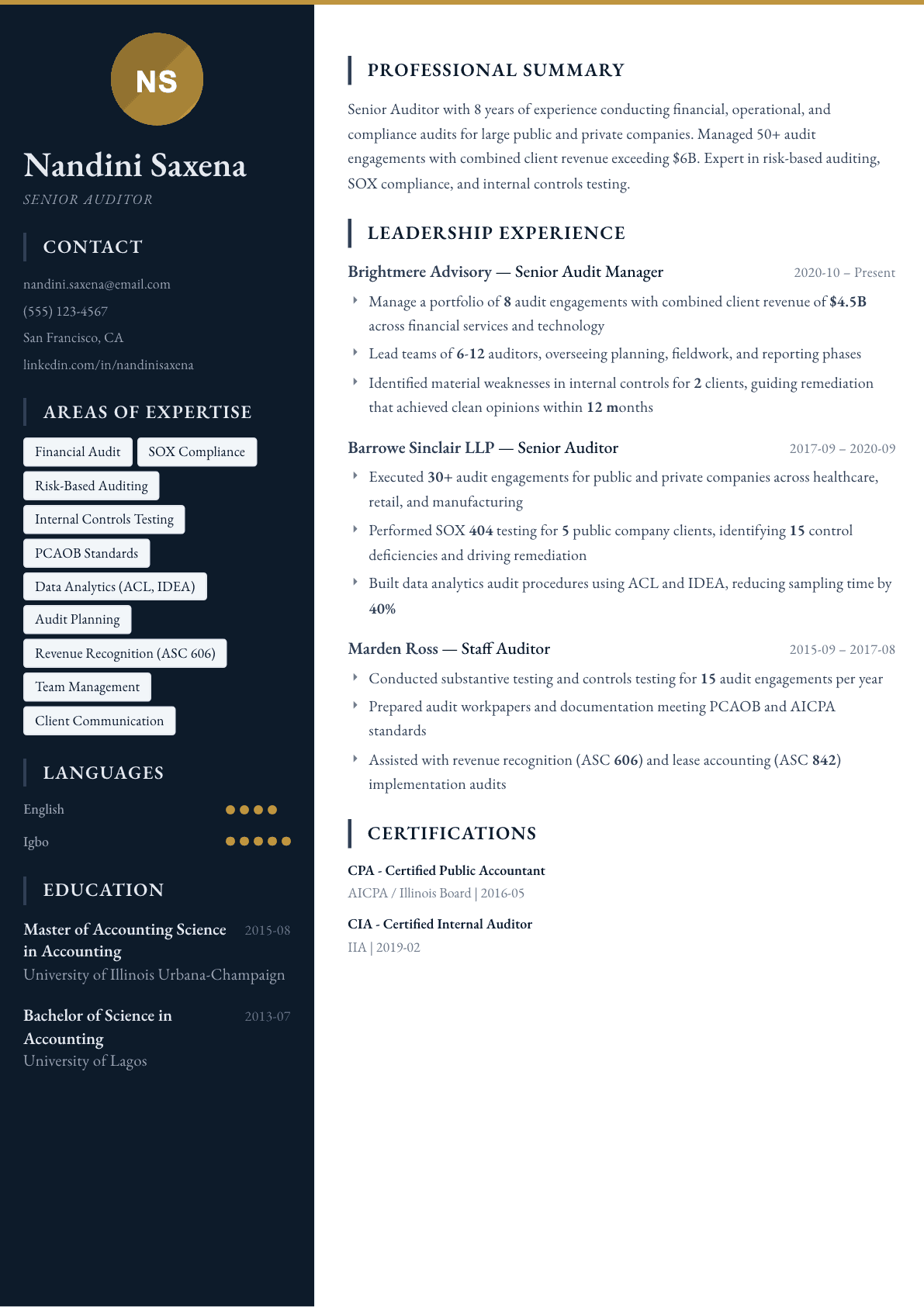
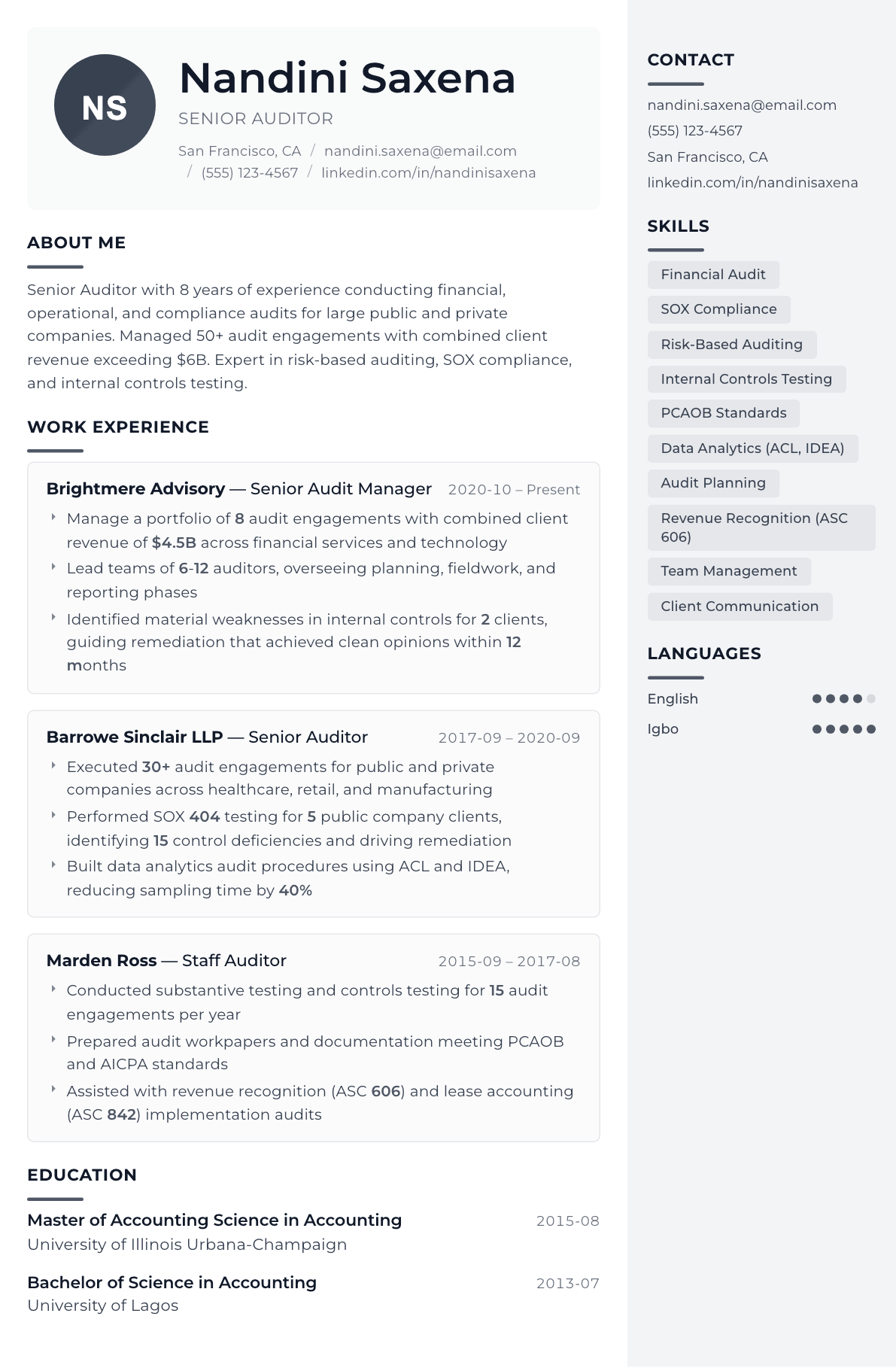
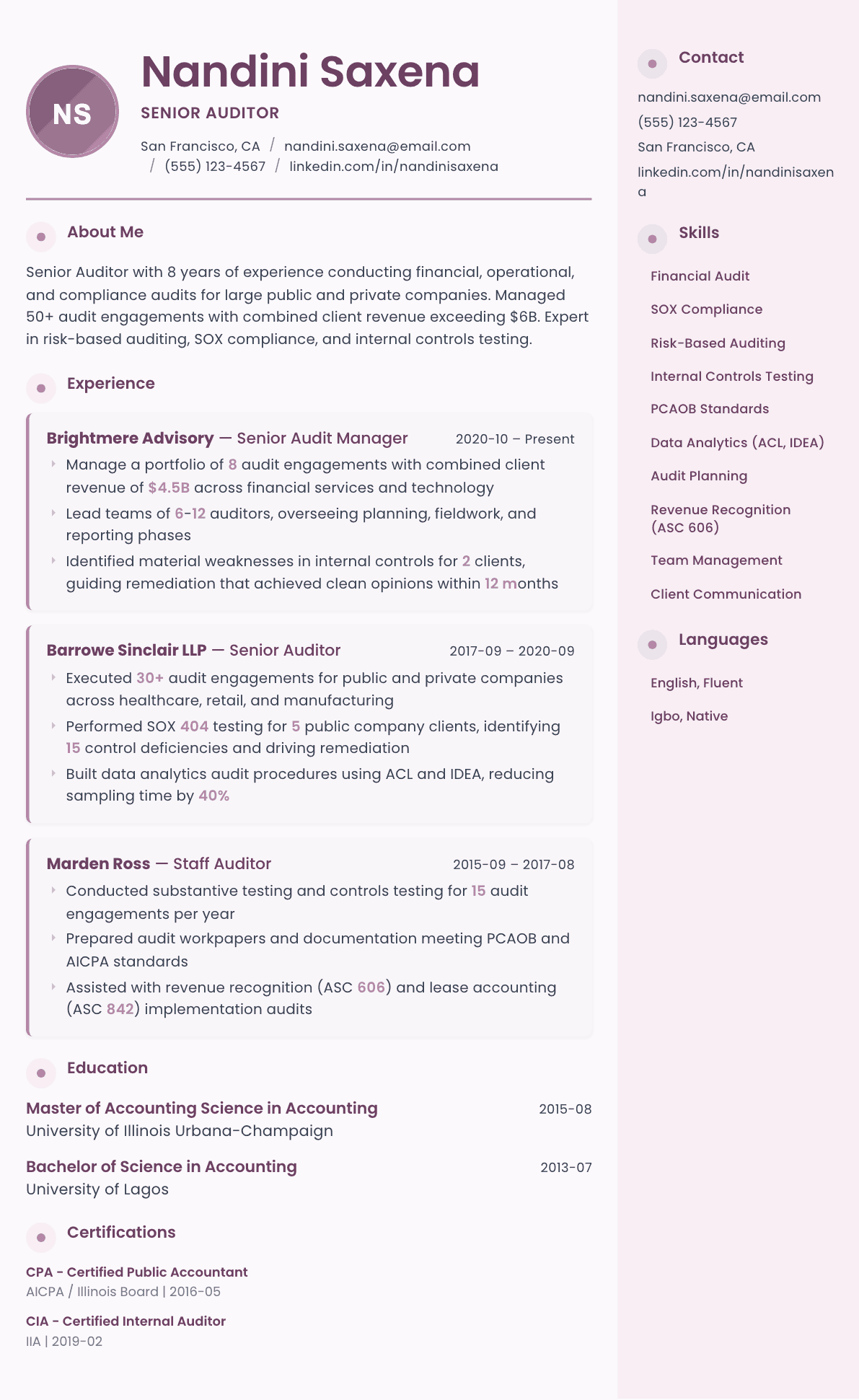
Example Auditor summary
CPA and Senior Auditor with 8 years at national firms conducting financial and SOX audits for large public companies. Managed 50+ engagements with $6B+ in combined client revenue. Expert in risk-based auditing, internal controls, and PCAOB standards. Seeking an Audit Director role to lead large-scale engagements at a top-tier firm.
Skills to list on a Auditor resume
- Financial Audit
- SOX 404 Compliance
- Risk-Based Auditing
- Internal Controls
- PCAOB Standards
- US GAAP
- IFRS
- Data Analytics
- Audit Planning
- ASC 606 / ASC 842
- Team Leadership
- Client Management
- Workpaper Documentation
What actually gets this resume read
- Quantify audit engagements: number of audits, client revenue, team sizes managed.
- Highlight specific audit standards: PCAOB, AICPA, IIA, IFRS, US GAAP.
- Show SOX compliance experience with control deficiencies identified and remediated.
- Include data analytics tools used in auditing: ACL, IDEA, Tableau, Power BI.
- Demonstrate progression from staff to senior to manager with increasing engagement complexity.
- CPA and CIA certifications should be prominently displayed.
How to write a auditor resume
An auditor resume has to answer a question of standards before anything else: whose rulebook did you work under? External audit under PCAOB or AICPA standards, internal audit under the Institute of Internal Auditors framework, and government audit under generally accepted government auditing standards are three professions that share a word. A resume that just says audit forces the reader to guess, and guessing usually ends with the file going back on the pile.
The second thing an audit manager checks is engagement complexity. Client industry, revenue band, whether the entity is public or private, whether the engagement included an integrated audit of internal control over financial reporting, and how much of the fieldwork you ran without a senior sitting next to you. Those facts tell a reviewer what you can be staffed on next busy season.
This guide walks through the section order audit recruiters expect from staff through manager, a complete auditing resume sample with notes on how auditing resume examples change by framework, how to describe engagements without breaching client confidentiality, before and after bullets that show testing judgment rather than task completion, and the questions auditors ask when they move from public practice into an internal audit department.
Format: engagements grouped, standards named, dates clean
Reverse-chronological, one page through senior, two at manager level. Public accounting careers produce dozens of engagements, so group them rather than listing each one: an industry heading, the revenue band, the entity type and the number of engagements is far more readable than a list of anonymized client names.
Name the standard framework in the role scope line, not just in the skills list. Writing that you performed integrated audits of public issuers under PCAOB standards, or risk based internal audits under the International Professional Practices Framework, does more for the file than any adjective on the page.
- Header: name with CPA, CIA or CISA when held, city and state, phone, email.
- Order: summary, certifications and licensure, audit experience, technical and data skills, education.
- Every role carries a scope line: framework, client industries, revenue band, team size, your review responsibility.
Summary: framework, portfolio, and where you sat in the team
Three lines that fix your position in the audit hierarchy. State the framework, the client or business unit portfolio, the number of engagements you carry in a year, and whether you plan, execute, review or sign. An auditor who reviews the work of three staff is a different hire from one who prepares workpapers, even at the same year count.
If you are targeting internal audit from external practice, say it in the summary and name the transferable parts: risk assessment, walkthroughs, control design evaluation and testing, and issue writing. If you are going the other way, lead with technical accounting and substantive testing rather than operational reviews.
Experience: risk, scope, testing, findings
A strong audit bullet moves through risk to conclusion. Name the cycle or process, the risk you were testing for, the population and how you selected from it, and what the testing produced. Performed testing of controls is a sentence about existence; testing forty purchase transactions selected by monetary unit sampling across two locations and identifying three approvals outside the delegated authority limit is a sentence about audit.
Findings are the deliverable, so give them their own weight. Say what deficiency you identified, how you classified it, who you wrote it up for, and whether the remediation was tested and closed. Auditors who can describe how they persuaded a process owner to accept a finding stand out, because that conversation is the hard part of the job.
Respect confidentiality without going vague. Anonymize the client as a global consumer products manufacturer or a state pension plan, keep the revenue band, keep the industry, and never name a client whose engagement details are not public.
SOX, internal control and the technology in the audit
For internal audit and integrated audit candidates, the internal control over financial reporting content deserves its own bullets: scoping and risk assessment, walkthroughs, control design and operating effectiveness testing, deficiency evaluation and aggregation, and management testing coordination with the external auditor. Naming the cycles you covered, such as order to cash, procure to pay, payroll, treasury and financial close, gives the reader a map of your coverage.
Data skills are now a real differentiator in audit. If you have replaced sampling with full population testing, say so and name the tool: ACL or Galvanize, IDEA, Alteryx, SQL, Power BI or Tableau. Add any use of the audit management platform the department runs, such as AuditBoard, TeamMate, Workiva or Pentana.
Keywords audit postings reuse
Audit job descriptions borrow heavily from the standards, so expect these phrases and mirror them where they are true: risk assessment, internal controls, walkthrough, test of design, test of operating effectiveness, substantive testing, sampling, workpaper documentation, audit report, remediation, control deficiency, materiality, and the framework names. Use each once in the skills area and once inside a bullet attached to real testing.
Auditing resume sample: senior internal auditor
Most people searching for an audit resume sample want a finished page they can hold their own against. Here is a complete audit resume example for a senior internal auditor who started in public accounting. The name and companies are invented. A resume for audit roles in external practice uses the same order, with engagements grouped by industry instead of business units.
Profile: Rachel Kim, CPA, CIA. Senior Internal Auditor at a public consumer goods company, after three years of external audit at a regional firm. Plans and leads operational and SOX audits, supervises two staff auditors, and writes the findings that go to the audit committee.
- Current role, Senior Internal Auditor, Harbor Consumer Brands, three years: lead six to eight audits a year across procurement, payroll, inventory and IT general controls.
- Run SOX walkthroughs and test controls for the procure to pay and inventory cycles, and review the workpapers of two staff auditors.
- Found duplicate vendor payments through a data analytics test of the full payables file, and worked with accounts payable to recover them and add a system control.
- Write audit reports with management action plans and track every open issue until it is closed and retested.
- Previous role, Audit Senior, Benton and Hale CPAs, three years: financial statement audits of private manufacturers and nonprofits under AICPA standards, leading fieldwork for teams of three.
- Skills: SOX 404 testing, COSO framework, risk assessment, data analytics in ACL and Excel, audit management software, report writing.
- Certifications and education: CPA, CIA; BS in Accounting.
Auditor resume summary examples
Audit associate
Accounting graduate and CPA candidate with 2 exam sections passed, plus a busy season internship on private company audits in manufacturing and nonprofit. Prepared cash, receivable and inventory workpapers, performed walkthroughs, and used IDEA for journal entry testing. Seeking a first year audit associate position.
Senior auditor
CPA and senior auditor with 5 years in public accounting, running fieldwork on integrated audits of public issuers in software and industrial products under PCAOB standards. Plans scope, reviews the work of three staff, and owns revenue, inventory and internal control over financial reporting sections of the file.
Audit manager
Audit manager and Certified Internal Auditor with 11 years across external and internal audit, currently owning the annual risk assessment and a plan of 22 engagements for a multinational manufacturer. Reports findings to the audit committee and led the department move to full population testing in Alteryx.
Work experience bullets: before and after
Before: Performed testing of internal controls for SOX compliance.
After: Tested 46 key controls across order to cash and procure to pay, evaluated two exceptions as significant deficiencies, and agreed remediation plans with the process owners before year end.
Control count, cycle names and the deficiency classification show real testing judgment instead of a compliance label.
Before: Prepared audit workpapers for various clients.
After: Owned the revenue, receivables and inventory sections for four private manufacturing clients, documenting testing in the firm workpaper system and clearing senior review notes without rework on the final two files.
Naming the sections, the client type and the review outcome tells a manager exactly what you can be staffed on.
Before: Identified issues and reported them to management.
After: Wrote 9 audit findings on segregation of duties in the payroll process, presented them to the divisional finance director, and retested and closed 7 within the following quarter.
Finding counts plus retested closures prove the work led to change rather than ending at a report.
Before: Used data analytics in audits.
After: Replaced a 60 item journal entry sample with full population analysis in Alteryx, flagging entries posted outside business hours and by users without posting authority for targeted follow-up.
Naming the old approach, the tool and the risk criteria shows the analytics served the audit rather than decorating it.
Before: Assisted with the annual audit plan.
After: Built the annual risk assessment through 14 process owner interviews and a control heat map, and converted it into a plan of 18 engagements approved by the audit committee.
The method behind the plan is what distinguishes an auditor who set the plan from one who was handed it.
Hard skills
- Risk-based audit planning
- Internal control over financial reporting (SOX)
- Walkthroughs and process documentation
- Test of design and operating effectiveness
- Substantive and analytical procedures
- Statistical and monetary unit sampling
- US GAAP and IFRS
- PCAOB and AICPA standards
- IIA International Professional Practices Framework
- Workpaper documentation and review
- ACL, IDEA and Alteryx
- AuditBoard, TeamMate and Workiva
Soft skills
- Professional skepticism
- Delivering an unwelcome finding
- Interviewing process owners
- Review of junior workpapers
- Independence and objectivity
Certifications worth listing
- Certified Public Accountant (CPA) (State Board of Accountancy, administered by NASBA and the AICPA)
- Certified Internal Auditor (CIA) (Institute of Internal Auditors)
- Certified Information Systems Auditor (CISA) (ISACA)
- Certification in Risk Management Assurance (CRMA) (Institute of Internal Auditors)
- Certified Fraud Examiner (CFE) (Association of Certified Fraud Examiners)
- Certified Government Auditing Professional (CGAP) (Institute of Internal Auditors)
Mistakes that cost auditor candidates the interview
- Never saying which standards applied, leaving a reader unable to tell external, internal and government audit apart.
- Listing individual client names from engagements, which raises a confidentiality flag before the experience is even read.
- Describing tasks completed rather than risks tested, so no bullet demonstrates the judgment that defines the work.
- Omitting review responsibility, which is the fastest way to be read as a staff auditor when you are applying as a senior.
- Leaving out remediation and closure, so findings look like paperwork rather than change that stuck.
- Putting analytics tools in a skills list with no bullet showing what the tool tested or what it found.
Auditor resume questions
What does an audit resume sample look like?
One or two pages with a profile naming your framework and level, then each role with a scope line covering industries, entity type and team size, followed by bullets on what you planned, tested, found and closed. Certifications sit near the top. The sample on this page shows a complete senior internal auditor resume.
How do I list audit clients without breaching confidentiality?
Describe them, do not name them. A global consumer products manufacturer with revenue in the low billions communicates industry, scale and complexity while keeping the engagement confidential. Group similar clients under one heading and give the number of engagements per year.
Should an auditor resume be one page or two?
One page through the senior level. Two pages become reasonable at manager and above, where the audit plan, committee reporting, staff development and multiple frameworks all need space. Anything longer signals that engagements were listed instead of grouped.
How do I move from external audit to internal audit?
Lead with control work rather than substantive testing. Highlight walkthroughs, control design evaluation, deficiency assessment and issue writing, then add operational thinking such as process efficiency observations. Naming progress toward the Certified Internal Auditor credential makes the direction credible.
Is the CPA required for an internal auditor?
It is expected in external audit and common but not required in internal audit, where the Certified Internal Auditor designation carries equivalent weight. Information systems audit roles favor the CISA. State whichever you hold or are pursuing, with the issuing body.
Related resume examples
- Accountant Resume example
- Forensic Accountant Resume example
- Compliance Analyst Resume example
- CPA Resume example
- Accounting Manager Resume example
- Audit Manager Resume example