Loss Prevention Officer Resume Examples: free ATS score
Write a Loss Prevention Officer Resume Stores Trust
By Mustafa Tarabya, founder of CVBooster · Published · Updated
Loss prevention officer resume examples, shrink and apprehension keywords, and a writing guide covering CCTV, audits, and case reports.
Sample resumes for a loss prevention officer
The same loss prevention officer content laid out in three CVBooster templates, so you can see what the finished document looks like before you write a word.
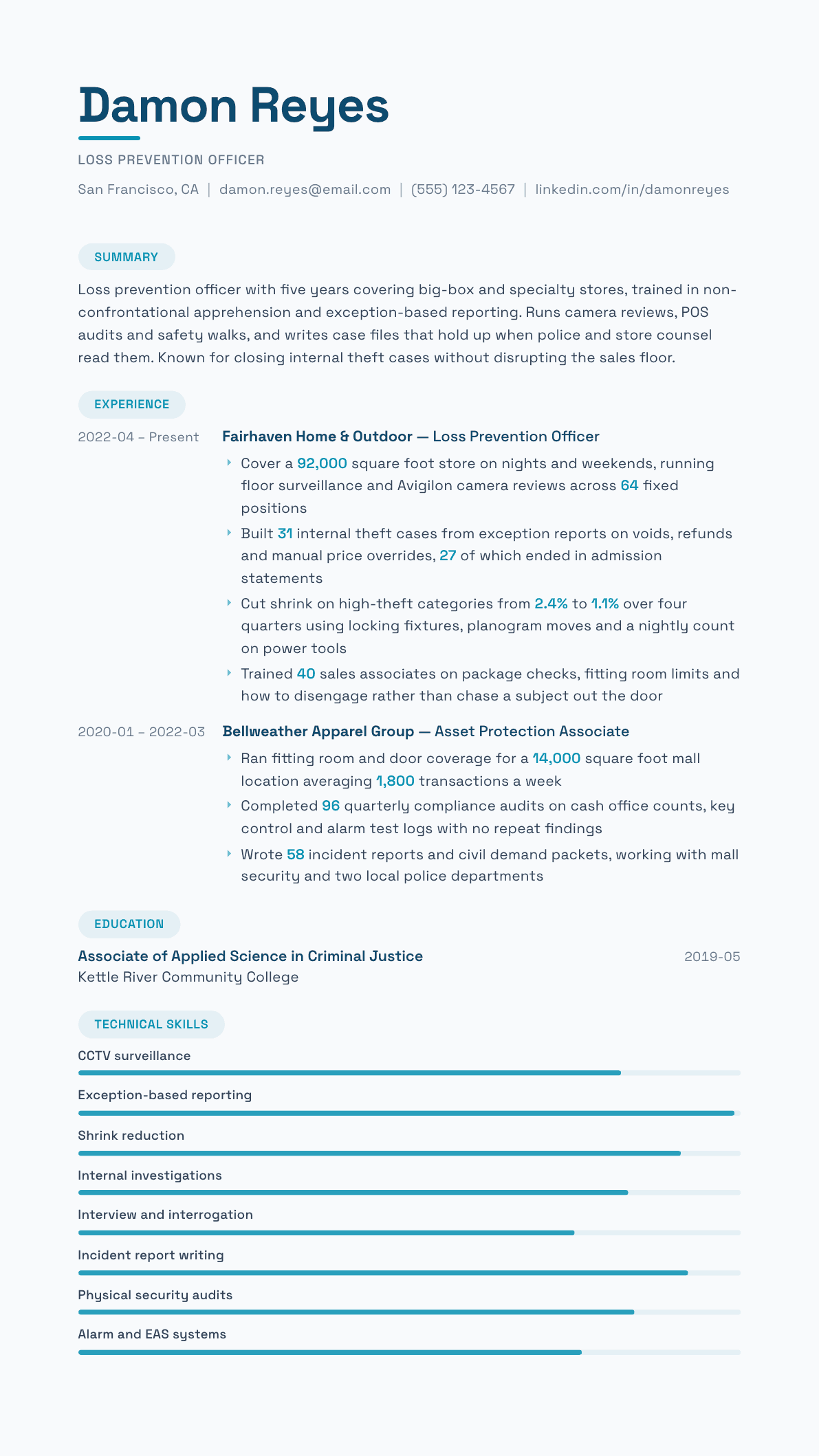
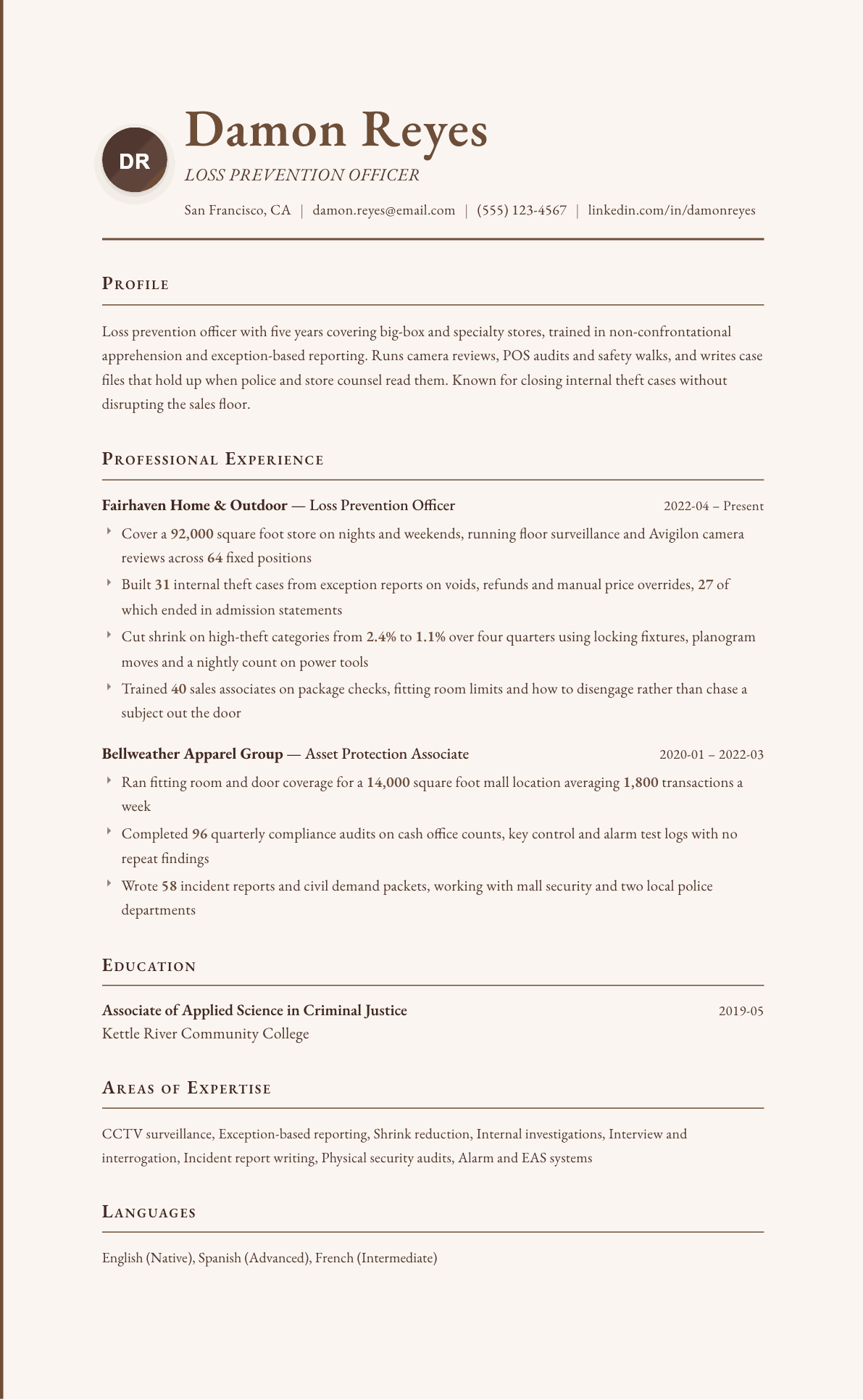
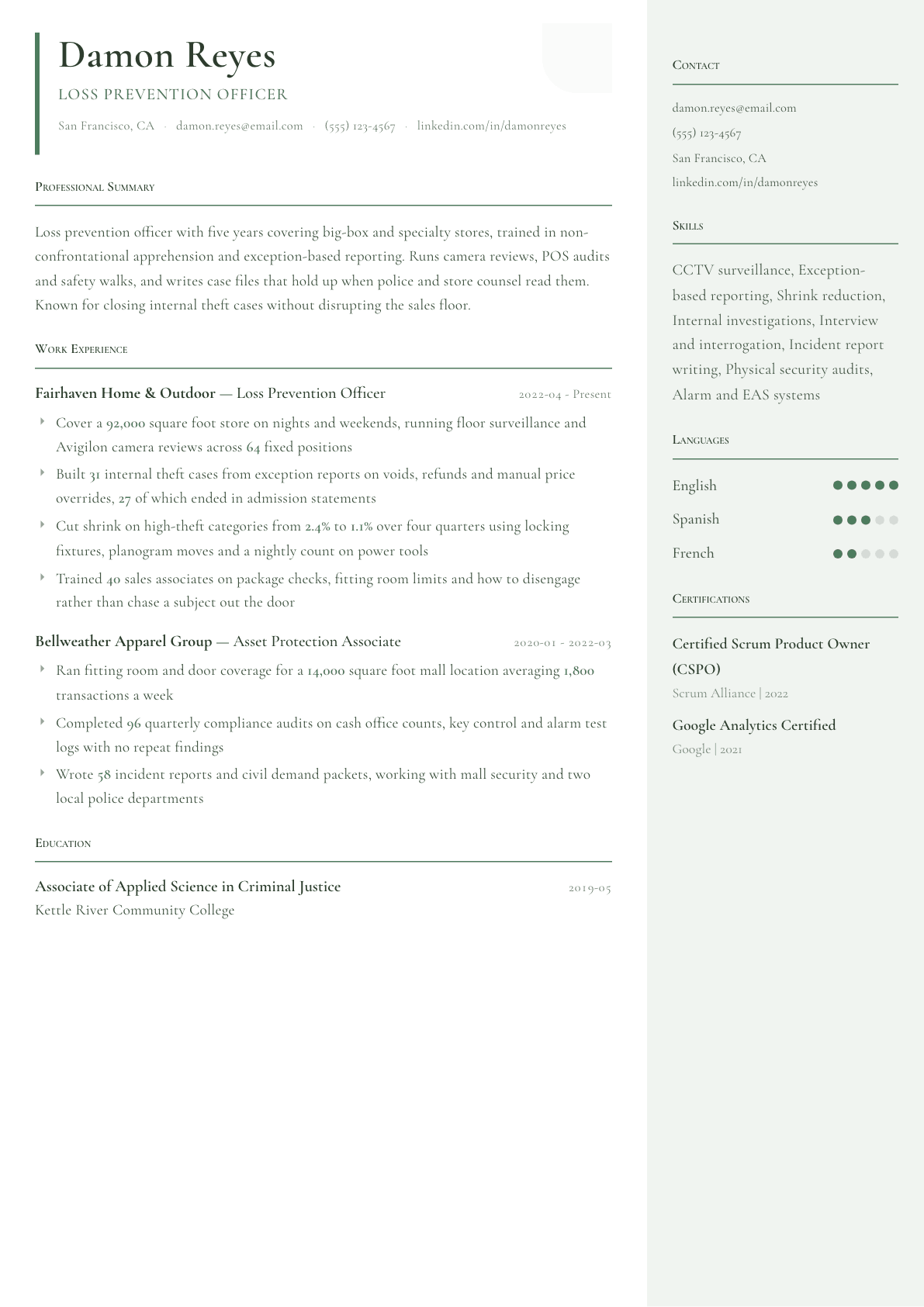
Example Loss Prevention Officer summary
Loss prevention officer with five years in high-volume retail, covering surveillance, internal investigations and store safety. Built and closed dozens of internal theft cases from exception reporting, reduced shrink in the highest-loss categories across four quarters, and trained store teams on package checks and safe disengagement. Wicklander-Zulawski trained and comfortable working alongside local police.
Skills to list on a Loss Prevention Officer resume
- CCTV monitoring
- Exception-based reporting
- Shrink analysis
- Internal theft investigation
- Non-confrontational apprehension
- Incident documentation
- Physical security audits
- Electronic article surveillance
- Cash office auditing
- Key control
- Safety compliance
- Civil demand process
- Witness statements
- Store awareness training
What actually gets this resume read
- Name the store format and square footage in every job so a hiring manager knows the volume you covered.
- Give shrink numbers as a before and after figure with the period, not a single vague improvement claim.
- Separate external theft from internal cases, because the two skill sets are hired and trained differently.
- List the camera platform, EAS system and exception reporting tool you used by name for keyword matching.
- Mention Wicklander-Zulawski or similar interview training near the top if you hold it, since it gates many roles.
- Show that you know the escalation policy: apprehension criteria, disengagement, and when you hand off to police.
How to write a loss prevention officer resume
The person hiring a loss prevention officer is usually a district asset protection manager who has already been burned twice: once by an officer who never made a case, and once by an officer who made a case badly and cost the company a civil claim. Everything on your resume is read against those two fears. Can you produce results, and can you produce them inside policy.
That means the resume has to carry two kinds of proof side by side. The operational half shows volume: store format, square footage, hours covered, camera count, how many cases you built and how many closed. The compliance half shows discipline: the apprehension criteria you worked under, when you disengaged, how your reports were written, and who you handed the file to.
This guide covers the section order asset protection recruiters expect, three example summaries from a new officer to a multi-store investigator, before and after bullets from real report language, and the questions officers ask when they sit down to write.
Format: one page, credentials visible before the fold
Reverse chronological, single column, no icons. Asset protection applications often route through the same applicant tracking system as the rest of the store payroll, and a two column layout scrambles employment dates in exactly the roles where date gaps get questioned hardest.
Put a short credentials line directly under your contact block: interview training, any state guard registration or card, first aid certification, and your driver record status if the role includes travel between stores. A district manager can then confirm you are placeable without opening a second document.
- Header: name, city and state, phone, email, and any state security registration number if your state issues one.
- Section order: summary, credentials, experience, education, skills.
- Add a short investigations section listing case types if you have built more than a handful of internal files.
Summary: format, coverage, and what you actually catch
Three lines. Name the retail format you have worked, the coverage you held, and the split between external and internal work. An officer who has spent four years on a big box floor is a different hire from one who ran mall apparel, and the manager reading the file needs to know which one arrived.
Skip the phrase highly motivated. Say instead that you have built internal cases from exception reporting, or that your background is external apprehension and door coverage. Both are respectable, but only one matches any given posting, so match it deliberately.
Experience: the store, the coverage, the case count
Open every job with the environment. Store format, square footage or sales volume, camera count, and whether you worked alone or on a team. Something like a ninety thousand square foot home improvement store with sixty four cameras and no second officer on nights tells a reader more than a paragraph of adjectives.
Then give the case work. Number of internal investigations built, how many reached an admission or a recovery, and the reporting tool that surfaced them. Voids, returns without receipt, manual price overrides, discount abuse and gift card activity are the exception categories that generate real files, so name the ones you worked.
Add the prevention half. Fixture changes, product protection, awareness training, audit compliance and safety walks are the work that keeps a store from needing an apprehension at all, and a district manager values it because it scales without adding payroll.
Credentials: interview training is the gate
Wicklander-Zulawski or Reid interview training is the single credential most often written into these postings, because a company will not let an untrained officer sit in a room with an associate. If you hold it, put it in the credentials line and again in a certifications section. If you do not, say what interview method you were trained on internally and by whom.
State requirements vary. Several states require a guard card or a private security registration to work in an asset protection role, and some require a separate card to detain. List yours with the issuing state so a recruiter can check placement without a phone call.
Skills: name the systems, not the qualities
The skills block is a keyword block. List the camera platform, the exception reporting tool, the case management system and the alarm and article surveillance hardware you have used. Avigilon, Genetec, March Networks, Sensormatic and Checkpoint are the kinds of names a screener searches for, and a generic mention of surveillance experience will not match any of them.
Leave integrity, vigilance and attention to detail out of the list. Those are claims. Prove them in the experience bullets by describing a case you disengaged from, an audit finding you cleared, or a report a prosecutor accepted.
Keywords the screening pass is looking for
Postings recycle the same vocabulary: shrink, asset protection, apprehension, exception based reporting, internal and external theft, physical security, safety compliance, civil recovery, and incident documentation. Use the exact phrasing from the posting once in your summary and once inside a bullet where it is backed by a fact. A screener reads the file immediately after the software does, so a stuffed keyword block costs you the interview it was meant to win.
Loss Prevention Officer resume summary examples
First officer role
Security officer moving into retail asset protection, with two years covering a shopping center on nights and a state guard registration in Ohio. Trained on CCTV monitoring, incident reporting and non-confrontational engagement, and comfortable working alongside mall security and responding police.
Four years in
Loss prevention officer with four years covering a ninety thousand square foot big box store solo on nights and weekends. Built 31 internal cases from exception reports on voids and refunds, cut shrink on high theft categories from 2.4% to 1.1%, and trained 40 associates on package checks and safe disengagement.
Multi-store investigator
Asset protection investigator covering 14 stores in a district, Wicklander-Zulawski trained, with nine years of internal case work and organized retail crime investigations. Runs district audits, partners with two police task forces, and mentors store level officers on case building and report standards.
Work experience bullets: before and after
Before: Watched cameras and looked out for shoplifters.
After: Ran floor and camera surveillance across 64 fixed positions on a sales floor of ninety two thousand square feet, working nights solo with no second officer on shift.
Camera count, square footage and solo coverage tell a district manager exactly how much responsibility you carried.
Before: Investigated employee theft.
After: Built 31 internal theft cases from exception reports on voids, refunds and manual price overrides, with 27 closing on a signed admission statement.
Naming the exception categories and the closure count proves method rather than a claim of having investigated something.
Before: Helped reduce shrink in the store.
After: Cut shrink on power tools and small electronics from 2.4% to 1.1% over four quarters using locking fixtures, a planogram move and a nightly count.
A before and after figure with the actions behind it turns a shared store result into your personal contribution.
Before: Wrote incident reports.
After: Documented 58 incidents and civil demand packets with timestamped video, witness statements and recovery values, all accepted by two local police departments without rework.
The reader learns your reports survive outside scrutiny, which is the part of the job that creates legal risk.
Before: Trained store staff on loss prevention.
After: Trained 40 sales associates on fitting room limits, receipt checks and how to disengage from a subject rather than follow one into the parking lot.
The specific policy content shows you teach safe behavior, not just awareness in the abstract.
Hard skills
- CCTV and video management systems
- Exception based reporting
- Internal theft investigation
- Interview and statement taking
- Shrink analysis
- Electronic article surveillance
- Alarm system operation
- Physical security audits
- Cash office and key control audits
- Incident and case documentation
- Civil recovery process
- Organized retail crime case building
Soft skills
- De-escalation
- Discretion with sensitive files
- Observation under pressure
- Clear written reporting
- Working with law enforcement
- Coaching store teams
Certifications worth listing
- Wicklander-Zulawski Interview and Interrogation Certification (Wicklander-Zulawski & Associates)
- LPQualified (LPQ) (Loss Prevention Foundation)
- LPCertified (LPC) (Loss Prevention Foundation)
- Certified Protection Officer (CPO) (International Foundation for Protection Officers)
- Physical Security Professional (PSP) (ASIS International)
Mistakes that cost loss prevention officer candidates the interview
- Listing apprehension counts with no mention of the policy you worked under, which reads as risk rather than results.
- Describing surveillance generically instead of naming the camera platform and exception reporting tool a store already runs.
- Leaving out store format and square footage, so a reader cannot tell a small mall unit from a warehouse club.
- Hiding a state guard registration in the education block where a recruiter checking placement will never find it.
- Claiming shrink reduction for the whole store when the district knows shrink results are shared across a team.
- Writing bullets that only cover external theft when the posting is clearly built around internal case work.
Loss Prevention Officer resume questions
Do I need interview certification to apply for a loss prevention officer job?
Not always for a store level opening, but it is the credential that separates candidates once you want internal case work. Many employers will not allow an uncertified officer to conduct an interview, so listing the training you do hold, even internal, matters.
Should I put apprehension numbers on a loss prevention resume?
Yes, but always with context. Give the count, the recovery value if you tracked it, and one clause about the criteria you followed. Numbers without policy language read as someone who chases people, which is the behavior most retailers are trying to hire away from.
How do I move from security guard work into retail asset protection?
Lead with the transferable half: camera monitoring, patrol discipline, incident reporting and working with responding officers. Then add anything retail specific you have touched, such as article surveillance tags, door coverage, or standing post in a shopping center during peak hours.
What do I write if my store never let me make apprehensions?
Write the prevention work instead. Audit compliance, product protection changes, awareness training, safety walks and exception report reviews are real asset protection work, and plenty of retailers now run a non-apprehension model that hires exactly that background.
Is a criminal justice degree required for this role?
It is common but rarely required at officer level. Experience, a clean record and interview training usually outrank the degree. A degree becomes more useful when you move toward regional investigator or corporate asset protection roles, where written case work and analytics carry more weight.