Loss Prevention Specialist Resume Examples: free score
Build a Loss Prevention Specialist Resume That Protects Your Career
By Mustafa Tarabya, founder of CVBooster · Published · Updated
Create a professional loss prevention resume with templates that showcase your security and risk management skills.
Sample resumes for a loss prevention specialist
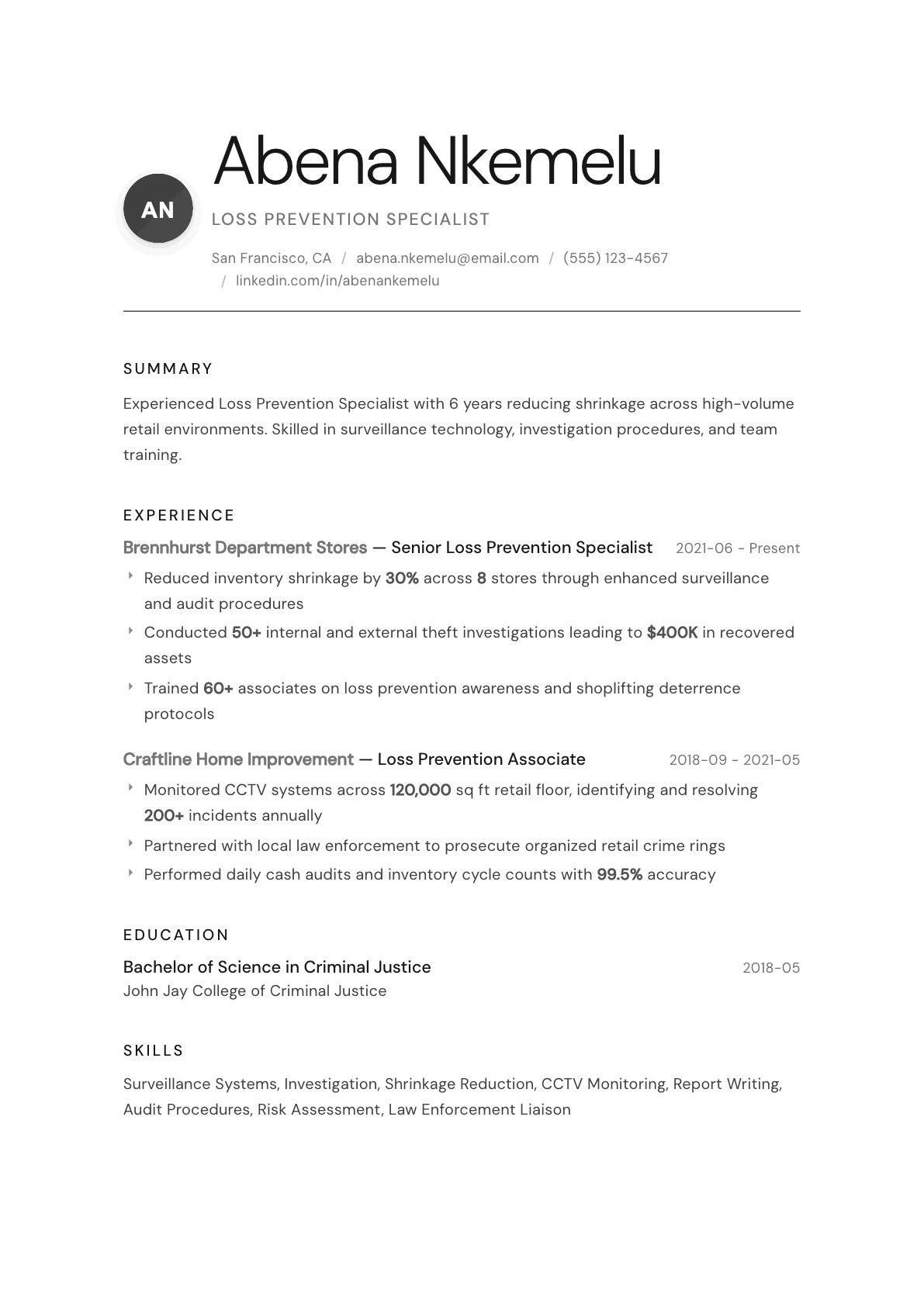
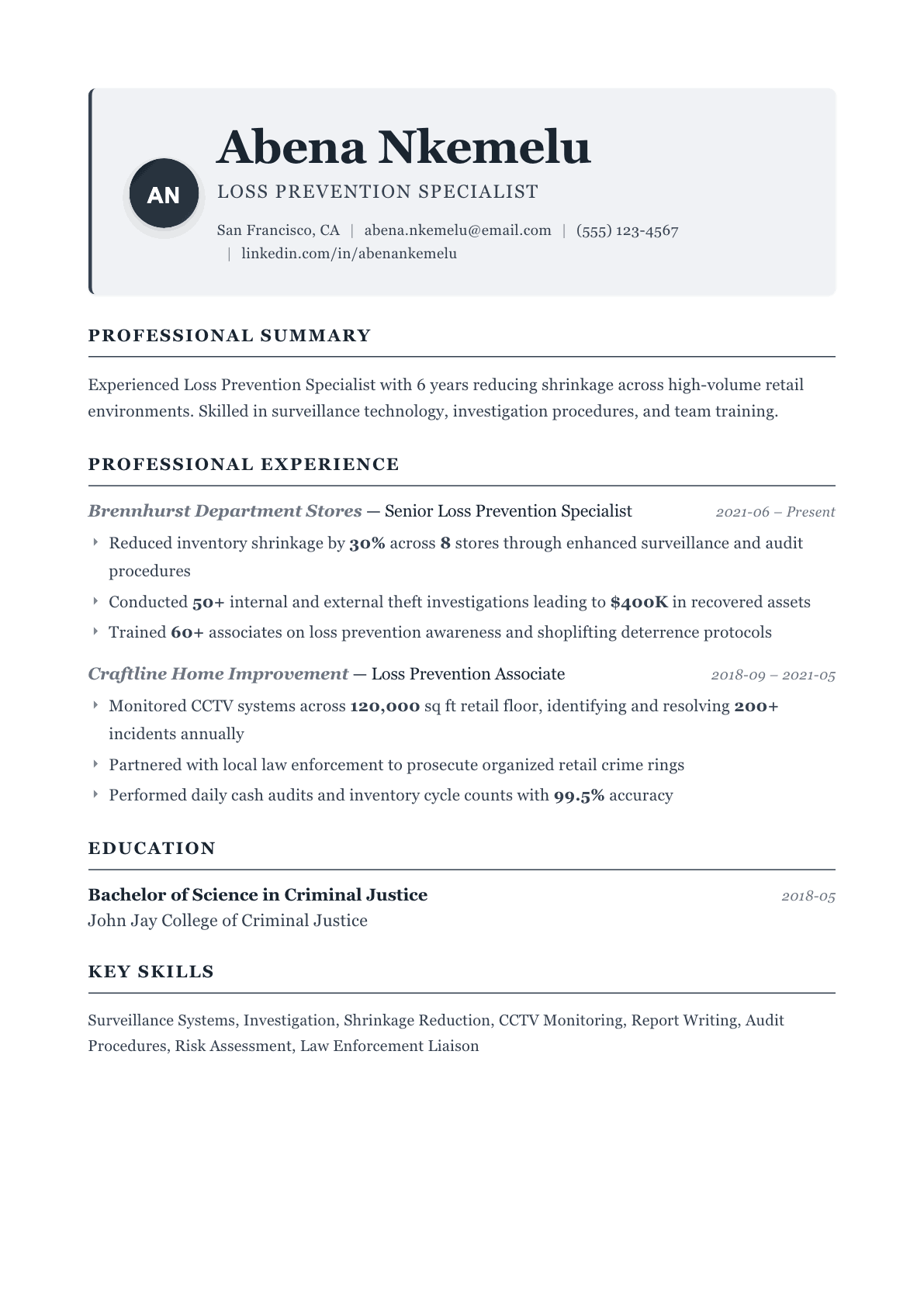
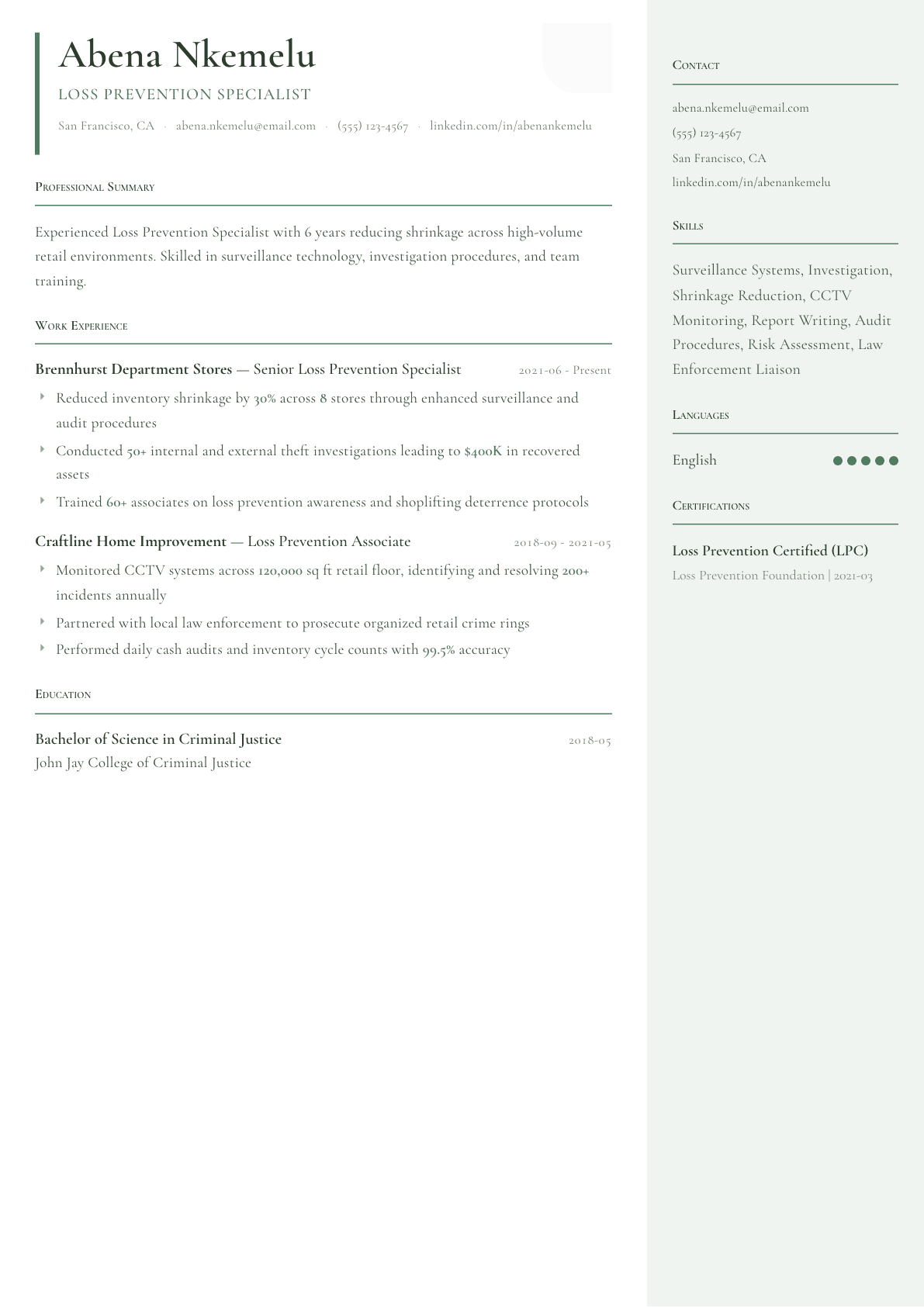
The same loss prevention specialist content laid out in three CVBooster templates, so you can see what the finished document looks like before you write a word.
Example Loss Prevention Specialist summary
Loss prevention specialist, 6 years, covering eight stores and cutting shrink 30% through audit routines and camera coverage changes. Has closed more than 50 internal and external investigations, recovered $400K in assets, and works cases with local police on organized retail crime.
Skills to list on a Loss Prevention Specialist resume
- Shrinkage Reduction
- Internal Investigations
- CCTV & Surveillance
- Audit & Compliance
- Risk Assessment
- Report Writing
- Law Enforcement Coordination
- Organized Retail Crime
- Employee Training
- Inventory Control
What actually gets this resume read
- Quantify shrinkage reduction and asset recovery in dollar amounts.
- Highlight investigation experience and collaboration with law enforcement.
- Include surveillance and security technology proficiencies.
- Showcase training programs you developed or delivered for store associates.
How to write a loss prevention specialist resume
A loss prevention specialist resume is read by an asset protection manager who has seen every version of this document and is filtering for two things: judgment and documentation. Judgment because a bad apprehension costs a company far more than the merchandise recovered. Documentation because every case you touch may end up in a police report, a civil demand or a wrongful detention claim, and the quality of your report is the company's defense.
The operational picture matters too. Store format and volume, whether the site is a soft goods store, a big box, a distribution center or a multi-site district, whether you worked overt or covert, what camera and exception reporting systems you used, and how your work split between external theft, internal investigations, operational shrink and safety. Those details tell a manager what kind of role you can step into.
This guide covers the section order asset protection teams expect, how to write case work without overstating your authority, summaries for an associate, a specialist and a multi-store investigator, before and after bullets, and the questions people ask when moving from security or law enforcement into retail loss prevention.
Format: scope line, then case work
One page under five years, two after that. Reverse chronological, single column. Under each title, put a scope line: store format and square footage or the number of sites, annual sales volume if you know it, whether the posture was overt or covert, your reporting line into the store or into a separate asset protection chain, and the case types you handled.
Independent reporting matters. A specialist who reports to a district asset protection manager rather than the store manager operates with more independence on internal cases, and hiring managers read that structural detail as a signal about the kind of investigations you have run.
- Header: name, city and state, phone, email, and any state guard or investigator license with its number.
- Section order: summary, licenses and certifications, experience with scope lines, systems and technology, training delivered, education.
- Separate external theft, internal investigations, operational shrink and safety, because employers weight them differently.
Writing case work without overstating it
Describe cases in the order a manager evaluates them: how the case was generated, what you did to build it, and how it closed. Case generation is the part that shows skill, whether it came from exception reporting on refunds and voids, from an anonymous tip line, from camera review of a known method, or from an inventory variance in one category. Anyone can watch a monitor. Building a case from data is the differentiator.
On internal cases, be precise about your role. Interview and interrogation training is real training with a real methodology, and a candidate who says they conducted loss prevention interviews under company policy with a witness present is describing something checkable. A candidate who implies they extracted confessions is describing a liability. State whether you were certified, who trained you, and whether a district manager or human resources partner participated.
Recovery figures are fine but they are not the whole story. A restitution amount, cases referred for prosecution, court appearances made, and civil recovery filed all show the case survived after you closed it. So does a bullet about a case you declined to pursue because the evidence was thin, which is the single most reassuring sentence an asset protection manager can read.
Shrink, audits and the operational half of the job
Most shrink is not dramatic theft. It is receiving errors, markdown abuse, damaged goods handling, missing paperwork, price accuracy problems and poor cycle count discipline. A specialist who has worked those causes is more valuable than one who has only made apprehensions, so give them their own bullets: operational audits performed, findings and the corrective actions that followed, and the shrink result at the next physical inventory.
Add the compliance and safety work if you carried it: incident reporting, slip and fall documentation, emergency procedures, key and alarm control, opening and closing standards, and vendor and delivery door controls. In many chains asset protection owns the safety program, and postings mention it explicitly.
Systems, awareness training and organized retail crime
Name the technology. Camera and video management platforms, electronic article surveillance systems and the tag types you handled, point of sale exception reporting tools, case management systems, alarm and access control platforms, and any analytics you used to prioritize which store or register to look at. Recruiters filter on these names and generalists rarely include them.
Awareness training and organized retail crime work both belong here. Say how many associates you trained and on what: challenge and greet, ticket switching, refund fraud, and how to report without confronting. On organized crime, describe your contribution honestly, whether you supplied footage and case packets to a corporate investigator, participated in a regional retail crime association, or worked directly with a police detective on a linked series.
Keywords the screener is scanning for
Asset protection postings repeat a defined vocabulary: shrink reduction, external theft, internal investigations, exception based reporting, closed circuit television, electronic article surveillance, apprehension, interview and interrogation, physical inventory, operational audit, safety compliance and organized retail crime. Use the ones that describe your actual work.
Titles vary by chain. Asset protection specialist, loss prevention officer, market investigator, safety and shrink coordinator and multi-unit investigator are largely the same family. Mirror the exact title from the posting in your summary line so a keyword screen does not sort you out over vocabulary.
Loss Prevention Specialist resume summary examples
Loss prevention associate
Loss Prevention Associate with 18 months on a big box sales floor covering camera review, electronic article surveillance response and door coverage. Trained on the company apprehension policy, wrote 60 incident reports with no procedural rejections, and holds an active state guard registration.
Loss prevention specialist
Loss Prevention Specialist at a high-volume soft goods store, generating cases from refund and void exception reporting rather than floor observation alone. Closed 41 external and 6 internal cases in a year, with restitution recovered and shrink cut from 2.1% to 1.3% at physical inventory.
Market investigator
Market Investigator covering 9 stores across two markets, leading internal investigations, operational audits and awareness training for more than 400 associates. Interview certified, supports organized retail crime cases with local detectives, and reports into the district asset protection chain.
Work experience bullets: before and after
Before: Monitored CCTV cameras and watched for shoplifters.
After: Ran camera review against known theft methods on high-loss categories and generated 41 external cases from refund and void exception reporting rather than floor observation alone.
Case generation from data is the skill an asset protection manager is hiring for; watching monitors is the baseline.
Before: Conducted internal theft investigations.
After: Built 6 internal cases from point of sale exception data and camera corroboration, conducted policy-compliant interviews with a witness present, and documented each file to the standard required for prosecution referral.
Naming the evidence trail, the witness and the documentation standard shows judgment rather than aggression.
Before: Helped reduce shrinkage at the store.
After: Cut shrink from 2.1% to 1.3% between physical inventories by auditing receiving paperwork, tightening markdown and damage procedures, and adding weekly cycle counts on the three highest loss categories.
The operational causes and the inventory result show you worked the shrink number, not just the theft cases.
Before: Trained employees about loss prevention.
After: Delivered awareness training to more than 400 associates on challenge and greet, ticket switching and refund fraud, and rebuilt the new hire module so reporting a concern never requires confronting a customer.
Scale, curriculum and a safety-first policy point make training a program rather than a slide deck.
Before: Worked with police on theft cases.
After: Assembled case packets with footage, transaction data and incident reports for 12 organized retail crime referrals, appeared in court twice, and coordinated with a regional retail crime association on a linked booster series.
Court appearances and case packet quality prove the work held up outside the store.
Hard skills
- Closed circuit television and video management systems
- Exception based reporting
- Electronic article surveillance
- Case management and report writing
- Internal investigation procedure
- Interview and interrogation methodology
- Physical inventory and cycle counts
- Operational and compliance audits
- Alarm and access control systems
- Evidence handling and chain of custody
- Organized retail crime case support
- Safety and incident documentation
Soft skills
- Judgment under pressure
- Objectivity in investigations
- Discretion and confidentiality
- De-escalation
- Precise written reporting
- Working with law enforcement
Certifications worth listing
- Loss Prevention Qualified (LPQ) (Loss Prevention Foundation)
- Loss Prevention Certified (LPC) (Loss Prevention Foundation)
- Certified Forensic Interviewer (CFI) (International Association of Interviewers)
- Certified Protection Professional (CPP) (ASIS International)
- Professional Certified Investigator (PCI) (ASIS International)
- Wicklander-Zulawski Interview and Interrogation Certification (Wicklander-Zulawski and Associates)
Mistakes that cost loss prevention specialist candidates the interview
- Writing apprehension counts as the whole resume, when operational shrink and audit work is the larger part of most asset protection jobs.
- Overstating your role in internal cases, which reads as a liability rather than as experience to anyone who has managed the function.
- Leaving out the exception reporting and camera platforms by name, the details recruiters actually filter on.
- Never mentioning report quality or how many files survived legal or prosecution review.
- Omitting the state guard or investigator license and number where the job requires one.
- Ignoring safety and incident work, which asset protection owns in many chains and postings list explicitly.
- Describing store coverage without format, volume or site count, so the reader cannot size the environment you worked.
Loss Prevention Specialist resume questions
Should I put apprehension numbers on a loss prevention resume?
Include them, but pair them with case quality: how cases were generated, restitution or prosecution outcomes, and whether any file was rejected on procedure. A high apprehension count with no documentation record can read as risk rather than performance.
How do I move from security guard or police work into retail loss prevention?
Translate the transferable half: report writing, evidence handling, statement taking, court testimony and de-escalation. Then close the retail gap by naming the systems you have learned, exception reporting concepts, shrink causes and the company policy limits on detention.
Do I need an interview certification?
It is not universally required, but for internal investigation roles it is frequently expected because it demonstrates a structured, policy-compliant methodology. If you have not taken it, say what training and policy you followed instead and who supervised your interviews.
What technology should I list on the resume?
The video management platform, the exception based reporting tool, the electronic article surveillance system and tag types, the case management system, and any alarm or access control platform. Name the products, since a screener matching a stack will search for them directly.
How do I show results if my store had no big cases?
Use the operational side. Audit findings and the corrective actions taken, receiving and markdown accuracy, cycle count discipline, awareness training delivered and the shrink result at physical inventory all demonstrate impact without a single apprehension.