Inventory Specialist Resume Examples: what gets the call
Build an Inventory Specialist Resume That Proves Accuracy
By Mustafa Tarabya, founder of CVBooster · Published · Updated
Inventory specialist resume examples, cycle count and WMS keywords, and a guide to writing bullets that prove your count accuracy.
Sample resumes for a inventory specialist
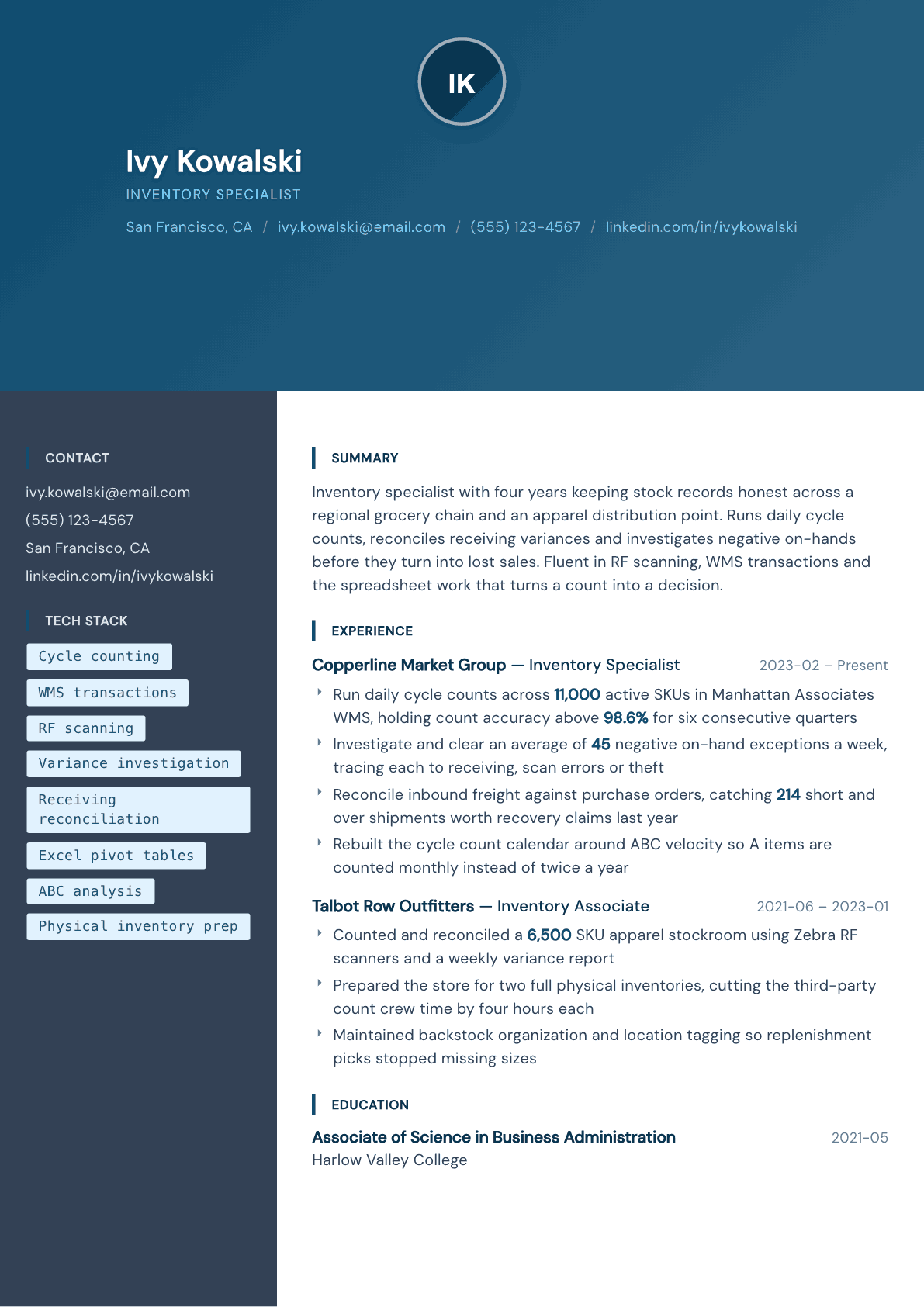
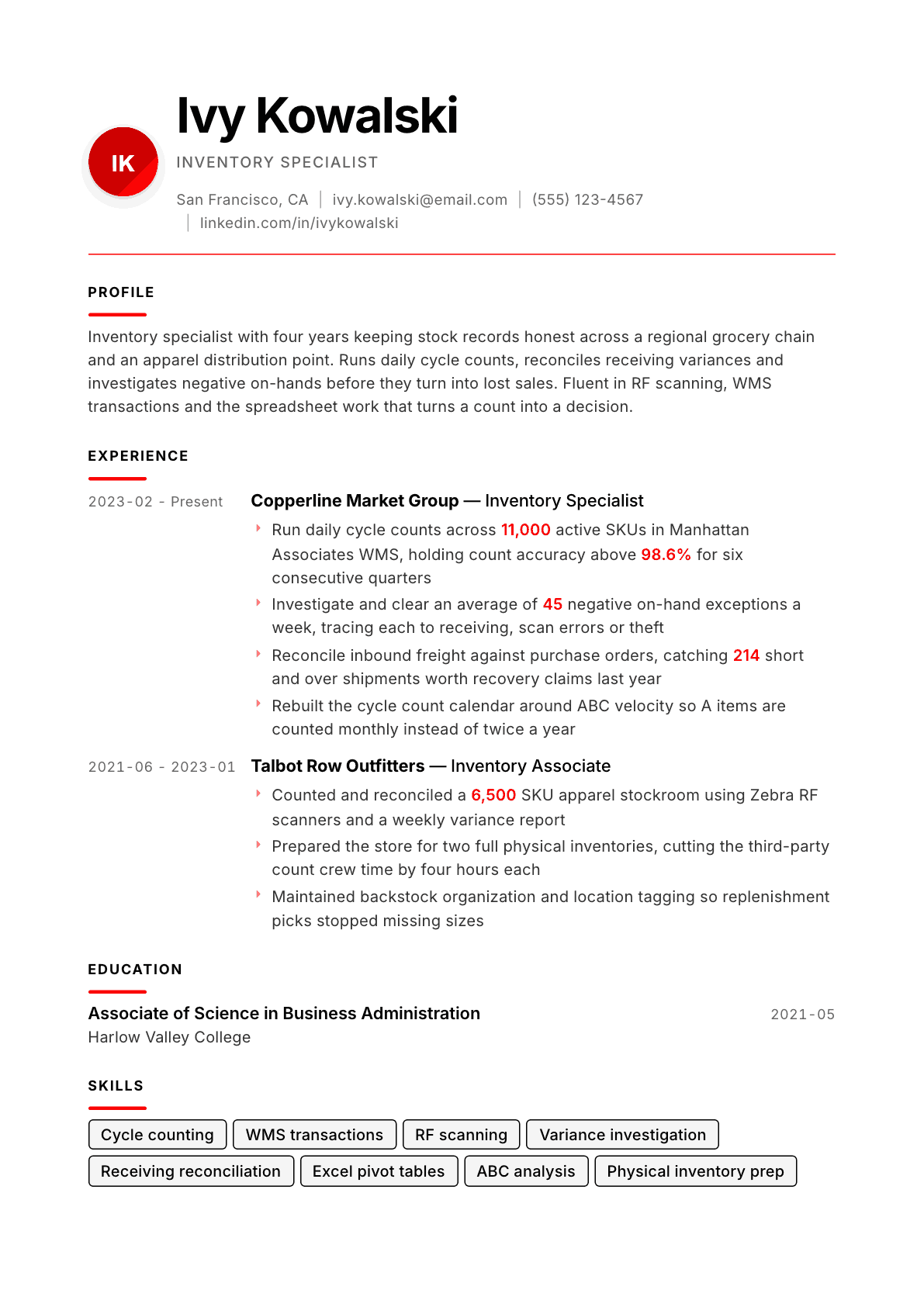
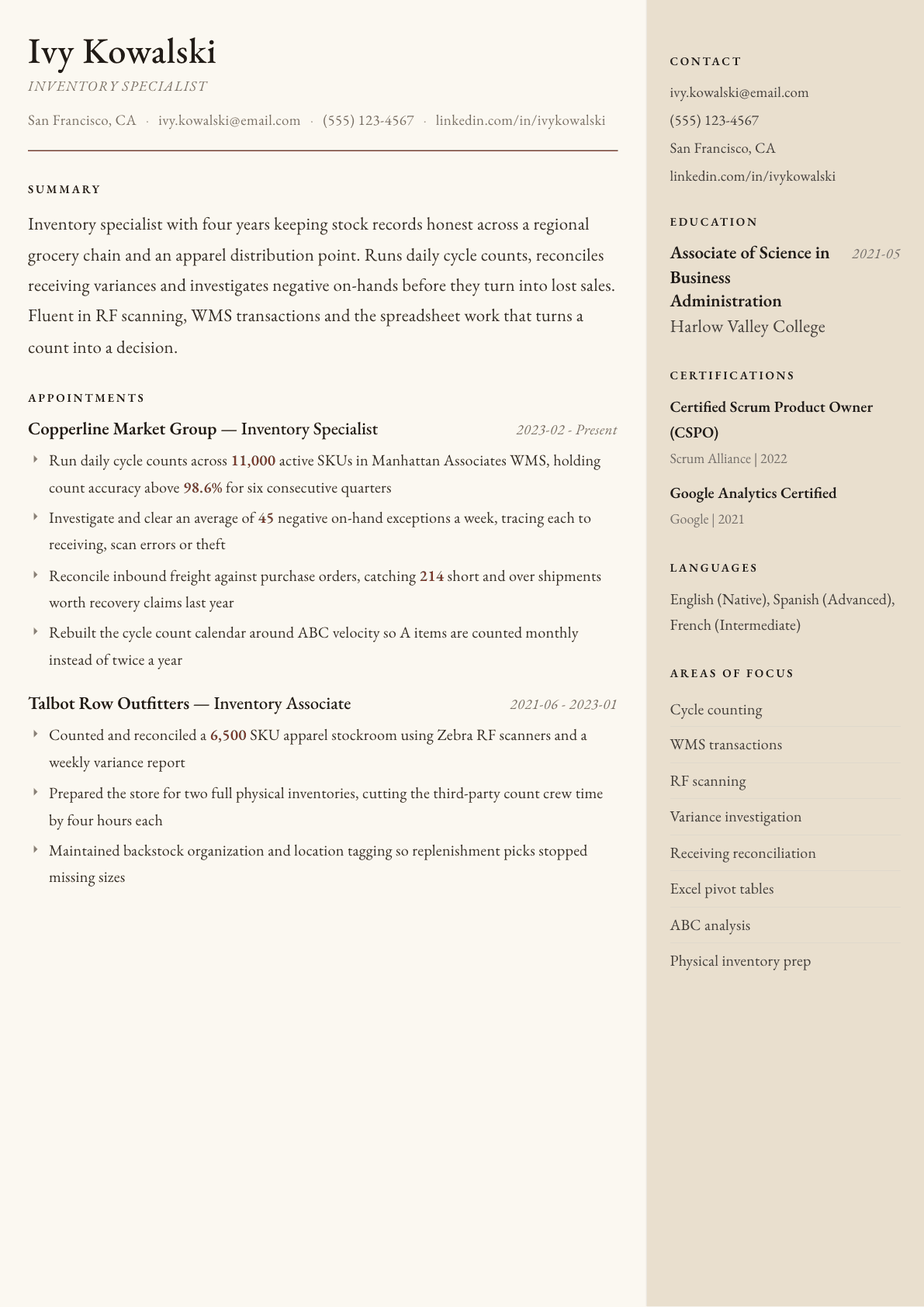
The same inventory specialist content laid out in three CVBooster templates, so you can see what the finished document looks like before you write a word.
Example Inventory Specialist summary
Inventory specialist with four years of cycle counting, variance investigation and receiving reconciliation across grocery and apparel stock. Holds count accuracy above 98% on an eleven thousand SKU catalog, clears negative on-hand exceptions weekly, and rebuilt a count calendar around item velocity. Comfortable in warehouse management systems, RF scanners and the spreadsheets that explain a variance to a district manager.
Skills to list on a Inventory Specialist resume
- Cycle counting
- Inventory reconciliation
- Warehouse management systems
- RF barcode scanning
- Variance analysis
- Receiving and put-away
- ABC classification
- Physical inventory
- Stock replenishment
- Purchase order matching
- Excel and pivot tables
- Negative on-hand research
- Location and bin accuracy
- Damage and salvage processing
What actually gets this resume read
- Put your count accuracy figure in the first bullet of your most recent job, with the SKU count behind it.
- Name the inventory system by name, because postings filter on the exact platform the store already runs.
- Show the investigation, not just the count: where variances came from and what you changed to stop them.
- Describe the scale you handled in SKUs, locations or pallet positions so the reader can size the job.
- Include physical inventory preparation if you have it, since that season is when most of these roles get filled.
- Keep the resume to one page and lead with numbers, because this job is judged on precision above all else.
How to write a inventory specialist resume
An inventory specialist resume is graded on one thing before anything else: whether the reader believes your numbers. The person hiring is usually an inventory or operations manager who spends part of every month explaining a variance to someone above them, and they are looking for the candidate who will shrink the size of that conversation.
That belief comes from specificity. Count accuracy alone means nothing without the catalog size behind it. A claim of reconciling receipts means nothing without the system where the reconciliation happened. The strongest resumes in this stack read like a short operations report, not a list of duties.
Below is the section order these hiring managers scan, three summaries covering a first stockroom job through a lead role, before and after bullets taken from the way counts really get described, and answers to the questions that come up when specialists write their first resume.
Format: one page, numbers on the left edge of every bullet
Reverse chronological, one column, plain headings. Distribution and store systems groups often screen with an applicant tracking system that reads a two column layout out of order, and this is a role where mangled dates look like a red flag rather than a formatting glitch.
Keep the whole file to a page unless you have supervised. The job is judged on precision, so a tight document is itself a small piece of evidence. Put the systems you know into a named skills block rather than sprinkling them through paragraphs where a keyword search will miss them.
- Header: name, city and state, phone, email, and any forklift or equipment certification.
- Section order: summary, systems and tools, experience, education, certifications.
- Lead each job with a scope line: SKU count, locations, and whether the site is a store, stockroom or distribution point.
Summary: catalog size, accuracy, and the system you live in
Three lines that answer three questions. How large a catalog have you controlled, what accuracy did you hold it at, and which platform did you do it in. A specialist who has held count accuracy above ninety eight percentage points on a catalog of several thousand items is immediately credible, while a specialist who is detail oriented is indistinguishable from every other file.
If you are moving from a general stock associate role, say so and name the counting work you already own. Receiving, put away, backstock organization and daily counts are all real inventory experience, and hiding them behind the title stock associate wastes the strongest thing on your resume.
Experience: count, investigate, correct
Every bullet should sit in one of three buckets: counting, investigating a variance, or changing something so the variance stops. A resume made only of counting bullets reads as a body that walks aisles. The investigation and correction bullets are what turn the reader toward an interview.
For counting, give the method and the cadence. Cycle counts by velocity class, wall to wall counts, blind counts, or a full physical inventory with a third party crew are different disciplines, and the posting usually names the one it wants. Say how many items or locations you touched in a normal week.
For investigation, name the causes you traced. Receiving errors, scan failures, unrecorded transfers, damaged goods never coded out, and theft are the usual suspects, and a specialist who can tell them apart is worth more than one who simply adjusts and moves on. For correction, describe the process you changed: a count calendar, a receiving check, a bin relabeling, a rule about who may adjust.
Systems and equipment: exact names only
Write the actual platform. SAP, Oracle, NetSuite, Manhattan Associates, Fishbowl, Infor and the store specific systems all appear in postings by name, and the screen is often a literal keyword match. Add the handheld hardware, since Zebra and Honeywell RF scanners come with their own transaction habits.
Spreadsheet skill deserves a line of its own. Pivot tables, lookup formulas and a habit of reconciling two exports against each other are the daily tools of the job, and a specialist who can build the variance report rather than wait for it is a different candidate entirely.
Keywords a screener searches on
The recurring vocabulary is narrow: cycle count, inventory accuracy, variance, reconciliation, on hand, adjustment, receiving, put away, replenishment, ABC classification and physical inventory. Mirror the posting language once in the summary and once inside a bullet that carries a fact. Do not repeat the same phrase in four bullets, because the human reading right after the software will notice the padding.
Inventory Specialist resume summary examples
Coming from stock work
Stock associate moving into inventory control, with two years of receiving, put away and weekly counts across a 6,500 item apparel stockroom. Trained on RF scanning and backstock location tagging, and used to reconciling a packing list against a purchase order before anything reaches a shelf.
Four years in
Inventory specialist with four years of daily cycle counting in a warehouse management system, holding accuracy above 98.6% on an active catalog of eleven thousand items. Clears roughly 45 negative on hand exceptions a week and traces each to receiving, scan error or theft rather than adjusting blind.
Lead specialist
Lead inventory specialist supporting four sites, responsible for the count calendar, adjustment approvals and the weekly variance package sent to operations. Rebuilt counting around item velocity so fast movers are counted monthly, which retired one of two annual wall to wall counts.
Work experience bullets: before and after
Before: Performed inventory counts on a regular basis.
After: Ran daily cycle counts across an active catalog of eleven thousand items in a warehouse management system, holding count accuracy above 98.6% for six consecutive quarters.
Catalog size, cadence and a sustained accuracy figure make the claim checkable instead of decorative.
Before: Fixed inventory discrepancies in the system.
After: Cleared an average of 45 negative on hand exceptions a week, tracing each back to a receiving error, a scan failure or a suspected theft before posting any adjustment.
Showing the root cause work proves you correct the process, not just the number on the screen.
Before: Received deliveries and checked paperwork.
After: Reconciled inbound freight against purchase orders line by line, catching 214 short and over receipts in a year and turning each into a supplier claim.
The recovery outcome converts a routine receiving task into money the employer did not lose.
Before: Helped with the annual physical inventory.
After: Prepared the site for two full physical counts by pre-labeling zones and staging backstock, cutting the third party crew time by four hours each event.
A time saving with the preparation behind it shows planning rather than attendance.
Before: Improved how we counted inventory.
After: Rebuilt the cycle count calendar around velocity classes so top movers are counted monthly instead of twice a year, which surfaced variances weeks earlier.
Naming the method and the effect turns a vague improvement into a design decision a manager can evaluate.
Hard skills
- Cycle counting
- Inventory reconciliation
- Warehouse management systems
- RF barcode scanning
- Variance root cause analysis
- Receiving and put away
- ABC velocity classification
- Physical inventory preparation
- Purchase order matching
- Excel pivot tables and lookups
- Bin and location accuracy
- Damage and salvage coding
Soft skills
- Methodical follow through
- Written variance explanations
- Working across receiving and sales floor teams
- Comfort correcting other people quietly
- Time discipline on a count calendar
Certifications worth listing
- Certified in Planning and Inventory Management (CPIM) (Association for Supply Chain Management)
- Certified Supply Chain Professional (CSCP) (Association for Supply Chain Management)
- Certified Logistics Associate (CLA) (Manufacturing Skill Standards Council)
- Powered Industrial Truck Operator Training (Occupational Safety and Health Administration)
Mistakes that cost inventory specialist candidates the interview
- Giving an accuracy figure with no catalog size, which lets a reader assume you counted a very small room.
- Writing counted inventory as a duty when the hiring problem is why the count keeps disagreeing with the system.
- Leaving the platform name out, since many of these postings screen on the exact system already installed.
- Listing every adjustment you posted without a single sentence about what caused the variances.
- Burying forklift or equipment certification at the bottom when it decides whether you can work the site at all.
- Using two columns and icons, which scrambles dates in the parsers most distribution employers run.
Inventory Specialist resume questions
What accuracy number should I put on an inventory specialist resume?
Use the one your reports actually showed, and pair it with the catalog size and the period. If your site never published a figure, describe the count volume instead, such as items counted per week, and the variance trend you saw over a season.
Do I need a CPIM certification to get hired?
No for most specialist openings, where system experience and a clean count record matter more. It becomes valuable when you want to move toward planning or an inventory manager role, because it signals you understand demand and replenishment as well as counting.
How do I show inventory experience if my title was stock associate?
Keep the real title, then let the bullets carry the inventory work: receiving reconciliation, cycle counts, backstock location tagging, and any variance research you did. Titles are checked in references, so change the emphasis rather than the words.
Should I list Excel skills separately from the inventory system?
Yes. The system holds the data, but the analysis usually happens in a spreadsheet, so naming pivot tables and lookup formulas tells a manager you can produce the variance report yourself instead of waiting for someone in the office to build it.
Is warehouse experience transferable to a retail inventory job?
Very much so, since the counting discipline is identical. Translate the vocabulary as you write: pallet positions become backstock locations, put away becomes replenishment, and pick accuracy becomes on shelf availability, so a store manager recognizes the work immediately.