Order Processing Specialist Resume Examples: free score
Build an Order Processing Specialist Resume That Shows Accuracy
By Mustafa Tarabya, founder of CVBooster · Published · Updated
Order processing specialist resume examples with ERP, EDI and order accuracy bullets, the keywords postings use, and a full writing guide.
Sample resumes for a order processing specialist
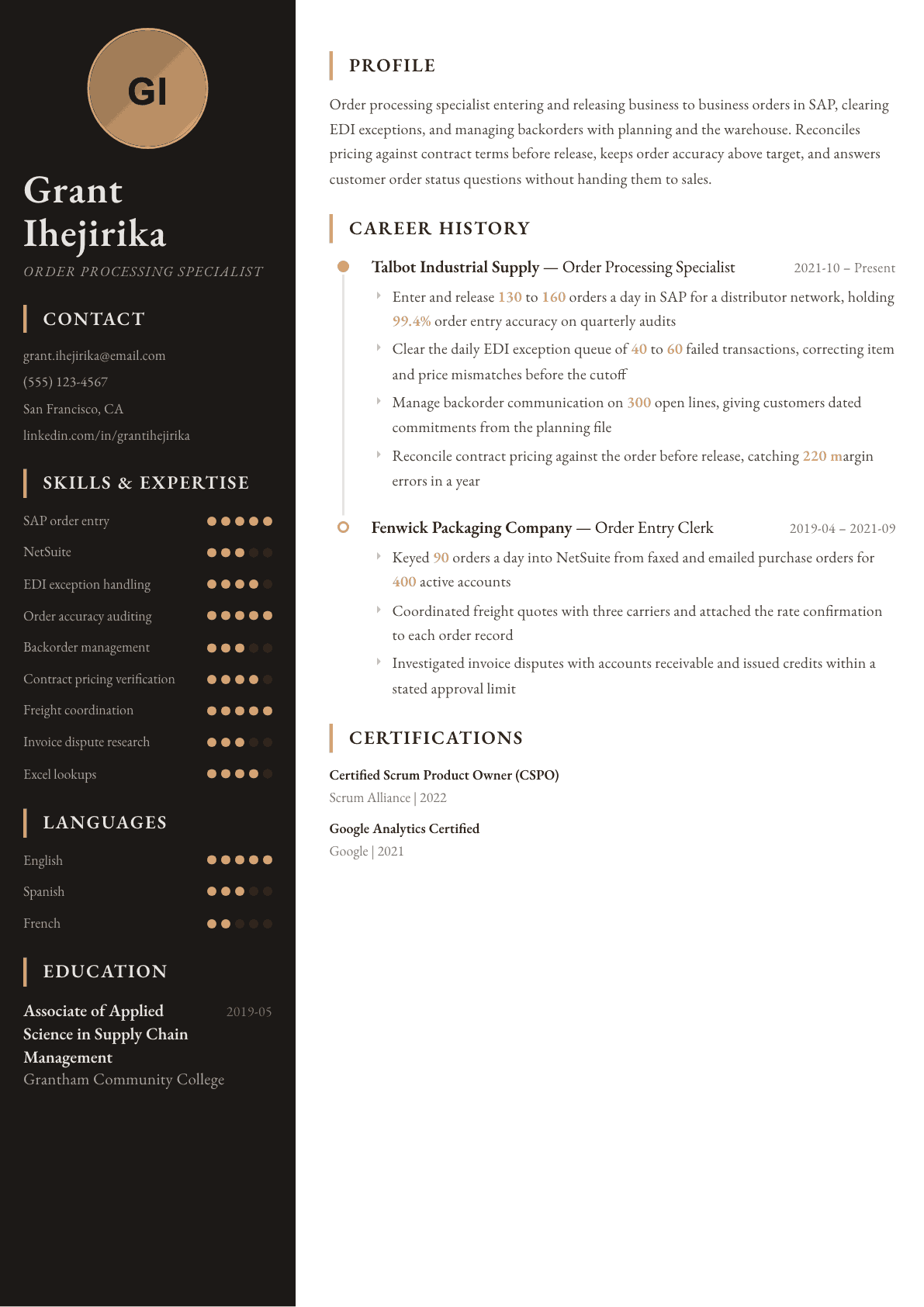
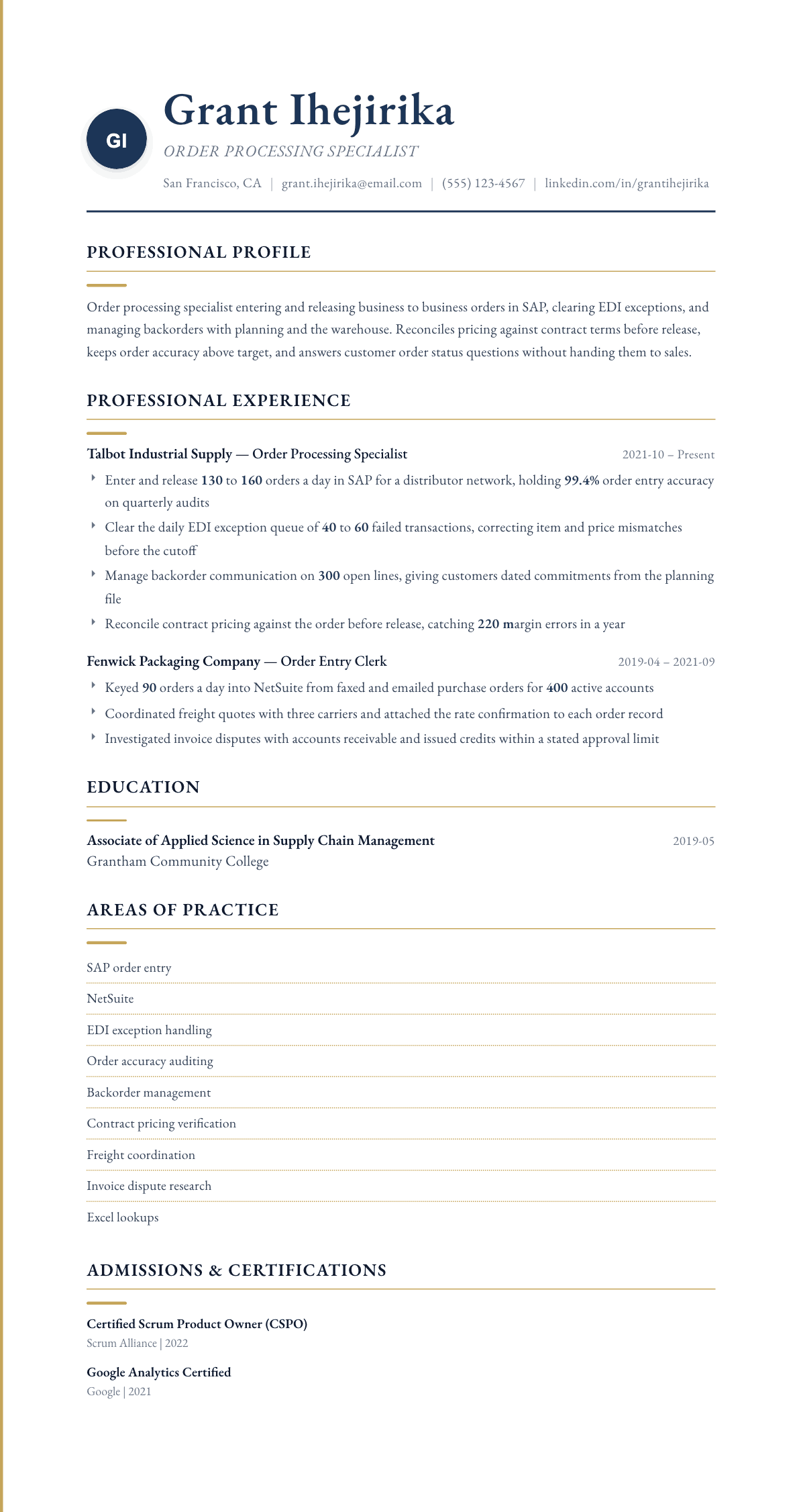
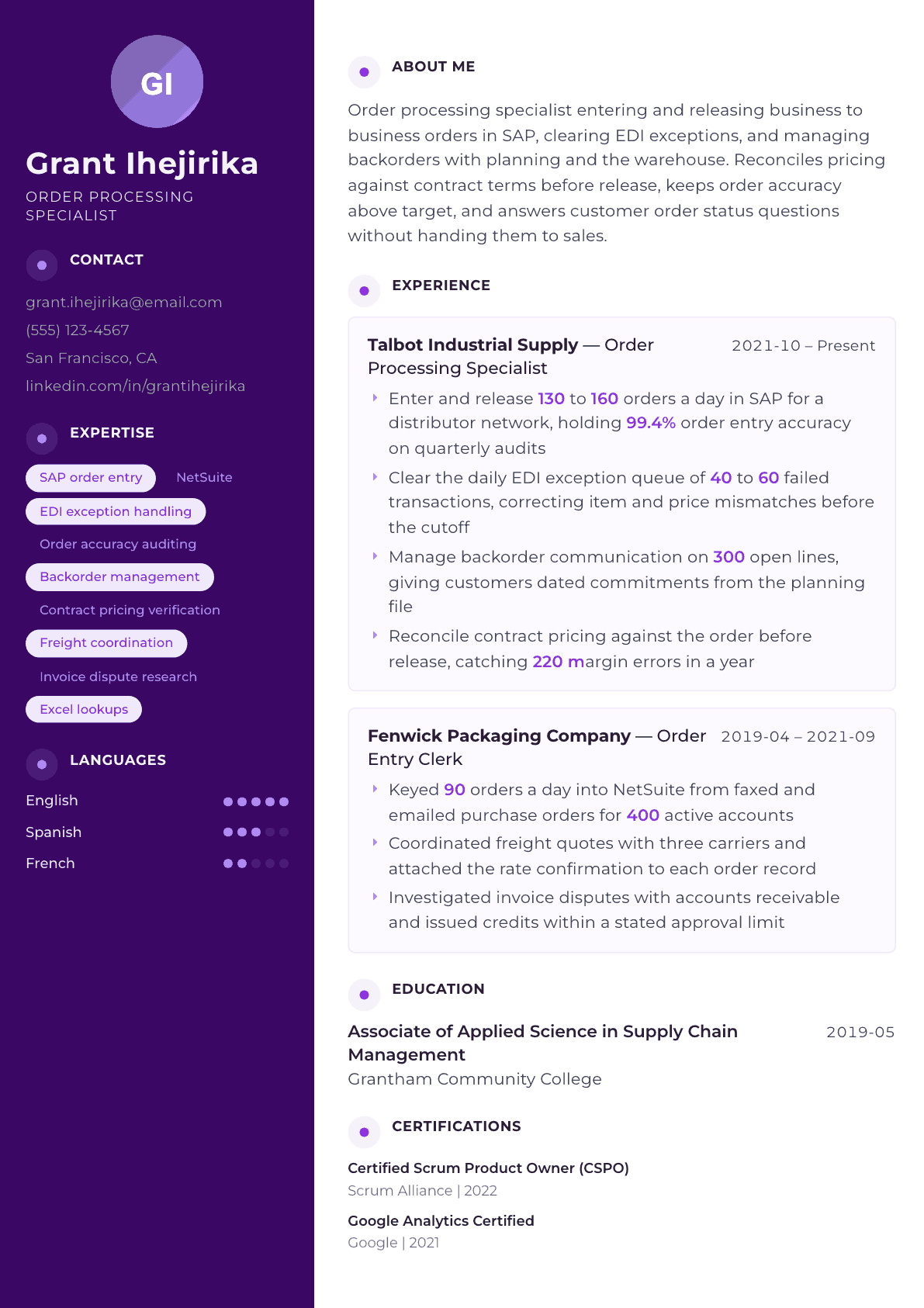
The same order processing specialist content laid out in three CVBooster templates, so you can see what the finished document looks like before you write a word.
Example Order Processing Specialist summary
Order processing specialist entering 130 to 160 business orders a day in SAP with 99.4% accuracy on quarterly audits. Clears a daily EDI exception queue, reconciles contract pricing before release, and caught 220 margin errors in a year. Manages backorder commitments across 300 open lines with planning and the warehouse, and answers customer order status directly. Seeking an order management analyst role.
Skills to list on a Order Processing Specialist resume
- Order processing
- Order entry
- SAP
- NetSuite
- Oracle ERP
- EDI transactions
- Backorder management
- Contract pricing verification
- Order accuracy
- Freight coordination
- Invoice reconciliation
- Credit holds
- Customer order status
- Excel lookups
- Inventory allocation
What actually gets this resume read
- Give daily order volume and an accuracy figure together, because accuracy without volume means very little.
- Name the ERP by product, whether SAP, Oracle, NetSuite, Dynamics 365 or a proprietary order system.
- Say whether you handled EDI, since electronic order flow and manual keying are different skill sets.
- Show what you caught: pricing errors, wrong ship-to addresses, duplicate purchase orders, credit holds.
- Describe how you worked with the warehouse and planning on backorders, not just that backorders existed.
- Include the credit or return approval limit you held, which signals how much judgment the role carried.
How to write a order processing specialist resume
An order processing specialist sits at the point where a customer commitment becomes a warehouse instruction, and everything downstream depends on the keystroke being right. The supervisor screening this resume is looking for two numbers together: how many orders a day you released and how accurate they were on audit. Either one alone is unreadable, because high volume with no accuracy figure sounds careless and high accuracy on a light queue sounds easy.
The second thing she checks is whether you worked electronic order flow or manual entry. Clearing an electronic data interchange exception queue before the daily cutoff is a different skill from keying purchase orders that arrived by email, and a distributor running most of its volume through electronic transactions will filter for it by name.
This guide covers the section order for an order management resume, how to write accuracy and exception work so a supervisor can trust it, three summaries from order entry clerk through senior specialist, before and after bullets, and the questions specialists ask when they want the next role to be order management or planning.
Format: one page, the system named before the metrics
One page, reverse chronological, plain single column. These roles are filtered by an applicant tracking system on the name of the enterprise resource planning platform more than on anything else, so the software has to appear in the skills section and again inside a bullet where it is doing real work.
Under each title, give the operating context in one line: the industry, the customer type and the channel mix. A distributor network taking orders through electronic transactions is a different environment from a manufacturer taking emailed purchase orders from four hundred accounts, and the bullets underneath read differently in each.
- Section order: summary, order systems and EDI skills, experience, education, certifications.
- Name the enterprise resource planning platform exactly: SAP, Oracle, NetSuite, Dynamics 365 or the proprietary system.
- Give order volume and accuracy in the same bullet, with the audit basis behind the accuracy figure.
- Say whether volume arrived by electronic transaction, portal, email or phone.
Summary: volume, accuracy, exception work, authority
Four lines. Daily order volume and the platform, then the accuracy figure and how it was measured, then the exception work you owned, then the approval limit you held. That last item is the one most order processing resumes leave out, and it is the clearest signal of how much judgment the last employer trusted you with.
If you are moving from data entry or general administration, translate honestly. Keying volume, error rate, working from source documents and reconciling against a second system are all real order processing competencies under different names, and stating them plainly beats claiming enterprise experience you do not have.
Experience: entry, exceptions, pricing, backorders, customers
Start with entry and accuracy. Say how many orders a day you entered and released, in which system, and what your accuracy was on the audit your employer actually ran. Quarterly audits, a sampling process or a monthly error report all count, and naming the basis is what stops the number from reading as a guess.
The exception queue is the second bullet and it is where the specialists separate from the clerks. Clearing forty to sixty failed electronic transactions a day means resolving item number mismatches, price discrepancies, unit of measure errors and invalid ship-to addresses before the cutoff. Give the daily count and name the failure types, because that is the vocabulary an order management supervisor uses.
Pricing verification comes next. Reconciling an order against contract terms before release protects margin, and a specialist who caught a meaningful number of pricing errors over a year has a bullet that finance will notice. Say what the errors were: expired contract pricing, the wrong customer tier, a missing freight term, a rebate that should have applied.
Then backorders and the customer-facing half. Managing open lines with planning and the warehouse, giving customers dated commitments from the planning file rather than a vague apology, and answering order status directly instead of routing it to a sales representative. That last point matters more than it looks, because it is the difference between a processing seat and a customer service seat that happens to key orders.
Systems and skills: the stack an order desk runs on
Name the enterprise resource planning platform, the electronic data interchange tool or value added network if you used one, the customer relationship platform where order inquiries landed, and the spreadsheet work you actually do. Lookup functions, pivot tables and reconciliation against an export are real order desk skills and they belong on the page in those words.
After the systems, list the order desk vocabulary a posting will reuse: order entry, order accuracy, backorder management, contract pricing verification, credit hold release, freight coordination, inventory allocation, purchase order processing, invoice reconciliation. Where you held a credit or return approval limit, say so in words rather than a figure if the amount was confidential.
Education, credentials and the move toward order management
An associate degree in supply chain or business is common and sits in two lines at the bottom. Supply chain credentials carry real weight here because they signal you understand what happens after release, and an order desk that reports into operations rather than sales will read them closely.
If the target is an order management analyst, planning or customer supply chain role, reorder the bullets toward analysis. Lead with the pricing errors you caught, the exception patterns you traced to a root cause, and any report you built on backorder aging or order defect types. Keying volume stays on the page, but it stops being the first thing the reader sees.
Order Processing Specialist resume summary examples
Order entry clerk
Order entry clerk keying 90 orders a day into NetSuite from emailed and faxed purchase orders for 400 active accounts. Coordinates freight quotes with three carriers, attaches rate confirmations to every order record, and investigates invoice disputes with accounts receivable within a set credit approval limit.
Four years on the order desk
Order processing specialist entering and releasing 130 to 160 orders a day in SAP for a distributor network, holding 99.4% entry accuracy on quarterly audits. Clears a daily electronic exception queue of 40 to 60 failed transactions, reconciles contract pricing before release, and manages backorder commitments across 300 open lines.
Senior specialist and order desk lead
Senior order processing specialist leading a four person order desk for an industrial distributor, owning the exception queue standard and the pricing verification checklist. Caught 220 margin errors in a year, cut order defect rework by tracing failures to three recurring item master issues, and trains new specialists on the platform.
Work experience bullets: before and after
Before: Entered customer orders into the system daily.
After: Entered and released 130 to 160 orders a day in SAP for a distributor network, holding 99.4% order entry accuracy across quarterly audits.
Volume and accuracy together, with the audit basis named, is the pairing an order desk supervisor screens on.
Before: Fixed errors in electronic orders.
After: Cleared a daily electronic data interchange exception queue of 40 to 60 failed transactions, correcting item number, unit of measure and price mismatches before the daily freight cutoff.
Naming the failure types and the cutoff shows you understand the exception queue rather than only that it existed.
Before: Checked pricing on orders before they shipped.
After: Reconciled contract pricing against every order before release, catching 220 margin errors in a year from expired agreements, wrong customer tiers and missing freight terms.
The error categories and the annual count turn a routine check into a margin protection result finance can see.
Before: Communicated with customers about backorders.
After: Managed backorder communication across 300 open lines, giving customers dated commitments pulled from the planning file rather than a general apology and a callback.
A dated commitment from a named source shows coordination with planning instead of a customer service reflex.
Before: Worked with the warehouse and the freight desk.
After: Coordinated freight quotes with three carriers and attached the rate confirmation to each order record, resolving 12 shipment discrepancies a month with the warehouse before invoicing.
Naming the carriers, the record habit and the monthly discrepancy volume replaces a vague claim of teamwork with a process.
Hard skills
- Order entry and release
- SAP
- NetSuite
- Oracle ERP
- Electronic data interchange exception handling
- Order accuracy auditing
- Contract pricing verification
- Backorder management
- Inventory allocation
- Credit hold release
- Freight coordination
- Invoice reconciliation
- Excel lookups and pivot tables
- Purchase order processing
Soft skills
- Attention to detail under a cutoff
- Cross-functional follow through
- Prioritizing by ship date
- Clear written commitments to customers
- Escalating a discrepancy early
- Patience with repetitive verification
Certifications worth listing
- Certified in Planning and Inventory Management (CPIM) (Association for Supply Chain Management)
- Certified Supply Chain Professional (CSCP) (Association for Supply Chain Management)
- SAP Certified Application Associate, Sales and Distribution (SAP)
- Microsoft Office Specialist: Excel Associate (Microsoft)
Mistakes that cost order processing specialist candidates the interview
- Giving order volume with no accuracy figure, or accuracy with no volume, so neither number can be judged.
- Reporting an accuracy rate without saying how it was measured, which invites the reader to discount it.
- Writing ERP instead of the product name, when the platform is the main filter these postings apply.
- Leaving out electronic order flow experience, which a distributor running most volume that way will search for directly.
- Describing backorders as a problem you communicated about rather than commitments you sourced from planning.
- Omitting the credit or return approval limit you held, which is the clearest measure of judgment on an order desk.
- Listing detail-oriented as a skill on a resume whose whole purpose is to prove it with an audit number.
Order Processing Specialist resume questions
What metrics belong on an order processing specialist resume?
Daily order volume, order entry accuracy with its audit basis, exception queue volume cleared, and open backorder lines managed. Add pricing errors caught over a year if you tracked them, since that figure gets attention from finance.
How do I write about electronic data interchange experience?
Give the daily exception count and name the failure types you resolved: item number mismatches, unit of measure errors, price discrepancies and invalid ship-to addresses. Say whether you worked against a daily freight cutoff, because that is the pressure of the job.
Should I name the enterprise resource planning system?
Always, and by product. SAP, Oracle, NetSuite and Dynamics 365 are the names recruiters search. If your employer used a proprietary system, name it and add one line on what it did so a reader can map your experience.
How do I show accuracy without sounding like I am guessing?
Attach the measurement. Quarterly audits, a monthly error report or a sampling process all work. A figure with a named basis is credible; a round number with nothing behind it reads as an estimate the candidate made up.
How do I move from order processing into order management or planning?
Reorder toward analysis. Lead with pricing errors caught, exception patterns traced to a root cause, and any reporting you built on backorder aging or order defect types. Keep the keying volume, but stop leading with it.
Related resume examples
- Billing Specialist Resume example
- Data Entry Clerk Resume example
- Inventory Clerk Resume example
- Customer Service Representative Resume example
- Purchasing Clerk Resume example
- Operations Assistant Resume example