Inventory Clerk Resume Examples: the lines they read
Build an Inventory Clerk Resume Around Counts and Accuracy
By Mustafa Tarabya, founder of CVBooster · Published · Updated
Inventory clerk resume examples with cycle count, WMS and reconciliation keywords, and a guide to writing bullets an inventory manager checks.
Sample resumes for a inventory clerk
The same inventory clerk content laid out in three CVBooster templates, so you can see what the finished document looks like before you write a word.
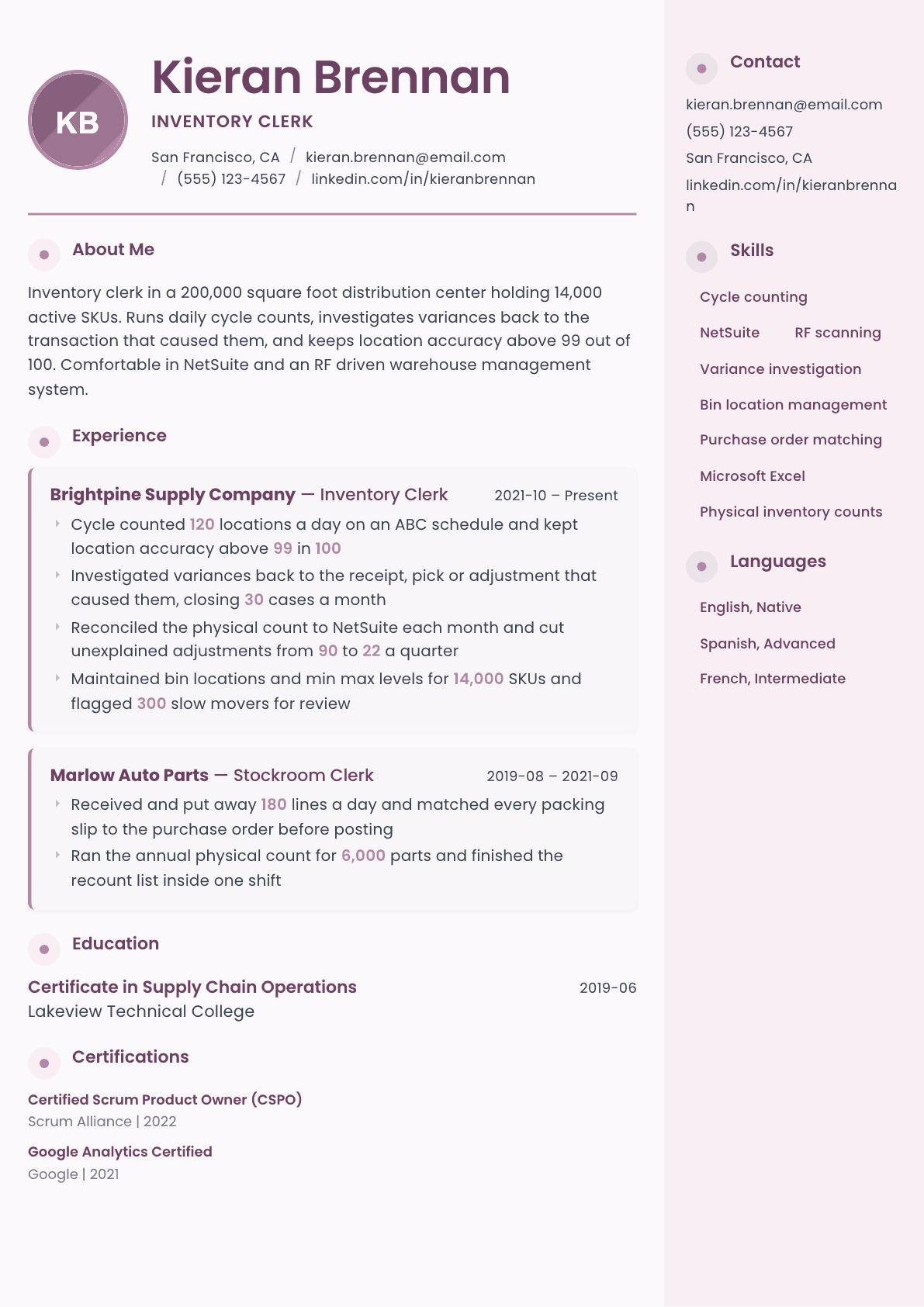
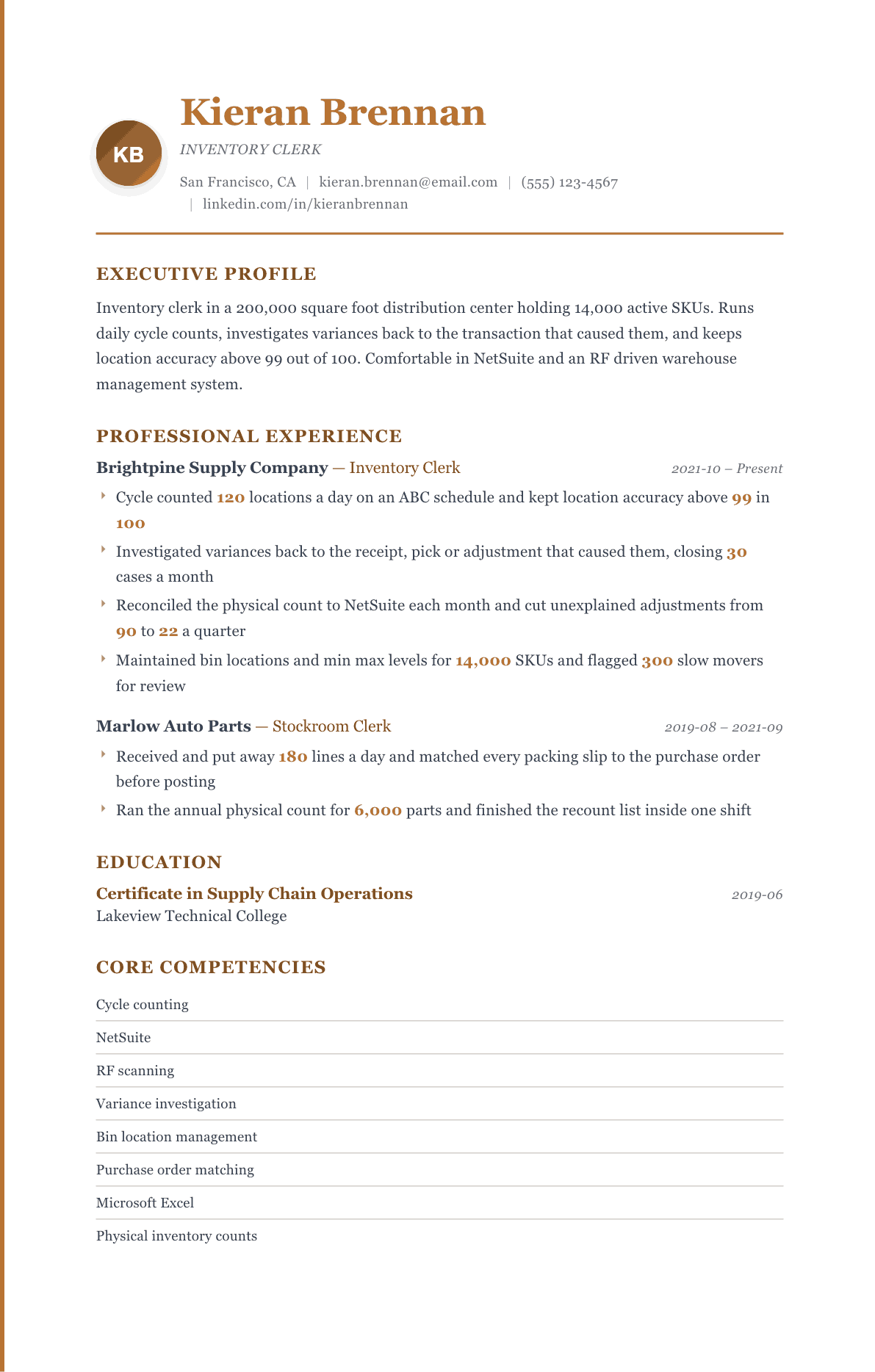
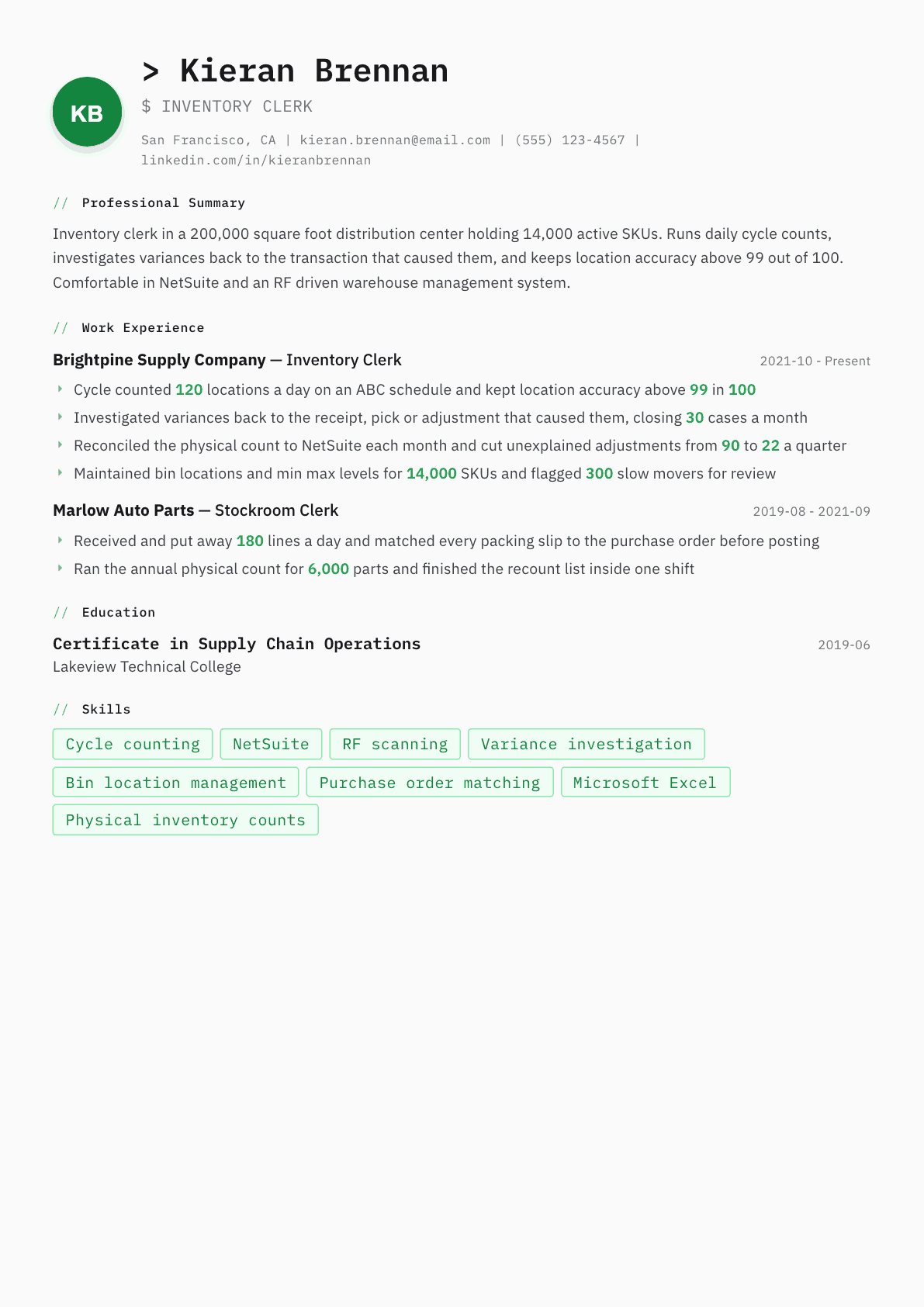
Example Inventory Clerk summary
Inventory clerk with four years in distribution and parts stockrooms, cycle counting 120 locations a day across 14,000 active SKUs and holding location accuracy above 99 in 100. Traces variances back to the receipt or pick that caused them, and cut unexplained adjustments from 90 to 22 in a quarter. Seeking an inventory control seat where counting discipline is measured and rewarded.
Skills to list on a Inventory Clerk resume
- Cycle counting
- Physical inventory
- Inventory reconciliation
- Variance investigation
- Bin and location management
- Min max replenishment
- NetSuite
- SAP inventory transactions
- RF scanning
- Purchase order matching
- Microsoft Excel lookups
- Stock rotation and FIFO
- Receiving and put away
- Slow moving stock reporting
What actually gets this resume read
- Give the SKU count and the site size, because counting 14,000 active parts is a different job from counting 400.
- Report inventory or location accuracy as a rate, since that single number is how an inventory manager is graded.
- Describe variance research, not just counting, because tracing a discrepancy to its transaction is the real skill.
- Name the system you post adjustments in, such as NetSuite, SAP, Fishbowl or a warehouse management system.
- Mention the counting method you follow, whether that is ABC cycle counting, wall to wall or blind recounts.
- Add Excel work such as lookups or pivot tables if you build the count sheets or variance reports yourself.
How to write a inventory clerk resume
An inventory clerk resume is graded on one number the whole department is graded on: accuracy. If the system says a bin holds forty units and the bin holds thirty one, someone promised stock that does not exist, and the inventory manager reading your resume spends his week preventing exactly that. He wants a clerk who counts to a schedule and, more importantly, who can trace a variance back to the transaction that caused it.
That second part is where most candidates undersell themselves. Counting is a task and anyone can be trained to do it. Research is a skill: reading the movement history of a part, finding the receipt posted to the wrong location or the pick that was never confirmed, and correcting the root cause rather than adjusting the number until it matches. Resumes that describe only counting get sorted into the temporary labor pile.
This guide covers how to structure the page for a distribution or manufacturing employer, three summaries across stockroom and inventory control stages, before and after bullets from cycle counting and variance research, and the questions clerks ask when they want to move into inventory control or planning.
Format: one page, scale and accuracy stated early
One page, reverse chronological, single column. Open each job with the scale: site size, number of active parts, and whether the operation is distribution, manufacturing or a service parts stockroom. Counting fourteen thousand active parts across a large building is a different job from counting four hundred in a back room, and only you can tell the reader which one you did.
Write large counts in words rather than with a thousands separator where you can, keep the accuracy rate visible in both the summary and the first bullet, and avoid any layout that puts your employment dates into a second column.
- Header: name, city and state, phone, email, and the inventory system you know best.
- Section order: summary, experience, systems and methods, certifications, education.
- Each job header: facility type, active part count, and the counting program in use.
Summary: parts, counts per day, accuracy, system
Say how many active parts the site carried, how many locations you counted a day, the accuracy you held, and which system you posted adjustments in. That is the whole seat in one sentence, and a manager can compare it directly against his current team.
Add the counting method. An organized cycle count program built on movement classes is a mature operation; a wall to wall count once a year is not. Naming the method tells the reader what kind of discipline you are used to working inside.
Experience: counting, researching, reconciling, maintaining
First bullet: counting volume and accuracy together. Locations counted a day on a defined schedule, plus the location or inventory accuracy you held. Second bullet: research. Describe tracing a variance back to the receipt, pick or adjustment that caused it and how many cases you closed, because this is the bullet that moves you out of the counting pile.
Third: reconciliation. Matching the physical count to the accounting system each period and reducing unexplained adjustments is the outcome a controller cares about, and an unexplained adjustment count that fell over a quarter is a strong figure to own.
Fourth: the maintenance work that prevents variances in the first place. Bin location integrity, minimum and maximum level upkeep, stock rotation discipline and flagging slow movers for review all show a clerk who improves the data rather than only auditing it.
Systems and methods: post, count, report
Name the system you post transactions in and be specific about what you were permitted to do in it. Counting in a handheld and having adjustments approved by a supervisor is different from holding adjustment authority yourself, and a manager will want to know which applies.
Then the method vocabulary, because this field has a precise one and using it correctly signals training. Movement class based cycle counting, blind recounts, tolerance thresholds, first in first out rotation, receipt to purchase order matching. Add the spreadsheet work if you build the count sheets or variance reports yourself, since that is often what gets a clerk promoted into inventory control.
- Systems: NetSuite, an enterprise resource planning inventory module, a warehouse management platform, and handheld scanning.
- Methods: movement class cycle counting, blind recounts, annual physical counts, variance research to source transaction.
- Reporting: reconciliation to the accounting record, adjustment analysis, slow moving stock reports, count sheet preparation in Excel.
Certifications and education: how a clerk becomes a planner
A high school diploma is the usual requirement and a supply chain certificate is a genuine advantage. Where clerks separate themselves is the professional credential path, since the planning and inventory management credential from the supply chain association is recognized across distribution and manufacturing and signals ambition beyond the stockroom.
Spreadsheet certification is worth more here than in most clerical roles, because variance analysis and count sheet building are done in a spreadsheet almost everywhere. List only credentials you have earned, with the issuing body written out in full.
Inventory Clerk resume summary examples
Stockroom clerk
Stockroom clerk with two years receiving and putting away 180 lines a day and matching every packing slip to the purchase order before posting. Ran the annual physical count for 6,000 parts and finished the recount list inside one shift. Seeking an inventory clerk seat with a cycle counting program.
Inventory clerk
Inventory clerk in a large distribution center holding fourteen thousand active parts. Cycle counts 120 locations a day on a movement class schedule, holds location accuracy above 99 in 100, and traces every variance back to the receipt, pick or adjustment that caused it before correcting the record.
Inventory control specialist
Inventory control specialist owning the counting schedule, the tolerance thresholds and the monthly reconciliation to the accounting record. Cut unexplained adjustments from 90 to 22 in a quarter by fixing the receiving process behind most of them, and maintains bin locations and replenishment levels across the site.
Work experience bullets: before and after
Before: Counted inventory in the warehouse.
After: Cycle counted 120 locations a day on a movement class schedule and held location accuracy above 99 in 100 across the counting year.
The daily location count, the schedule type and an accuracy rate turn counting into a measured program.
Before: Investigated inventory discrepancies.
After: Traced variances back to the receipt, pick or adjustment that caused them by reading the movement history of each part, closing 30 research cases a month.
Describing the research method and the case volume shows root cause work rather than adjusting numbers until they match.
Before: Reconciled inventory with the accounting system.
After: Reconciled the physical count to the inventory record each month and cut unexplained adjustments from 90 to 22 a quarter by correcting the receiving step behind most of them.
The before and after plus the process fix proves the reconciliation changed the operation rather than only reporting on it.
Before: Maintained bin locations and stock levels.
After: Maintained bin locations and minimum and maximum replenishment levels for fourteen thousand active parts, and flagged 300 slow movers for review by the buying team.
Part count and a specific handoff to buying show the clerk feeding decisions rather than only tidying the shelf.
Before: Received deliveries and put stock away.
After: Received and put away 180 lines a day, matching every packing slip against the purchase order before posting so quantity errors never entered the record.
The matching step names the control that stops variances at the door, which is where an inventory manager wants them stopped.
Hard skills
- Cycle counting programs
- Annual physical inventory
- Variance research to source transaction
- Inventory reconciliation
- Bin and location management
- Minimum and maximum replenishment levels
- NetSuite
- Enterprise inventory transactions
- Radio frequency scanning
- Purchase order matching
- Stock rotation and first in first out
- Excel lookups and pivot reporting
Soft skills
- Patience with repetitive counting
- Curiosity about where a number went wrong
- Honesty about a count you got wrong
- Coordination with receiving and picking
- Clear written variance notes
- Working independently across a large floor
Certifications worth listing
- Certified in Planning and Inventory Management (CPIM) (Association for Supply Chain Management)
- Certified Supply Chain Professional (CSCP) (Association for Supply Chain Management)
- Certified Logistics Associate (CLA) (Manufacturing Skill Standards Council)
- Microsoft Office Specialist: Excel Associate (Microsoft)
Mistakes that cost inventory clerk candidates the interview
- Describing counting without research, which reads as temporary labor rather than as inventory control.
- Giving no active part count or site size, so the reader cannot judge whether the operation was large or small.
- Omitting the accuracy rate, when that single figure is how the whole inventory function is graded.
- Naming no system, which leaves the manager unsure whether you have posted a transaction in your life.
- Ignoring the counting method, so a mature cycle count program reads the same as one annual count.
- Leaving out spreadsheet work, which is exactly the skill that promotes a clerk into inventory control or planning.
Inventory Clerk resume questions
What accuracy figure should an inventory clerk put on a resume?
The one your site already reported, and label it correctly. Location accuracy, unit accuracy and value accuracy are different measures and an interviewer may well ask which you meant. If nothing was reported, describe the counting schedule and tolerance you worked to instead.
How do I show variance research rather than just counting?
Write a bullet about the trace itself: reading movement history, finding the misposted receipt or the unconfirmed pick, and correcting the process rather than the number. Add how many cases you closed in a period so the reader sees it was routine work.
Does inventory clerk experience transfer between industries?
Yes, the counting and reconciliation discipline moves cleanly between distribution, manufacturing and service parts. What changes is the part complexity, the rotation rules and any lot or serial tracking, so name whichever of those you have handled.
Is a supply chain certification worth it for an inventory clerk?
It matters most when you want to move into inventory control, planning or buying. For a clerk seat the accuracy record and system experience carry the decision, but the planning and inventory management credential is recognized widely and makes the next step easier to argue.
Should I mention forklift or equipment experience?
List it briefly if you hold employer authorization, since counting high locations often requires it and it makes you more useful on a short handed day. Keep it in the skills block rather than the bullets so it does not crowd out the accuracy evidence.
Related resume examples
- Warehouse Worker Resume example
- Inventory Control Specialist Resume example
- Shipping Clerk Resume example
- Logistics Coordinator Resume example
- Order Processing Specialist Resume example
- Purchasing Clerk Resume example