Billing Specialist Resume Examples: the lines they read
Balance the Books with a Billing Specialist Resume
By Mustafa Tarabya, founder of CVBooster · Published · Updated
Build a billing specialist resume showcasing your invoicing accuracy, accounts receivable management, and payment processing expertise.
Sample resumes for a billing specialist
The same billing specialist content laid out in three CVBooster templates, so you can see what the finished document looks like before you write a word.
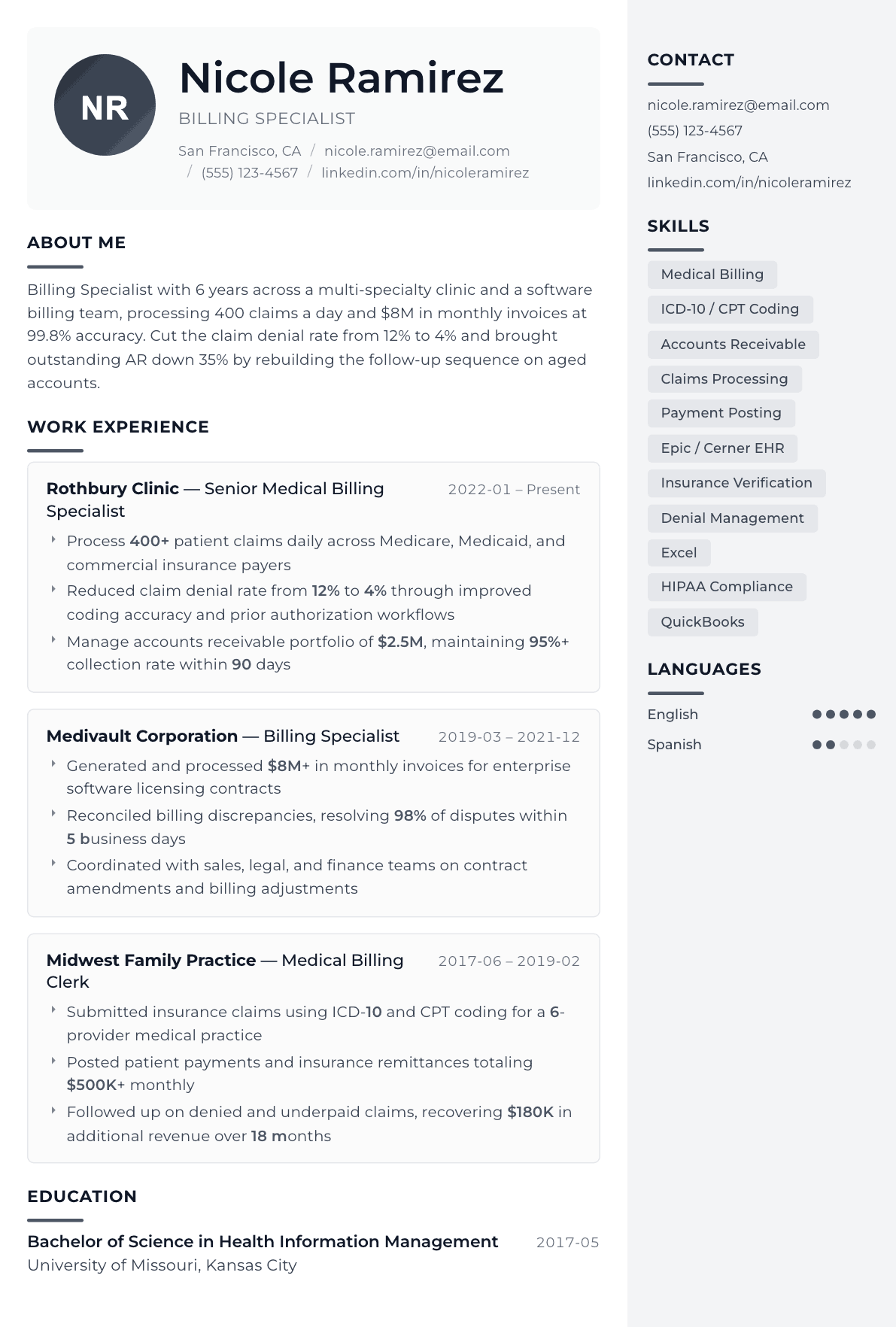
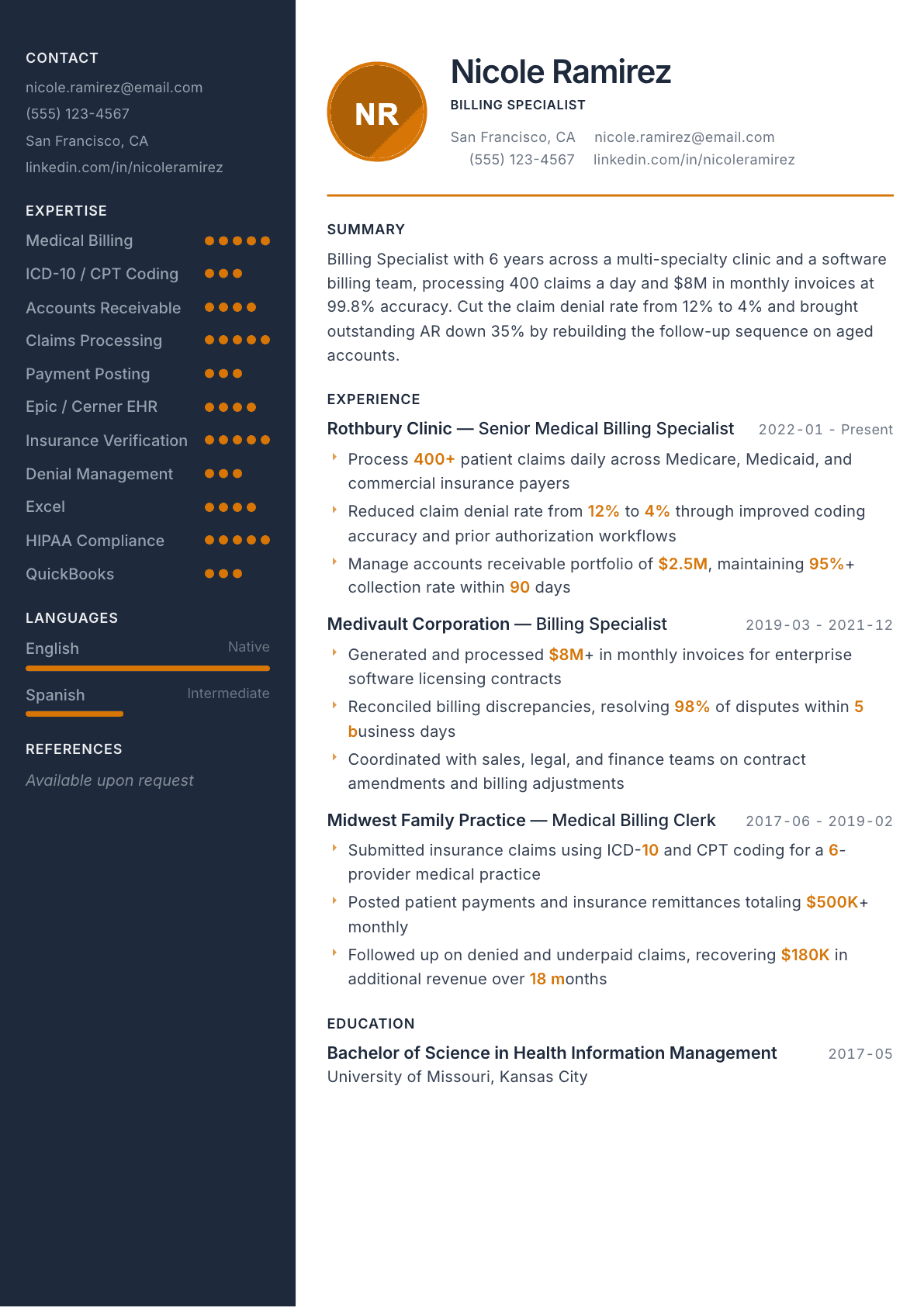
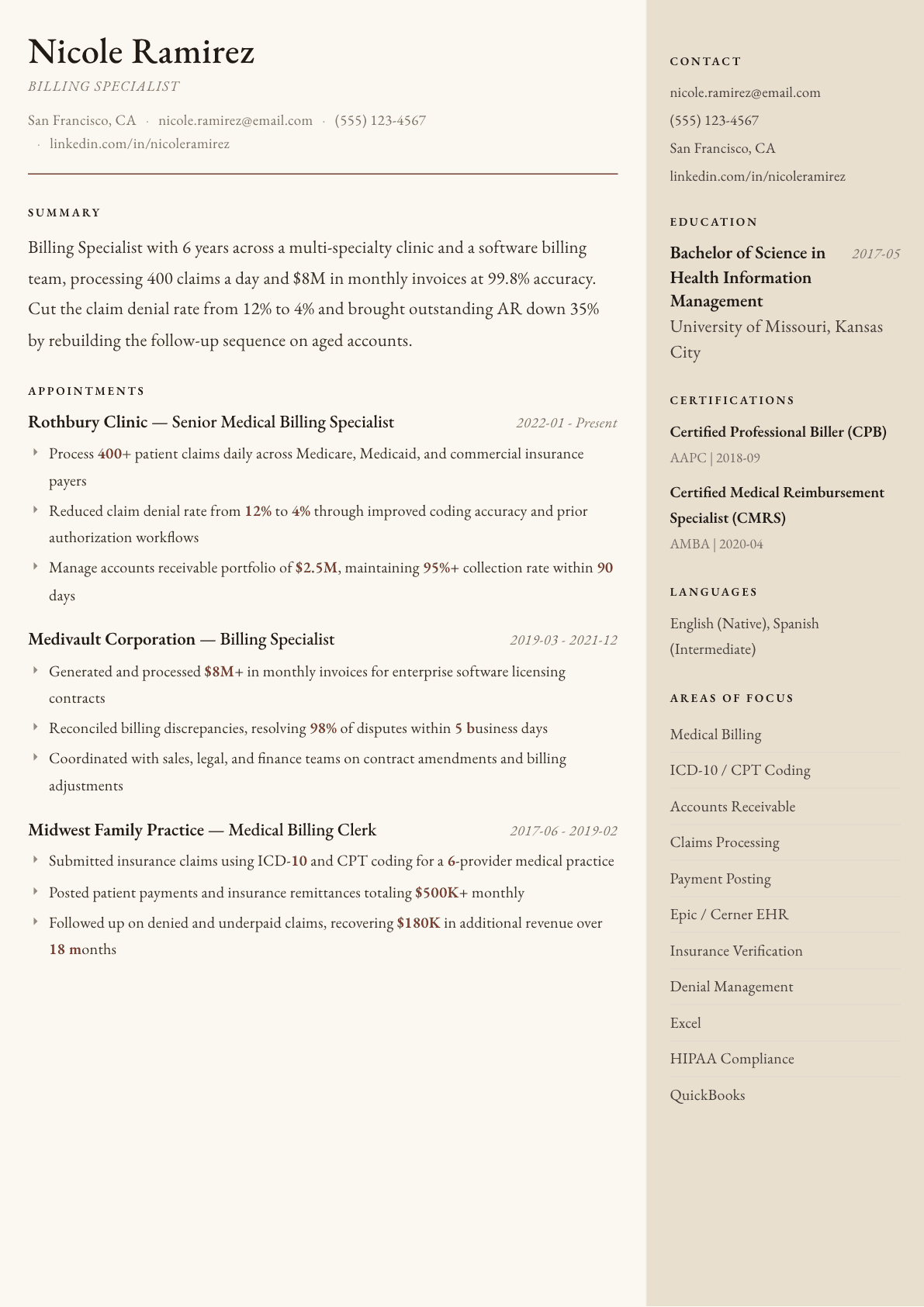
Example Billing Specialist summary
Certified professional biller with 6 years in medical and contract billing, working Medicare, Medicaid and commercial payers in Epic and Cerner. Owns a $2.5M receivables portfolio at a 95% collection rate inside 90 days, and rebuilt the prior authorization step that took denials from 12% to 4%.
Skills to list on a Billing Specialist resume
- Medical Billing
- ICD-10 / CPT Coding
- Accounts Receivable
- Claims Submission
- Payment Posting
- Denial Management
- Insurance Verification
- Epic / Cerner / Athenahealth
- QuickBooks / SAP
- HIPAA Compliance
- Revenue Cycle Management
- Excel / Data Analysis
- Customer Service
- Collections
What actually gets this resume read
- Quantify your billing volume: monthly invoices processed, dollar amounts, and accuracy rates.
- Highlight denial management results: reduction in denial rates and revenue recovered.
- Include CPB, CPC, or CMRS certifications as these are key credentials for billing professionals.
- Specify billing software: Epic, Cerner, Athenahealth, QuickBooks, SAP, Oracle.
- Show collection rate improvements and AR aging reduction achievements.
- Mention compliance knowledge: HIPAA, Medicare/Medicaid regulations, CMS guidelines.
How to write a billing specialist resume
A billing specialist resume has one job: prove you get money in the door cleanly and on time. The revenue cycle manager or controller reading it is looking for three things in the first ten seconds. What kind of billing, medical or commercial. Which system you worked in. And whether you touched denials and collections or only keyed charges.
Those distinctions matter more than candidates expect. Medical billing built on ICD-10-CM, CPT and payer rules is a different craft from contract and subscription invoicing in an ERP, and a resume that blurs the two reads as thin in both. Name the payer mix or the billing model in the first line and the reader stops guessing.
This guide sets out the section order billing postings expect, what to do with metrics such as clean claim rate and aging buckets, three summaries at different stages of a billing career, rewritten bullets, and the questions billing specialists ask when they update a resume after a few years in the same seat.
Format: one page, systems visible near the top
Reverse chronological, one page for under about eight years. Billing is a systems job, so a short systems block sitting directly under the summary does more work than anything else on the page. A manager hiring for an Epic Resolute shop scans for that word before she reads a single bullet.
Keep the layout plain. Hospital and large practice applicant tracking systems are conservative parsers, and a billing resume that arrives with scrambled dates undermines the exact claim you are making about accuracy.
- Header: name, credentials such as CPB or CPC, city and state, phone, email.
- Section order: summary, systems and payers, experience, certifications, education.
- State the billing type in the first line: professional, facility, dental, durable medical equipment, or commercial invoicing.
Summary: billing type, volume, and one number you own
Say the specialty and the setting, the daily or monthly claim or invoice volume, the payer mix or client base, and one performance figure you are accountable for. Clean claim rate, denial rate, days in accounts receivable, or collection rate within a defined aging window all read as ownership rather than activity.
Avoid opening with detail-oriented. Every billing specialist claims accuracy, so demonstrate it instead with a volume paired with an error or denial figure in the same sentence. That pairing is the whole argument.
Experience: charges in, denials worked, cash collected
Structure each job around the revenue cycle rather than the day. Charge entry and coding review, claim submission and clearinghouse scrubbing, payment posting from remittance advice, denial and appeal work, patient or customer statements, and collections follow-up. A reader wants to know how far along that chain your responsibility reached.
Denials are where a billing specialist proves value, so give them their own bullet. Name the denial reasons you worked most, medical necessity, missing prior authorization, timely filing, coordination of benefits, bundling edits, and say what you changed upstream so the same denial stopped arriving.
On the commercial side the chain is different but the logic holds: contract setup, milestone or usage billing, credit memos, dunning cycles, dispute resolution and the monthly close. Say which part of the close you owned and by which working day it had to be finished.
- Name the practice management or ERP system for every job, not just the current one.
- Give volume as claims or invoices per day or month, not as "high volume".
- Pair each volume with an accuracy, denial or aging figure.
Systems, payers and codes: the keyword block
Group this section so a screener can scan it. Billing and practice management systems, clearinghouses, coding sets, payer types, and office tools. Epic Resolute, Cerner, Athenahealth, NextGen, eClinicalWorks, Availity, Waystar, NetSuite, SAP, Oracle, QuickBooks and Excel are the names that recur across postings.
Include the payer mix explicitly. Medicare, Medicaid, commercial plans, managed care, workers compensation and self-pay each carry different rules, and a manager staffing a Medicare-heavy desk is filtering for that word. For coding, list ICD-10-CM, CPT, HCPCS Level II and modifier use rather than the word coding on its own.
Certifications, education and compliance language
Certification is worth more than a degree in medical billing hiring. Put the credential after your name in the header and again in its own section with the issuing body and the year it was earned. If you are studying for one, list it as in progress with the exam date rather than leaving the section empty.
Mention compliance in the language of the field. HIPAA privacy and security handling, minimum necessary access, audit readiness and payer contract terms show that you understand the risk attached to the data you sit on. Say that you handled protected health information under HIPAA, never anything that identifies a patient or a client.
Billing Specialist resume summary examples
New to billing
Medical billing graduate with CBCS certification and a 6-month externship posting payments and working aged claims for a 4-provider family practice. Trained in ICD-10-CM, CPT and modifier basics, comfortable in eClinicalWorks, and seeking a billing specialist role in an outpatient setting.
Five years in
Billing specialist with five years in outpatient professional billing, submitting 300 claims daily across Medicare, Medicaid and commercial payers in Athenahealth. Holds CPB certification, maintains a 96% clean claim rate, and reduced timely filing write-offs by rebuilding the front-end eligibility check.
Lead or supervisor
Senior billing specialist and team lead with eleven years across hospital facility and professional billing, currently supervising 6 billers in Epic Resolute. Owns denial management and appeals, cut days in accounts receivable from 54 to 38, and runs the monthly revenue cycle review with the practice managers.
Work experience bullets: before and after
Before: Submitted insurance claims for a medical office.
After: Submitted 250 to 300 professional claims daily in Athenahealth for a 12-provider multispecialty group, scrubbing through Availity before release and clearing clearinghouse rejections same day.
Volume, system, clearinghouse and turnaround give a manager everything she needs to place your experience.
Before: Worked on denied claims.
After: Worked an average of 90 denials per week, appealing medical necessity and prior authorization rejections with clinical documentation and overturning roughly two thirds on first appeal.
Naming the denial reasons and the overturn outcome shows appeal skill instead of queue clearing.
Before: Helped reduce accounts receivable.
After: Reduced claims aged over 90 days from 22% to 9% of total accounts receivable by rebuilding the follow-up worklist into payer-specific queues with defined touch intervals.
The aging bucket and the method turn a vague improvement into a repeatable process a new employer can use.
Before: Posted payments from insurance companies.
After: Posted electronic remittance advice and manual payments for two payer groups daily, reconciling against bank deposits and flagging underpayments against the contracted fee schedule.
Reconciliation and contract comparison prove analysis, not data entry.
Before: Answered patient billing questions.
After: Handled 40 patient billing calls daily, explaining explanation of benefits statements, setting up payment plans within policy, and resolving coordination of benefits errors at the source.
The call volume and the specific issue types show the customer-facing half of billing that managers worry about.
Hard skills
- ICD-10-CM and CPT coding review
- HCPCS Level II and modifiers
- Claim submission and scrubbing
- Denial management and appeals
- Payment posting and remittance advice
- Accounts receivable follow-up and aging
- Prior authorization and eligibility verification
- Epic Resolute and Cerner
- Athenahealth and NextGen
- Availity and Waystar clearinghouses
- Contracted fee schedule review
- Excel reconciliation and reporting
- HIPAA compliant record handling
Soft skills
- Accuracy under volume
- Payer negotiation persistence
- Clear explanation of charges
- Documentation discipline
- Deadline focus around close
- Escalation judgment
Certifications worth listing
- Certified Professional Biller (CPB) (AAPC)
- Certified Professional Coder (CPC) (AAPC)
- Certified Coding Specialist (CCS) (American Health Information Management Association)
- Certified Billing and Coding Specialist (CBCS) (National Healthcareer Association)
- Certified Revenue Cycle Representative (CRCR) (Healthcare Financial Management Association)
- Certified Medical Reimbursement Specialist (CMRS) (American Medical Billing Association)
Mistakes that cost billing specialist candidates the interview
- Writing "billing and collections" with no claim or invoice volume attached, which leaves the reader unable to size the desk.
- Hiding the practice management or ERP system in a skills list instead of naming it under each job where it was used.
- Leaving the payer mix out, so a Medicare-heavy employer cannot tell whether you know its rules.
- Skipping denials entirely and describing only charge entry, which reads as the junior half of the role.
- Claiming an accuracy figure with no volume beside it, since accuracy on ten claims a day means nothing.
- Listing a certification without the issuing body or the year, which makes a screener assume it lapsed.
- Including patient names, account numbers or any protected health information in an example bullet.
Billing Specialist resume questions
Should a billing specialist resume list medical and commercial billing together?
Lead with whichever matches the posting and keep the other as supporting experience. Both are legitimate, but a hiring manager wants the top third of the page to be the kind of billing she is filling, with the second type showing range beneath it.
Do I need a certification to work as a billing specialist?
Not always, since many employers hire on experience alone, but CPB, CPC or CBCS clears the initial screen faster and is often required for hospital roles. If you are working toward one, list it as in progress with the scheduled exam date.
What metrics belong on a billing resume?
Clean claim rate, denial rate, first pass resolution, days in accounts receivable, percentage of receivables aged past ninety days, collection rate, and daily claim or invoice volume. Choose two or three you genuinely owned rather than reciting the whole dashboard.
How do I show billing experience without breaching HIPAA?
Describe the work and the volumes, never an identity. Say the specialty, the number of providers, the payer types and the claim counts. Nothing that names a patient, an account number or a diagnosis attached to a person belongs on a resume.
Can I move from medical billing into corporate invoicing?
Yes, and the bridge is the receivables half of the job. Lead with aging management, collections calls, reconciliation and dispute resolution, then name any ERP or accounting exposure, since those transfer directly while the coding knowledge does not.
Related resume examples
- Data Entry Clerk Resume example
- Medical Receptionist Resume example
- Administrative Assistant Resume example
- Medical Front Desk Resume example
- Order Processing Specialist Resume example
- Medical Administrative Assistant Resume example