Validation Engineer Resume Examples: what gets the call
Build a Validation Engineer Resume Around Protocols and Approvals
By Mustafa Tarabya, founder of CVBooster · Published · Updated
Validation engineer resume example with IQ OQ PQ protocol bullets, regulated industry keywords and a step by step writing guide.
Sample resumes for a validation engineer
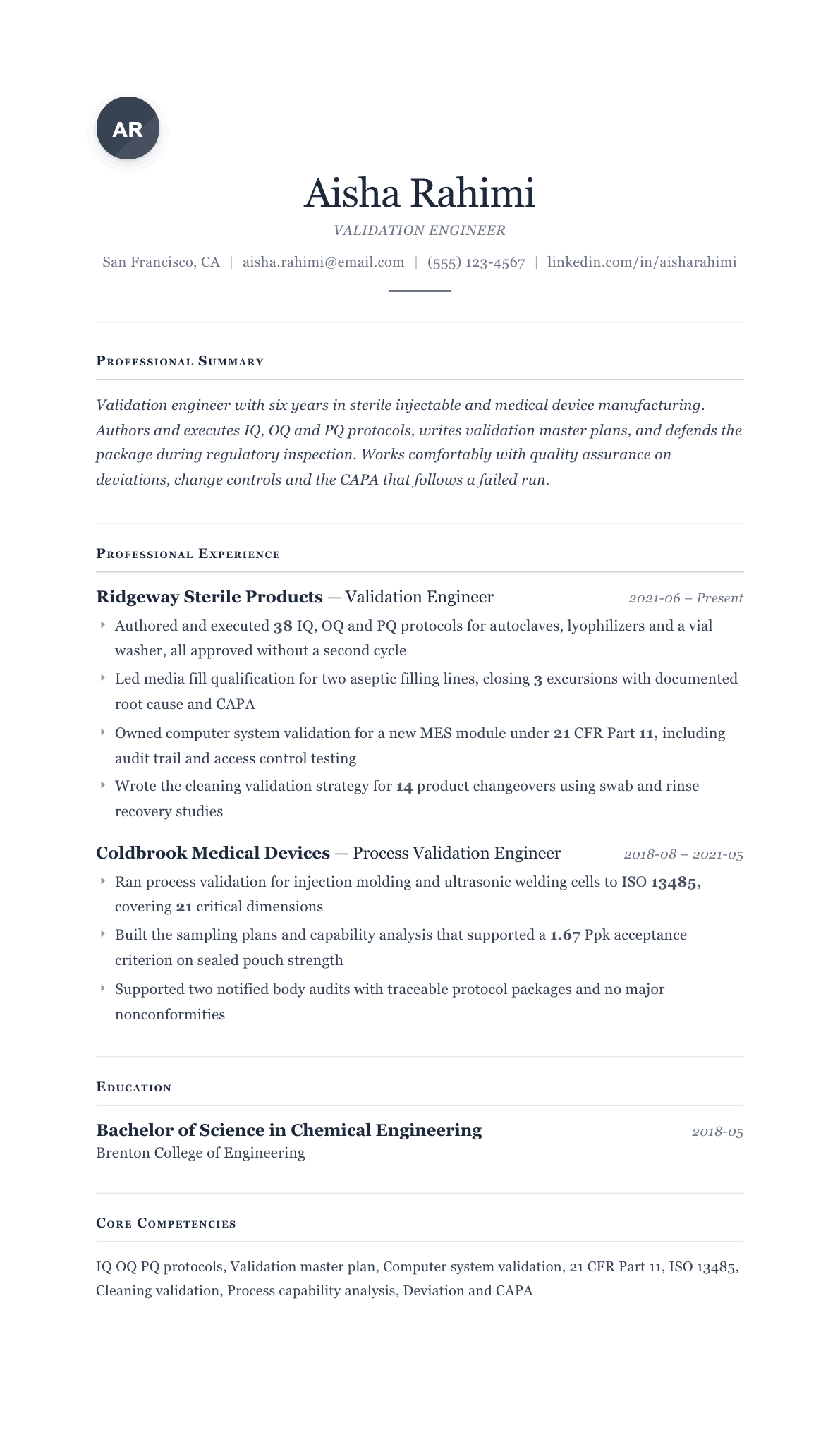
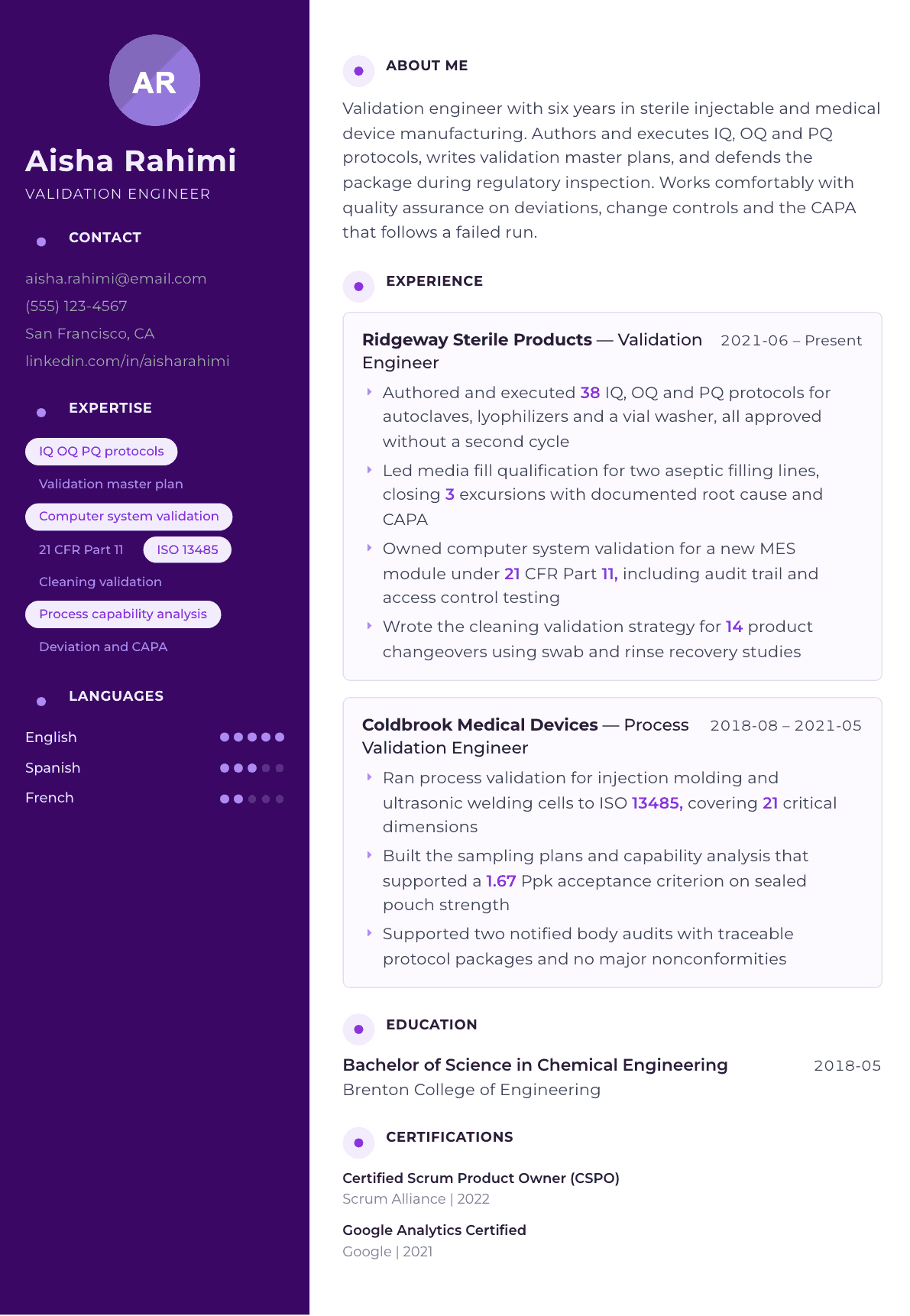
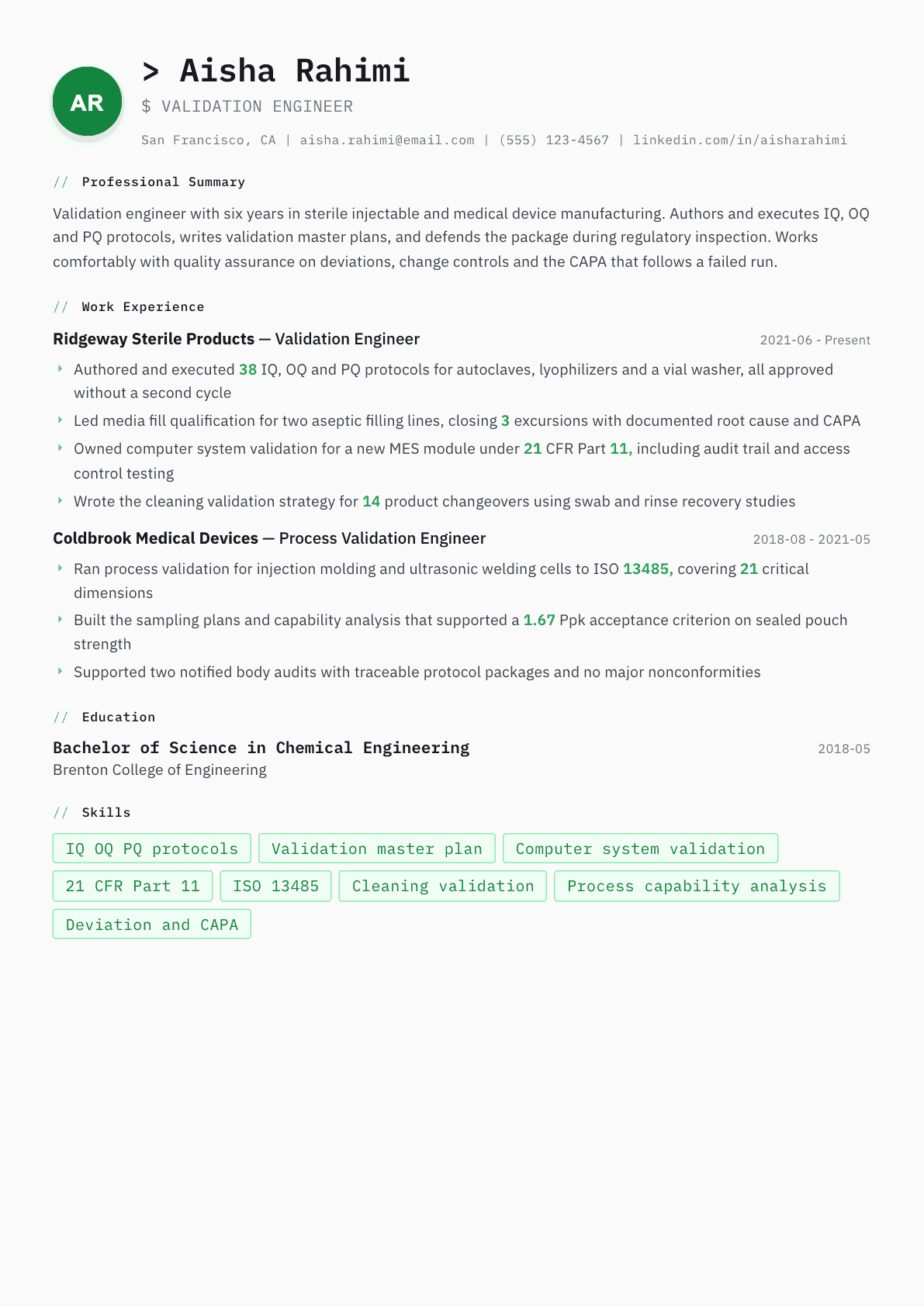
The same validation engineer content laid out in three CVBooster templates, so you can see what the finished document looks like before you write a word.
Example Validation Engineer summary
Validation engineer with six years across sterile pharmaceutical manufacturing and medical device production. Authors validation master plans, executes qualification protocols on process equipment and utilities, and validates computerized systems against 21 CFR Part 11. Investigates deviations through to closed corrective action and has supported notified body audits without major findings. Seeking a senior validation role on a new facility startup.
Skills to list on a Validation Engineer resume
- Installation qualification
- Operational qualification
- Performance qualification
- Validation master plan
- Computer system validation
- 21 CFR Part 11
- GAMP 5
- ISO 13485
- Cleaning validation
- Process validation
- Risk assessment and FMEA
- Deviation investigation
- CAPA
- Change control
- Statistical sampling plans
- Audit support
What actually gets this resume read
- Name the regulated framework you worked under, because pharmaceutical GMP, medical device and food safety validation are judged separately.
- Count the protocols you authored and the protocols you executed, since hiring managers treat authoring as the harder skill.
- Say how many of your packages passed approval on the first review, as rework rate is the quiet quality signal here.
- List audit and inspection exposure by body, whether that was a notified body, a customer audit or a regulatory inspection.
- Show that you can handle a failure: describe one deviation you investigated through to closed CAPA with the corrective action named.
- Mention the quality system tools you worked in, such as TrackWise or Veeva, because document flow is half of the daily work.
How to write a validation engineer resume
A validation engineer resume is a compliance document about a compliance job. The person reading it has seen protocols that were approved on the first review and protocols that went around four times, and they are trying to work out which kind you write. That judgment is made from specificity: the equipment you qualified, the framework you worked under, the volume of protocols you authored, and how you handled the run that failed.
Candidates lose ground by writing in the passive voice of the quality system. Phrases like supported validation activities and participated in qualification could describe anyone who attended a meeting. Hiring managers in regulated manufacturing want to know what you personally wrote, executed, approved and defended.
Below is the structure that works for this discipline, what to place in each section, three example summaries, five rewritten bullets, and the questions validation engineers ask most.
Format: framework in the header, protocols in the body
Reverse chronological, two pages once you have several sites or several product types. Name your regulated framework in the header line next to the title, because pharmaceutical good manufacturing practice, medical device quality systems and food safety validation are read by different hiring teams who rarely swap candidates.
Add a short qualification scope block under the summary listing the equipment and system classes you have qualified. Utilities, process equipment, cleanrooms, computerized systems, analytical instruments and cleaning processes each imply a different skill set, and the block saves the reader from mining your bullets.
- Header: name, validation discipline, regulated framework, city and state, contact details.
- Section order: summary, qualification scope, experience, quality systems, education, certifications.
- Per job: site type, product form, and whether you authored, executed or approved.
Summary: framework, equipment class, and approval record
Open with years, the regulated setting and the product form, because sterile injectable, solid dose, biologics and implantable device work carry different expectations. Then state your position in the document flow. Authoring protocols is a different level of trust than executing them, and approving them is different again.
Close with something that only a validation engineer can claim credibly: an approval rate on first review, a package that carried an inspection without observations, or a qualification completed inside a plant shutdown window.
Experience: protocols authored, executed, and defended
Count your protocols and split them by type. Installation qualification, operational qualification, performance qualification, process validation, cleaning validation and computerized system validation should each be named where you have done them, with the equipment attached. Autoclaves, lyophilizers, depyrogenation tunnels, water for injection systems, injection molding cells and sterilization processes are all recognizable to a reviewer.
Give at least one bullet to a failure. Every experienced validation engineer has had an excursion or a failed run. Describing the investigation, the root cause and the corrective action that closed it proves competence far better than a record of everything going smoothly.
Include inspection and audit exposure by type of auditor. Supporting a customer audit, a notified body assessment or a regulatory inspection are separate experiences, and a hiring manager preparing for one of them is looking for a person who has stood in that room.
Computerized systems and data integrity
If you validate software or automated equipment, treat it as its own section. Name the lifecycle approach you follow, the categories of system involved, and the specific controls you tested: audit trail review, user access levels, electronic signature workflow, backup and restore, and disaster recovery. Data integrity findings are among the most common inspection observations, so this section carries weight.
Say which quality system platform you worked in for deviations, change controls and document management. Reviewers use these platform names as a proxy for how mature the environment was.
- System classes: process control, manufacturing execution, laboratory information management, building management.
- Controls tested: access levels, audit trail, electronic signature, data backup and restore, time synchronization.
- Lifecycle artifacts: user requirements, functional and design specifications, traceability matrix, summary report.
Statistics and acceptance criteria
Acceptance criteria are where validation engineering becomes engineering. Explain how you set sample sizes, what confidence and reliability you targeted, which capability index you used and why. A resume that shows a candidate can defend a sampling plan under questioning is rare and valued.
Where you used a specific sampling standard or a capability requirement agreed with a customer, name it. Vague references to statistical methods invite the interviewer to test you, while a named approach invites a conversation between peers.
Validation Engineer resume summary examples
New graduate
Chemical engineering graduate with an industrial placement executing operational qualification protocols on tablet coating equipment under a good manufacturing practice quality system. Trained in deviation reporting and document control. Seeking an entry validation engineering role in pharmaceutical or device manufacturing.
Five years in
Validation engineer with 5 years in sterile injectable manufacturing, authoring and executing installation, operational and performance qualification protocols for autoclaves, lyophilizers and washers. Owns cleaning validation for 14 product changeovers and closes deviations through verified corrective action.
Senior validation engineer
Senior validation engineer with 11 years across device and sterile pharmaceutical sites, writing validation master plans for facility startups and approving protocols as subject matter expert. Has led computerized system validation under electronic records rules and supported four regulatory inspections without major observations.
Work experience bullets: before and after
Before: Supported equipment qualification activities.
After: Authored and executed 38 installation, operational and performance qualification protocols for autoclaves, lyophilizers and a vial washer, with every package approved on the first quality review.
Volume, equipment names and a first pass approval record replace a phrase that could describe any team member.
Before: Worked on aseptic process validation.
After: Led media fill qualification on two aseptic filling lines, investigating 3 excursions to documented root cause and closing each with a verified corrective action before requalification.
Handling excursions is the real test of the role, and naming the count makes the claim checkable.
Before: Validated a new software system.
After: Owned computerized system validation for a manufacturing execution module under electronic records requirements, testing audit trail integrity, role based access and backup restore against a traceability matrix.
Naming the controls tested proves data integrity knowledge rather than general software familiarity.
Before: Wrote cleaning validation documents.
After: Developed the cleaning validation strategy covering 14 product changeovers, including swab and rinse recovery studies, worst case product selection and analytical method suitability.
Worst case selection and recovery studies are the technical heart of cleaning validation and show real ownership.
Before: Helped during audits.
After: Supported two notified body audits by presenting protocol packages, traceability records and deviation closures directly to the assessor, with no major nonconformities raised against validation.
Facing the auditor personally is a much stronger claim than being present during an audit week.
Hard skills
- Installation and operational qualification
- Performance qualification
- Validation master planning
- Process validation and capability analysis
- Cleaning validation and recovery studies
- Computerized system validation
- Electronic records and signature controls
- Risk assessment and failure mode analysis
- Sampling plan and acceptance criteria design
- Deviation investigation
- Corrective and preventive action
- Change control
- Technical report writing
- Audit and inspection support
Soft skills
- Precision in written procedure
- Composure during inspection questioning
- Cross-functional negotiation with quality
- Attention to traceability
- Coaching operators through execution
Certifications worth listing
- Certified Quality Engineer (CQE) (American Society for Quality)
- Certified Quality Auditor (CQA) (American Society for Quality)
- Certified Six Sigma Green Belt (CSSGB) (American Society for Quality)
- Certified Pharmaceutical Industry Professional (CPIP) (International Society for Pharmaceutical Engineering)
Mistakes that cost validation engineer candidates the interview
- Writing in quality system passive voice so the reader cannot tell what you personally authored or executed.
- Naming the framework nowhere, leaving a device recruiter unsure whether your background is pharmaceutical.
- Presenting a flawless record with no failed run, which reads as either inexperience or omission.
- Listing document types without the equipment or process they qualified.
- Ignoring computerized system validation on postings that clearly require electronic records competence.
- Skipping the statistical basis for acceptance criteria, which is the first thing a technical interviewer probes.
Validation Engineer resume questions
How many protocols should I mention on a validation resume?
Give totals by type rather than a list. A reader wants to know roughly how many packages you have authored and executed, and across what equipment classes. Then pick two or three protocols with an interesting outcome and describe those in full.
Does validation experience transfer between pharmaceutical and medical device work?
The discipline transfers well and the vocabulary does not. Rewrite your resume in the target framework language, keep the equipment and statistical work visible, and show that you understand the different documentation expectations rather than assuming the reader will translate for you.
Should I include deviations and failures on my resume?
Yes, one of them. Describe the excursion, the investigation method, the root cause and the corrective action that closed it. Hiring managers know failures happen and treat a candidate who can narrate one clearly as more experienced than one whose record looks untouched.
How do I show validation work if I was a contractor on short assignments?
Group contract assignments under one heading with the agency or your own consultancy, then list each site as a project with dates, scope and deliverables. That keeps the page readable and prevents a long sequence of short entries from looking like instability.
What quality system software should I list?
List the platforms you used for deviations, change control and document management, along with any electronic batch record or laboratory system you validated. Those names tell a hiring manager how mature your previous environment was and how quickly you will be productive.
Related resume examples
- Quality Engineer Resume example
- Process Engineer Resume example
- Supplier Quality Engineer Resume example
- Test Engineer Resume example
- Systems Engineer Resume example
- Commissioning Engineer Resume example