Process Engineer Resume Examples: the lines they read
Process Engineer Resume and Process Engineering Resume Example
By Mustafa Tarabya, founder of CVBooster · Published · Updated
Process engineer resume and a full process engineering resume example: the industry line, baseline-to-result bullets, safety and quality systems.
Sample resumes for a process engineer
The same process engineer content laid out in three CVBooster templates, so you can see what the finished document looks like before you write a word.
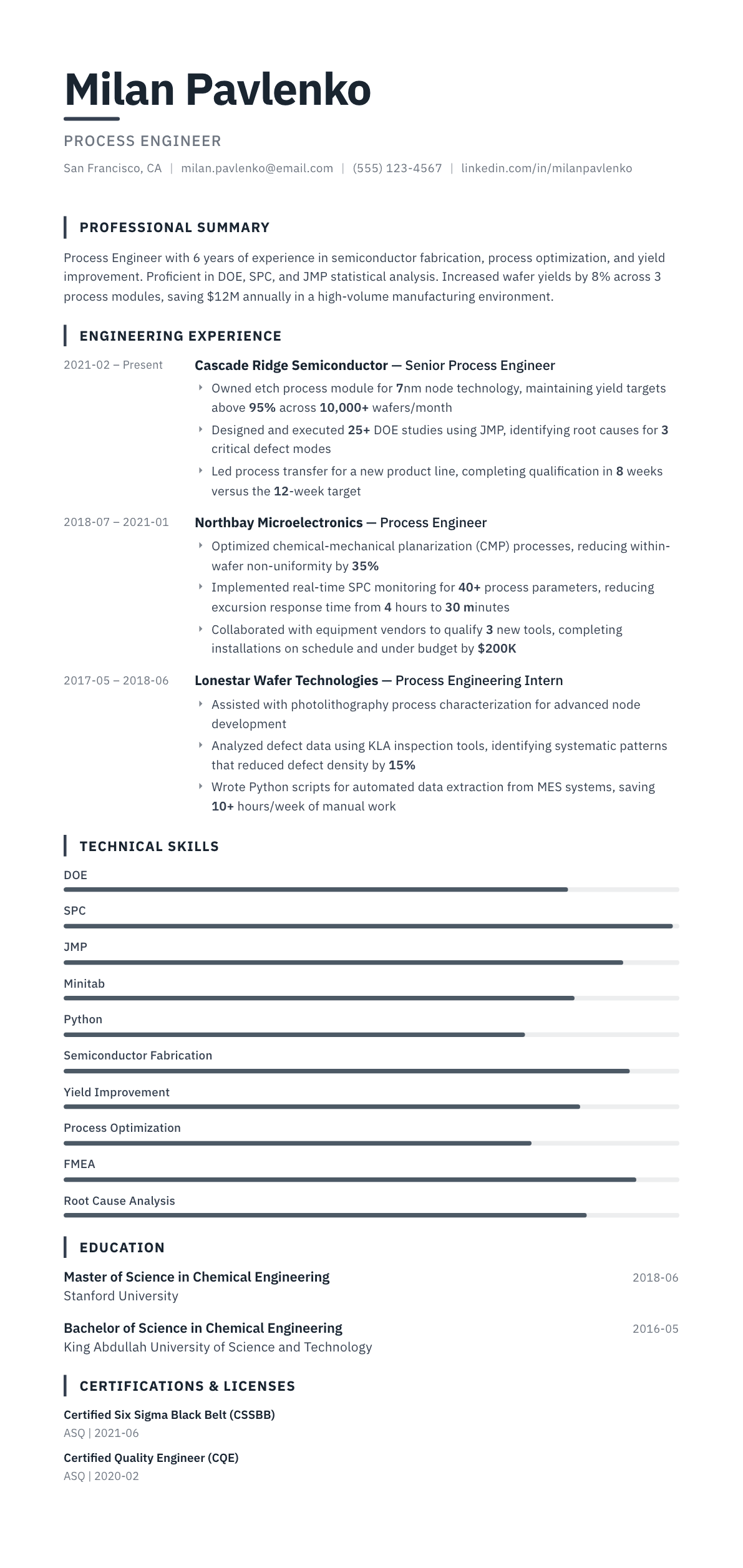
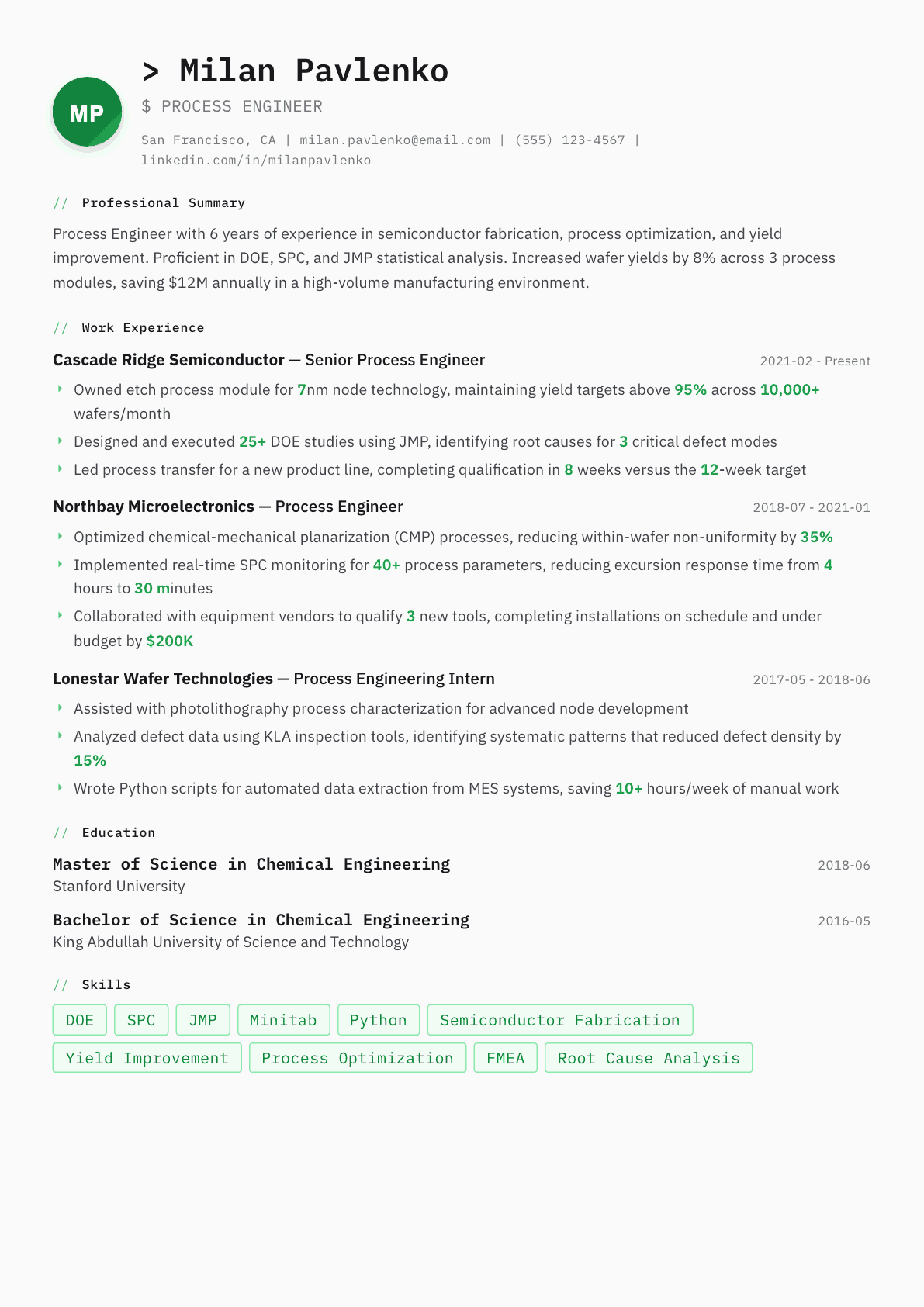
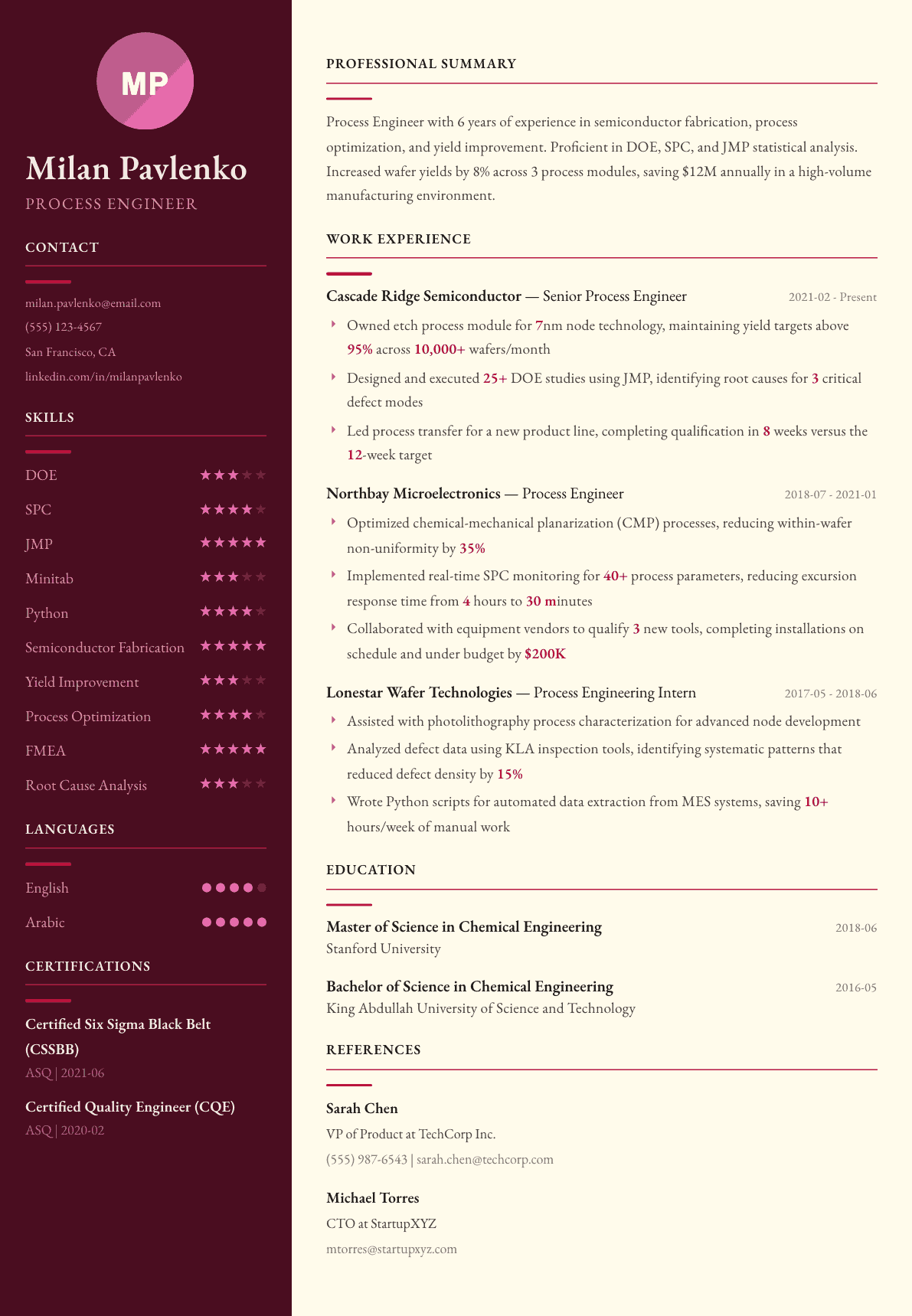
Example Process Engineer summary
Six Sigma Black Belt with 6 years of process engineering experience in semiconductor manufacturing. Expert in DOE, SPC, and JMP with a track record of increasing wafer yields by 8% and delivering $12M in annual savings. Skilled in process optimization, troubleshooting, and cross-functional team leadership.
Skills to list on a Process Engineer resume
- DOE
- SPC
- JMP
- Minitab
- Process Optimization
- Yield Improvement
- FMEA
- Root Cause Analysis
- Python
- MATLAB
- Six Sigma
- Lean Manufacturing
- Process Transfer
- Equipment Qualification
- Data Analytics
What actually gets this resume read
- Highlight statistical and analytical tools: JMP, Minitab, DOE, SPC, ANOVA, regression analysis.
- Quantify yield and efficiency improvements: yield percentages, defect reduction, cost savings.
- Specify the industry and process types: semiconductor, chemical, pharmaceutical, food & beverage.
- Include programming skills used for data analysis: Python, R, MATLAB, SQL.
- Reference quality methodologies: Six Sigma, FMEA, 8D, fishbone diagrams, Pareto analysis.
- Describe equipment and technology platforms you have worked with.
How to write a process engineer resume
The title process engineer covers at least three different jobs. In chemicals and refining it means owning a unit: heat and material balances, equipment sizing, and the reason a column is not making spec. In semiconductor and electronics manufacturing it means owning a process module and its yield. In discrete manufacturing it means owning a production line, its cycle time and its scrap rate. The screener knows which one she is hiring for, and a resume that does not declare its industry gets filed under maybe.
The second thing the screener checks is whether your improvements are real. Every process engineer resume claims optimization. Few name the baseline, the change made, the measurement method and the sustained result, which is exactly what a plant manager needs in order to believe the number.
This guide covers how to signal your industry in the first three lines, a complete process engineering resume written out section by section, how to write improvement bullets that survive scrutiny, summaries at three career stages, and the safety and quality systems that a process engineer is expected to name.
Declare the industry and the process in line one
Open the summary with the sector, the unit operations or modules you own, and the scale: continuous or batch, wafer starts per week, tons per day, units per hour. A refinery hiring manager and a wafer fab hiring manager use the same job title and share almost no vocabulary, so the first line has to route the reader.
Then name the process itself. Distillation, crystallization, fermentation, extrusion, injection molding, plating, etch, deposition, photolithography, chemical mechanical planarization: these are the words postings use, and they are the words the screening software is matching.
- Header: name, city and state, phone, email, and licensure if you hold it.
- Order: summary, technical skills, experience, projects if early career, education, certifications.
- State whether your environment is regulated: pharmaceutical good manufacturing practice, food safety, process safety management, or automotive quality standards.
Experience: baseline, intervention, measurement, sustained result
The strongest bullets follow one shape. State what the process was doing before, what you changed, how you proved it worked, and whether it held. Without the baseline a reader cannot size the win, and without the measurement method a reader assumes the win was noise.
Name the analysis you actually used. Design of experiments with the factor and level count, statistical process control charts and capability indices, measurement system analysis, root cause tools such as fault tree or fishbone, and the software you ran it in. Minitab, JMP, Aspen HYSYS, Aspen Plus, MATLAB, Python and the plant historian all belong here.
Include the unglamorous ownership work, because it is what fills a process engineer's week: management of change packages, standard operating procedure revisions, deviation and excursion investigations, equipment qualification, commissioning and startup support, and the operator training that makes a change stick on all shifts.
Safety and quality systems belong on the page
In chemicals, refining and any plant handling hazardous materials, a process engineer is expected to participate in process hazard analysis and hazard and operability studies, to write and update the safe operating limits, and to understand relief system design basis. Say which studies you led and which you participated in, because leading a hazard and operability session is a distinct skill.
In regulated manufacturing, name the framework: current good manufacturing practice, validation protocols for installation, operational and performance qualification, change control, and deviation handling. In automotive and aerospace supply, name the quality system and the launch documents you have produced.
Skills: separate the process from the tools
Split your technical skills into two groups so a reader can scan them. The first is process knowledge: the unit operations, equipment types and control strategies you understand. The second is the toolkit: simulation packages, statistical software, data systems, scripting, and computer-aided design.
Add the data layer, because it is now a differentiator. Pulling process data from a historian, writing a query or a Python script to trend it, and building a monitoring dashboard puts you ahead of engineers who still wait for a report from another team.
Education, licensure and early-career projects
Chemical, mechanical, materials or industrial engineering is the usual degree, and the field belongs next to the title. Professional licensure matters most in consulting and in roles that sign off on designs, so list the discipline and the state, or list the passed fundamentals examination if you are still on the path.
Early in your career, replace the thin experience section with a projects section. A senior design project with a real mass balance, a co-op assignment that reduced a changeover, or a capstone that scaled a batch process are all evaluated on the same terms as a first job: what was the problem, what did you calculate, what changed.
A process engineering resume, written out
Here is a full process engineering resume for an invented engineer at a specialty chemicals plant, in the order a plant manager reads it. If you work in a fab or on a discrete assembly line, keep the structure and swap the unit for your process module or line, and the yield or scrap measure for the one your site reports.
- Header: Omar Haddad, PE, Process Engineer, Baton Rouge, LA, phone, email, LinkedIn.
- Summary: Process engineer with six years in continuous specialty chemicals production, owning a distillation and reaction unit. Leads root cause investigations, writes management of change packages and runs debottlenecking projects from the heat and material balance through startup.
- Process Engineer, Bayou Specialty Chemicals, current role. Unit: two reactors, a distillation train and the solvent recovery system. Bullets: raised column throughput by redesigning the reflux control strategy, confirmed over three months of plant data; cut off spec batches after a root cause study traced them to feed temperature swings; led the process hazard analysis revalidation for the unit and closed every action item.
- Associate Process Engineer, Gulf Polymers, previous role, two years: supported operators on night callouts, updated operating procedures after each management of change, and built the unit daily performance report.
- Skills: heat and material balances, Aspen HYSYS simulation, statistical process control, root cause analysis, P&ID review, management of change, process hazard analysis, Python for plant data.
- Education and licensure: BS in Chemical Engineering; Professional Engineer license; Lean Six Sigma Green Belt.
Process Engineer resume summary examples
Recent graduate
Chemical engineering graduate with two co-op rotations in specialty chemicals, supporting batch reactor operations, mass balance verification and standard operating procedure updates. Trained in Aspen Plus, Minitab and design of experiments, with a capstone scaling a crystallization step from bench to pilot.
Five years in
Process engineer with 5 years owning the etch module in a high-volume wafer fab, responsible for yield, tool matching and excursion response across 6 chambers. Runs designed experiments in JMP and maintains statistical process control limits for 40 monitored parameters.
Lead process engineer
Lead process engineer with 12 years in continuous chemical manufacturing, owning two distillation trains and a reaction section rated at 400 tons per day. Leads hazard and operability studies, approves management of change packages, and mentors 4 unit engineers.
Work experience bullets: before and after
Before: Improved process efficiency and reduced waste.
After: Raised first-pass yield on the coating line from 88% to 95% by rebalancing dwell time and cure temperature through a 3-factor designed experiment, holding the gain across 6 months of production.
Baseline, method and sustained result make the improvement checkable instead of a claim.
Before: Troubleshot production issues on the unit.
After: Diagnosed a recurring column flooding event to a fouled tray section using historian trends and gamma scan data, and specified a cleaning interval that eliminated the unplanned rate cuts.
The diagnostic path and the corrective action show engineering reasoning rather than presence at a problem.
Before: Worked on process safety documentation.
After: Led 4 hazard and operability study sessions for a reactor revamp, closing 60 recommendations and rewriting the safe operating limits and relief basis for the affected equipment.
Facilitation, recommendation count and the documents produced show ownership of a formal safety process.
Before: Used statistical tools to monitor the process.
After: Built control charts and capability tracking for 40 critical parameters in Minitab, cutting excursion detection time from a full shift to under an hour and defining the response procedure for operators.
Parameter count, detection time and the operator procedure turn tool familiarity into an operational outcome.
Before: Helped with new equipment installation.
After: Ran commissioning and qualification for a new dryer, writing the installation and operational qualification protocols and training 3 shifts of operators before handover to production.
Naming the protocols and the training coverage shows the project actually reached steady-state production.
Hard skills
- Process optimization
- Mass and energy balances
- Design of experiments
- Statistical process control
- Root cause analysis
- Process and instrumentation diagrams
- Hazard and operability studies
- Management of change
- Equipment commissioning and qualification
- Aspen HYSYS and Aspen Plus
- Minitab and JMP
- Python and SQL for process data
- Lean manufacturing and value stream mapping
- Standard operating procedure authoring
Soft skills
- Working with operators on the floor
- Cross-functional troubleshooting
- Technical writing for procedures
- Prioritizing under production pressure
- Training and change adoption
Certifications worth listing
- Professional Engineer (PE), Chemical or Mechanical (State engineering licensing boards, via NCEES examinations)
- Certified Six Sigma Green Belt (CSSGB) (American Society for Quality)
- Certified Six Sigma Black Belt (CSSBB) (American Society for Quality)
- Fundamentals of Engineering (FE) (NCEES)
- OSHA 30-Hour General Industry (OSHA Training Institute Education Centers)
Mistakes that cost process engineer candidates the interview
- Never naming the industry, so a refinery recruiter and a fab recruiter both assume you belong to the other one.
- Quoting an improvement number without the baseline or the measurement method, which makes an honest result look invented.
- Listing simulation software without any bullet showing what you modeled and what decision the model changed.
- Skipping process safety involvement in a plant environment, where hazard study participation is a hiring requirement.
- Describing team projects with no line separating your calculations from the group deliverable.
- Filling the page with duties such as monitoring production, which describes the job rather than your performance in it.
Process Engineer resume questions
How specific should process improvement numbers be?
Specific enough to be audited. Give the before value, the after value, the period over which it held and the way it was measured. A precise pair of numbers with a method reads as true, while a rounded claim with no baseline invites doubt in the interview.
Should a process engineer resume include process diagrams or charts?
No. Graphics break applicant tracking parsers and add nothing a sentence cannot carry. Keep visual work for a portfolio or an interview presentation, and describe the diagrams you have authored or revised as deliverables in the experience section.
Do I need a Six Sigma certification as a process engineer?
It helps in manufacturing and is often listed as preferred rather than required. What matters more is showing the underlying work: a designed experiment, a capability study, a measurement system analysis. Certification without an applied example convinces nobody.
How do I move from one process industry to another?
Lead with the unit operations and analysis methods that transfer, since heat transfer, separations, statistics and root cause work are common ground. State the target industry in the summary and use its vocabulary in the skills section rather than your previous employer's internal terms.
What belongs in a process engineer skills section?
Two groups: process knowledge such as unit operations, control strategies and equipment types, and tools such as simulation, statistical software and data querying. Keep soft skills out of the list and show them instead in bullets about operator training and cross-team troubleshooting.
Related resume examples
- Chemical Engineer Resume example
- Quality Engineer Resume example
- Manufacturing Engineer Resume example
- Industrial Engineer Resume example
- Mechanical Engineer Resume example
- Plant Engineer Resume example