Test Engineer Resume Examples: free ATS score and gap list
Write a Test Engineer Resume That Shows Coverage and Escapes
By Mustafa Tarabya, founder of CVBooster · Published · Updated
Test engineer resume example with fixture, automation and defect containment bullets, screening keywords and a complete writing guide.
Sample resumes for a test engineer
The same test engineer content laid out in three CVBooster templates, so you can see what the finished document looks like before you write a word.
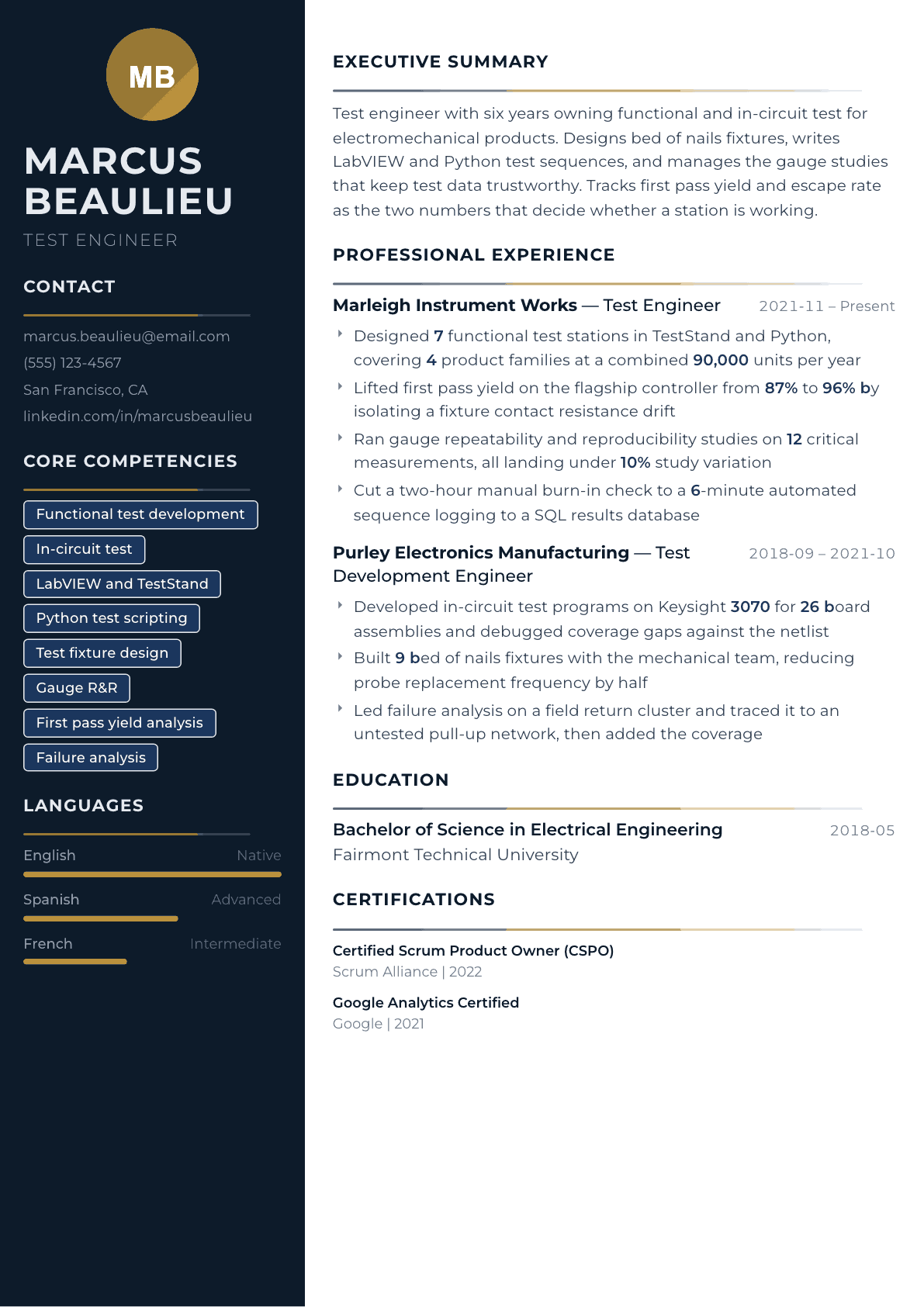
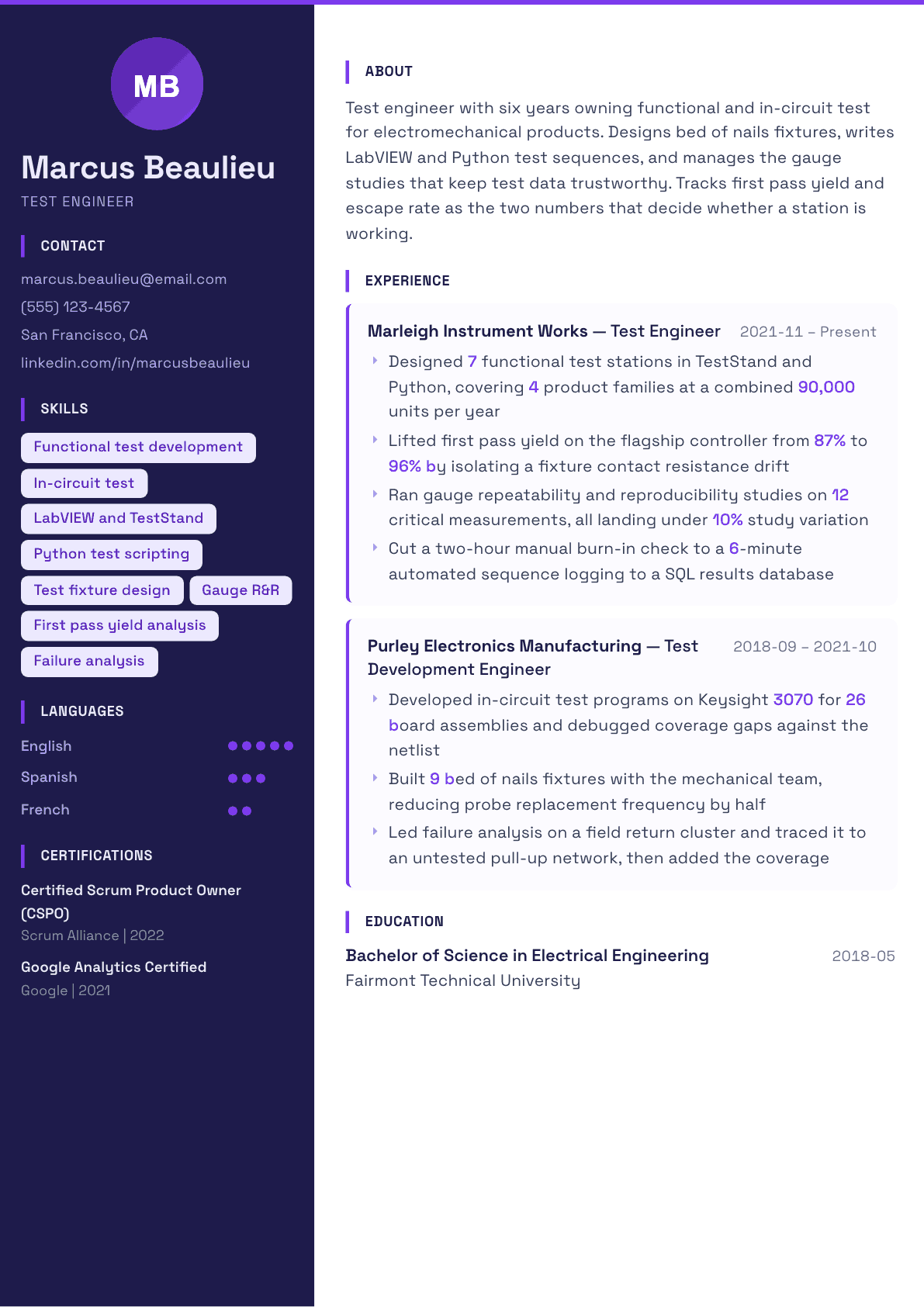
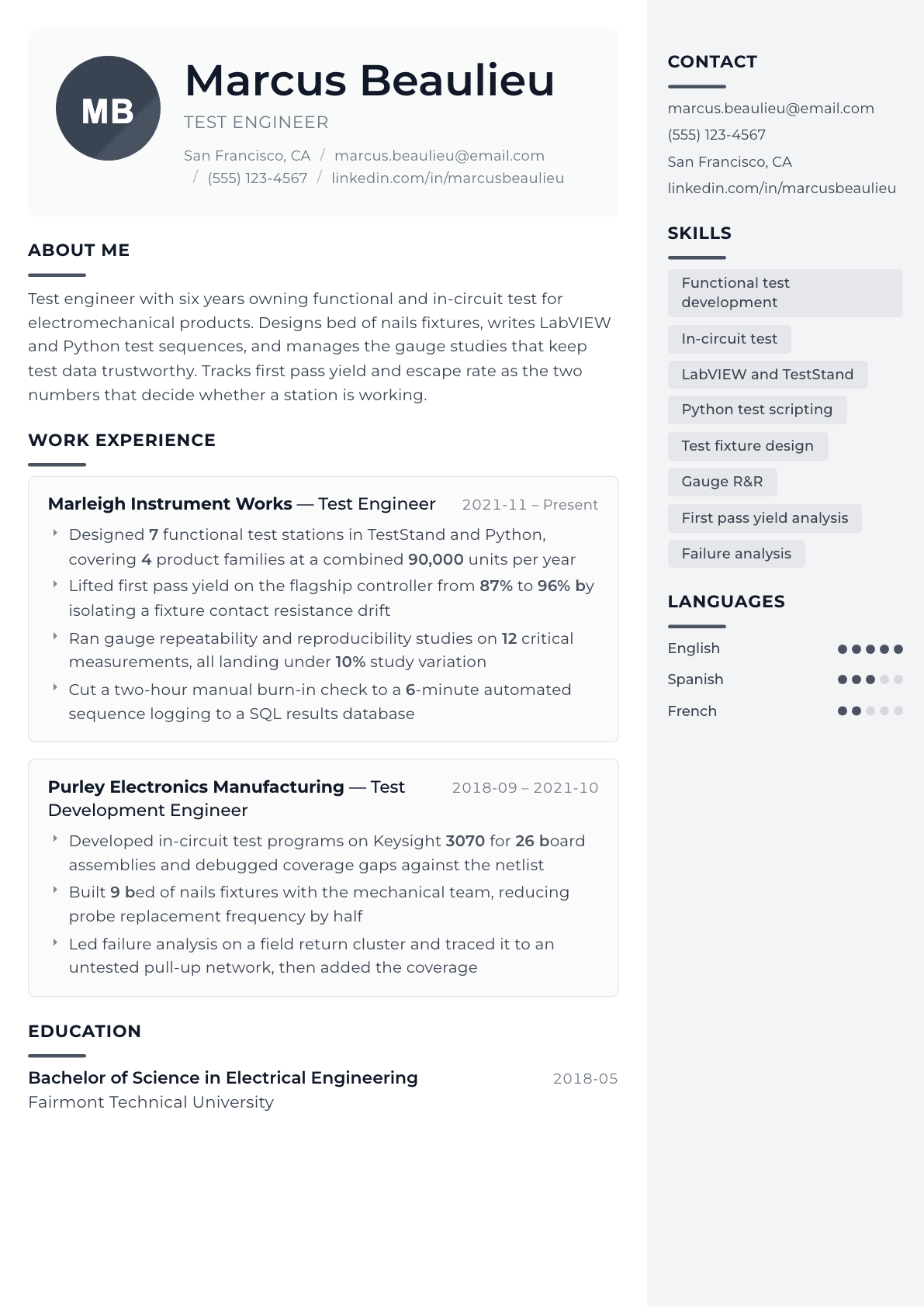
Example Test Engineer summary
Test engineer with six years building functional and in-circuit test for electromechanical products in volume manufacturing. Designs bed of nails fixtures, writes TestStand and Python sequences, and runs gauge studies before trusting any measurement. Has raised first pass yield on a flagship line and closed a field escape by adding the missing coverage. Seeking a lead test engineering role at a hardware manufacturer.
Skills to list on a Test Engineer resume
- Functional test development
- In-circuit test programming
- Boundary scan
- Test fixture design
- LabVIEW
- NI TestStand
- Python
- Keysight 3070
- Oscilloscope and DMM measurement
- Gauge R&R
- Statistical process control
- First pass yield
- Root cause analysis
- Design for testability
- Environmental stress screening
What actually gets this resume read
- State whether your testing is hardware, software or both, because the two hiring pipelines rarely read each other resumes.
- Quantify coverage, not activity: a percentage of nets tested or requirements verified says far more than a list of tools.
- Report first pass yield movement and field escapes, since those are the two metrics a manufacturing manager already tracks.
- Name the test executive and instrument stack, because TestStand, LabVIEW, pytest and Keysight platforms are all screened separately.
- Describe one fixture you designed end to end, including probe selection and wiring, to prove hands on capability.
- Include your measurement systems analysis work, because gauge studies prove you know when the measurement itself is the problem.
How to write a test engineer resume
Test engineer is one of the most ambiguous titles in engineering hiring. It can mean a person who writes automated software tests, a person who builds production test stations for circuit boards, or a person who runs environmental and durability testing on physical products. A resume that does not resolve that ambiguity in the first two lines gets passed over by all three hiring managers.
Once the domain is clear, the reader is checking two things: coverage and escapes. Coverage is what your testing actually verifies, expressed as a proportion of nets, requirements or failure modes. Escapes are the defects that reached the customer anyway. A test engineer who talks about tools without talking about coverage sounds like a technician, and gets paid like one.
This guide is written for hardware and manufacturing test engineering, and covers layout, section content, three example summaries, five rewritten bullets and the questions candidates ask when their resume is not converting.
Format: resolve the domain in the header
Put a domain qualifier next to the title in the header, such as production test engineer, hardware validation engineer or test development engineer. The applicant tracking system indexes the header, and the human reading it decides in a few seconds whether to keep going.
Single column, reverse chronological, one page under seven years. If you have built many stations, add a short test systems block after the summary listing station type, product family and instrument stack, so the experience section can focus on outcomes.
- Header: name, test domain qualifier, city and state, phone, email.
- Section order: summary, test systems block, experience, technical skills, education, certifications.
- Per job: product type, annual volume, and whether you developed or sustained the test.
Summary: what you test, at what volume, to what coverage
Give the product category, the manufacturing volume and the type of test you own. Functional test, in-circuit test, boundary scan, burn-in, environmental stress screening and system level test are distinct disciplines, and naming yours immediately positions you.
Then name a metric you moved. First pass yield, test time per unit, escape rate or fixture uptime are the numbers a manufacturing manager already reviews weekly, so a summary that speaks in those terms lands as a peer rather than an applicant.
Experience: stations built, coverage added, failures caught
Describe each test station as a small product you delivered. State the number of stations, the products they covered, the executive and language used, the instruments, and the throughput achieved. A station that ran unattended across three shifts is a stronger claim than a script that worked on a lab bench.
Coverage deserves at least one bullet per role. Say what proportion of nets an in-circuit program tested, or how many requirements a functional sequence verified, and describe one coverage gap you found and closed. Closing a gap that had produced field returns is the single most persuasive bullet a test engineer can write.
Include the fixture work explicitly. Probe selection, contact force, wiring, guarding and preventive maintenance intervals are where most test problems really live, and mechanical detail proves you have opened the fixture rather than only run it.
Data and measurement systems analysis
A test engineer who cannot defend the measurement is not finished. Describe your gauge repeatability and reproducibility work, your correlation studies between stations, and the limits you set with process capability rather than by copying the drawing tolerance. This is the block that separates senior from mid level candidates.
Say where the results go. A test station that logs to a database and drives a control chart is a manufacturing asset. A station that prints pass or fail on a screen is a gate. Name the database, the analysis tool and any dashboards you built.
- Measurement systems: gauge studies, station to station correlation, calibration intervals, guard banding.
- Data: results database, statistical process control charts, yield reporting, Pareto of failure codes.
- Limits: capability driven limits, tightened limits for early ramp, retest policy and its risks.
Design for testability and the influence you carry
Manufacturing test roles gain seniority through influence on design. Describe your design for testability reviews, the access you negotiated, the test points and boundary scan chains you asked for, and the coverage that resulted. A test engineer who is invited to schematic review is a different hire than one who receives finished boards.
Note the standards and practices you work to where relevant, since assembly acceptance criteria and electrostatic discharge control are part of a production test environment and reviewers look for them.
Test Engineer resume summary examples
New graduate
Electrical engineering graduate with an internship building a functional test fixture for a motor controller, including probe layout and a LabVIEW sequence. Familiar with oscilloscope, multimeter and power supply automation. Seeking an entry test engineering role in electronics manufacturing.
Five years in
Test engineer with 5 years developing functional and in-circuit test for electromechanical products at volumes near 90 thousand units per year. Builds fixtures and TestStand sequences, runs gauge studies, and raised first pass yield on a flagship controller from 87% to 96%.
Senior test engineer
Senior test engineer with 11 years owning test strategy across four product lines, from design for testability review through production station deployment at two contract manufacturers. Leads failure analysis on field returns and has closed three escape paths by adding targeted coverage.
Work experience bullets: before and after
Before: Developed test programs for manufacturing.
After: Developed 7 functional test stations in TestStand and Python covering 4 product families, running unattended across three shifts at a combined 90 thousand units per year.
Station count, product breadth and volume tell the reader the scale you can carry.
Before: Improved yield on the production line.
After: Raised first pass yield on the flagship controller from 87% to 96% by isolating contact resistance drift in the test fixture and changing to a longer travel spring probe.
The root cause and the physical fix show diagnosis rather than a yield number that appeared on its own.
Before: Wrote in-circuit test programs.
After: Wrote in-circuit test programs for 26 board assemblies, debugging coverage against the netlist and lifting tested node coverage on the main assembly by adding 40 test pads at schematic review.
Coverage and the design influence that enabled it are what a test manager is actually buying.
Before: Investigated customer returns.
After: Led failure analysis on a field return cluster, traced the defect to an untested pull-up network, added the coverage to the functional sequence and confirmed the failure mode disappeared from later builds.
Following an escape through to closed coverage proves the full test engineering loop.
Before: Reduced test time.
After: Replaced a two-hour manual burn-in check with a 6-minute automated sequence logging to a results database, freeing one operator per shift and enabling yield trending by failure code.
Labor freed and new data capability make the saving legible beyond the test department.
Hard skills
- Functional test development
- In-circuit test programming
- Boundary scan and JTAG
- Test fixture design
- LabVIEW and NI TestStand
- Python test automation
- Instrument control over GPIB and Ethernet
- Oscilloscope and multimeter measurement
- Gauge repeatability and reproducibility
- Statistical process control
- Design for testability review
- Environmental stress screening
- Failure analysis
- Results database and yield reporting
Soft skills
- Working alongside line operators
- Explaining coverage to designers
- Prioritizing under ramp pressure
- Clear test documentation
- Negotiating test access at design review
Certifications worth listing
- Certified LabVIEW Developer (National Instruments)
- Certified TestStand Developer (National Instruments)
- Certified Quality Engineer (CQE) (American Society for Quality)
- IPC-A-610 Certified IPC Specialist (IPC)
Mistakes that cost test engineer candidates the interview
- Leaving the domain ambiguous so software test and hardware test managers both assume you belong to the other one.
- Listing instruments and languages with no statement of what the test actually covers.
- Reporting yield numbers without the root cause work that moved them.
- Ignoring fixture mechanics, which is where most real production test failures originate.
- Skipping measurement systems analysis, which senior reviewers treat as the dividing line for the role.
- Describing test as a gate rather than as a source of data the factory uses to improve.
- Omitting design for testability influence, which is the main path to seniority in this discipline.
Test Engineer resume questions
How do I make clear I am a hardware test engineer, not a software QA engineer?
Say it in the header and repeat it in the first summary line with physical evidence: fixtures, instruments, boards, units per year. Recruiters filter on those nouns. Without them the title alone will route your resume to the wrong pipeline.
What test metrics should a resume actually include?
First pass yield and its movement, test time per unit, coverage as a proportion of nets or requirements, escape rate, and station uptime. Choose the two your target employer is most likely to track, and show a before and after rather than a static figure.
Should I list every product I have tested?
No. Group them into families and give the count and volume. A reader wants to know whether you have handled high mix low volume work or a single high volume line, because the test strategy and the daily pressures are completely different.
How much programming detail belongs on a test engineer resume?
Name the executive, the languages and the instrument interfaces, then show one automation result with a time or coverage number attached. Deep software architecture detail belongs in the interview. The resume needs to prove you can build and maintain a sequence that survives a factory.
Is contract manufacturer experience valued?
Yes, and it is worth calling out. Deploying and supporting a test station at an external site adds documentation, training and remote debugging demands that internal-only engineers have never faced. Name the transfer, the site and how you kept the stations correlated.
Related resume examples
- QA Engineer Resume example
- Manufacturing Engineer Resume example
- Test Automation Engineer Resume example
- Validation Engineer Resume example
- RF Engineer Resume example
- Semiconductor Engineer Resume example