What Is a Cover Letter? Definition, Parts and 6 Examples
By Mustafa Tarabya, founder of CVBooster · Published · Updated
11 min read
A cover letter is a one page letter you send with your resume that tells one employer why you want this job and why you fit it, in full sentences your resume cannot use. The constraint is that it only works when it is written for that one job; a letter that would fit any advert does nothing. The Purdue Online Writing Lab defines it plainly: "A cover letter introduces you and your resume to potential employers or organizations you seek to join". Below are the five parts, the length, and six complete letters from first job to senior. Written by Mustafa Tarabya, who hired for his own company, read every application himself and now writes CVBooster's guides.
You have been asked for a cover letter, you have a perfectly good resume, and you are now wondering why a company wants the same information twice, in a worse format. It does not. It wants the part your resume left out.
Cover letter definition: what it is for
The resume is the record. The cover letter is the argument. It takes two or three things from your resume and connects them, in sentences, to what this employer said it needs.
In the UK the same document is often called a covering letter. The National Careers Service describes it in one line: "A cover letter introduces you to an employer and asks them to think about your application." That is the whole job. Purdue lists what it adds on top of the resume, including the chance to "Provide a sample of your written communication skills".
A cover letter is for four things:
- Saying which job you want, by its exact title.
- Showing two or three matches between the advert and your experience, with proof.
- Explaining what a resume cannot: a career change, a gap, a move, why this company.
- Asking for the interview.
Here is what that looks like at its simplest, for a first job.
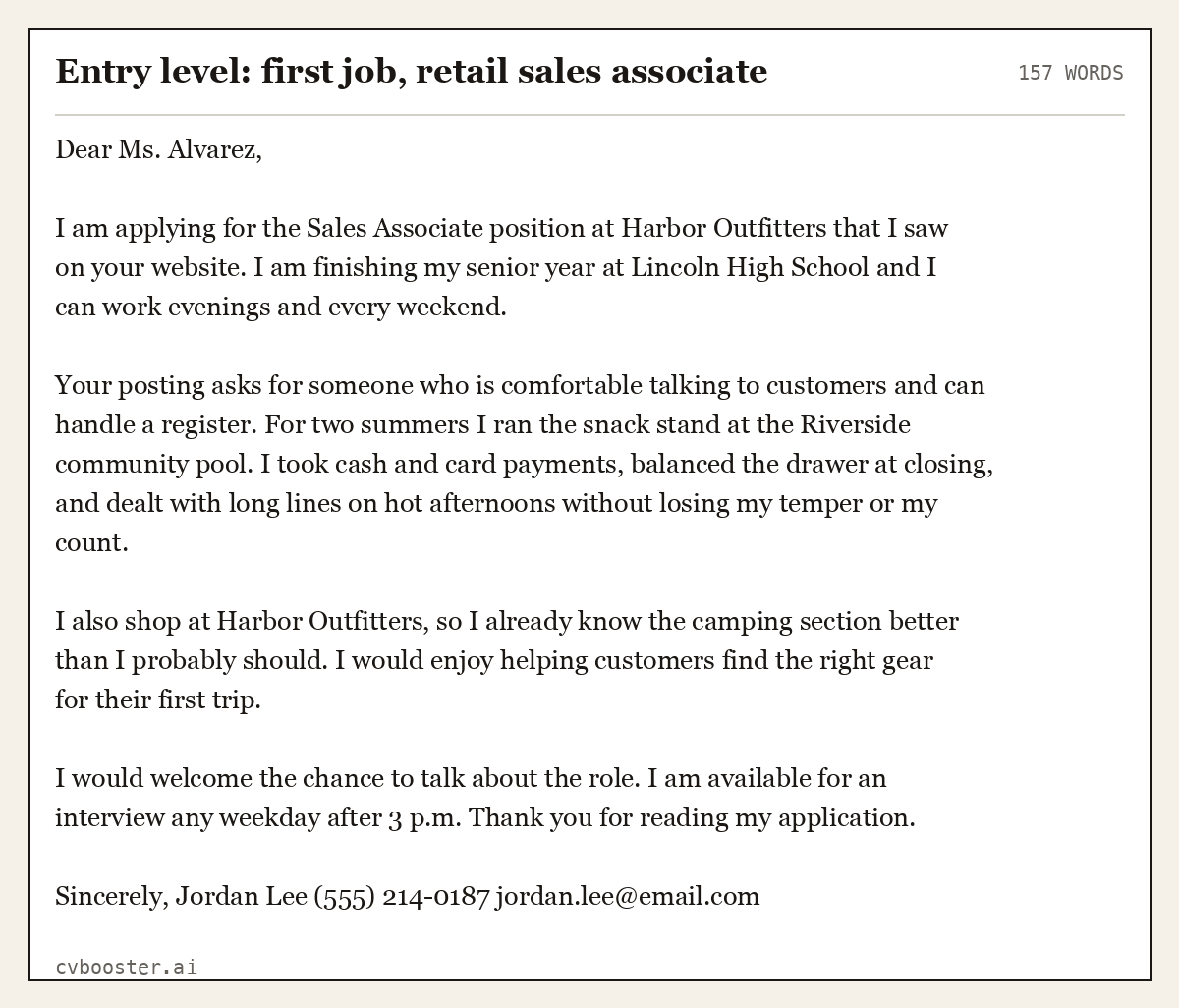
Entry level: first job, retail sales associate (157 words)
Dear Ms. Alvarez,
I am applying for the Sales Associate position at Harbor Outfitters that I saw on your website. I am finishing my senior year at Lincoln High School and I can work evenings and every weekend.
Your posting asks for someone who is comfortable talking to customers and can handle a register. For two summers I ran the snack stand at the Riverside community pool. I took cash and card payments, balanced the drawer at closing, and dealt with long lines on hot afternoons without losing my temper or my count.
I also shop at Harbor Outfitters, so I already know the camping section better than I probably should. I would enjoy helping customers find the right gear for their first trip.
I would welcome the chance to talk about the role. I am available for an interview any weekday after 3 p.m. Thank you for reading my application.
Sincerely, Jordan Lee (555) 214-0187 jordan.lee@email.com
The five parts of a cover letter
Every cover letter, at every level, has the same five parts. CareerOneStop, sponsored by the U.S. Department of Labor, names them as a heading and greeting, a brief introduction, your highlights and a closing.
- Heading. Your name, phone, email and the date. Add your city only if location matters for the job.
- Greeting. A named person if you can find one. CareerOneStop says: "Address the letter to a specific person whenever possible." If you cannot find a name, use the reader's job title, such as "Dear Hiring Manager".
- Opening paragraph. The job title, where you saw it, and one sentence on why you fit.
- Body, one or two paragraphs. Two or three requirements from the advert, each matched with something you did.
- Closing. Ask for the interview, thank the reader, sign off with "Sincerely".
The example below follows the five parts exactly, for a mid level job.
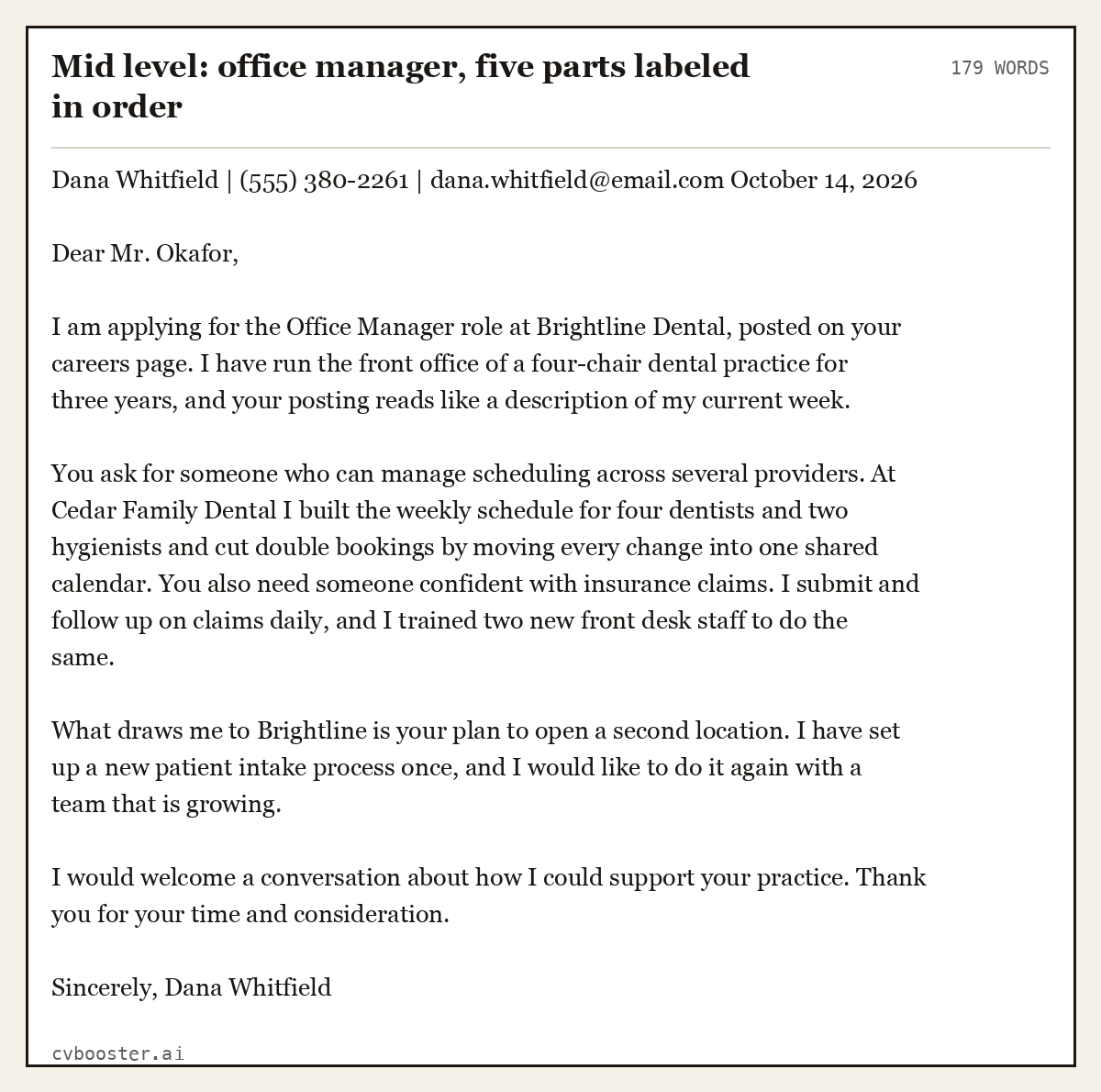
Mid level: office manager, five parts labeled in order (179 words)
Dana Whitfield | (555) 380-2261 | dana.whitfield@email.com October 14, 2026
Dear Mr. Okafor,
I am applying for the Office Manager role at Brightline Dental, posted on your careers page. I have run the front office of a four-chair dental practice for three years, and your posting reads like a description of my current week.
You ask for someone who can manage scheduling across several providers. At Cedar Family Dental I built the weekly schedule for four dentists and two hygienists and cut double bookings by moving every change into one shared calendar. You also need someone confident with insurance claims. I submit and follow up on claims daily, and I trained two new front desk staff to do the same.
What draws me to Brightline is your plan to open a second location. I have set up a new patient intake process once, and I would like to do it again with a team that is growing.
I would welcome a conversation about how I could support your practice. Thank you for your time and consideration.
Sincerely, Dana Whitfield
How long is a cover letter?
One page, three to five short paragraphs. CareerOneStop puts a number on it: "A good letter can be about 200-400 words, with just 3-4 short paragraphs." Prospects, the UK graduate careers site, agrees on the ceiling: "cover letters should not exceed one A4 page."
If yours runs to a second page, cut the paragraph that repeats your resume. That paragraph is always there, and it is always the one to cut. For short versions that still do the job, see our short cover letter examples.
Cover letter vs resume: what goes where
The resume lists. The cover letter connects. Prospects says the letter "should complement your CV but not duplicate it", and the easiest test is this: if a sentence in your letter could be a bullet on your resume, it is in the wrong document.
- Resume: dates, titles, duties, results, skills, education.
- Cover letter: why this job, which of those results matter here, and anything that needs a sentence of context.
Our full comparison is in cover letter vs resume. The next example shows the context a resume cannot carry: a career change.
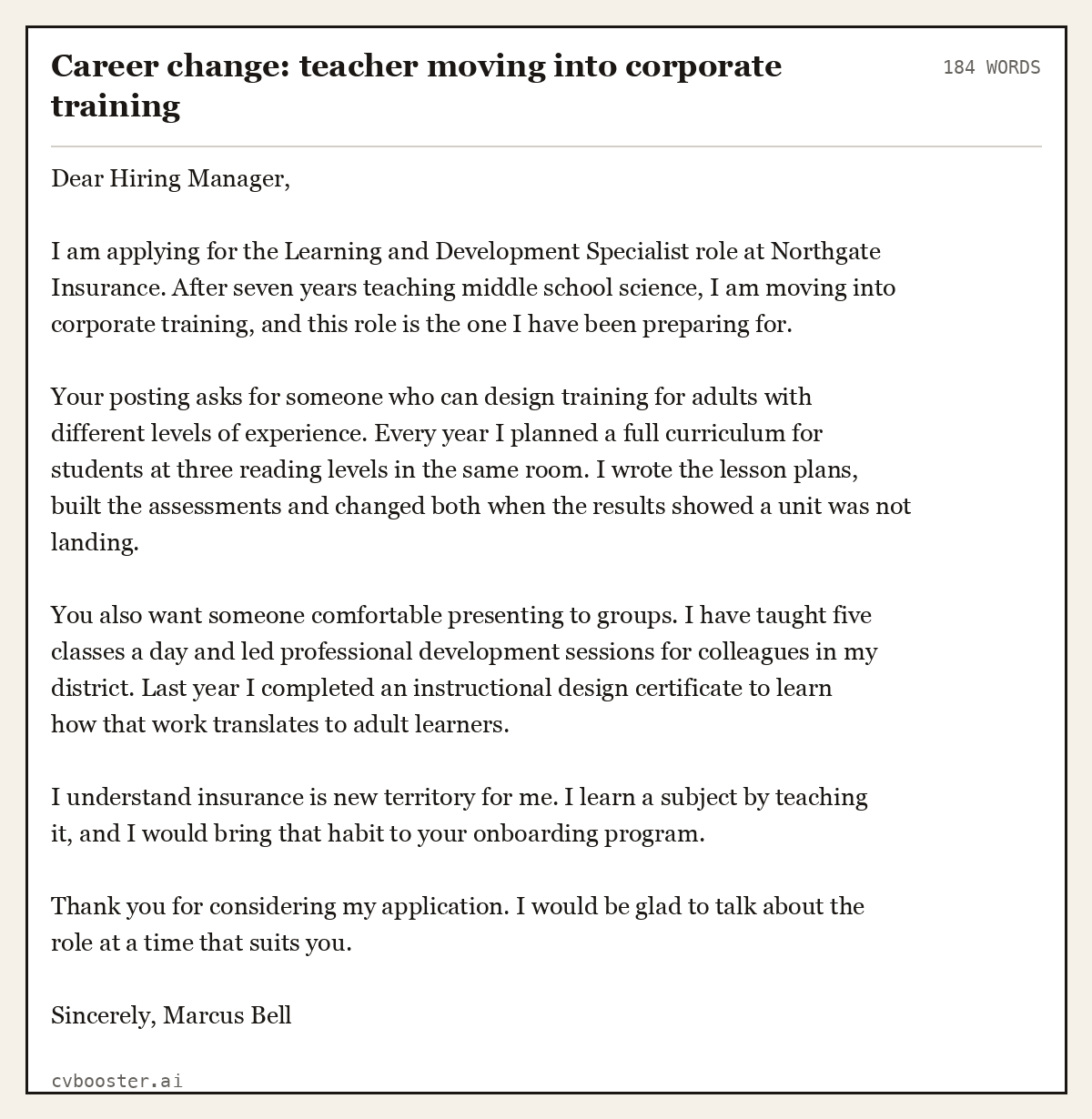
Career change: teacher moving into corporate training (184 words)
Dear Hiring Manager,
I am applying for the Learning and Development Specialist role at Northgate Insurance. After seven years teaching middle school science, I am moving into corporate training, and this role is the one I have been preparing for.
Your posting asks for someone who can design training for adults with different levels of experience. Every year I planned a full curriculum for students at three reading levels in the same room. I wrote the lesson plans, built the assessments and changed both when the results showed a unit was not landing.
You also want someone comfortable presenting to groups. I have taught five classes a day and led professional development sessions for colleagues in my district. Last year I completed an instructional design certificate to learn how that work translates to adult learners.
I understand insurance is new territory for me. I learn a subject by teaching it, and I would bring that habit to your onboarding program.
Thank you for considering my application. I would be glad to talk about the role at a time that suits you.
Sincerely, Marcus Bell
Do you always need a cover letter?
Not always. CareerOneStop says it straight: "Many employers don't ask for a cover letter when you apply." It names three situations where you should send one: the posting asks for it, the posting lists it as optional, or the employer asks you to email your resume, in which case the email body becomes the letter.
My rule from the hiring side: if there is a box for it, fill the box. I wrote the adverts for my own company, so I knew exactly which four things I was looking for. Most of the applications never mentioned any of them, and a letter is the easiest place to name them.
Here is the email version, which is how most cover letters are sent now.
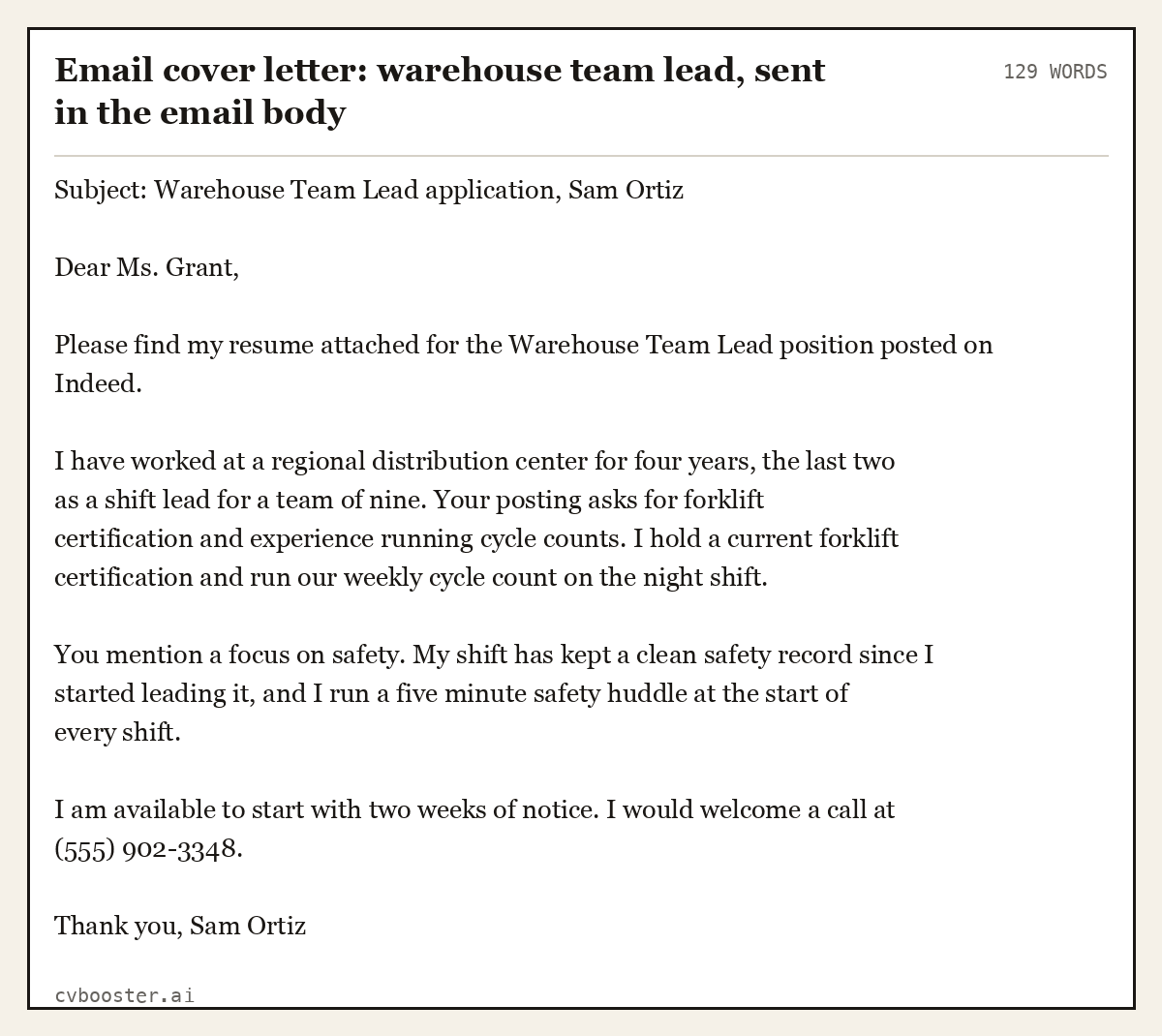
Email cover letter: warehouse team lead, sent in the email body (129 words)
Subject: Warehouse Team Lead application, Sam Ortiz
Dear Ms. Grant,
Please find my resume attached for the Warehouse Team Lead position posted on Indeed.
I have worked at a regional distribution center for four years, the last two as a shift lead for a team of nine. Your posting asks for forklift certification and experience running cycle counts. I hold a current forklift certification and run our weekly cycle count on the night shift.
You mention a focus on safety. My shift has kept a clean safety record since I started leading it, and I run a five minute safety huddle at the start of every shift.
I am available to start with two weeks of notice. I would welcome a call at (555) 902-3348.
Thank you, Sam Ortiz
What a covering letter looks like in the UK
UK letters follow the same five parts, with three differences. They are often called covering letters, they sit next to a CV rather than a resume, and the sign off depends on the greeting. The National Careers Service gives the rule: end with "Yours sincerely" when you know the name, and "If you’ve addressed the letter ‘Dear Sir or Madam’, you should end the letter with ‘Yours faithfully’."
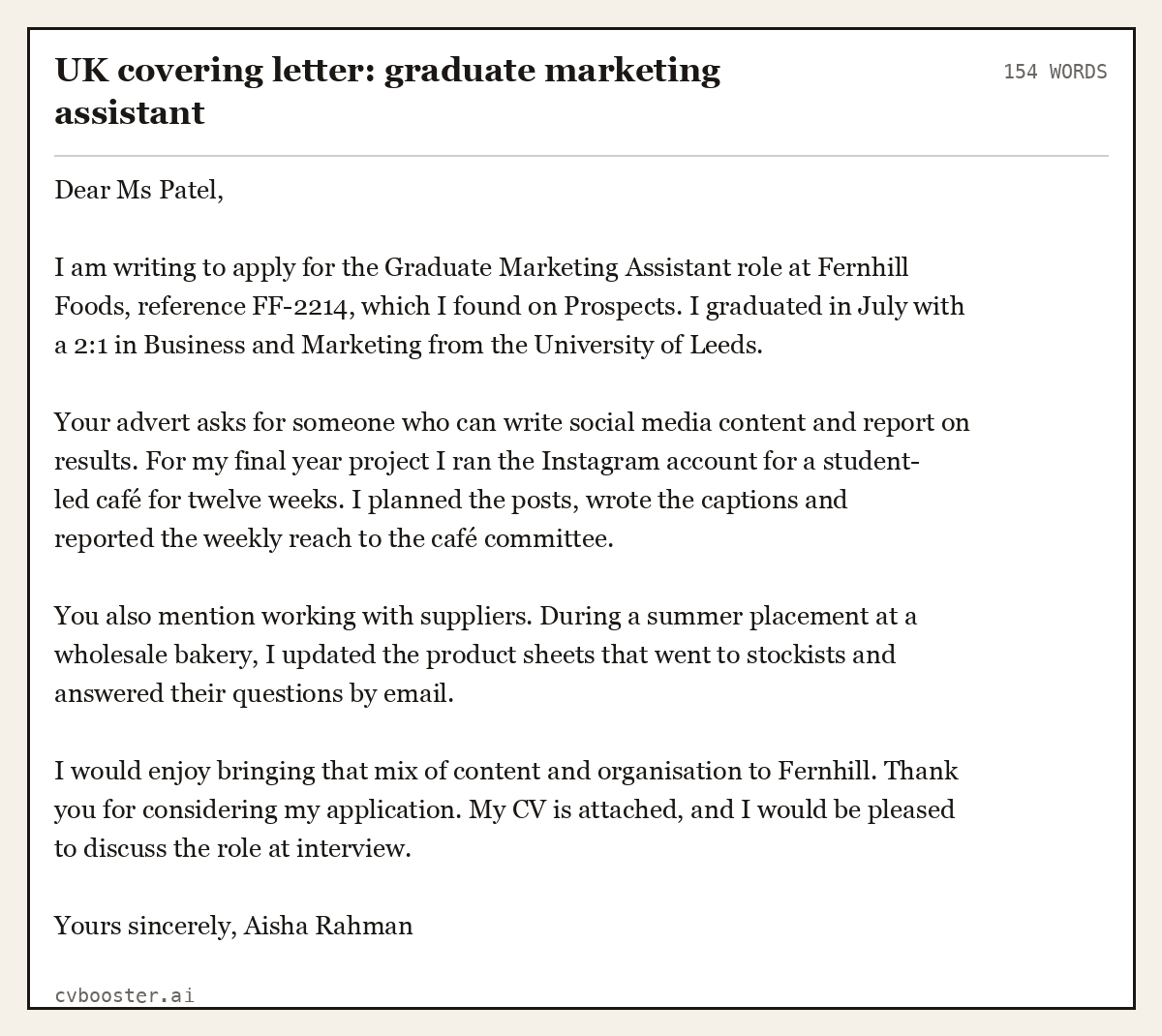
UK covering letter: graduate marketing assistant (154 words)
Dear Ms Patel,
I am writing to apply for the Graduate Marketing Assistant role at Fernhill Foods, reference FF-2214, which I found on Prospects. I graduated in July with a 2:1 in Business and Marketing from the University of Leeds.
Your advert asks for someone who can write social media content and report on results. For my final year project I ran the Instagram account for a student-led café for twelve weeks. I planned the posts, wrote the captions and reported the weekly reach to the café committee.
You also mention working with suppliers. During a summer placement at a wholesale bakery, I updated the product sheets that went to stockists and answered their questions by email.
I would enjoy bringing that mix of content and organisation to Fernhill. Thank you for considering my application. My CV is attached, and I would be pleased to discuss the role at interview.
Yours sincerely, Aisha Rahman
Senior cover letter: shorter, sharper, more specific
The more senior the role, the shorter the letter tends to be, because the reader has less time and more to compare. Lead with the one result that matches their biggest problem. The how to end a cover letter guide covers the last paragraph in more detail.
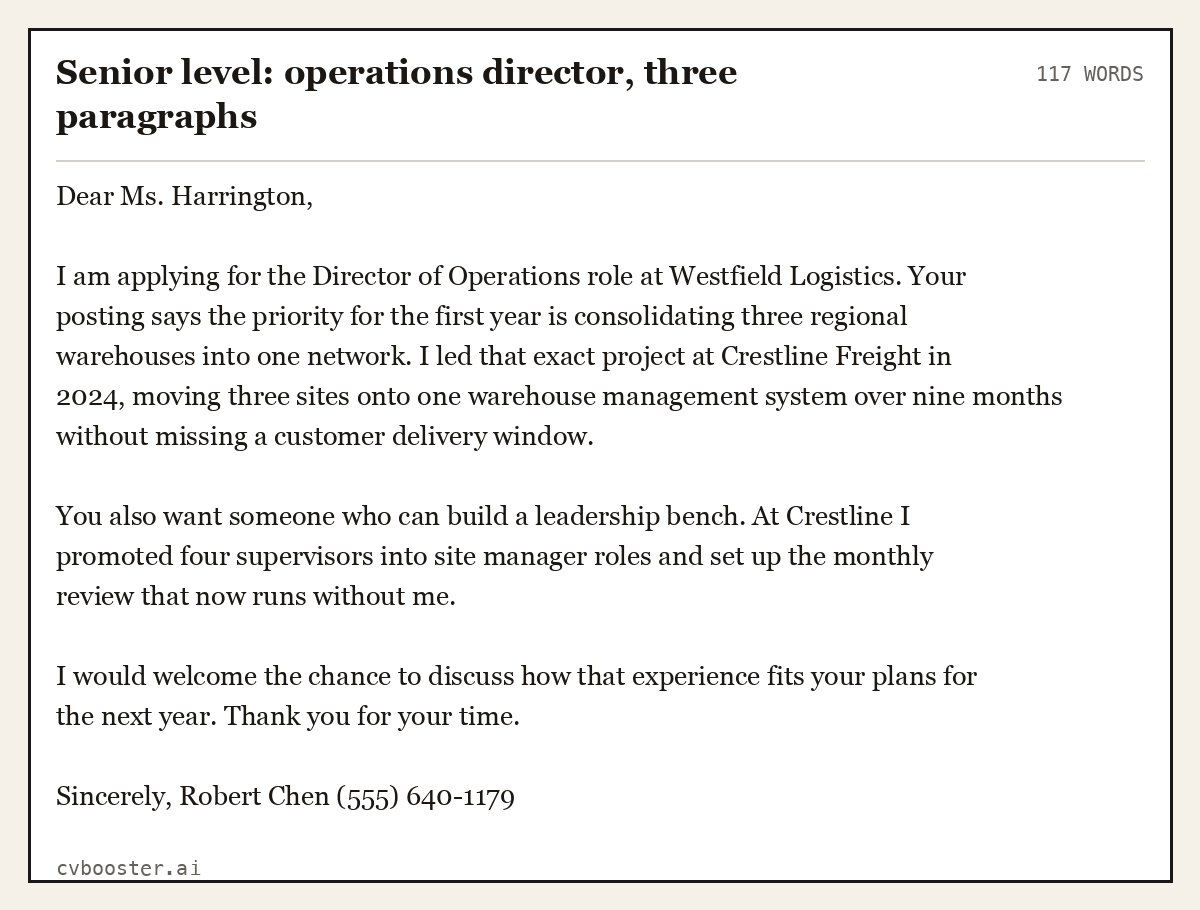
Senior level: operations director, three paragraphs (117 words)
Dear Ms. Harrington,
I am applying for the Director of Operations role at Westfield Logistics. Your posting says the priority for the first year is consolidating three regional warehouses into one network. I led that exact project at Crestline Freight in 2024, moving three sites onto one warehouse management system over nine months without missing a customer delivery window.
You also want someone who can build a leadership bench. At Crestline I promoted four supervisors into site manager roles and set up the monthly review that now runs without me.
I would welcome the chance to discuss how that experience fits your plans for the next year. Thank you for your time.
Sincerely, Robert Chen (555) 640-1179
Common cover letter mistakes
- Writing it for any job. If you could swap the company name and send it elsewhere, it is a template, not a letter.
- Retelling the resume. The reader has the resume. Use the letter for the why and the context.
- Opening with your life story. The job title goes in sentence one.
- Two pages. One page is the ceiling every source above agrees on.
- No ask. End by asking for the interview, plainly.
The step by step version, from a blank page, is in how to write a cover letter, and the layout rules are in our cover letter format guide.
Frequently asked questions
What is a cover letter in simple words?
A cover letter is a short letter you send with your resume when you apply for a job. It says which job you want, why you are a good match, and asks for an interview. It uses full sentences to explain things your resume can only list, such as why you want this particular job.
What is the main purpose of a cover letter?
The main purpose is to connect your experience to one specific job and persuade the employer to read your resume and invite you to interview. It also shows how you write, explains context like a career change or a gap, and proves you read the posting rather than sending the same letter everywhere.
What should a cover letter include?
A heading with your contact details and the date, a greeting to a named person if possible, an opening that names the job, one or two paragraphs matching your experience to the posting, and a closing that asks for an interview. Sign off with "Sincerely" in the US or "Yours sincerely" in the UK.
Is a cover letter the same as a resume?
No. A resume is a structured list of your work history, skills and education. A cover letter is a one page letter in paragraphs that picks two or three points from the resume and explains why they matter for this job. Send both together, and do not repeat the resume line by line.
What is a cover letter called in the UK?
In the UK it is often called a covering letter, and it goes with a CV rather than a resume. The structure is the same. The main difference is the sign off: "Yours sincerely" when you know the reader's name, "Yours faithfully" when you start with "Dear Sir or Madam".
Is a cover letter still necessary?
Send one whenever the posting asks for it or lists it as optional. Many employers do not ask for one, and then your resume can stand alone. If there is a place to add one, adding a short letter written for that job is a small amount of work for a clear advantage.
Related articles
- How to Write a Cover Letter: Structure, Examples, and What to Skip
- Letter of Intent Template: 6 Full Job Examples to Copy
- Application Letter for Student: 5 Full Samples to Copy
- Application Letter Format in Word: UK Layout and 5 Letters
More articles
- Personal Info in a CV: What UK Employers Want Left Off
- What to Bring to an Interview: A UK Checklist for Every Job
- Where to Put Internship on Resume: 6 Layout Examples
Looking for a worked example for your job title? Browse the resume examples by job title.