Credit Analyst Resume Examples: the lines they read
Build a Credit Analyst Resume That Assesses Every Risk
By Mustafa Tarabya, founder of CVBooster · Published · Updated
Create a credit analyst resume showcasing credit risk assessment, financial statement analysis, and portfolio monitoring with quantified lending decisions.
Sample resumes for a credit analyst
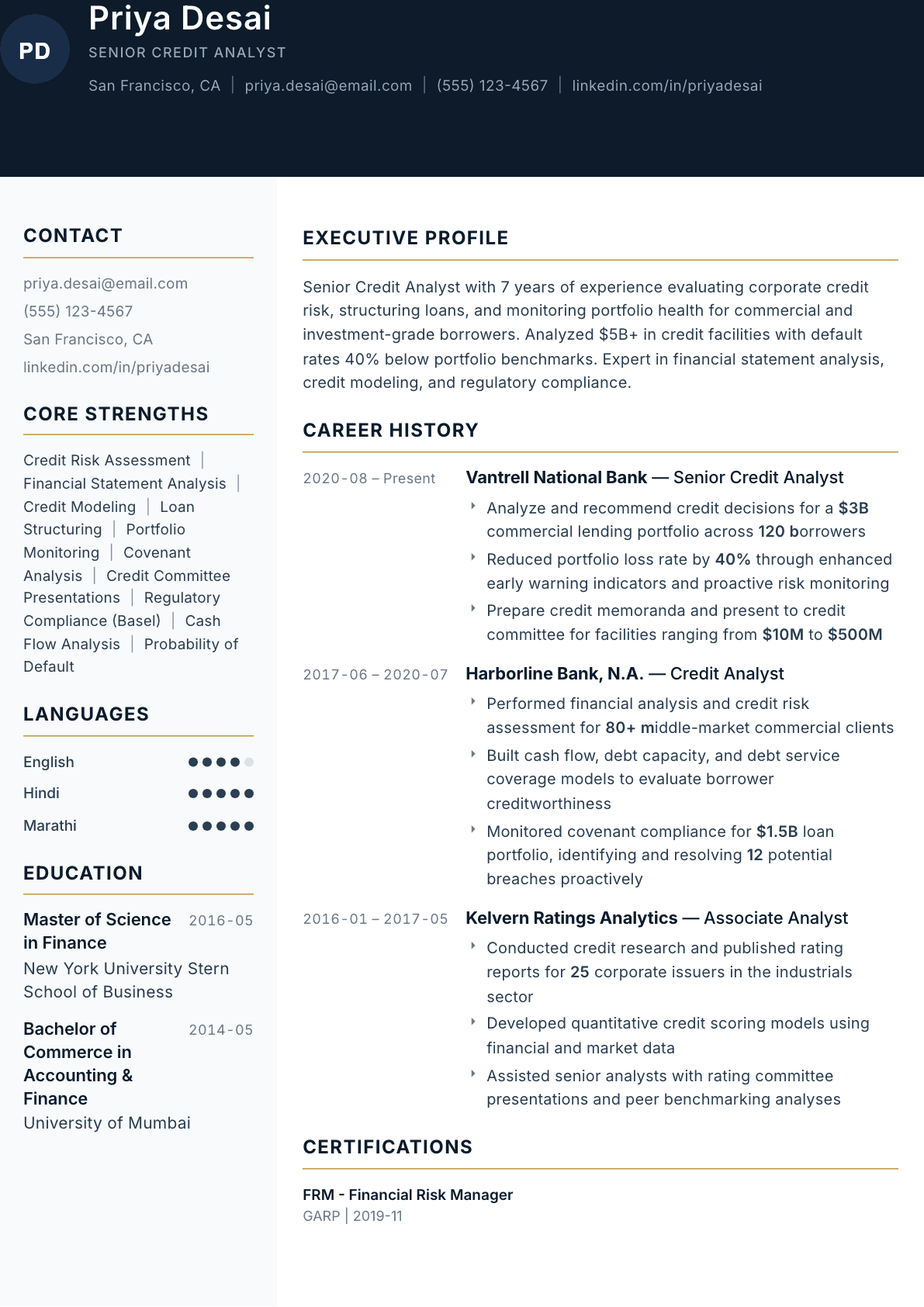
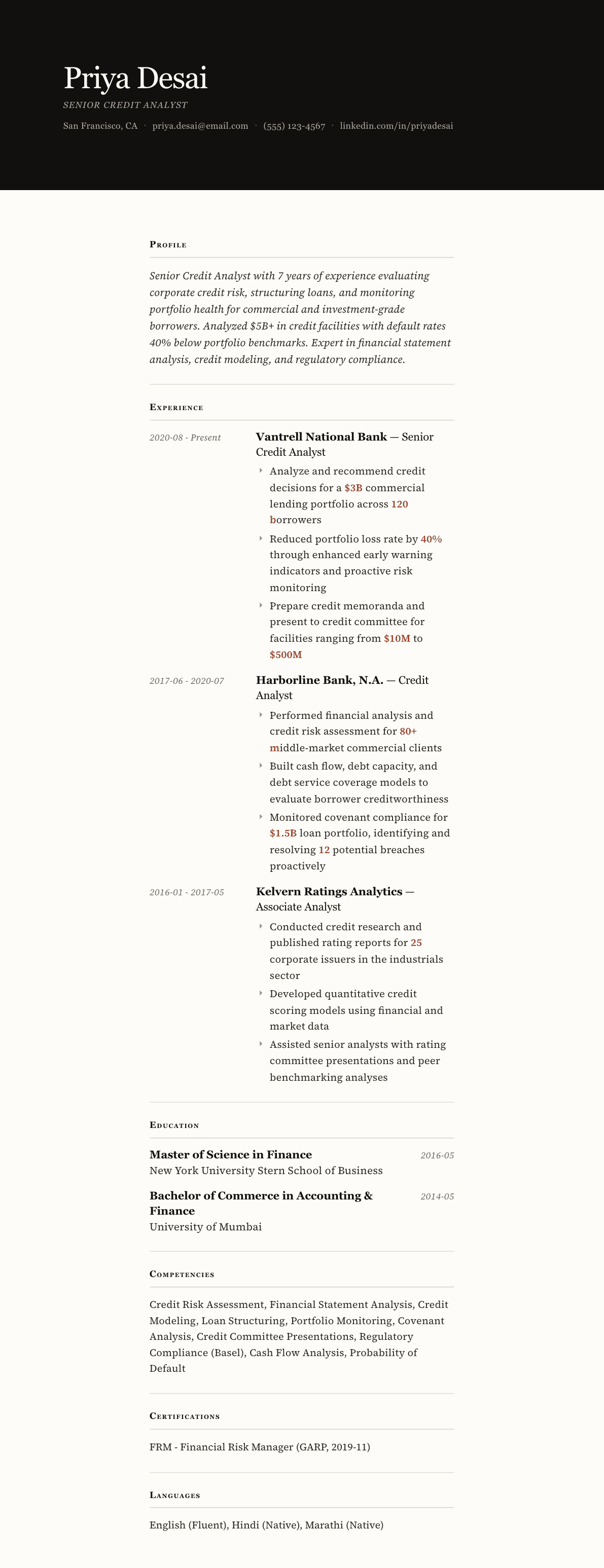
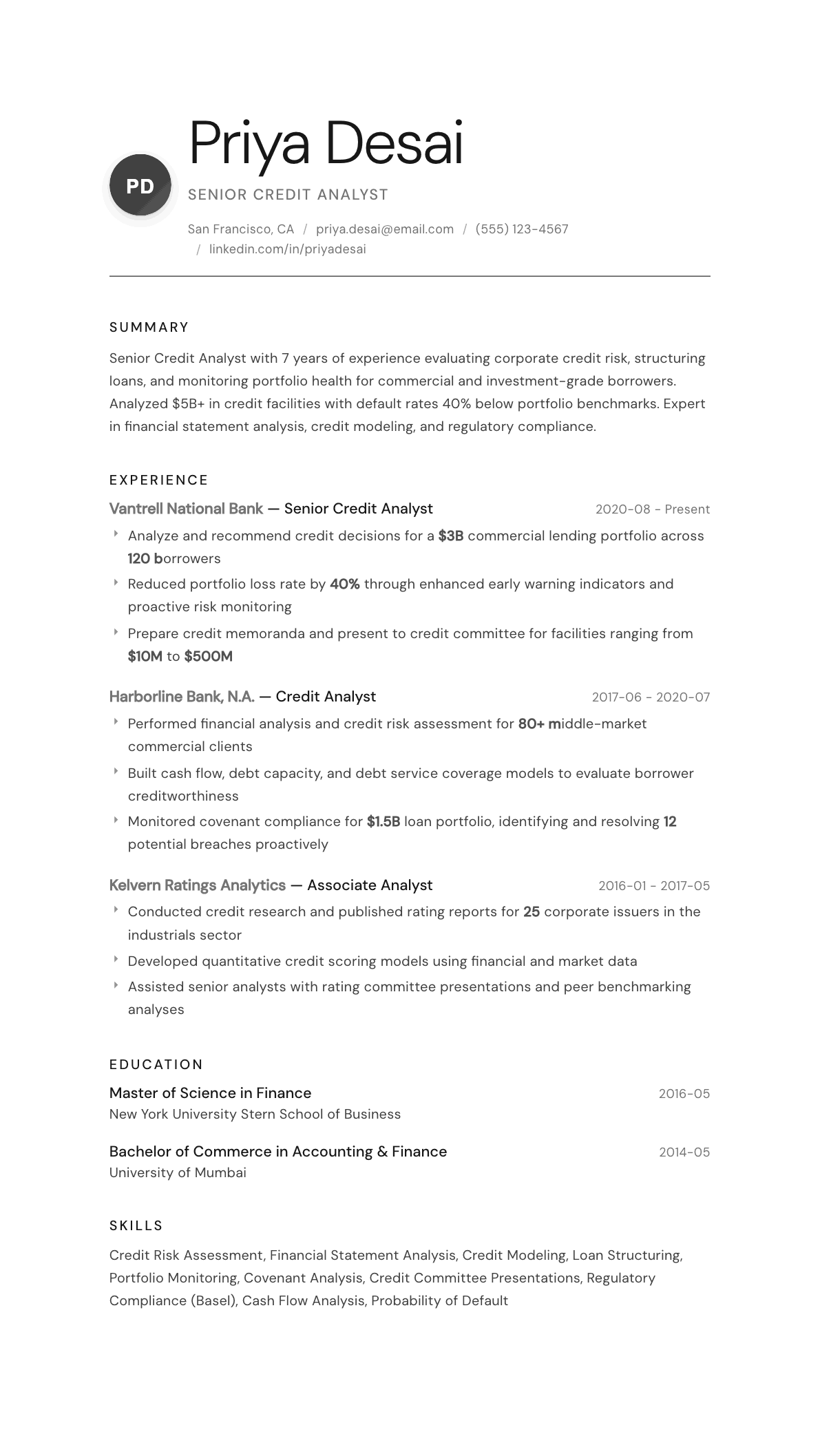
The same credit analyst content laid out in three CVBooster templates, so you can see what the finished document looks like before you write a word.
Example Credit Analyst summary
FRM-certified Senior Credit Analyst with 7 years of experience evaluating corporate credit risk and managing $5B+ in lending portfolios. Reduced portfolio loss rates by 40% through enhanced monitoring and early warning systems. Expert in financial modeling, loan structuring, and Basel compliance. Seeking a Credit Manager role to lead credit strategy at a major financial institution.
Skills to list on a Credit Analyst resume
- Credit Risk Assessment
- Financial Statement Analysis
- Credit Modeling
- Loan Structuring
- Portfolio Monitoring
- Covenant Analysis
- Cash Flow Analysis
- Probability of Default (PD)
- Loss Given Default (LGD)
- Basel Compliance
- Credit Committee Presentations
- Stress Testing
What actually gets this resume read
- Quantify portfolio size, number of borrowers, and facility ranges you analyzed.
- Show portfolio performance metrics: default rates, loss rates, early warning detection.
- Highlight credit modeling skills: cash flow models, scoring models, stress testing.
- Include credit committee presentation experience and decision-making involvement.
- Demonstrate industry specialization (real estate, healthcare, energy) if applicable.
- FRM and CFA designations are highly valued in credit roles.
How to write a credit analyst resume
A credit analyst resume is a writing sample disguised as a career history. The credit officer reading it knows that the job is to reach a defensible opinion about whether a borrower can repay, and then defend it in front of people who want the deal done. If the resume itself is vague about facts, it is quietly answering the only question that matters.
Say which credit you analyze. Commercial and industrial lending, commercial real estate, asset based lending, leveraged finance, corporate bond research, consumer and small business scoring, and counterparty credit are separate disciplines with different documents, different metrics and different committees. Naming yours, along with the facility sizes and industries you cover, is what puts the file in the right pile.
This guide covers how to structure a credit analyst resume around a portfolio, how to write underwriting and monitoring work so a credit officer can judge your thinking, five bullet rewrites, and the questions analysts ask when they move toward a lending or portfolio management seat.
Format: portfolio scope first, credentials in the header
One page through roughly seven years, two after. Reverse-chronological, plain, no visual clutter. Under each role, lead with the portfolio: borrower count, aggregate exposure, facility size range, industries, and whether the credits were investment grade, middle market or leveraged.
Put the chartered financial analyst or financial risk manager credential after your name, and give exam progress if you are partway through, since credit teams sponsor candidates and want to know where you are in the sequence.
- Header: name with CFA or FRM when held, city and state, phone, email.
- Order: summary, credit portfolio experience, modeling and systems skills, credentials and exam progress, education.
- Portfolio line per role: exposure, borrower count, facility range, industry mix, risk grade band.
Summary: portfolio, product, and where your opinion lands
Name the product set, the portfolio size and what happens to your work. An analyst whose credit memos go directly to committee with a recommendation is more senior than one who prepares spreads for a relationship manager to present, even at the same experience level. Say which you are.
Add the analytical center of gravity. Cash flow modeling and debt capacity, covenant construction and testing, collateral and borrowing base analysis, real estate underwriting with debt service coverage and loan to value, or portfolio level stress testing all describe different strengths, and a credit officer hires for the one they lack.
Experience: spread, analyze, structure, monitor
Work through the credit process. Spreading: how many financial statements you normalize a year, in what system, for what kind of borrower, including the adjustments you make to reported earnings. Analysis: the ratios that drive your view, such as leverage, fixed charge coverage, debt service coverage, working capital cycle and liquidity, plus the qualitative work on industry, management and customer concentration.
Structure is where an analyst becomes valuable. Recommending an advance rate, a covenant package, an amortization profile, a guarantee, a borrowing base with eligibility criteria, or a springing test is real credit work, and naming it separates you from someone who only produces spreads.
Monitoring is the half of the job that keeps a bank out of trouble. Covenant compliance testing, annual reviews, risk rating changes, watch list preparation, early warning indicators, and the file you flagged before anyone else did are the strongest bullets a credit analyst can write, because they show judgment that was proven right by events.
The credit memo and the committee
The credit memo is your product, so treat it as one. Say how many you write a year, the typical facility size, whether you present at committee or write for someone who does, and what a memo of yours contains: the transaction request, the borrower and industry analysis, the historical and projected financial analysis, the sensitivity cases, the collateral and structure, the risks and the mitigants.
Being able to say that a recommendation was declined and why is a mark of seniority, not a weakness. Credit officers respect an analyst who has held a negative view in a room that wanted a yes.
Models, systems and keywords
Name the tools by their real names: Moody Analytics CreditLens or RiskCalc, nCino, Sageworks, Baker Hill, Bloomberg, Capital IQ, FactSet, plus Excel modeling and SQL for portfolio analysis. Add regulatory and framework knowledge where it applies, such as regulatory risk rating definitions, allowance methodology and stress testing practice.
Mirror posting language once in the skills area and once in a bullet: credit analysis, financial statement spreading, cash flow modeling, covenant analysis, risk rating, loan structuring, portfolio monitoring, annual review, credit memorandum and committee presentation.
Credit Analyst resume summary examples
Credit analyst I
Finance graduate with a credit training program completed and a year spreading financial statements for small business borrowers in Sageworks. Prepares annual review packages, tests covenant compliance and drafts the financial analysis section of credit memos for a relationship manager to present.
Commercial credit analyst
Commercial credit analyst covering a middle market portfolio of 45 borrowers and roughly 600 million dollars in exposure across manufacturing and distribution. Writes 30 credit memos a year with a recommendation, builds cash flow and sensitivity models, and presents smaller renewals directly to committee.
Senior credit analyst
Senior credit analyst on leveraged and asset based transactions with facilities from 20 to 150 million dollars, owning structure recommendations, covenant packages and borrowing base eligibility. Mentors two analysts, presents to credit committee, and runs the quarterly watch list and risk rating review for the portfolio.
Work experience bullets: before and after
Before: Analyzed financial statements for commercial borrowers.
After: Spread and normalized statements for 60 middle market borrowers annually, adjusting for owner compensation, non-recurring items and lease treatment before calculating leverage and fixed charge coverage.
The adjustments are the analysis, and naming them proves you build the numbers rather than typing them into a template.
Before: Wrote credit memos for loan approvals.
After: Authored 34 credit memoranda covering facilities from 5 to 40 million dollars, each with a base and downside case, a covenant recommendation and an explicit risk and mitigant section, and presented 12 at committee.
Memo count, facility range, contents and committee presentations describe the product and the level you operate at.
Before: Monitored the loan portfolio for problems.
After: Tested quarterly covenant compliance across 45 credits, identified a fixed charge coverage breach two quarters before the borrower reported it, and moved the relationship to the watch list ahead of a restructuring.
An early warning that proved correct is the single most persuasive thing a credit analyst can put on a resume.
Before: Built financial models in Excel.
After: Built a cash flow model with a borrowing base and seasonal working capital swing for a distributor, ran a downside case on gross margin compression, and set the advance rate the structure ultimately used.
A model that changed a structure decision is credit modeling, while a model in Excel is a software claim.
Before: Recommended loans for approval.
After: Recommended declining a real estate request where the debt service coverage relied on unsigned leases, documented the position for committee, and the credit was later approved with additional recourse and a reserve.
Holding and documenting a negative view shows independence, which is the trait a credit officer is really hiring for.
Hard skills
- Financial statement spreading and normalization
- Cash flow and debt capacity modeling
- Ratio analysis including leverage and coverage
- Covenant construction and compliance testing
- Loan structuring and advance rate recommendation
- Borrowing base and collateral analysis
- Commercial real estate underwriting
- Risk rating methodology and annual reviews
- Credit memorandum writing
- Industry and management assessment
- Moody Analytics, Sageworks and nCino
- Excel modeling, Capital IQ and Bloomberg
Soft skills
- Independent judgment under sales pressure
- Clear written argument
- Committee presentation
- Asking a borrower an uncomfortable question
- Attention to a footnote
Certifications worth listing
- Chartered Financial Analyst (CFA) (CFA Institute)
- Financial Risk Manager (FRM) (Global Association of Risk Professionals)
- Credit Risk Certification (CRC) (Risk Management Association)
- Certified Credit Professional programs (National Association of Credit Management)
- Certified Public Accountant (CPA) (State Board of Accountancy, administered by NASBA and the AICPA)
Mistakes that cost credit analyst candidates the interview
- Not naming the credit product, so a commercial real estate portfolio reads as generic lending and lands nowhere.
- Giving borrower counts with no exposure or facility range, which hides whether the credits were small or substantial.
- Describing spreading and ratios with no structure or recommendation, which reads as support rather than analysis.
- Leaving monitoring out entirely, even though catching deterioration early is the clearest proof of credit judgment.
- Writing that you supported committee without saying whether you wrote the memo or presented the recommendation.
- Filling the page with adjectives about analytical rigor in a document whose own facts are imprecise.
Credit Analyst resume questions
What portfolio numbers should a credit analyst put on a resume?
Borrower count, aggregate exposure, facility size range, industry mix and risk grade band. Together they describe the credits you have actually underwritten, and each is something a hiring credit officer can discuss with you specifically.
Does a credit analyst need the CFA?
It is common in corporate and investment credit and less expected in commercial banking, where the Risk Management Association credential fits better. Listing exam progress helps either way, since teams budget for sponsorship and want to know your stage.
How do I move from credit analyst to relationship manager or lender?
Show the client facing and structuring parts of what you already do: borrower meetings, site visits, term sheet input, structure recommendations and committee presentations. Then add the business development interest explicitly, because banks promote analysts who want the calling side.
Should I mention a credit that went bad?
Only where you saw it early. A downgrade you initiated, a covenant breach you caught before it was reported, or a watch list transfer you drove all show judgment. Never present a loss you missed as an accomplishment in restructuring.
How technical should the modeling detail be on the resume?
Enough that a credit officer can tell you build models rather than fill templates. Name the structure of the model, the adjustments you make to reported earnings, the sensitivity cases you run, and the decision the output supported.
Related resume examples
- Financial Analyst Resume example
- Underwriter Resume example
- Risk Manager Resume example
- Risk Analyst Resume example
- Banker Resume example
- Compliance Manager Resume example