Collections Specialist Resume Examples: read this first
Build a Collections Specialist Resume Recruiters Trust
By Mustafa Tarabya, founder of CVBooster · Published · Updated
A collections specialist resume example with call volume, recovery rate and aging bucket bullets, ATS keywords, and a step by step writing guide.
Sample resumes for a collections specialist
The same collections specialist content laid out in three CVBooster templates, so you can see what the finished document looks like before you write a word.
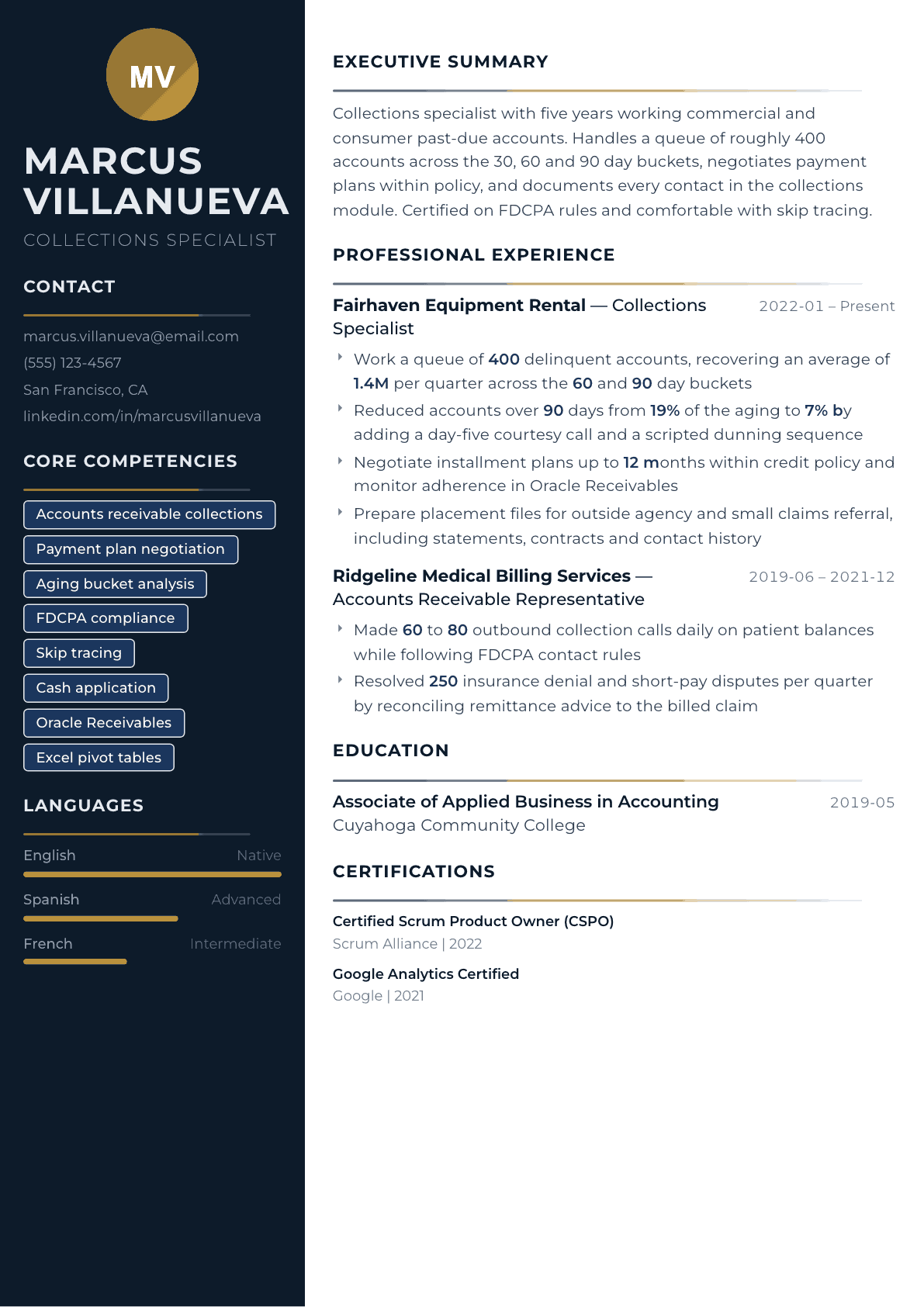
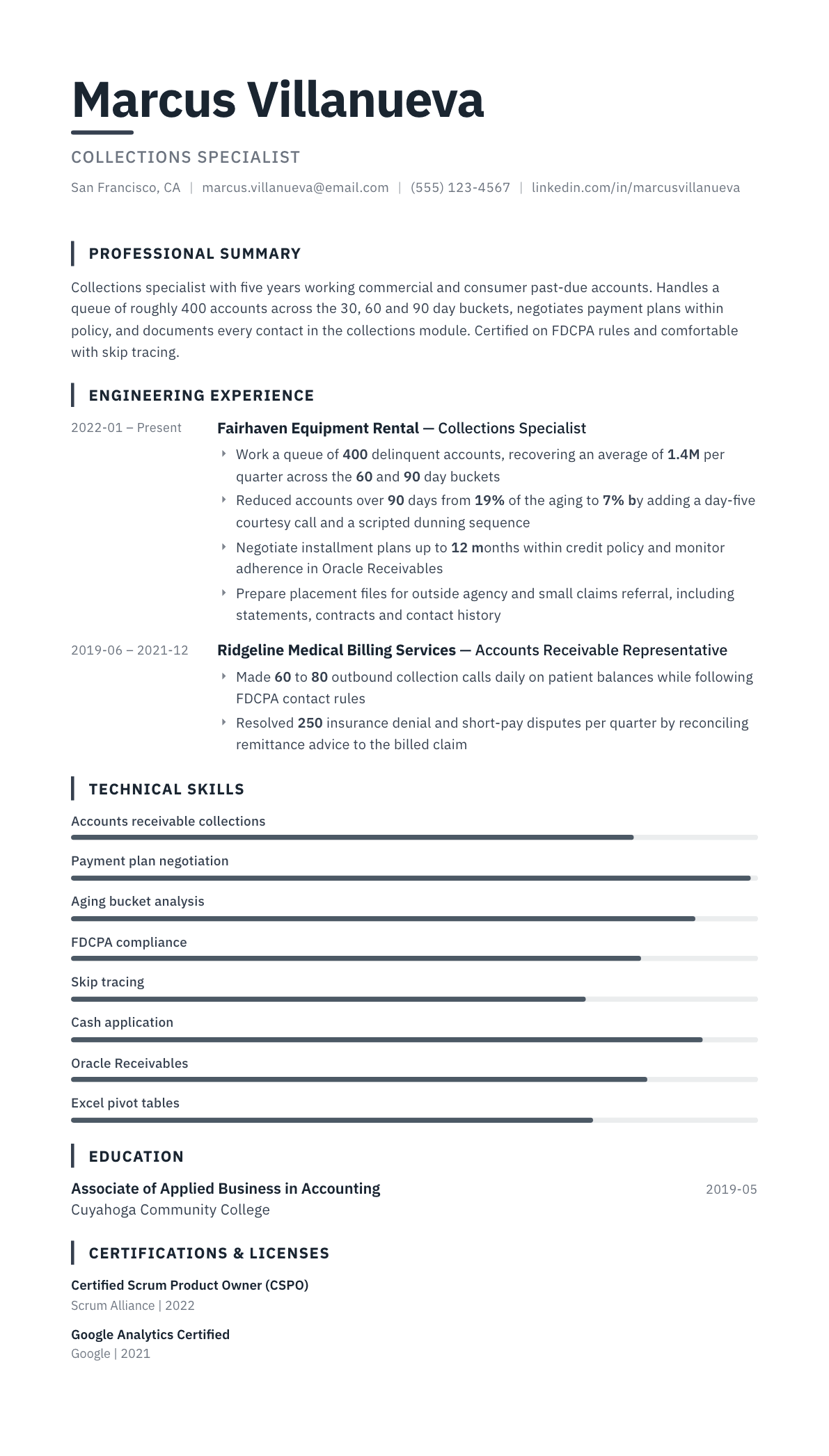
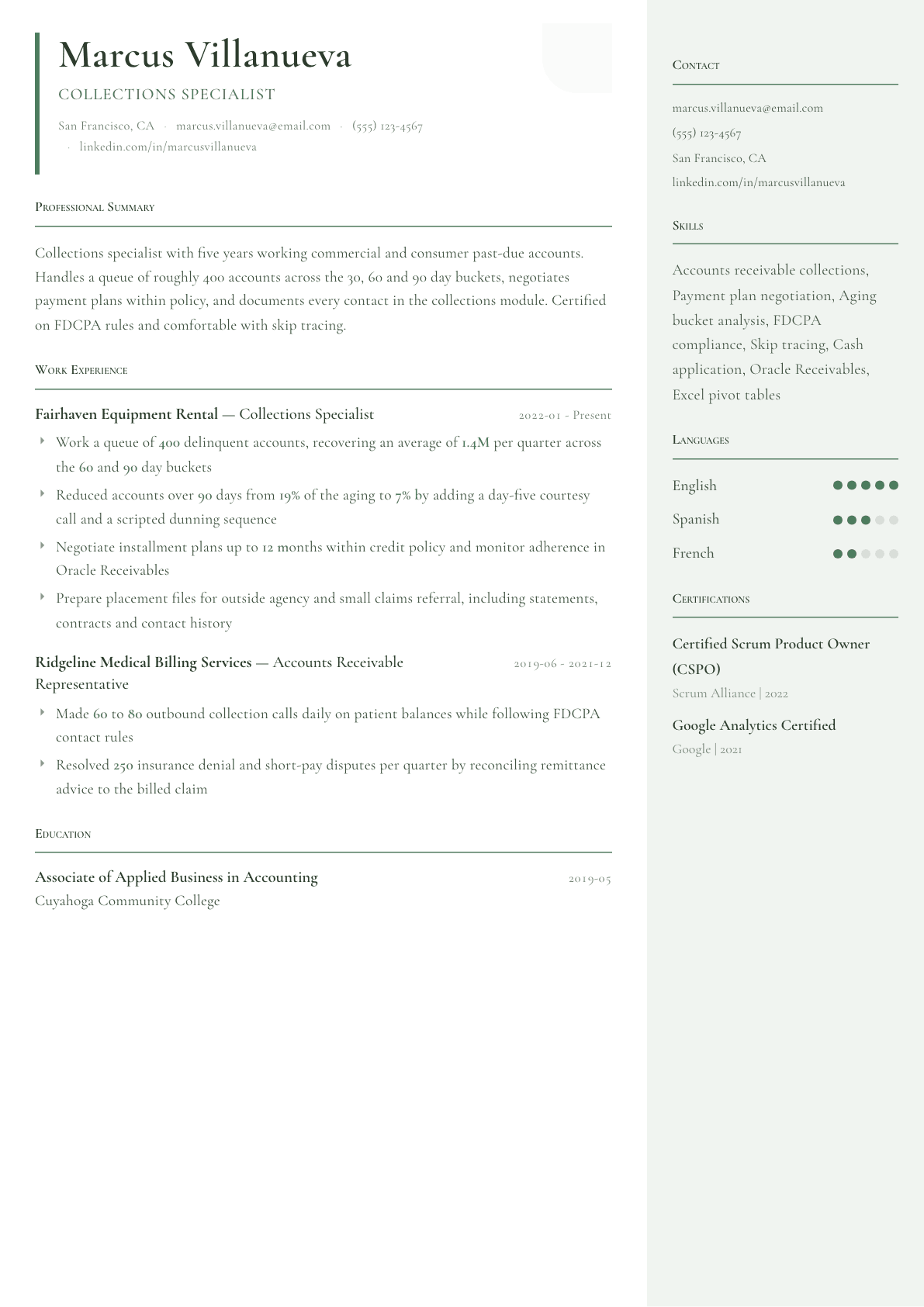
Example Collections Specialist summary
Collections specialist with five years recovering past-due commercial and patient balances. Works a rolling queue near 400 accounts, negotiates installment plans inside credit policy, and keeps every contact documented for audit. Cut the share of receivables aged past 90 days by more than half through an earlier courtesy call and a consistent dunning sequence, while holding a clean record on contact rules.
Skills to list on a Collections Specialist resume
- Accounts receivable collections
- Aging and bucket analysis
- Payment plan negotiation
- Dunning sequence management
- Dispute and deduction research
- Cash application
- FDCPA compliance
- Skip tracing
- Agency placement files
- Invoice reconciliation
- Customer account reconciliation
- Oracle Receivables
- NetSuite
- Excel reporting
What actually gets this resume read
- Give the size of your queue and the dollar value you work, because a collector on 400 accounts is a different hire than one on 40.
- Report recovery in the way a manager measures it: amount collected, percent of the aging over 90 days, and promise-to-pay kept rate.
- Say which contact rules you work under, FDCPA for consumer debt or commercial terms, so a compliance-minded employer can place you fast.
- Separate collections from cash application and dispute research, and show how much time each took, since many postings blend all three.
- Name the systems: Oracle Receivables, SAP, NetSuite, Epicor, and any dialer or dunning tool you used to run the outreach sequence.
- Include the escalation path you followed, from courtesy call to demand letter to agency placement, because judgment on when to escalate is what gets tested.
How to write a collections specialist resume
Hiring for a collections specialist is a volume decision. The manager reading your resume has a queue that is not being worked and needs to know how many accounts you can carry, how much you have recovered, and whether you will keep the company out of trouble while you do it. A page full of soft phrasing about customer service answers none of that.
The three facts that matter sit in your daily work: the size of the queue, the age of the balances you chase, and the rules you operate under. A collector on four hundred commercial accounts with contract disputes is doing a different job than one making eighty consumer calls a day under contact restrictions, and the resume has to make clear which one you are.
This guide shows how to present the queue, how to write recovery numbers a manager will believe, three summaries for different stages of a collections career, before and after bullets, and the questions collectors most often ask about their own resume.
Format: one page, plain, with a metrics band near the top
Keep it to a single page unless you have more than a decade of history. Use a single column and a standard font, because receivables teams often screen through an applicant tracking system that mangles tables and icons.
Directly under the summary, place a short line of numbers: queue size, portfolio value, monthly recovery, and average aging worked. A collections supervisor scanning twenty resumes will stop on the one that puts those four figures where they can be read in three seconds.
- Header: name, city and state, phone, email.
- Order: summary, key metrics line, systems, experience, education, certifications.
- Every job opens with the queue: account count, balance range, consumer or commercial.
Summary: what you collect, from whom, and how much
Two or three lines. Name the debt type first, commercial trade, consumer installment, medical patient balances or utility, because the collection rules and the conversation change completely between them. Then the queue size and the recovery you routinely deliver.
If you are moving from consumer to commercial collections, say so and name the transferable part: negotiation inside policy, documentation discipline, reconciliation of a disputed invoice. The reader will not connect it for you.
Experience: the queue, the sequence, and the escalation
Open each role with the assignment. "Rolling queue of four hundred delinquent commercial accounts, balances from two thousand to ninety thousand, thirty to one hundred eighty days past due" tells a manager exactly what you are used to holding.
Then write bullets around three things. First, what you recovered, in currency amount or in movement of an aging bucket. Second, the sequence you ran, the courtesy call, the dunning letters, the demand notice, the hold on future orders. Third, the judgment calls, when you escalated to an agency, when you accepted an installment plan, when you flagged a customer as a reserve candidate.
Leave out the bullets that describe collections itself. Making outbound calls, sending statements and updating notes are the baseline for the role and take space from the evidence that separates you.
Compliance and documentation: prove you are safe to hire
On consumer accounts, a manager is quietly checking that you understand contact rules, disclosure requirements, dispute handling and validation obligations. Name the framework you have worked under and any training you completed, because a collector who creates regulatory exposure costs far more than an empty seat.
On commercial accounts, the equivalent proof is documentation. Show that you kept contact history, promise records and dispute coding clean enough to hand to counsel or to an outside agency without rebuilding the file.
Systems and keywords the filter is scanning
List the receivable system by name, whether Oracle Receivables, SAP, NetSuite, Epicor, Sage Intacct or a hospital billing platform, and add any dialer, dunning engine or workflow tool. Then mirror the posting vocabulary once each: past due accounts, aging report, promise to pay, payment plan, cash application, dispute resolution, agency placement and reconciliation. Use each where it is true, never as a block of terms at the foot of the page.
Collections Specialist resume summary examples
First collections role
Accounts receivable representative with 18 months on patient balances, making 60 to 80 outbound calls daily and posting payments the same shift. Comfortable reading remittance advice and reconciling short pays. Seeking a commercial collections seat where I can work larger balances and disputes.
Four years in
Collections specialist working a rolling queue of 400 commercial accounts across the 30, 60 and 90 day buckets. Recovers about 1.4M per quarter, negotiates installment plans inside credit policy, and cut the over-90 share of the aging from 19% to 7% by adding an early courtesy call.
Lead collector
Senior collections specialist and team lead for four collectors on a 60M receivable. Owns agency placement, small claims referral and the weekly aging review with credit and sales. Rebuilt the dunning sequence and the dispute routing so claims reach the responsible department within two days.
Work experience bullets: before and after
Before: Called customers about overdue invoices.
After: Worked a rolling queue of 400 past-due commercial accounts, contacting each within five days of due date and recovering an average of 1.4M per quarter.
Queue size, contact timing and quarterly recovery replace an activity that every collector performs.
Before: Helped reduce the amount of old receivables.
After: Cut accounts aged past 90 days from 19% of the receivable to 7% in three quarters by introducing a scripted five-touch sequence and escalating unresponsive accounts at day 75.
The starting share, the ending share and the mechanism make the improvement checkable.
Before: Set up payment arrangements for customers who could not pay.
After: Negotiated installment plans up to 12 months within credit policy for 60 accounts, tracked adherence in Oracle Receivables, and kept the kept-promise rate above 85%.
It shows the authority limits you worked inside and the follow-through measure a supervisor cares about.
Before: Resolved billing disputes with customers.
After: Cleared 250 denial and short-pay disputes per quarter by reconciling remittance advice to the billed claim and routing coding errors back to billing within 48 hours.
The volume and the reconciliation method prove analysis rather than message-taking.
Before: Prepared accounts for the collection agency.
After: Built placement files for 40 accounts a year, assembling signed contracts, statements, full contact history and dispute records so outside counsel could act without requesting more documentation.
Naming the contents of the file shows the documentation discipline that makes a placement stick.
Hard skills
- Commercial and consumer collections
- Aging bucket analysis
- Dunning sequence design
- Payment plan negotiation
- Promise-to-pay tracking
- Dispute and deduction research
- Cash application and posting
- Account reconciliation
- Skip tracing
- Agency and small claims placement
- Oracle Receivables and NetSuite
- Excel pivot tables and lookups
Soft skills
- Difficult conversations without escalation
- Persistence across long cycles
- Objection handling
- Note-taking discipline
- Judgment on when to escalate
- Working with sales without conflict
Certifications worth listing
- Credit Business Associate (CBA) (National Association of Credit Management)
- Certified Revenue Cycle Specialist (CRCS) (American Association of Healthcare Administrative Management)
Mistakes that cost collections specialist candidates the interview
- Writing call volume as the headline number, which measures effort rather than money recovered.
- Omitting the queue size, leaving a supervisor unable to tell whether you can carry their book.
- Mixing consumer and commercial work without labeling which is which, since the rules and the pitch differ entirely.
- Skipping the systems, which is the fastest way to be filtered out of a receivables posting.
- Presenting yourself as a customer service representative who happened to chase invoices, instead of a recovery specialist.
- Claiming a recovery figure with no period attached, so the reader cannot tell if it is monthly, quarterly or a career total.
Collections Specialist resume questions
How do I show collections results if my employer never gave me numbers?
Reconstruct them from what you can defend. Count the accounts in your queue, estimate the balance range, and describe a bucket that improved while you owned it. State the basis plainly rather than inventing a precise figure you cannot support in an interview.
Is a collections resume different for medical receivables?
Yes. Healthcare collections runs on payer denials, remittance codes, patient responsibility and appeal deadlines, so name the payers, the clearinghouse and the billing system. A general commercial resume will read as unfamiliar with the revenue cycle.
Should I mention compliance training on the resume?
If you work consumer debt, yes, and put it near the top. Contact rules, dispute validation and disclosure requirements are the risk a manager is hiring against, so any formal training or clean audit record belongs in the skills or certifications block.
How much detail should I give about the systems I used?
Name each platform and what you did inside it. Posting cash in one system, running aging queries in another and building placement files from a third tells the reader you can be productive in week one rather than month three.
Can a collections specialist resume lead to a credit analyst role?
It can when you emphasize the analysis side. Highlight reconciliation work, dispute root-cause findings, customer financial reviews and any input you gave to limit or hold decisions, then say plainly in the summary that you are targeting underwriting.
Related resume examples
- Billing Specialist Resume example
- Accounts Payable Specialist Resume example
- Credit Manager Resume example
- Accounts Receivable Specialist Resume example
- Accountant Resume example
- Fraud Analyst Resume example