Anti-Money Laundering Analyst Resume Examples: free score
Build an Anti-Money Laundering Analyst Resume Banks Trust
By Mustafa Tarabya, founder of CVBooster · Published · Updated
AML analyst resume examples with SAR narrative bullets, KYC and sanctions keywords, plus a guide to writing alert clearance and escalation experience.
Sample resumes for a anti-money laundering analyst
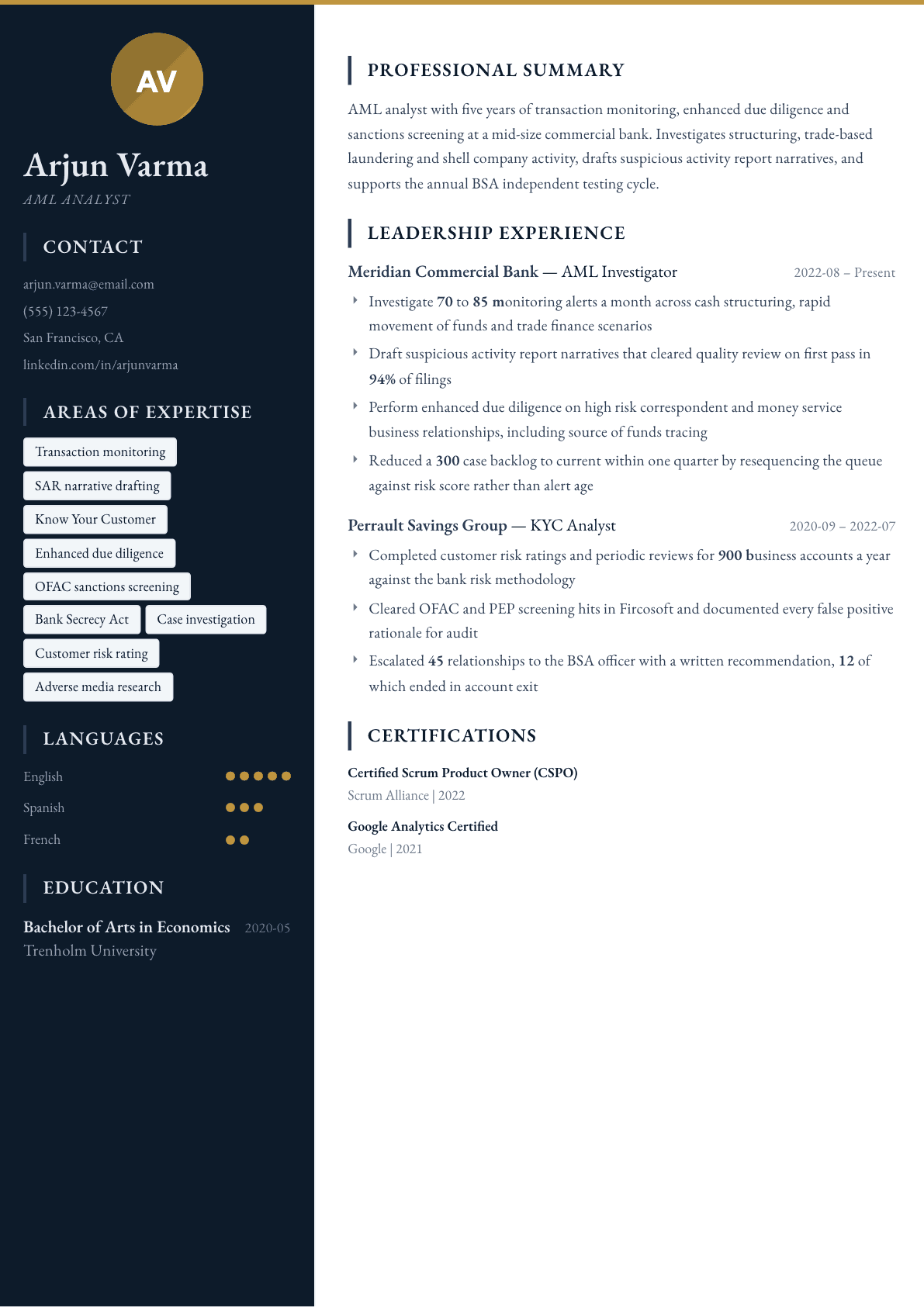
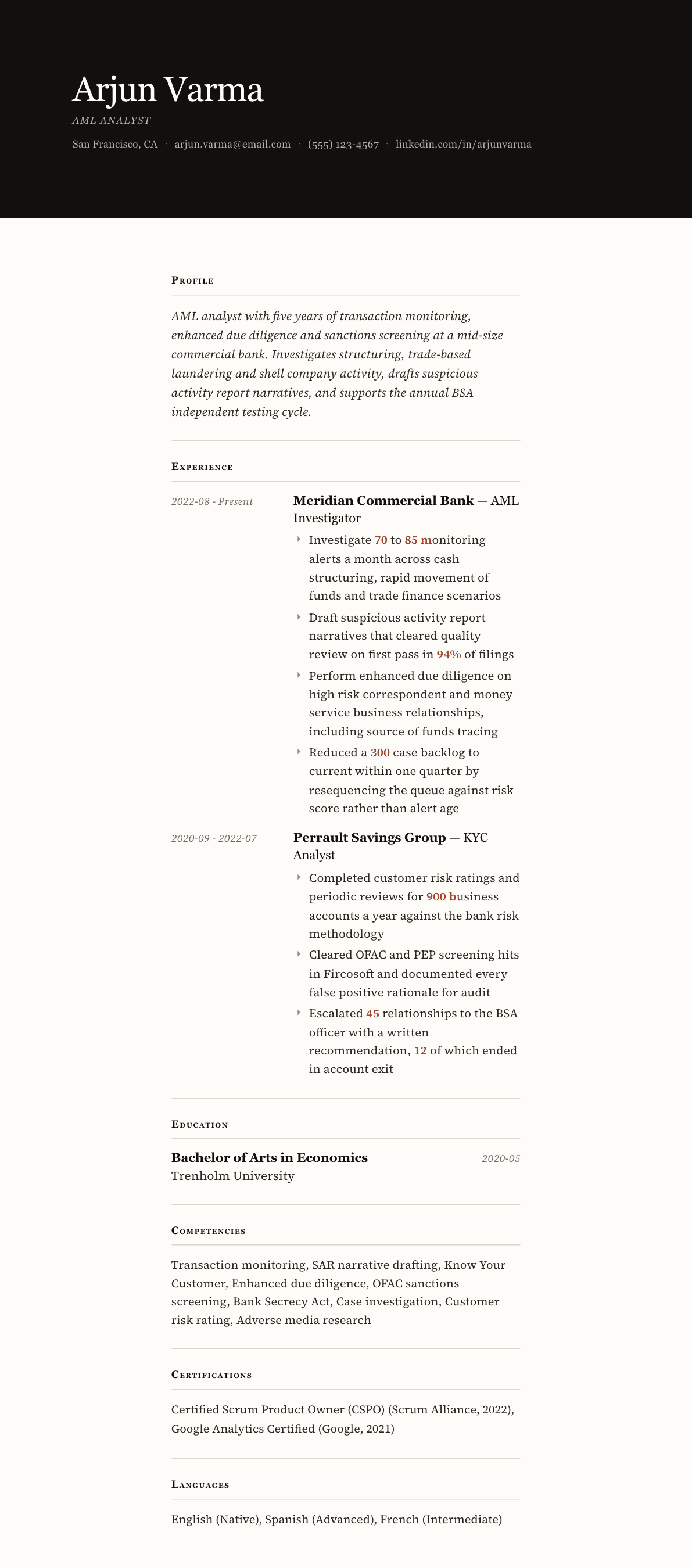
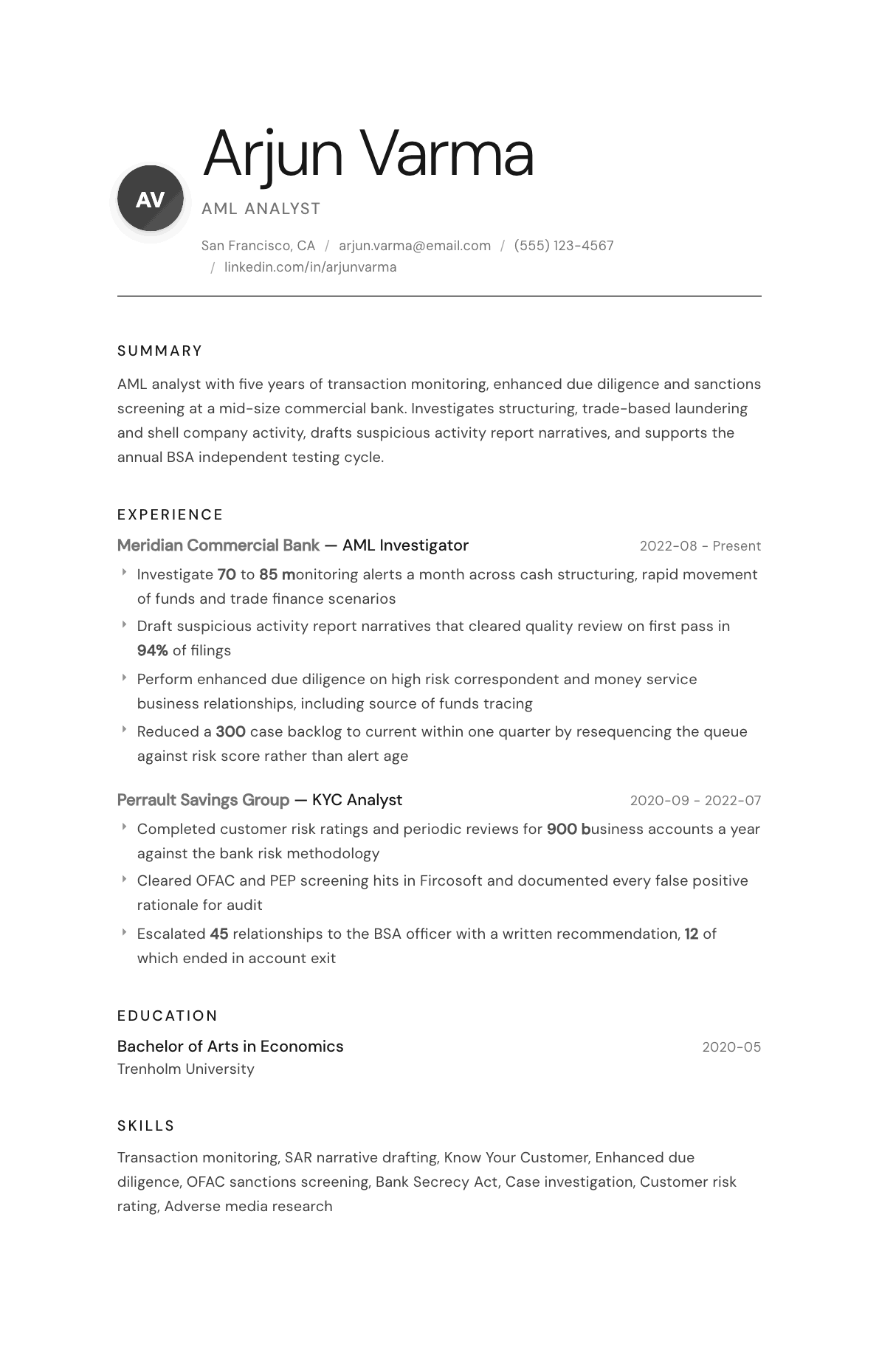
The same anti-money laundering analyst content laid out in three CVBooster templates, so you can see what the finished document looks like before you write a word.
Example Anti-Money Laundering Analyst summary
AML analyst with five years of monitoring, due diligence and sanctions work inside a commercial bank. Investigates 70 to 85 alerts a month across structuring and trade finance scenarios and drafts suspicious activity report narratives that pass quality review on first read. Cleared a 300 case backlog by resequencing on risk score. CAMS certified and comfortable in front of examiners.
Skills to list on a Anti-Money Laundering Analyst resume
- Transaction monitoring
- Suspicious activity reporting
- Know Your Customer
- Customer due diligence
- Enhanced due diligence
- OFAC sanctions screening
- Bank Secrecy Act compliance
- Politically exposed person screening
- Adverse media research
- Customer risk rating
- Case management systems
- Structuring detection
- Trade-based money laundering
- Regulatory examination support
- Beneficial ownership verification
What actually gets this resume read
- Say how many alerts or cases you close in a month, because AML hiring managers read that number as your production baseline.
- Name the typologies you have investigated: structuring, funnel accounts, trade-based laundering, human trafficking indicators or shell layering.
- State whether you drafted the suspicious activity report narrative yourself or only prepared the supporting file for someone else.
- List the monitoring and screening platforms exactly as postings write them, such as Actimize, Verafin, Fircosoft or WorldCheck.
- Show the escalation path you owned, since an analyst who takes a case to the BSA officer is doing different work than one who clears hits.
- Add the CAMS credential or its exam date if you hold it, because many postings treat it as a screening threshold.
How to write a anti-money laundering analyst resume
An anti-money laundering analyst is hired to produce defensible files. The alert you close, the due diligence you record and the narrative you draft all end up in front of an examiner or an internal quality reviewer, and the person reading your resume is trying to work out whether your files would survive that. Everything on the page should serve that single judgment.
Because of this, the resume is unusually literal. A hiring lead in financial crime wants the institution type, the monitoring system, the alert or case volume, the typologies you investigated, and whether you wrote the suspicious activity report narrative yourself or handed a folder to someone senior who did. Vagueness on that last point is the fastest way to lose an interview slot.
The sections below cover the layout financial crime teams expect, summaries for a first compliance role through to a case lead, before and after bullets that fix the usual understatement, and answers to the questions people ask when they move between correspondent banking, money service businesses and financial technology.
Format: single column, credential block near the top
Use reverse chronological order and one page unless you have more than eight years. Bank compliance recruiting runs through applicant tracking systems that break on two column layouts, and a dropped date on a compliance resume raises exactly the wrong question about your record keeping.
Give certifications their own short block directly under the summary. In financial crime the credential is often a gate rather than a bonus, so making a recruiter scroll to the bottom to find it costs you nothing but the interview.
- Header: name, city and state, phone, email, and any language you can conduct research in.
- Sections: summary, certifications, experience, systems and tools, education.
- Name the institution type each time: community bank, correspondent bank, money service business, broker dealer or payments firm.
Summary: institution, program area, volume, filing authority
Three lines that answer where you worked, which part of the program you sat in, how much you handled and how far your authority went. Program areas are distinct: transaction monitoring, customer due diligence, sanctions screening, and investigations each hire separately even though the postings sound alike.
State filing involvement precisely. Drafting a narrative that clears quality review, preparing a supporting file for a filer, and holding filing authority as a designated officer are three different levels of responsibility, and a compliance manager reads them as three different candidates.
Experience: alerts, typologies, escalations, outcomes
Lead each job with an orientation line: institution type, portfolio size, monitoring platform and your queue. Then bullets built on the four things a financial crime lead measures. Monthly alert or case throughput comes first. Typologies come second, because structuring, funnel accounts, trade-based laundering and shell company layering demonstrate very different investigative reach.
The third is escalation. Write how many relationships you referred, to whom, and what happened, including account exits and filings. This is the strongest evidence available that your judgment was trusted, and most analysts leave it off because it feels like the reviewer decided, not them.
The fourth is quality. First pass approval rates on narratives, backlog cleared, and clean audit or examination findings all belong here. Avoid the empty bullet that says you conducted investigations in accordance with policy, which is true of everyone who has ever held the title.
Due diligence and sanctions detail
If your work includes onboarding or periodic review, quantify it by accounts reviewed a year and by risk tier, then name what you verified: beneficial ownership, source of funds, expected activity, and negative news. High risk categories carry weight, so say when you handled money service businesses, cash intensive merchants, correspondent relationships or politically exposed persons.
Sanctions screening work needs the platform and the disposition discipline. Clearing a hit is routine, documenting a defensible false positive rationale that an auditor accepts is the actual skill, and writing it that way separates you from a queue processor.
- Screening and monitoring platforms, named exactly as postings write them.
- Volume by review type: onboarding files, periodic reviews, screening hits, enhanced due diligence cases.
- Any examination or independent testing cycle you supported, and your part in it.
Keywords in every financial crime posting
The recurring vocabulary is narrow and worth mirroring: transaction monitoring, customer due diligence, enhanced due diligence, beneficial ownership, sanctions screening, politically exposed persons, adverse media, risk rating, suspicious activity reporting, currency transaction reporting and the Bank Secrecy Act. Place each term once where it describes real work. Repetition inside a keyword list at the bottom of the page adds nothing and reads as filler to the human who opens the file next.
Anti-Money Laundering Analyst resume summary examples
First compliance seat
Economics graduate with a year of retail banking operations and account opening experience, including identity verification and document review. Trained on the Bank Secrecy Act and studying for the CAMS exam. Seeking a customer due diligence seat where I can build monitoring and investigation experience under review.
Five years investigating
Anti-money laundering investigator handling 70 to 85 alerts a month at a commercial bank across structuring, rapid movement of funds and trade finance scenarios. Drafts suspicious activity report narratives that cleared quality review first pass in 94% of filings, and performs enhanced due diligence on correspondent relationships.
Case lead
Senior financial crime analyst leading a four person investigations pod, reviewing narrative quality before filing and owning the escalation path to the BSA officer. Nine years across community banking and payments, two full examination cycles supported, and the design of the current alert triage sequencing model.
Work experience bullets: before and after
Before: Reviewed transaction monitoring alerts and escalated as needed.
After: Investigate 70 to 85 monitoring alerts a month across cash structuring, rapid movement of funds and trade finance scenarios, escalating 12 relationships a quarter with written recommendations.
Volume, named typologies and escalation counts show reach and trusted judgment instead of a job description.
Before: Prepared suspicious activity reports.
After: Draft suspicious activity report narratives covering the subject, the account activity, the pattern and the reason for suspicion, clearing quality review on first pass in 94% of filings.
Describing the narrative structure and adding a quality rate proves filing competence rather than proximity to it.
Before: Performed KYC reviews for customers.
After: Completed periodic reviews for 900 business accounts a year, verifying beneficial ownership, source of funds and expected activity against the bank risk methodology.
Annual volume plus the specific verification elements tells a reviewer exactly what your files contained.
Before: Helped clear a backlog of cases.
After: Reduced a 300 case backlog to current within one quarter by resequencing the queue against customer risk score rather than alert age, and documented the change for the next examination.
The method and the documentation turn a workload story into evidence of process improvement under scrutiny.
Before: Handled OFAC screening alerts.
After: Cleared sanctions and politically exposed person screening hits in a dedicated screening platform, documenting a defensible false positive rationale for every disposition retained for audit.
The rewrite emphasizes the documentation standard, which is the part an examiner actually tests.
Hard skills
- Transaction monitoring
- Suspicious activity report drafting
- Customer due diligence
- Enhanced due diligence
- Beneficial ownership verification
- Sanctions and watchlist screening
- Adverse media research
- Customer risk rating methodology
- Bank Secrecy Act requirements
- Currency transaction reporting
- Case management systems
- Typology analysis
Soft skills
- Evidence-based writing
- Investigative curiosity
- Discretion with sensitive files
- Prioritization across a queue
- Working with examiners
- Clear escalation communication
Certifications worth listing
- Certified Anti-Money Laundering Specialist (CAMS) (ACAMS)
- Certified Fraud Examiner (CFE) (Association of Certified Fraud Examiners)
- Certified Regulatory Compliance Manager (CRCM) (American Bankers Association)
- Certified Financial Crime Specialist (CFCS) (Association of Certified Financial Crime Specialists)
Mistakes that cost anti-money laundering analyst candidates the interview
- Being ambiguous about filing involvement, which forces the interviewer to spend the first ten minutes establishing what you actually did.
- Listing regulations without ever showing a case where you applied one to a real customer situation.
- Omitting the institution type, so a correspondent banking team cannot tell whether you have seen a nested relationship.
- Describing alert work in policy language that could be copied from any program manual.
- Leaving out backlog, quality review and examination support, which are the outcomes compliance leaders trust most.
- Burying the CAMS credential at the bottom of the page when many postings treat it as a screening threshold.
Anti-Money Laundering Analyst resume questions
Can I get an anti-money laundering analyst job without banking experience?
Yes, most commonly through account opening, teller operations, audit or law enforcement backgrounds. Position the transferable pieces directly: identity verification, document review, investigative writing and evidence handling all map onto the work, and hiring managers recruit from those paths regularly.
How many alerts per month should I put on my resume?
Your real average, stated as a range across a period. Numbers that are implausibly high suggest shallow reviews, and no number at all leaves the reader guessing. A range with the alert types attached is the most credible way to present throughput.
Do I need the CAMS certification to be competitive?
It is not universally required, but many bank postings list it as preferred and some use it to filter. If you do not hold it, list your exam registration or your progress honestly and lean harder on case volume, typology range and quality evidence in the experience section.
Should I name the monitoring system I used?
Always. Financial crime postings are written against specific platforms and the screening filter matches those exact strings. If your employer used an in-house tool, say so and describe its function, because that tells a reader what capability you are used to having.
How do I write about a case without breaching confidentiality?
Describe the typology, the method and the outcome, never the customer, the jurisdiction detail or the amounts. Saying you investigated a funnel account pattern across multiple states and escalated it for filing communicates everything a hiring manager needs without identifying anyone.
Related resume examples
- Compliance Analyst Resume example
- Auditor Resume example
- Fraud Analyst Resume example
- Compliance Manager Resume example
- Personal Banker Resume example
- Bank Teller Resume example