Compliance Manager Resume Examples: the lines they read
Craft a Compliance Manager Resume for Regulated Employers
By Mustafa Tarabya, founder of CVBooster · Published · Updated
Compliance manager resume examples with program ownership bullets, regulator-facing keywords, and a guide to showing testing, training and remediation results.
Sample resumes for a compliance manager
The same compliance manager content laid out in three CVBooster templates, so you can see what the finished document looks like before you write a word.
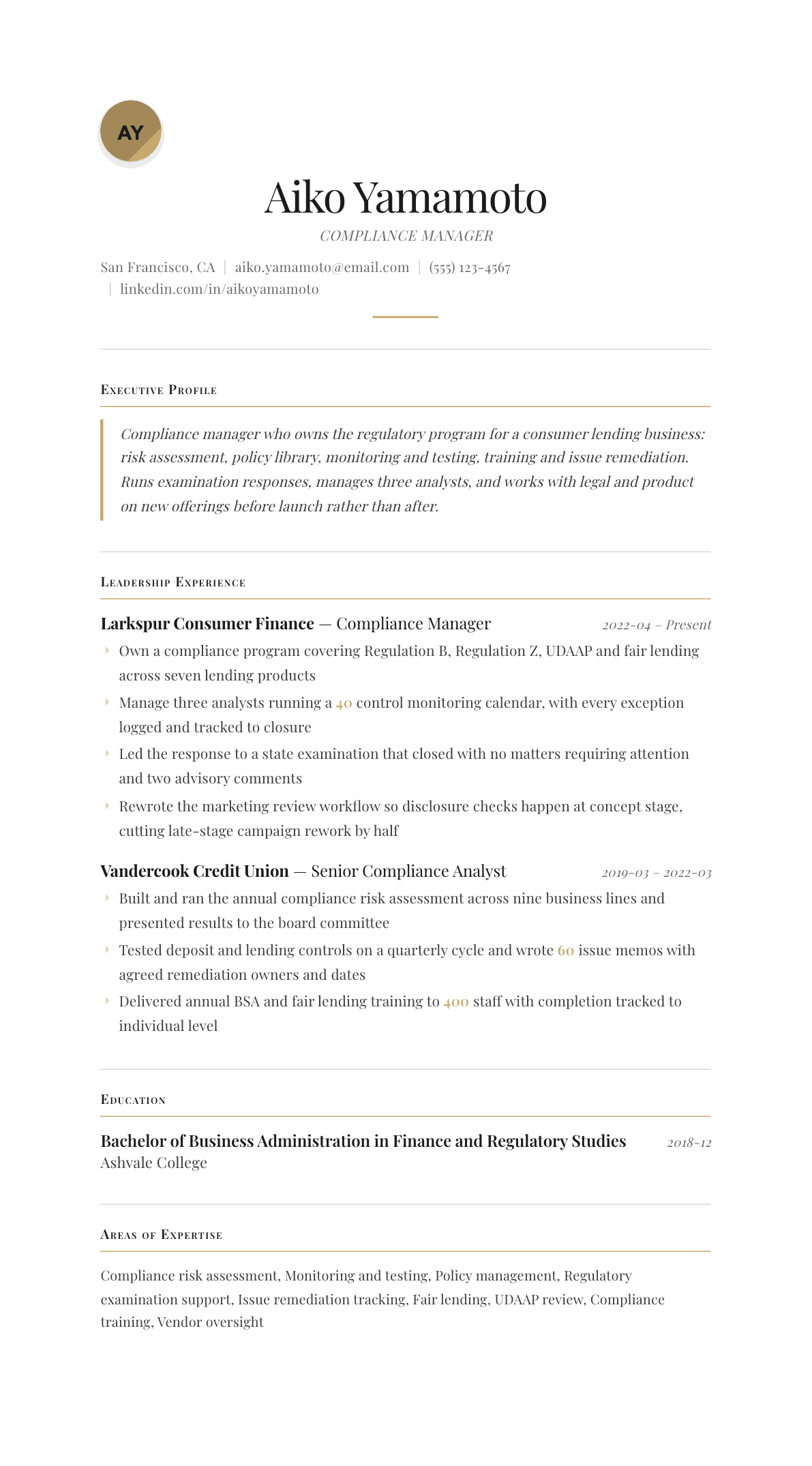
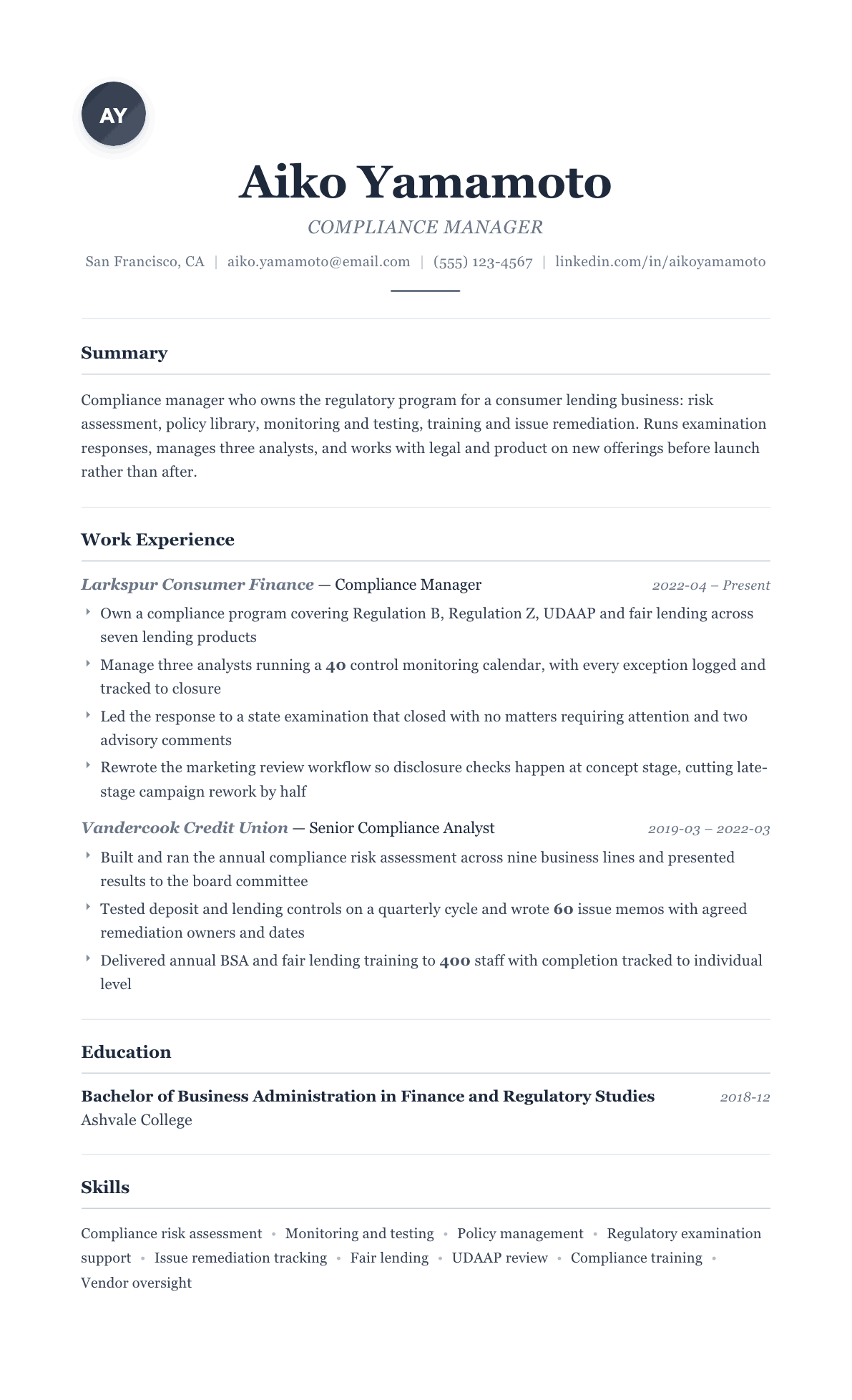
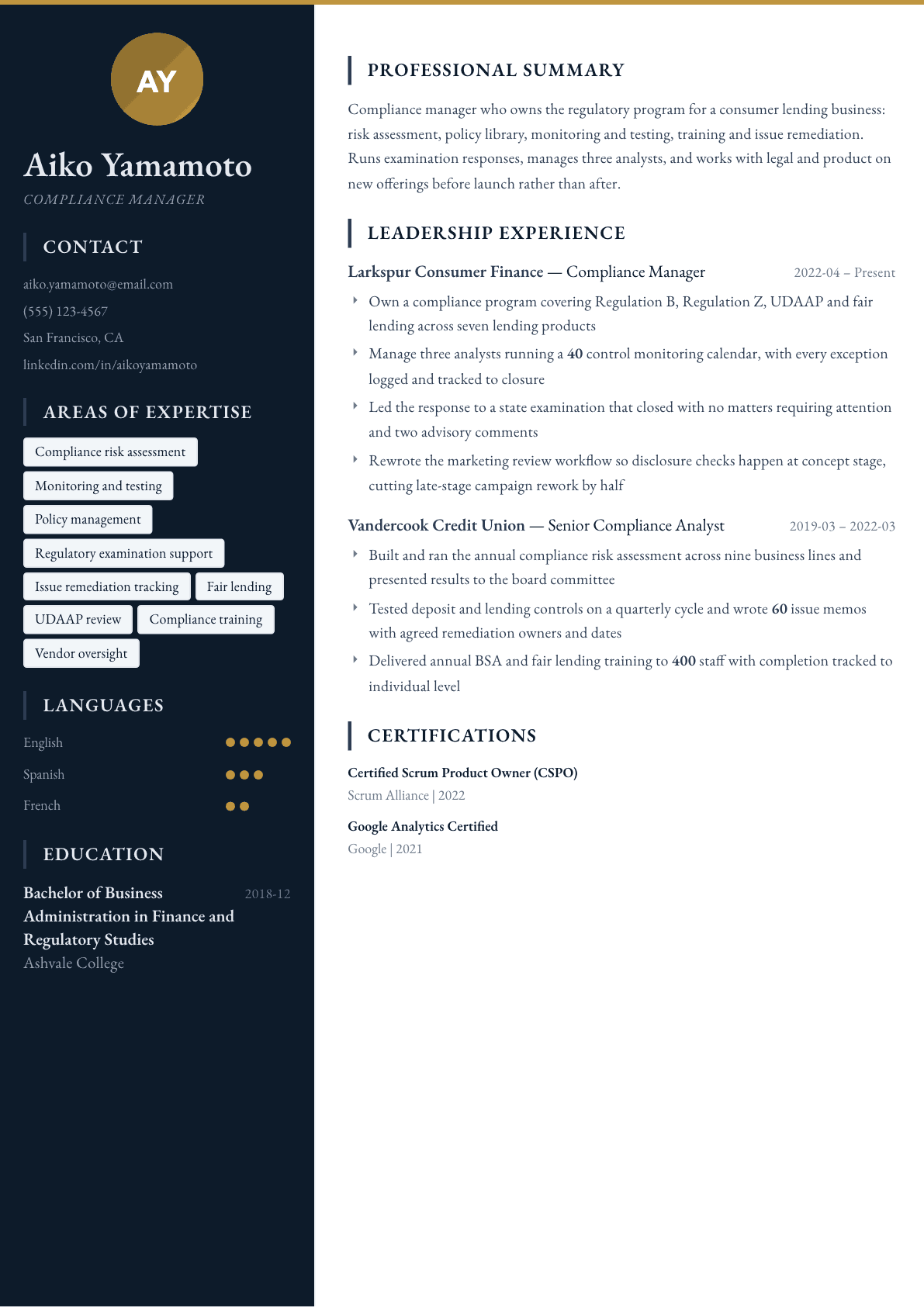
Example Compliance Manager summary
Compliance manager with seven years in consumer lending and credit union regulation. Owns risk assessment, a 40 control testing calendar, policy governance and training across seven products, and manages a team of three analysts. Led a state examination that closed with no matters requiring attention. Strongest where compliance sits inside product design rather than reviewing finished work.
Skills to list on a Compliance Manager resume
- Compliance program management
- Regulatory risk assessment
- Monitoring and testing
- Policy and procedure governance
- Examination management
- Issue and remediation tracking
- Fair lending analysis
- UDAAP review
- Anti-money laundering oversight
- Third party risk management
- Compliance training design
- Complaint management
- Board and committee reporting
- Regulatory change management
What actually gets this resume read
- Name the regulations you own by number and letter, because a hiring committee reads Regulation Z and UDAAP as scope, not jargon.
- Show the shape of the program you ran: number of controls tested, business lines covered, and how many people reported to you.
- State examination outcomes in neutral language, describing findings closed and commitments met rather than claiming a perfect record.
- Separate advisory work from testing work, since compliance managers are hired for one or the other and rarely for both equally.
- Give remediation evidence: issues opened, owners assigned, and whether items closed by their agreed date.
- Put the industry in the summary line, because banking, insurance, healthcare and gaming compliance are different jobs with the same title.
How to write a compliance manager resume
A compliance manager resume is read by someone who has to defend the hire to a regulator, a board committee or an external auditor. That reader is looking for program ownership: the regulations in your scope, the controls you tested, the issues you tracked to closure and how you behaved when an examination went sideways. Titles alone tell them nothing, because the same title covers a one person function and a department of thirty.
The second thing they check is whether you are an advisory compliance manager or a testing compliance manager. One sits with product and legal deciding what the business may do. The other builds a monitoring calendar and proves whether the business did it. Most people are stronger at one, and a resume that blurs the two gets passed over for both.
This guide sets out the sections a regulated employer expects, three summaries covering the step up from analyst through to program owner, before and after bullets on the parts compliance managers habitually understate, and the questions that come up when moving between industries.
Format: two pages is normal, scope goes first
Reverse chronological, single column, two pages once you have run a program. Compliance hiring rewards completeness over brevity because the reader is auditing your coverage. What is not on the page is assumed absent, and that assumption is expensive when a posting names eight regulations and your resume names three.
Open each role with a scope line rather than a duty list. Business lines covered, regulations owned, team size, control count and reporting line give the reader the shape of the job in one sentence. Everything after that is evidence.
- Header: name, city and state, phone, email, and the industries you have been regulated in.
- Sections: summary, experience with scope lines, program capabilities, certifications, education.
- Name your reporting line. Reporting to a chief compliance officer or a board committee signals independence.
Summary: industry, regulations, program elements, team
Lead with the industry, because consumer lending, insurance, healthcare privacy, broker dealer and gaming compliance share a title and almost nothing else. Then the regulations you personally own, the program elements you run, and the size of the team reporting to you.
Close the summary with the part of the job you are strongest at. Someone who has repeatedly built a monitoring function from nothing should say so, because employers with an immature program will pay for that specifically and will not find it by reading between the lines.
Experience: controls, testing, issues, examinations
Build each role around four evidence types. First, the risk assessment: how many business lines, how often it refreshed and who received the results. Second, monitoring and testing: control count, the review cycle, and what your reviews found. Third, issue management: issues raised, owners assigned, and closure against agreed dates, which is the metric that tells a reader whether your findings had teeth.
Fourth, examinations and audits. Describe outcomes in neutral, verifiable language: findings closed, commitments met, matters requiring attention resolved within their timeline. Claiming a spotless record invites a question you may not be able to answer, and experienced compliance leaders read overclaiming as a risk in itself.
Advisory work needs its own bullets. New product review, marketing and disclosure review, regulatory change assessment and complaint theme analysis are where compliance either earns a seat in the business or gets treated as a checkpoint at the end.
Program capabilities: name what you can build from zero
A short capability block below your experience is worth including because it lets a reader match your background to a program gap quickly. Say which elements you have built rather than inherited: policy architecture, control library, testing calendar, training curriculum, complaint management, third party oversight, regulatory change tracking and committee reporting.
Training deserves a line of its own with headcount, format and how completion was evidenced, because in examinations the completion evidence is what gets requested rather than the slide deck.
- Program elements you have designed, separated from ones you have maintained.
- Governance forums you presented to and how often.
- Systems you administered, such as governance risk and compliance platforms or policy management tools.
Keywords compliance postings screen against
The recurring terms are compliance risk assessment, monitoring and testing, issue remediation, regulatory change management, policy governance, third party risk, complaint management, examination readiness, and the specific regulation citations for the industry. Use the citation format the posting uses, since a filter matching Regulation Z will not match a paraphrase about lending disclosure rules. Place each term inside a bullet where it describes something you did.
Compliance Manager resume summary examples
Stepping up from analyst
Senior compliance analyst moving into program ownership, with four years of control testing across deposit and lending products, annual risk assessment support for nine business lines, and authorship of the issue memos that drive remediation. Ready to own a monitoring calendar and the committee reporting that sits on top of it.
Running a program
Compliance manager owning the regulatory program for a consumer lending business across seven products: risk assessment, a 40 control monitoring calendar, policy library, training and issue remediation. Manages three analysts and led a state examination that closed with no matters requiring attention and two advisory comments.
Head of compliance
Compliance leader with twelve years in banking and consumer finance, currently running a nine person function covering monitoring, testing, advisory and complaint management. Rebuilt a program cited in a prior examination and closed every commitment on schedule. Reports quarterly to the board risk committee.
Work experience bullets: before and after
Before: Responsible for ensuring compliance with applicable regulations.
After: Own a compliance program covering Regulation B, Regulation Z, UDAAP and fair lending across seven lending products, with a documented control mapping from each requirement to a tested control.
Naming regulations and the requirement to control mapping turns an empty obligation into a described program.
Before: Conducted compliance monitoring and testing.
After: Manage three analysts running a 40 control monitoring calendar on a quarterly cycle, with every exception logged, assigned an owner and tracked to closure against an agreed date.
Control count, cadence, team size and the closure discipline give a reader the whole operating model in one line.
Before: Handled a regulatory examination.
After: Led the response to a state examination: coordinated the document request list, prepared four business line interviews and closed the cycle with no matters requiring attention and two advisory comments.
Describing the mechanics of the response, then a neutral outcome, is more credible than any claim of a clean result.
Before: Worked with marketing on advertising reviews.
After: Rewrote the marketing review workflow so disclosure and substantiation checks happen at concept stage, cutting late-stage campaign rework by half across the year.
Moving a control earlier in a process is a structural fix, and the rework reduction makes the value concrete.
Before: Delivered compliance training to employees.
After: Delivered annual Bank Secrecy Act and fair lending training to 400 staff across three formats, with completion tracked to individual level and evidenced for the independent testing cycle.
Headcount, formats and completion evidence answer the question an examiner asks, which a training claim alone does not.
Hard skills
- Compliance program design
- Regulatory risk assessment
- Monitoring and testing calendars
- Control library and mapping
- Issue and remediation management
- Examination and audit response
- Policy and procedure governance
- Regulatory change management
- Third party and vendor oversight
- Complaint management analysis
- Fair lending review
- Board and committee reporting
Soft skills
- Influencing without authority
- Difficult conversations with business owners
- Regulator-facing composure
- Team development
- Precise written argument
- Judgment on materiality
Certifications worth listing
- Certified Regulatory Compliance Manager (CRCM) (American Bankers Association)
- Certified Compliance and Ethics Professional (CCEP) (Compliance Certification Board)
- Certified Anti-Money Laundering Specialist (CAMS) (ACAMS)
- Certified Internal Auditor (CIA) (Institute of Internal Auditors)
Mistakes that cost compliance manager candidates the interview
- Writing duties instead of scope, so the reader cannot tell a one person function from a department of thirty.
- Claiming a perfect examination history, which experienced compliance leaders read as either luck or overstatement.
- Blending advisory and testing experience so that neither hiring track sees a clear fit.
- Leaving out issue closure rates, the single strongest proof that your findings changed behavior.
- Paraphrasing regulation names rather than citing them the way the posting does, which defeats the screening filter.
- Omitting the industry from the summary when compliance skills transfer far less across sectors than candidates assume.
Compliance Manager resume questions
How long should a compliance manager resume be?
Two pages once you have run a program. Compliance readers audit coverage rather than skim, so anything you leave off is treated as experience you do not have. Three pages is only justified when you have led multiple programs across different regulatory regimes.
Can I move between industries as a compliance manager?
Yes, but position the transferable machinery rather than the regulations. Risk assessment, control testing, issue management, training and examination response work the same everywhere. Show that you learned one regulatory regime quickly and you make the case that you can learn another.
Should I mention examination findings against my program?
Mention how you resolved them, never hide them. A bullet describing a cited program that you rebuilt with every commitment closed on schedule is genuinely stronger than silence, because remediation leadership is a scarce and directly relevant skill.
Do compliance managers need a law degree?
Rarely. Most postings ask for regulatory experience and a professional certification instead. A law degree helps in advisory heavy roles and in regulatory interpretation work, but it does not substitute for having run a monitoring calendar or faced an examiner.
How do I show independence on a compliance resume?
State your reporting line and your governance forums. Reporting to a chief compliance officer or presenting directly to a board committee signals that your findings were not filtered by the business, which is exactly the structural detail a hiring committee is checking for.
Related resume examples
- Compliance Analyst Resume example
- Auditor Resume example
- Internal Auditor Resume example
- Anti-Money Laundering Analyst Resume example
- Credit Analyst Resume example
- Underwriter Resume example