Fraud Analyst Resume Examples: free ATS score and gap list
Write a Fraud Analyst Resume That Proves Detection Judgment
By Mustafa Tarabya, founder of CVBooster · Published · Updated
Fraud analyst resume examples, alert-queue bullets, SQL and case management keywords, plus a writing guide for card, ACH and account takeover work.
Sample resumes for a fraud analyst
The same fraud analyst content laid out in three CVBooster templates, so you can see what the finished document looks like before you write a word.
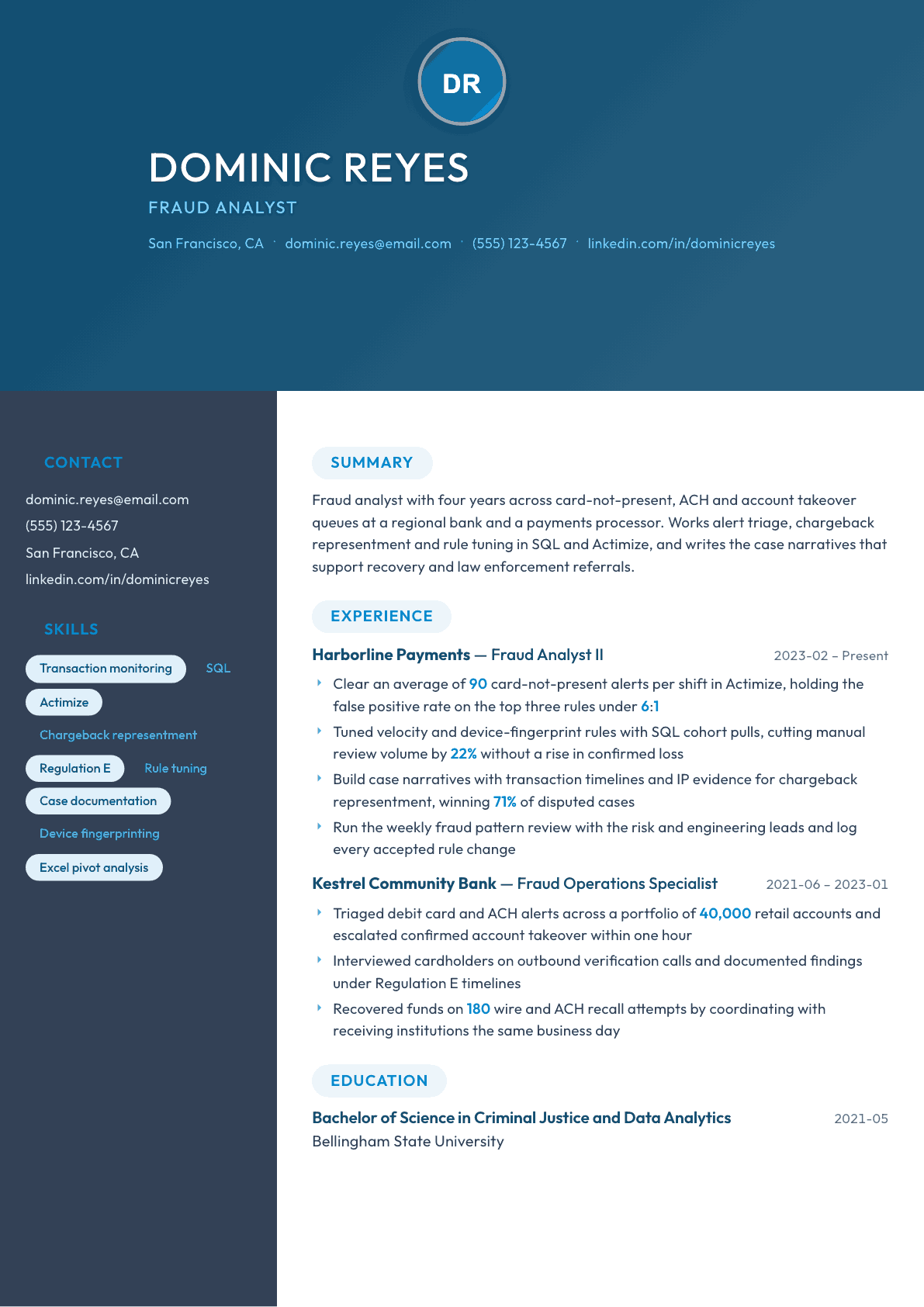
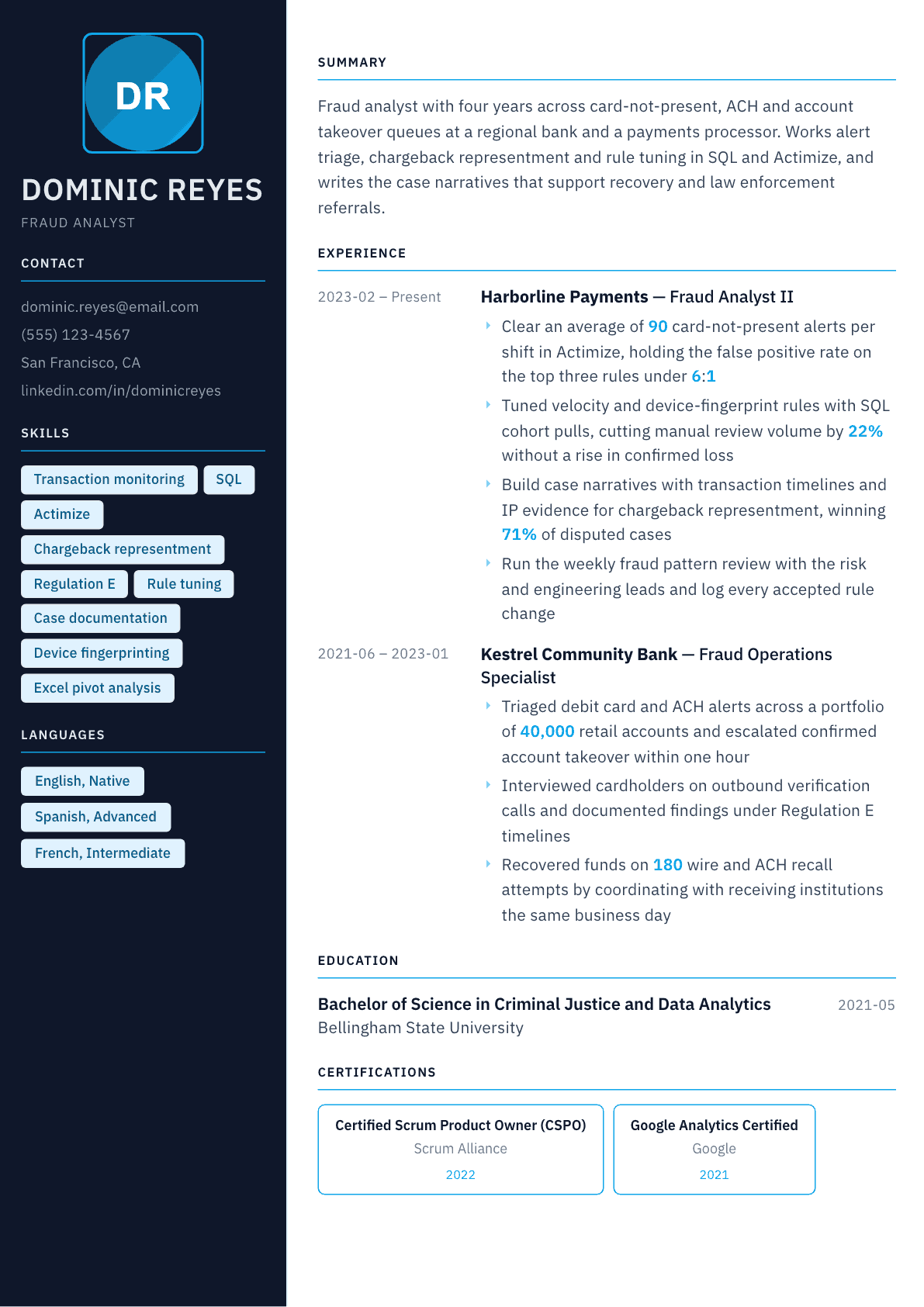
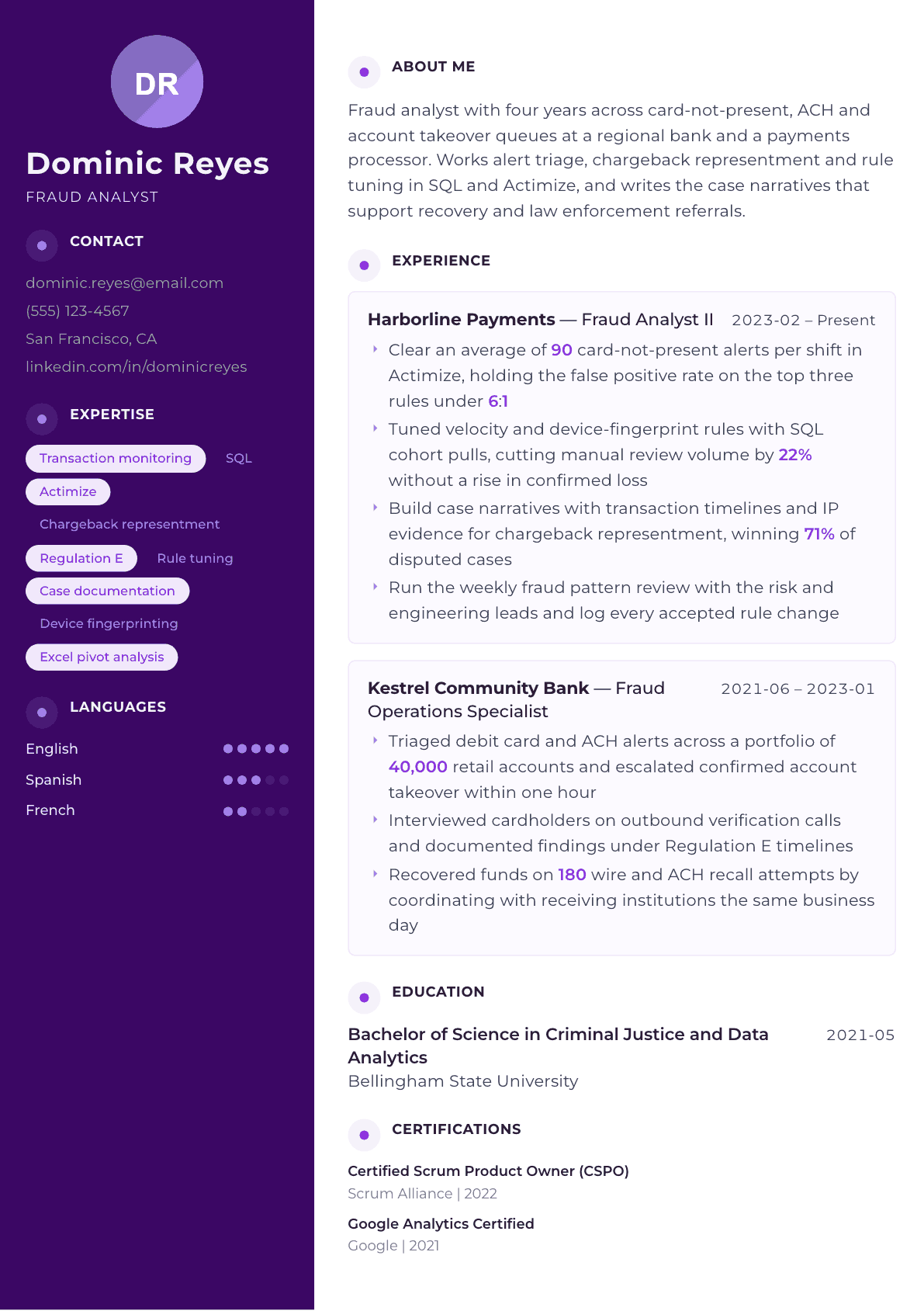
Example Fraud Analyst summary
Fraud analyst with four years in card and ACH monitoring for a payments processor and a community bank. Clears roughly 90 alerts per shift, tunes velocity rules in SQL, and writes case narratives that support representment and recovery. Cut manual review volume by 22% while confirmed loss stayed flat. Looking for a senior fraud strategy seat where rule design is the main job.
Skills to list on a Fraud Analyst resume
- Transaction monitoring
- Alert triage
- SQL
- Fraud rule tuning
- Chargeback representment
- Account takeover investigation
- Synthetic identity detection
- Device fingerprinting
- Case management systems
- Regulation E
- SAR referrals
- Excel and pivot analysis
- Link analysis
- Loss and recovery reporting
- Customer verification calls
What actually gets this resume read
- Name the fraud typologies you have actually worked: card-not-present, first-party, synthetic identity, account takeover, or check kiting.
- Give alert volume per shift and a false positive ratio, because a fraud manager sizes your throughput before anything else on the page.
- List the case management and monitoring platforms by name, since postings filter on Actimize, Falcon, Sift, Featurespace or an in-house queue.
- Show at least one bullet where you changed a rule or a threshold, not only where you cleared the queue someone else built.
- Mention SQL depth honestly: joins and window functions read very differently from running a saved query someone handed you.
- Keep regulatory work visible with Regulation E, Regulation Z and SAR referral language, because those phrases sit in the screening filter.
How to write a fraud analyst resume
A fraud analyst resume gets sorted on two questions before anyone reads a sentence: which fraud did you work, and how much of it did you clear. Card-not-present disputes, first-party abuse, synthetic identity onboarding, account takeover and check kiting are separate crafts with separate queues, and a manager staffing an overnight card team will not read a resume that only says financial crime.
The second filter is judgment. Anyone can approve or decline an alert. The analyst who gets hired is the one who explains why a rule was firing on legitimate travel spend, proposes the threshold change, and shows what happened to confirmed loss after the change went live. That story has to sit in the bullets, not be implied by a job title.
What follows is the structure a fraud hiring manager expects, three summaries written for different points in a fraud career, before and after bullets pulled from the way analysts really describe their queue, and the questions that come up when someone moves from operations into fraud strategy.
Format: one page until you own strategy work
Reverse chronological, one page for anything under six years. Fraud teams read fast and hire from a short list, so a dense single page beats a padded two page file. Keep a single column: bank and processor screening tools mangle sidebars, and losing the dates on a fraud resume is fatal because shift history matters.
Order the sections so the queue work is visible immediately: summary, then experience, then tools and platforms, then education and certifications. A separate platform section is worth the space because postings screen on named systems and a recruiter should not have to hunt for them inside a paragraph.
- Header: name, city and state, phone, email, and whether you are open to overnight or weekend coverage.
- Sections: summary, experience, fraud platforms and tools, analytics skills, education and certifications.
- Say if your experience is issuer side, acquirer side, merchant side or platform side. They are not interchangeable.
Summary: typology, volume, tooling, one decision you owned
Three lines. Name the fraud types you worked, the channel, the alert volume you carry, and the platform you carry it in. Then one specific thing you changed. A summary that opens with detail oriented and analytical describes the whole applicant pool and identifies nobody in it.
If you are moving between fraud domains, say it directly and name the transferable mechanics. Someone leaving debit card operations for merchant risk should point at velocity logic, device signals and dispute handling, because those carry across even though the loss profile does not.
Experience: the queue, the ratio, the rule you touched
Every role needs the institution type, the channel, the volume and the tooling. A line such as issuer side debit and credit queue, roughly ninety alerts a shift, worked in a named case management platform, gives a manager the entire operating picture in one sentence.
Then bullets that separate you from the rest of the shift. Fraud managers look for four things: throughput with a quality measure attached, investigation depth on complex cases, rule or model feedback, and clean documentation. A false positive ratio next to your alert count is worth more than any adjective, because it proves you were not clearing the queue by declining everything.
Recovery and dispute work deserves its own bullet. Representment win rates, wire recall coordination, and Regulation E timing are concrete outcomes a manager can verify in an interview, which is exactly why they carry weight on the page.
Tools and analytics: name the stack, then state the depth
List the monitoring and case platforms by their real names, because postings are written against them and the screening filter matches strings, not concepts. Alongside those, state your data depth honestly. Running a saved query is not the same as writing joins and window functions to build a cohort, and a fraud strategy team will find out in the first technical conversation.
If you have worked on model or rule performance, describe the loop: what you observed in the queue, what you tested, how the change was approved, and what moved afterward. That loop is the whole difference between a fraud operations analyst and a fraud strategy analyst, and it is the promotion most people on this page are applying for.
- Monitoring and case tools you have actually logged into, not ones your team licensed.
- Query depth: what you can write unaided in SQL, and whether you use Python or a notebook environment.
- Reporting: the loss, recovery or queue health report you produced and who received it.
Keywords the screening filter is matching
Fraud postings recycle a small vocabulary: transaction monitoring, alert triage, chargeback representment, account takeover, false positive rate, rule tuning, link analysis, suspicious activity referral, and the regulation names. Use the exact wording from the posting once in your summary and once inside a bullet where it is doing real work. A keyword block at the bottom fools nothing and wastes the space a fifth bullet could have used.
Fraud Analyst resume summary examples
First fraud role
Recent analytics graduate with one year in retail banking operations, including outbound cardholder verification calls and debit dispute intake under Regulation E. Comfortable in SQL joins and pivot analysis, and looking for a card fraud queue where I can build monitoring experience under a strong review process.
Four years in the queue
Fraud analyst clearing about 90 card-not-present alerts a shift on the issuer side, holding false positives on the top rules under a 6:1 ratio. Tunes velocity and device rules with SQL cohort pulls, and won 71% of representment cases through documented transaction timelines. Moving toward fraud strategy.
Fraud strategy lead
Senior fraud analyst owning rule strategy for card and ACH channels across nine years, the last three designing and back-testing detection logic before release. Cut manual review volume 30% in a year with confirmed loss flat, and runs the monthly pattern review with engineering, risk and operations leads.
Work experience bullets: before and after
Before: Reviewed fraud alerts daily and made approve or decline decisions.
After: Clear roughly 90 card-not-present alerts per shift in a case management queue, holding the false positive ratio on the top three rules under 6:1 across the year.
Volume plus a quality ratio proves throughput without the suspicion that you cleared the queue by declining everything.
Before: Helped reduce false positives on fraud rules.
After: Pulled six months of declined and approved cohorts in SQL to isolate a travel spend pattern, then proposed a velocity threshold change that cut manual review volume 22% with confirmed loss unchanged.
The rewrite shows the full loop of observation, analysis, proposal and measured result rather than a claim of contribution.
Before: Worked on chargebacks and disputes for customers.
After: Built representment packages with transaction timelines, device and IP evidence and delivery confirmation, winning 71% of disputed cases across the card portfolio.
Naming the evidence types and attaching a win rate turns routine dispute handling into demonstrable investigative work.
Before: Investigated account takeover cases.
After: Investigated account takeover cases from credential stuffing indicators through to funds movement, escalating confirmed compromise within one hour and coordinating same-day recall attempts with receiving institutions.
The strong version traces the case end to end and includes the response times a fraud manager measures her team on.
Before: Wrote reports for management about fraud trends.
After: Produced the weekly fraud pattern review comparing loss by channel, merchant category and rule, and logged every accepted rule change with the owner and effective date.
Specifying the cuts of data and the change log shows governance discipline, which is what senior fraud roles are actually hired for.
Hard skills
- Transaction monitoring
- Alert triage and disposition
- SQL cohort analysis
- Fraud rule tuning
- Chargeback representment
- Account takeover investigation
- Synthetic identity detection
- Device fingerprinting signals
- Link and network analysis
- Case management platforms
- Regulation E dispute handling
- Loss and recovery reporting
Soft skills
- Decision making under time pressure
- Written case narrative
- Customer interview technique
- Escalation judgment
- Cross-team coordination
- Attention to pattern detail
Certifications worth listing
- Certified Fraud Examiner (CFE) (Association of Certified Fraud Examiners)
- Certified Anti-Money Laundering Specialist (CAMS) (ACAMS)
- Certified Financial Crime Specialist (CFCS) (Association of Certified Financial Crime Specialists)
Mistakes that cost fraud analyst candidates the interview
- Writing financial crime experience without naming the channel, so a card team cannot tell whether you have ever seen a card transaction.
- Listing alert volume with no quality measure, which invites the assumption that you cleared the queue by declining aggressively.
- Claiming rule tuning when the real contribution was flagging a pattern to someone else, a gap that collapses in the first interview.
- Hiding platform names inside paragraphs when postings screen on those exact strings.
- Skipping recovery and dispute outcomes, which are the easiest verifiable results a fraud analyst has available.
- Using the same resume for issuer, merchant and platform roles even though the loss profile and the tooling differ completely.
Fraud Analyst resume questions
Do I need SQL to get a fraud analyst job?
For queue operations roles you can start without it, but every move toward strategy, rule tuning or model feedback assumes it. Learn joins, aggregation and window functions well enough to build a cohort unaided, then say exactly that on the resume instead of listing SQL as a bare word.
How do I show fraud results without disclosing confidential loss figures?
Use ratios and rates instead of amounts. False positive ratios, representment win rates, percentage reductions in manual review, and recovery counts all communicate scale without exposing anything your employer would consider sensitive or contractually protected.
Is a fraud analyst resume different from an anti-money laundering resume?
Yes. Fraud work is loss driven and fast, measured in alerts cleared and money recovered. Money laundering work is regulator driven and evidentiary, measured in filings and case quality. Applying to both with one document usually reads as a weak fit for each.
Should I list the Certified Fraud Examiner credential if I am still studying for it?
Yes, with honest status. Write the credential name, the issuing association and the phrase in progress with your scheduled exam window. Recruiters treat a booked exam as commitment, but they will verify the credential itself before an offer, so never imply completion.
How do I move from fraud operations into fraud strategy?
Get one bullet that shows a change you proposed and the measured effect. Volunteer for rule performance reviews, back-testing, or a queue health report. Strategy teams hire from operations constantly, but only from analysts who can point at something they altered rather than something they processed.
Related resume examples
- Forensic Accountant Resume example
- Compliance Analyst Resume example
- Anti-Money Laundering Analyst Resume example
- Risk Analyst Resume example
- Claims Adjuster Resume example
- Collections Specialist Resume example