Medical Front Desk Resume Examples: the lines they read
Write a Medical Front Desk Resume That Clinic Managers Trust
By Mustafa Tarabya, founder of CVBooster · Published · Updated
Medical front desk resume example with registration, insurance and scheduling bullets, the keywords clinics screen for, and a full writing guide.
Sample resumes for a medical front desk
The same medical front desk content laid out in three CVBooster templates, so you can see what the finished document looks like before you write a word.
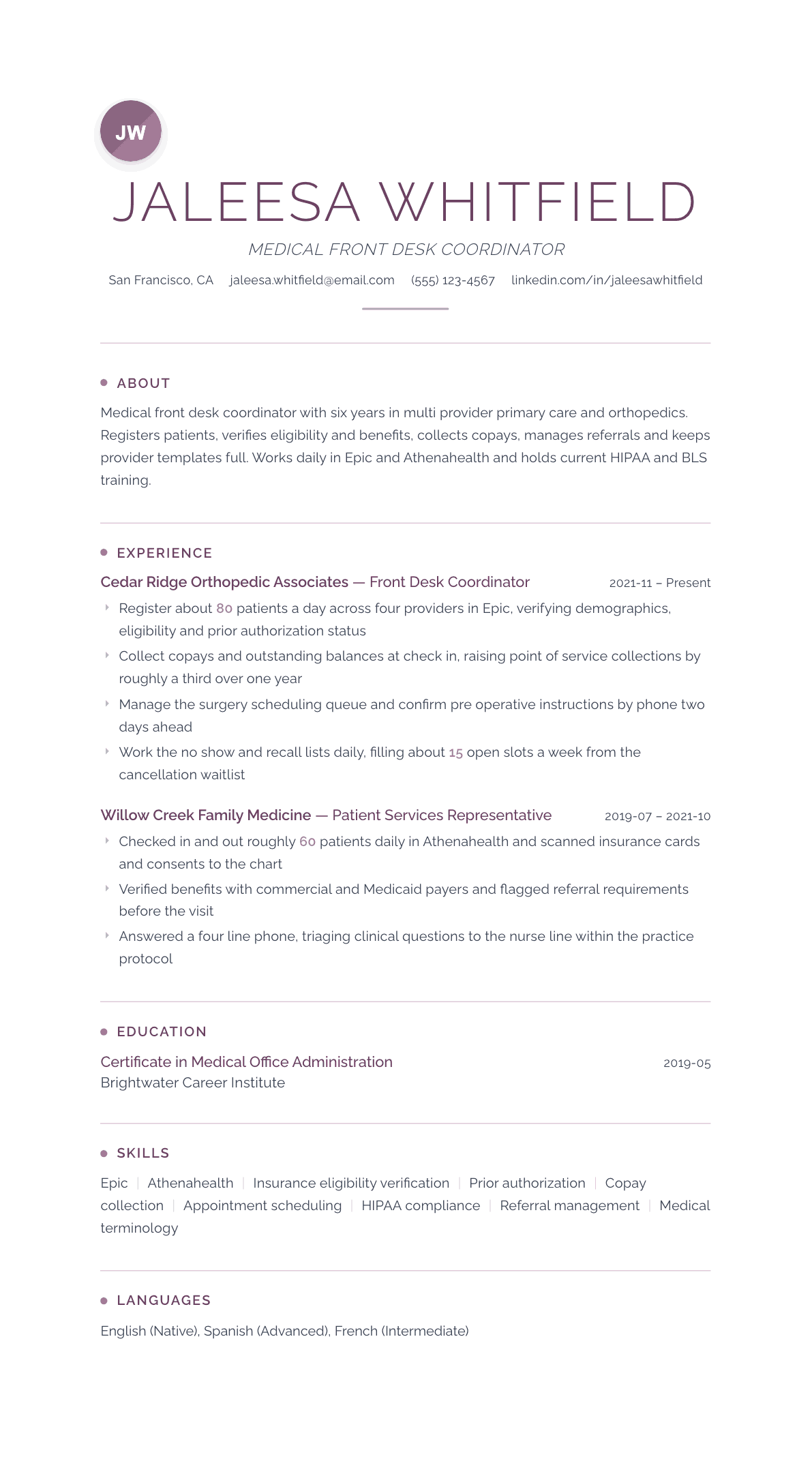
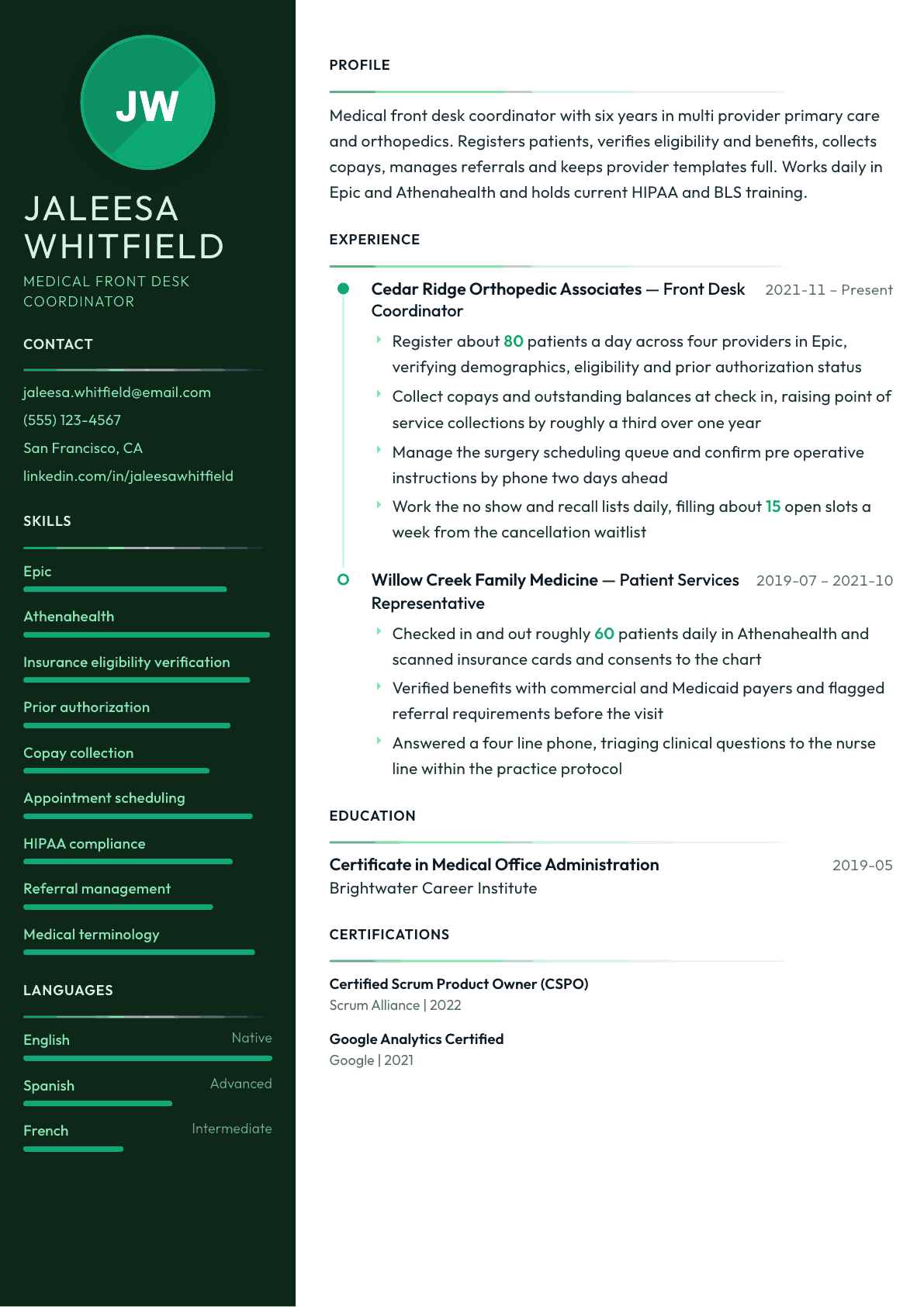
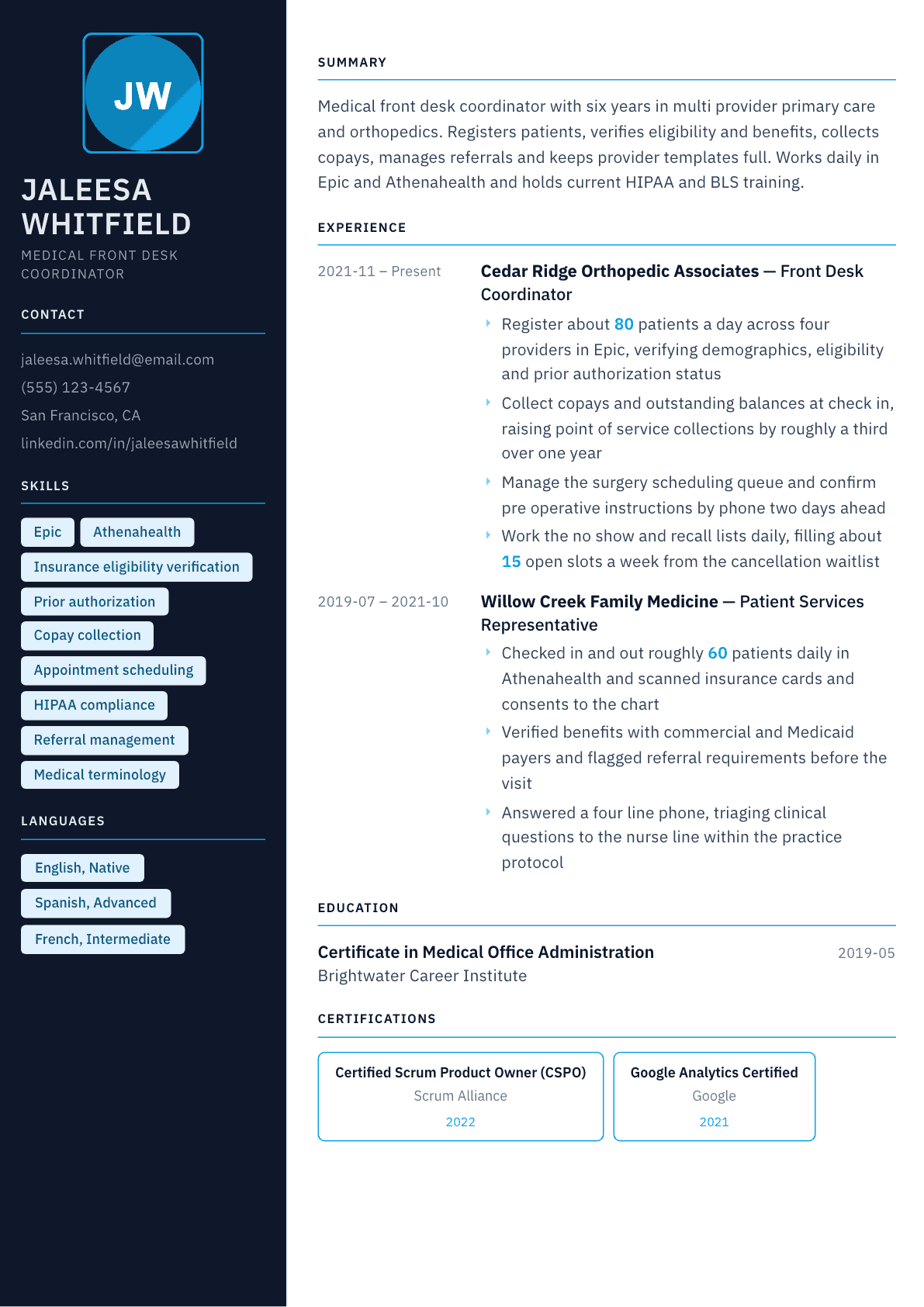
Example Medical Front Desk summary
Medical front desk coordinator with six years in primary care and orthopedic clinics. Registers about 80 patients a day across four providers in Epic, verifies eligibility and prior authorization, and collects copays at check in. Runs the surgery scheduling queue and fills roughly 15 cancelled slots a week from the waitlist. HIPAA trained and comfortable with commercial and Medicaid payers. Seeking a lead front desk role.
Skills to list on a Medical Front Desk resume
- Patient registration
- Epic
- Athenahealth
- Insurance eligibility verification
- Prior authorization
- Referral coordination
- Copay and balance collection
- Appointment and surgery scheduling
- HIPAA compliance
- Medical terminology
- Chart scanning and indexing
- Waitlist and recall management
- Multi line phone triage
- CPT and ICD code lookup
What actually gets this resume read
- Name the electronic health record first, because Epic, Athenahealth, eClinicalWorks and NextGen decide how fast you can be productive.
- Give the daily patient volume and the number of providers you support, since that pair defines the pace of the front desk.
- Show revenue impact through point of service collections, since front desk collections are one of the few numbers a practice manager tracks.
- Say plainly that you verify eligibility, benefits and prior authorization, because those three phrases appear in nearly every clinic posting.
- Mention HIPAA training and any BLS certification, and put both in a credentials section rather than burying them in the skills list.
- Add a bullet on filling cancellations from a waitlist, because keeping the provider template full is what the manager is really buying.
How to write a medical front desk resume
A practice manager hiring for the medical front desk is buying two things: a full provider template and clean claims. Everything else on the resume is context. If your bullets show that you keep the schedule full, verify eligibility and prior authorization before the visit, and collect at check in, you are answering the only questions she has.
The electronic health record decides how fast you become useful, so it belongs in the first line. Epic, Athenahealth, eClinicalWorks and NextGen each have their own registration, scheduling and scanning workflows, and a manager running one of them will always shortlist someone who already knows the screens over someone who wrote experience with electronic records.
This guide covers the credentials section clinics expect, how to write registration and verification bullets that show revenue awareness, why waitlist and recall work is the most undervalued line on these resumes, and how to present privacy training without turning the page into compliance boilerplate.
Format: one page, credentials in their own block near the top
One page, single column, reverse chronological. Give privacy training and any clinical certifications their own short block above or immediately below the summary rather than folding them into a long skills list. A practice manager checks for those first and should not have to hunt.
Under each job, add a short setting line: the specialty, the number of providers and whether it is a hospital owned clinic, a private practice or a multi site group. Orthopedics with four providers and a surgery scheduling queue is a very different desk from a single provider family practice, and the pace difference is the whole point.
- Order: summary, credentials, systems, experience, education.
- Name the electronic health record in the summary and again in the relevant job.
- Give daily patient volume and the number of providers you support.
- List the payers you work with, such as commercial plans, Medicare and Medicaid.
Summary: record system, volume, providers, revenue
Open with years, specialty and the record system. Then the pair that defines the workload: patients registered a day and providers supported. Those two numbers together tell the manager whether you have worked at her pace, and neither one alone does.
Close with something about money. Collecting copays and outstanding balances at check in is the front desk contribution to practice revenue, and it is one of the few numbers a practice manager watches personally. A candidate who mentions point of service collection is speaking her language before the interview starts.
Experience: registration, verification, collection, schedule integrity
Registration bullets should include the verification that goes with them. Confirming demographics, checking eligibility, and reviewing prior authorization status before the visit are the three steps that prevent a denied claim, and the phrases eligibility, benefits and prior authorization appear in nearly every clinic posting, so they should appear in your bullets.
Collection deserves an explicit line. Describe what you collect at check in, whether you discuss outstanding balances, and whether you set up payment arrangements. If your collections improved over a period, say so with an honest description of the change rather than a precise figure you cannot support.
Schedule integrity is the undervalued half of this job. Working the no show and recall lists, filling canceled slots from a waitlist, and confirming pre operative instructions two days ahead all protect provider time. A manager reading those bullets understands that you actively defend the template instead of watching it empty.
- State the record system by product for each job, not just the most recent one.
- Cover eligibility, benefits and prior authorization explicitly in at least one bullet.
- Give a collections bullet with what you ask for and when.
- Show waitlist and recall work with the number of slots you refill.
Credentials, privacy training and terminology
List privacy training with the employer or program that delivered it, plus any current life support certification with its issuing body and expiry. These are checkable facts, and checkable facts are what a credentialing coordinator wants.
Medical terminology and code familiarity belong in the skills list, described honestly. Looking up procedure and diagnosis codes to check a referral or an authorization is different from coding a claim. Claim you can do the first if that is true, and leave coding to the roles where you actually did it.
Skills and the keywords clinic postings reuse
The recurring vocabulary is stable: patient registration, insurance verification, eligibility and benefits, prior authorization, referral coordination, copay collection, appointment scheduling, medical terminology, chart scanning and indexing, and privacy compliance. Mirror the posting wording once in the summary and once in a bullet where it is proven.
Add the phone reality. A multi line phone with clinical questions triaged to the nurse line under a written protocol is a genuine front desk skill, because the risk of taking clinical questions at the desk is exactly what the protocol exists to prevent.
Medical Front Desk resume summary examples
New to the front desk
Medical office administration certificate holder with a year of clinic reception experience. Checks in about 35 patients a day in Athenahealth, verifies demographics and insurance eligibility before the visit, and scans referrals and lab results into the chart the same day. Privacy trained. Seeking a full time medical front desk position.
Six years in
Medical front desk coordinator with six years in primary care and orthopedic clinics. Registers about 80 patients a day across four providers in Epic, verifies eligibility and prior authorization, and collects copays at check in. Runs the surgery scheduling queue and fills roughly 15 canceled slots a week from the waitlist.
Front office lead
Front office lead with eleven years in multi provider specialty clinics, now supervising five registration staff across two sites. Owns the point of service collection standard, the prior authorization tracker and the daily template audit. Trains new hires on Epic registration and referral workflows and reports collection results to the practice manager.
Work experience bullets: before and after
Before: Checked in patients and updated their information.
After: Registered about 80 patients a day across four providers in Epic, verifying demographics, insurance eligibility and prior authorization status before each appointment.
Volume, provider count, the record system and the three verifications show a full registration workflow.
Before: Collected copays from patients.
After: Collected copays and outstanding balances at check in using a scripted request and a payment plan option, raising point of service collections steadily over one year.
Describing the method and the result connects the front desk directly to practice revenue.
Before: Scheduled appointments and surgeries.
After: Managed the surgery scheduling queue, confirmed pre operative instructions by phone two days ahead, and coordinated authorization approvals before the date was released.
The confirmation call and the authorization dependency show you protect the surgical schedule, not just book it.
Before: Called patients who missed appointments.
After: Worked the no show and recall lists daily and filled about 15 open slots a week from the cancellation waitlist, keeping provider templates close to full.
A weekly refill number ties your work to provider productivity, which is what the manager is measured on.
Before: Answered phones and took messages for the nurses.
After: Covered a four line phone and triaged clinical questions to the nurse line within the practice protocol, documenting each message in the chart with a callback expectation.
Naming the protocol and the documentation step shows you handle clinical calls safely rather than informally.
Hard skills
- Patient registration
- Epic
- Athenahealth
- Insurance eligibility verification
- Prior authorization tracking
- Referral coordination
- Copay and balance collection
- Appointment and surgery scheduling
- Privacy compliance procedures
- Medical terminology
- Chart scanning and indexing
- Waitlist and recall management
- Multi line phone triage
- Procedure and diagnosis code lookup
Soft skills
- Calm with anxious patients
- Asking for payment without friction
- Accuracy under a full waiting room
- Discretion at an open counter
- Clear handoff to clinical staff
- Persistence on authorization follow up
Certifications worth listing
- Certified Medical Administrative Assistant (CMAA) (National Healthcareer Association)
- Certified Medical Office Manager (CMOM) (Practice Management Institute)
- Certified Patient Account Representative (CPAR) (Georgia Chapter of the Healthcare Financial Management Association)
- Basic Life Support (BLS) (American Heart Association)
- Certified Professional Biller (CPB) (American Academy of Professional Coders)
Mistakes that cost medical front desk candidates the interview
- Writing electronic medical records instead of naming Epic, Athenahealth, eClinicalWorks or NextGen by product.
- Giving patient volume without the number of providers, so the manager cannot judge the pace of the desk.
- Leaving eligibility, benefits and prior authorization out of the bullets when every posting asks for them.
- Saying nothing about collections, which is the one front desk number a practice manager tracks personally.
- Skipping waitlist and recall work, which is the clearest evidence that you defend the provider template.
- Burying privacy training and life support certification inside a long skills list instead of a credentials block.
- Claiming coding experience because you looked up codes, which falls apart in the first interview question.
Medical Front Desk resume questions
Which electronic health record should I put first?
The one the posting names, if you genuinely know it. Otherwise lead with the system you used most recently and longest. Practice managers weigh record system familiarity heavily because it directly determines how long your orientation takes.
How do I show collections without exaggerating?
Describe the practice rather than inventing a figure. Say what you request at check in, whether you offer payment arrangements, and how balances are flagged in the system. If collections improved while you owned the process, say so plainly and be ready to explain how.
Do I need a certification for a medical front desk job?
Most clinics hire without one, but a medical administrative assistant credential helps a candidate with limited clinical office history, and a life support certification is expected in some settings. Both give a screener something verifiable beyond your job titles.
Can retail or hotel front desk experience get me hired in a clinic?
Yes, if you translate it. High volume check in, cash handling with reconciliation, complaint handling and scheduling all map across. Add medical terminology study or a short medical office course so the manager sees you have closed the vocabulary gap.
How much detail should I give about insurance work?
Enough to prove you prevent denials. Name eligibility and benefit checks, prior authorization tracking, referral requirements and the payer types you handle. That level of detail separates a check in clerk from a coordinator who protects the claim before it is created.
Related resume examples
- Medical Receptionist Resume example
- Billing Specialist Resume example
- Dental Receptionist Resume example
- Intake Coordinator Resume example
- Medical Administrative Assistant Resume example
- Medical Transcriptionist Resume example