Medical Administrative Assistant Resume Examples: free
A Medical Administrative Assistant Resume Clinics Shortlist
By Mustafa Tarabya, founder of CVBooster · Published · Updated
Medical administrative assistant resume example with scheduling and insurance bullets, EHR keywords, and a practical writing guide.
Sample resumes for a medical administrative assistant
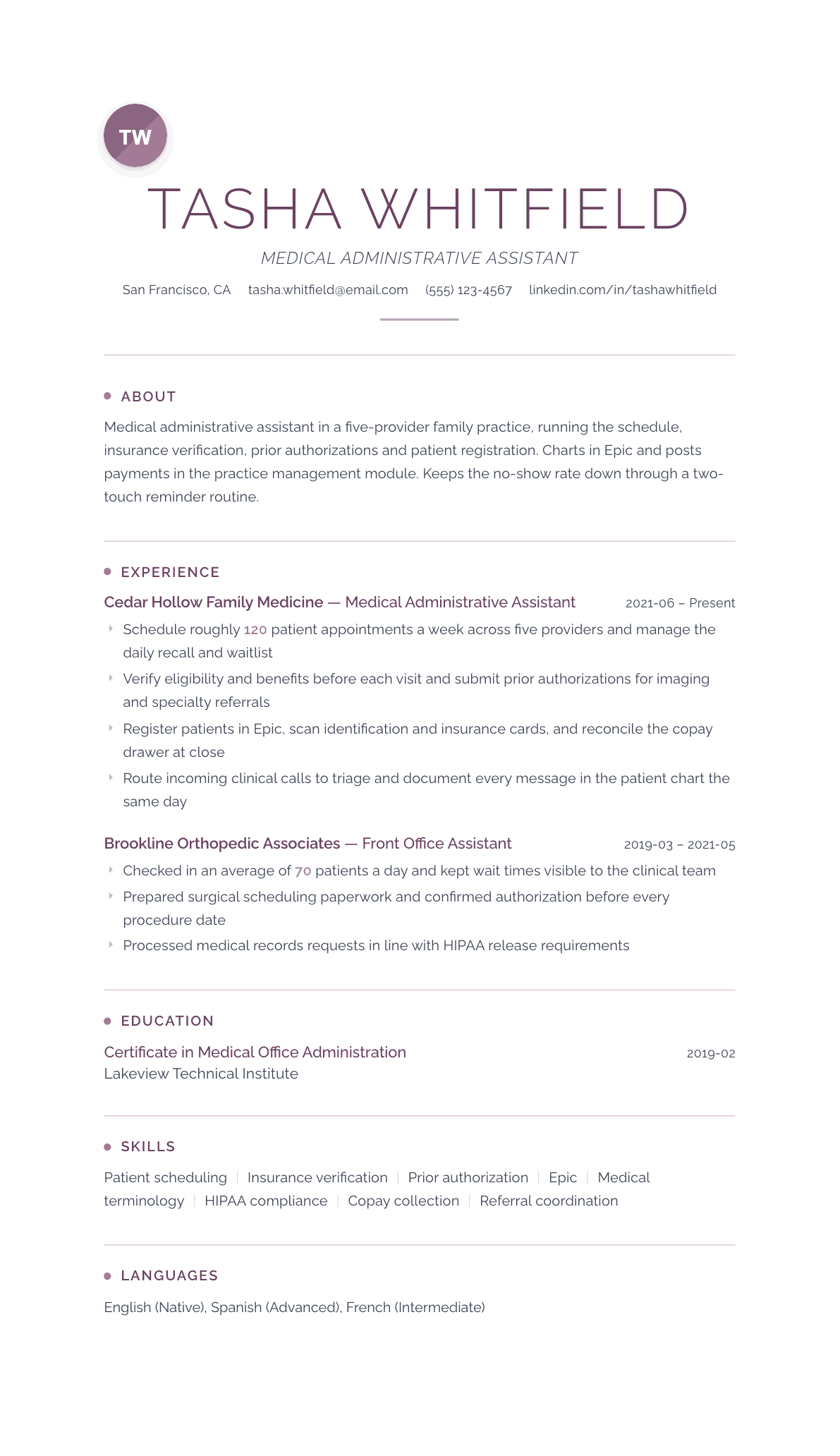
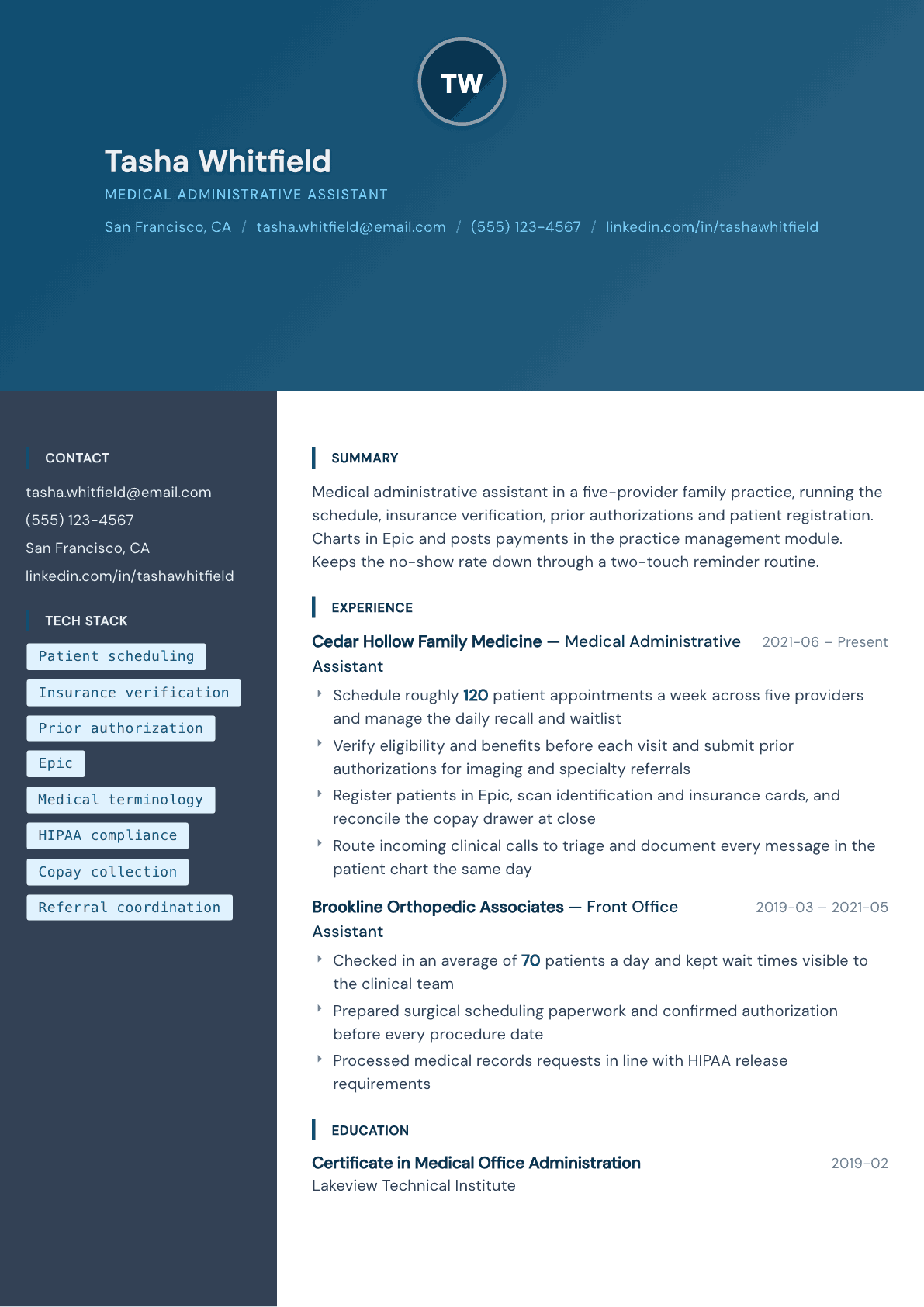
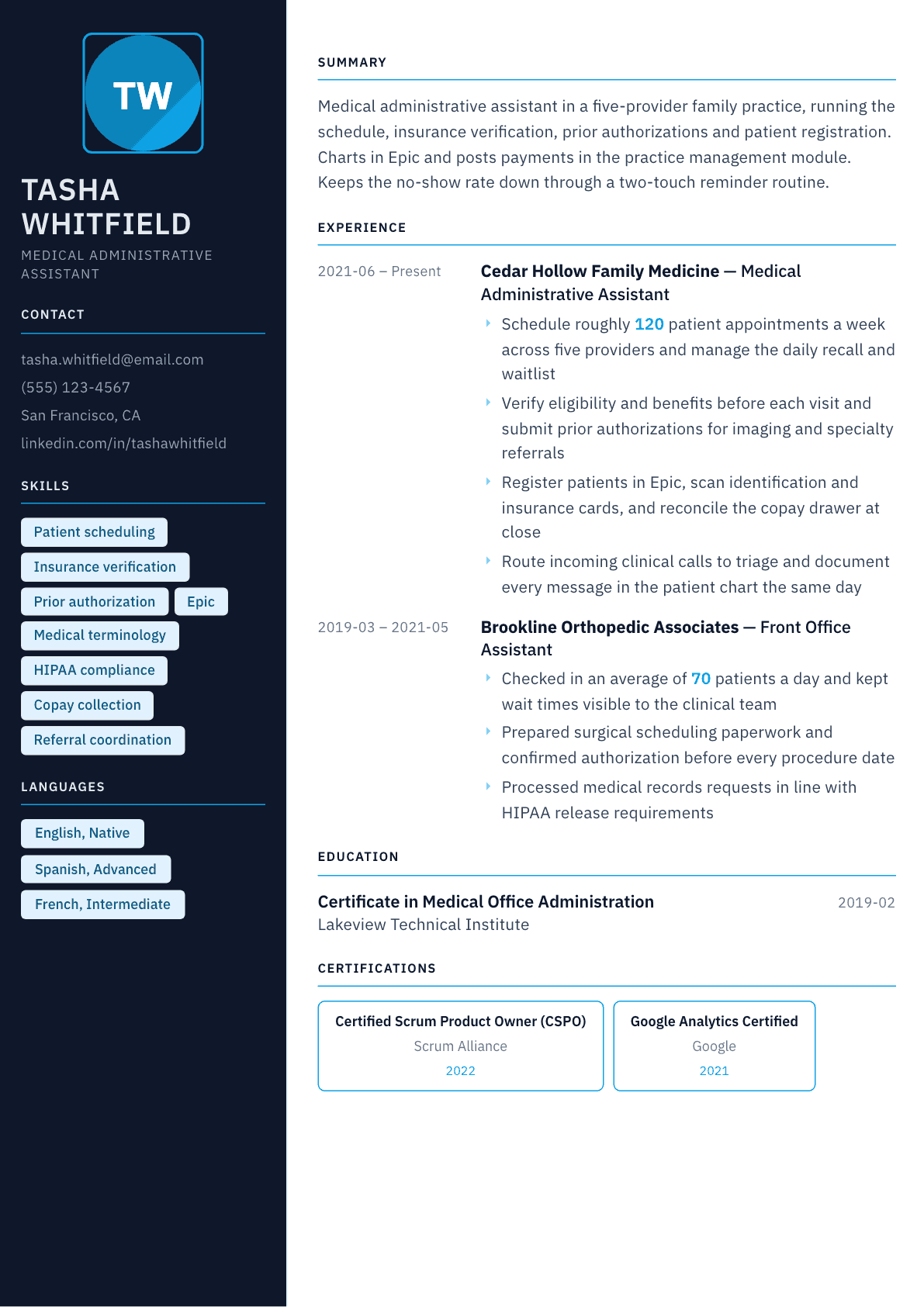
The same medical administrative assistant content laid out in three CVBooster templates, so you can see what the finished document looks like before you write a word.
Example Medical Administrative Assistant summary
Medical administrative assistant with five years in family medicine and orthopedics. Schedules across multiple providers, verifies eligibility and secures prior authorizations before the visit, and registers patients in Epic. Handles records releases under HIPAA and reconciles daily copay collections. Looking for a clinic front office role where reducing no-shows and authorization delays is part of the job description.
Skills to list on a Medical Administrative Assistant resume
- Patient scheduling
- Insurance verification
- Prior authorization
- Referral coordination
- Epic
- Cerner
- Medical terminology
- HIPAA compliance
- Patient registration
- Copay collection
- Medical records requests
- Appointment reminders
- Charge entry
- Multi-line phone systems
What actually gets this resume read
- Name the electronic health record you have used, such as Epic, Cerner, athenahealth or eClinicalWorks. Clinics filter on it.
- Give the specialty and the provider count, because a five-provider family practice differs from a single dermatologist.
- Show insurance work in detail: eligibility checks, prior authorizations, referrals, and what happens when a claim is denied.
- Put HIPAA in a bullet about a real task, such as records releases, rather than listing it as a bare compliance word.
- Include patient volume per day or per week, since front office hiring is about whether you can hold the pace.
- Add any billing or coding exposure separately, because clinics often want one person who can cover both desks.
How to write a medical administrative assistant resume
Clinic front offices hire on two questions: can you hold the pace, and do you already know the insurance work. A practice manager reading your resume is picturing a waiting room at nine in the morning with a full schedule, three walk-ins and a fax from a specialist that needs a prior authorization by noon. Everything on the page should answer whether you can stand in the middle of that.
The fastest filter is the electronic health record. Postings name Epic, Cerner, athenahealth, eClinicalWorks or NextGen directly, and a resume without a record system on it will not survive the keyword pass. The second filter is specialty and provider count, because supporting five family medicine providers is a different rhythm from one dermatologist.
This guide covers how to write scheduling and registration work with real volumes, how to describe eligibility checks and prior authorizations so a manager believes you have done them, where compliance belongs on the page, and how to show billing exposure without claiming to be a coder.
Format: one page, clinical vocabulary near the top
One page is right for almost every front office career. Use a single column, month and year dates, and a plain header with your city and state. Larger health systems run applicant tracking software that reads plain layouts reliably, and a graphic template with columns risks losing your record system names entirely.
Put a short line under each employer giving the setting: the specialty, the number of providers, and whether it was a hospital-owned clinic, a private practice or a multi-site group. That line does more work than three bullets, because it tells the reader exactly what kind of schedule you have run.
- Section order: summary, skills and systems, experience, education and certifications.
- Name the record system in the summary, the skills list and at least one bullet.
- Give patient volume per day or per week for every clinical employer.
Summary: setting, systems, and the number that matters
Open with the specialty and the provider count, then the record system, then the part of the job you are strongest at. A medical administrative assistant in a five-provider family practice who registers in Epic, verifies benefits and clears prior authorizations before the visit has said more in one sentence than most resumes say in a page.
Close on an outcome the practice manager wants. Lower no-show rates, authorizations cleared before the appointment date, or a copay drawer that reconciles every night are the results the front desk is measured on, and stating one puts you ahead of a summary made of adjectives.
Scheduling, registration and the daily flow
Give the numbers. Appointments booked per week across how many providers, patients checked in per day, the recall list, the waitlist and how you fill a cancellation. Add the reminder routine, because reducing no-shows is a measurable saving and a two-touch reminder process is something a manager can adopt.
Then registration: identity and insurance card scanning, demographic updates, consent forms, and the copay collection and reconciliation at close of day. Money handling at the front desk is a trust point, so say that you reconciled and to whom you handed off.
Cover the phones honestly. A multi-line system, the triage routing rule you follow for clinical calls, and same-day documentation of every message in the patient chart. Practice managers hear complaints about messages that never reached the nurse, so a bullet that closes that loop lands well.
Insurance work: eligibility, authorization, denial
This is the section that separates candidates. Describe eligibility and benefits verification before the visit, prior authorization submissions for imaging, procedures and specialty referrals, and what you do when an authorization is denied or expires. Name the payer types you have worked with, such as commercial plans, Medicare and Medicaid, and say whether you used payer portals or phoned in.
Referral coordination belongs here too: tracking the outbound referral, chasing the consult note back, and closing the loop in the chart. That is the piece most front offices lose track of, and a candidate who mentions it sounds experienced immediately.
If you have touched charge entry, claim submission or denial follow-up, list it as separate exposure rather than claiming a coding role. Small practices often want one person who can cover both desks, and honest partial experience is more hireable than an overstated title.
Compliance and skills: attach it to a task
Do not list compliance as a word on its own. Put it in a bullet about a real task: processing a medical records request against a signed release, verifying patient identity before discussing results, or keeping the check-in screen turned away from the waiting room. A specific practice proves you understand the rule, while the bare word proves you have heard of it.
For skills, list the record and practice management systems by name, then the clinical office vocabulary a posting uses: patient scheduling, insurance verification, prior authorization, referral coordination, medical terminology, patient registration, copay collection, medical records requests. Keep the soft skills for the bullets, where they are shown rather than claimed.
Medical Administrative Assistant resume summary examples
New certificate holder
Medical office administration certificate holder with a 160-hour clinic externship covering check-in, scheduling and insurance card capture for a three-provider practice. Trained in medical terminology and an electronic health record, and comfortable on a multi-line phone. Seeking a front office role in primary care.
Three years in primary care
Medical administrative assistant in a five-provider family practice, scheduling around 120 appointments a week and managing the daily recall and waitlist. Verifies eligibility before each visit, submits prior authorizations for imaging and specialty referrals, and registers patients in Epic. Reconciles the copay drawer at close each day.
Lead front office
Lead medical administrative assistant with eight years across family medicine and orthopedics, training new front desk staff and owning the authorization queue for surgical scheduling. Works in Epic and a practice management module, handles records releases under a signed release process, and runs the reminder routine that keeps no-shows down.
Work experience bullets: before and after
Before: Scheduled patient appointments.
After: Scheduled around 120 appointments a week across five providers and worked the recall and waitlist to fill same-day cancellations before the slot was lost.
Volume, provider count and the cancellation recovery show whether you can hold a full clinic schedule.
Before: Verified insurance for patients.
After: Verified eligibility and benefits before every visit and submitted prior authorizations for imaging and specialty referrals through payer portals, tracking each to approval.
The order of operations and the follow-through are what a practice manager needs to see, not the word verified.
Before: Checked patients in at the front desk.
After: Checked in an average of 70 patients a day, scanned identification and insurance cards into the chart, and kept the clinical team updated on wait times.
Daily volume plus the registration steps proves pace and accuracy at the same time.
Before: Followed HIPAA rules.
After: Processed medical records requests against signed authorization forms and verified patient identity before releasing any result over the phone.
A compliance rule shown as a concrete practice is believable in a way that the bare word never is.
Before: Collected payments from patients.
After: Collected copays at check-in and reconciled the drawer against the day sheet at close, handing off discrepancies to the practice manager the same afternoon.
The reconciliation and the handoff turn cash handling into a controlled process a manager can trust.
Hard skills
- Patient scheduling and recall
- Insurance eligibility verification
- Prior authorization
- Referral coordination
- Patient registration
- Epic
- Cerner
- Medical terminology
- Medical records requests
- Copay collection and reconciliation
- Charge entry exposure
- Multi-line phone systems
- Appointment reminder workflows
Soft skills
- Pace at a full front desk
- Calm with anxious patients
- Accuracy when interrupted
- Discretion in a shared waiting room
- Clear handoff to clinical staff
- Patience on hold with payers
Certifications worth listing
- Certified Medical Administrative Assistant (CMAA) (National Healthcareer Association)
- Certified Electronic Health Records Specialist (CEHRS) (National Healthcareer Association)
- Certified Medical Administrative Specialist (CMAS) (American Medical Technologists)
- Basic Life Support (BLS) (American Heart Association)
Mistakes that cost medical administrative assistant candidates the interview
- Leaving the electronic health record off the page, which drops the resume at the first keyword pass in most health systems.
- Writing insurance verification as two words with no mention of authorizations, denials or payer portals.
- Omitting patient volume, so a manager cannot tell whether you have worked a full clinic or a quiet specialty office.
- Listing compliance as a standalone skill instead of attaching it to records releases or identity verification.
- Claiming billing and coding responsibility when the real experience was charge entry, which unravels in the interview.
- Using a decorative two-column template that hides the systems and certifications behind a parsing failure.
Medical Administrative Assistant resume questions
Which electronic health record should I put on my resume?
The ones you have genuinely used, named exactly as the vendor spells them, and in the order of how deeply you know them. If the posting names a system you have not used, say which one you know and note that you have moved between records before, since transferable record experience is often accepted.
Do I need a certification for a medical administrative assistant job?
Many clinics hire without one, but a credential such as the Certified Medical Administrative Assistant shortens the screening argument, especially for applicants coming from a non-clinical office. Put it near the top with the issuing body spelled out, and add current basic life support if you hold it.
How do I show that I can reduce no-shows?
Describe the reminder routine you ran: how many touches, by which channel, how far ahead, and what you did with a confirmed cancellation. Practice managers care about the empty slot more than the missed appointment, so include how you filled it from a waitlist.
Should I include externship hours if I have no paid clinic experience?
Yes. Give the setting, the number of providers, the hours completed and the tasks you actually performed, the same way you would write a paid role. Drop it once you have a year of paid front office work behind you.
How do I move from a general office job into a medical office?
Lead with scheduling volume, phone handling and records accuracy, which transfer directly, then close the gap visibly with medical terminology training or a front office certificate. Name any exposure to insurance, benefits or health records from your previous work, however small.
Related resume examples
- Medical Receptionist Resume example
- Medical Office Manager Resume example
- Medical Records Clerk Resume example
- Medical Assistant Resume example
- Dental Receptionist Resume example
- Scheduling Coordinator Resume example