Credit Manager Resume Examples: the lines they read
Write a Credit Manager Resume That Proves Portfolio Control
By Mustafa Tarabya, founder of CVBooster · Published · Updated
Credit manager resume examples, a sample credit policy portfolio, DSO and bad-debt keywords, plus a full writing guide for commercial credit roles.
Sample resumes for a credit manager
The same credit manager content laid out in three CVBooster templates, so you can see what the finished document looks like before you write a word.
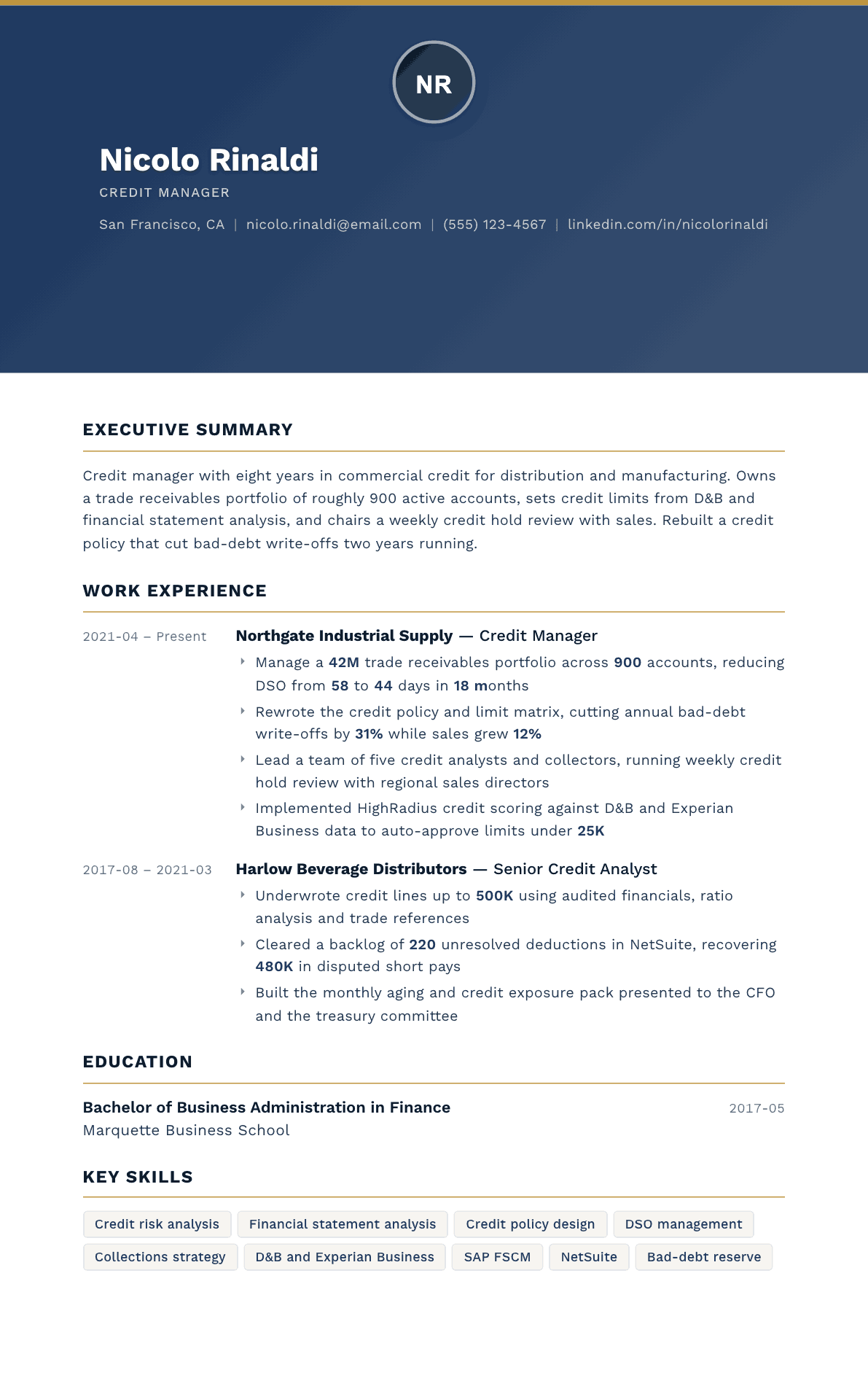
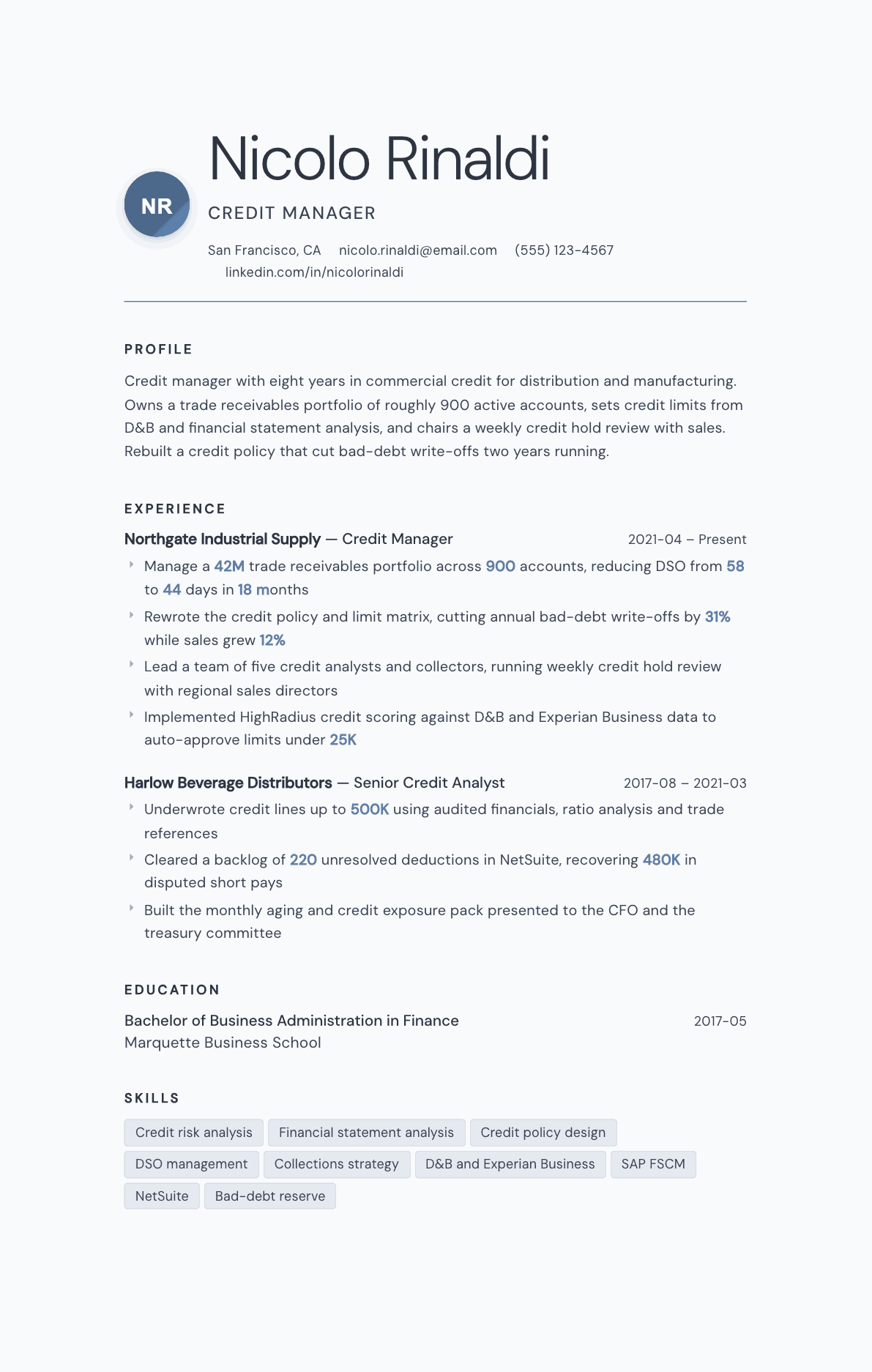
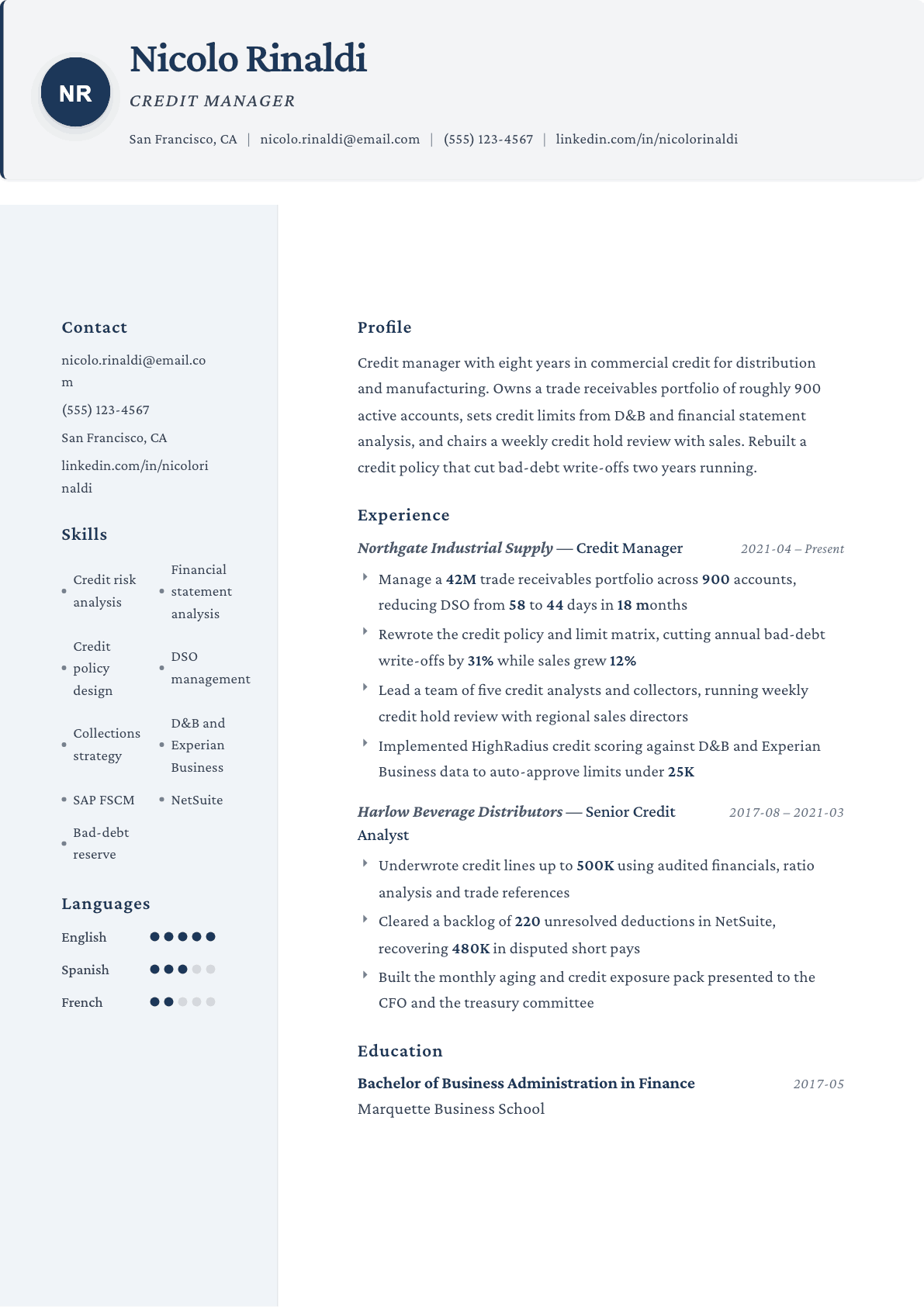
Example Credit Manager summary
Credit manager with eight years underwriting commercial trade credit for wholesale and manufacturing customers. Owns a receivables portfolio near 900 accounts, sets limits from audited financials and bureau data, and leads five analysts through a weekly credit hold review. Cut DSO by 14 days and lowered bad-debt write-offs across two consecutive years by rewriting the credit policy and automating low-risk approvals.
Skills to list on a Credit Manager resume
- Credit risk analysis
- Financial statement analysis
- Credit policy and limit setting
- Accounts receivable management
- DSO and aging analysis
- Bad-debt reserve estimation
- Collections strategy
- Dispute and deduction resolution
- Credit application underwriting
- D&B and Experian Business reports
- UCC filings and lien rights
- Letters of credit
- SAP FSCM
- Oracle Receivables
- HighRadius
- Team leadership
What actually gets this resume read
- Put the portfolio size, account count and industry mix in the first line of every job, because that is the scope a controller checks first.
- Quantify DSO, aging buckets over 90 days, bad-debt write-offs and dispute recovery, since credit managers are hired on those four numbers.
- Name the credit bureaus and scoring sources you underwrite from: D&B, Experian Business, Equifax Commercial, and the credit application workflow.
- Show that you can say no to sales without stalling revenue, using a credit hold review or a limit escalation process you actually ran.
- List the ERP and credit modules by name, for example SAP FSCM, Oracle Receivables, NetSuite or HighRadius, near the top of your skills section.
- Mention letters of credit, UCC filings, personal guarantees and lien rights if you have used them, as they separate commercial credit from consumer credit.
How to write a credit manager resume
A credit manager resume is judged on one question: can this person hold the receivable down without strangling sales? The controller who hires you wants proof that you have priced risk on real customers, set limits you could defend, and pushed cash in the door faster than the person before you. Everything else on the page is context.
That proof is concrete. It is the size of the portfolio, the number of active accounts, the industry mix, the days sales outstanding when you arrived and the number when you left. It is the write-off line, the aging bucket past ninety days, and the escalation process you built so a sales director could not simply overrule a hold.
This guide covers the order a credit leader reads the page, how to write the portfolio line, three summaries for different career stages, before and after bullets from real credit files, and the questions credit professionals ask when they sit down to rewrite the document.
Format: one page under a decade, two pages once you have run a department
Reverse chronological, single column, no graphics. Credit is a documentation discipline and the resume should look like a clean file. Put a short skills band under the summary so the applicant tracking system finds the bureau names and the ERP before it reaches your experience.
Lead each role with a scope line before the bullets. Something like "commercial trade portfolio, nine hundred accounts, forty million receivable, industrial distribution" answers half the interview in one line and lets the reader calibrate every bullet that follows.
- Header: name, city and state, phone, email, and any credit designation you hold.
- Order: summary, core competencies, professional experience, education, certifications and associations.
- Give each job a scope line: portfolio value, account count, customer industries, team size.
Summary: portfolio, authority, and the number you moved
Three or four lines. Name the type of credit you underwrite, commercial trade credit is a different job from consumer lending or bank credit, then your approval authority, the portfolio you carry, and one measured result. A summary that opens with "detail oriented finance professional" is invisible in a stack of credit resumes because every applicant claims it.
If you are moving between industries, address it directly. Construction credit with lien rights and joint check agreements is not the same as consumer products credit with high account volume and small balances, so say which one you know and which one you are targeting.
Experience: risk decisions, not task lists
Three to five bullets per role. Lead with the decisions only a credit manager makes: setting or revising limits, releasing or holding orders, requiring a personal guarantee or a letter of credit, reserving for a customer heading toward insolvency. Then the operating results, and finally the process or policy work.
Write the outcome as a movement rather than a state. "Reduced days sales outstanding from fifty-eight to forty-four across eighteen months" carries more weight than "maintained strong DSO" because it shows a starting point, a direction and a period. Do the same for the aging bucket past ninety days and for the write-off line.
Cut the bullets that describe the job rather than your version of it. Reviewing credit applications, running aging reports and calling customers appear on every credit resume ever written, so they buy no space.
Tools and sources: name every one
Recruiters filter on system names. List the ERP receivable module you worked in, the credit management platform if you had one, and the risk sources you underwrote from. Dun and Bradstreet reports, Experian Business, Equifax Commercial, NACM industry credit group data, and audited financial statements are all different inputs and a hiring manager reads the mix as a signal of how deep your analysis goes.
Name the legal instruments too. UCC financing statements, mechanics lien notices, personal guarantees, standby letters of credit and credit insurance policies tell a reader you have protected an exposure rather than only measured it.
Keywords the screening software is matching
Credit postings recycle the same phrases: credit risk analysis, credit limit, credit policy, days sales outstanding, aging, bad debt reserve, collections strategy, order release, financial statement analysis, and the ERP. Use each phrase once where it is true, in the skills band and again inside a bullet where you can back it up. Never repeat a term in a block at the bottom of the page, because a human reads the file immediately after the software passes it.
Credit Manager resume summary examples
Credit analyst moving up
Credit analyst with three years underwriting trade lines up to 250K for a building products distributor. Reviews audited financials, bureau reports and trade references, and prepares the monthly exposure pack. Seeking a credit manager role where I can own policy and limit authority.
Running a portfolio
Credit manager with eight years on a 900 account commercial portfolio in industrial distribution. Cut DSO from 58 to 44 days, lowered write-offs two years running, and chairs the weekly credit hold review with regional sales. Authority to 2M, with escalation above that to the CFO.
Department leader
Director of credit with fifteen years leading credit, collections and cash application for a multi-division manufacturer. Owns a 180M receivable, a team of fourteen, and the bad debt reserve methodology reviewed by external audit. Rebuilt the credit policy and the customer onboarding workflow across four acquired entities.
Work experience bullets: before and after
Before: Responsible for managing accounts receivable and reducing DSO.
After: Owned a 42M trade receivable across 900 accounts and cut DSO from 58 to 44 days in 18 months by tightening order release rules and adding a day-five courtesy call.
The portfolio size, the starting number and the two actions turn a claim into a case a controller can verify.
Before: Reviewed credit applications and set credit limits.
After: Underwrote new trade lines to 500K using audited financials, ratio analysis and three trade references, and rebuilt the limit matrix so risk-scored accounts under 25K approved automatically.
It names the dollar authority, the inputs and the policy change instead of describing the general duty.
Before: Worked closely with the sales team on past-due accounts.
After: Chaired a weekly credit hold review with four regional sales directors, clearing an average of 30 held orders per session while keeping the over-90 bucket under 5% of the aging.
A named forum with a cadence and a constraint proves you can hold the line without blocking revenue.
Before: Reduced bad debt for the company.
After: Lowered annual bad-debt write-offs by 31% over two years by rewriting the credit policy, requiring personal guarantees on thin-file accounts and filing UCC statements on equipment sales.
Three specific mechanisms explain how the number moved, which is what a hiring manager actually tests.
Before: Handled customer disputes and deductions.
After: Cleared a backlog of 220 unresolved deductions in NetSuite and recovered 480K in disputed short pays by rebuilding the dispute coding and routing claims to the responsible department within two days.
The volume, the recovery and the process fix show ownership of a problem rather than participation in it.
Hard skills
- Commercial credit underwriting
- Financial statement and ratio analysis
- Credit policy and limit matrices
- Days sales outstanding management
- Aging and portfolio exposure reporting
- Bad-debt reserve methodology
- Collections and escalation strategy
- Deduction and dispute resolution
- UCC filings and lien rights
- Letters of credit and guarantees
- Dun and Bradstreet and Experian Business
- SAP FSCM and Oracle Receivables
Soft skills
- Negotiation with sales leadership
- Decision-making under incomplete information
- Customer conversations about money
- Team coaching
- Escalation judgment
- Written credit rationale
Certifications worth listing
- Credit Business Associate (CBA) (National Association of Credit Management)
- Credit Business Fellow (CBF) (National Association of Credit Management)
- Certified Credit Executive (CCE) (National Association of Credit Management)
- Certified Credit and Risk Analyst (CCRA) (National Association of Credit Management)
- Certified Receivables Compliance Professional (CRCP) (Receivables Management Association International)
Mistakes that cost credit manager candidates the interview
- Leaving out the portfolio value and account count, which makes every result on the page impossible to size.
- Claiming a strong receivable without a before and after, so the reader cannot tell whether you inherited it or built it.
- Describing credit work generically when the industry drives the job: construction lien rights and consumer volume are different trades.
- Hiding your approval authority, which is the single fastest way for a hiring manager to place you at the right level.
- Listing collections activity only, which reads as a collector resume and quietly disqualifies you from the manager role.
- Omitting the ERP and the bureau sources, so the resume misses the exact terms the screening filter was built around.
Credit Manager resume questions
How technical should a credit manager resume be about financial analysis?
Specific enough to prove you read statements rather than scores. Name the ratios you underwrite on, current ratio, debt to equity, interest coverage and cash conversion, and say when you require audited statements instead of a bureau report alone.
Should I include collections work if I now manage credit?
Yes, but subordinate it. One bullet on collections strategy and escalation shows you understand the recovery end. Several bullets on call volume and payment plans will read as a collector resume and push you back a level.
What if my company never tracked DSO?
Use whatever they did track. Percentage of receivable past due, write-off against sales, aging bucket movement, dispute cycle time or cash collected against forecast all show the same discipline. Say which measure the business used and why.
Do credit certifications from NACM actually matter?
They matter most when you are moving between industries or stepping up a level, because they signal formal training in credit law, financial analysis and policy. List the designation, the issuing body and whether it is in progress or complete.
How do I show that I balanced risk against sales growth?
Pair the two numbers in one bullet. Write the write-off reduction alongside the revenue or shipment growth over the same period, then name the mechanism, an automated approval band or a hold review, that let both move in the right direction.
Related resume examples
- Credit Analyst Resume example
- Controller Resume example
- Collections Specialist Resume example
- Finance Manager Resume example
- Accounts Receivable Specialist Resume example
- Underwriter Resume example