Controller Resume Examples: free ATS score and gap list
Create a Controller Resume That Balances Perfectly
By Mustafa Tarabya, founder of CVBooster · Published · Updated
Build a controller resume demonstrating financial reporting leadership, close process optimization, and accounting team management with clear operational metrics.
Sample resumes for a controller
The same controller content laid out in three CVBooster templates, so you can see what the finished document looks like before you write a word.
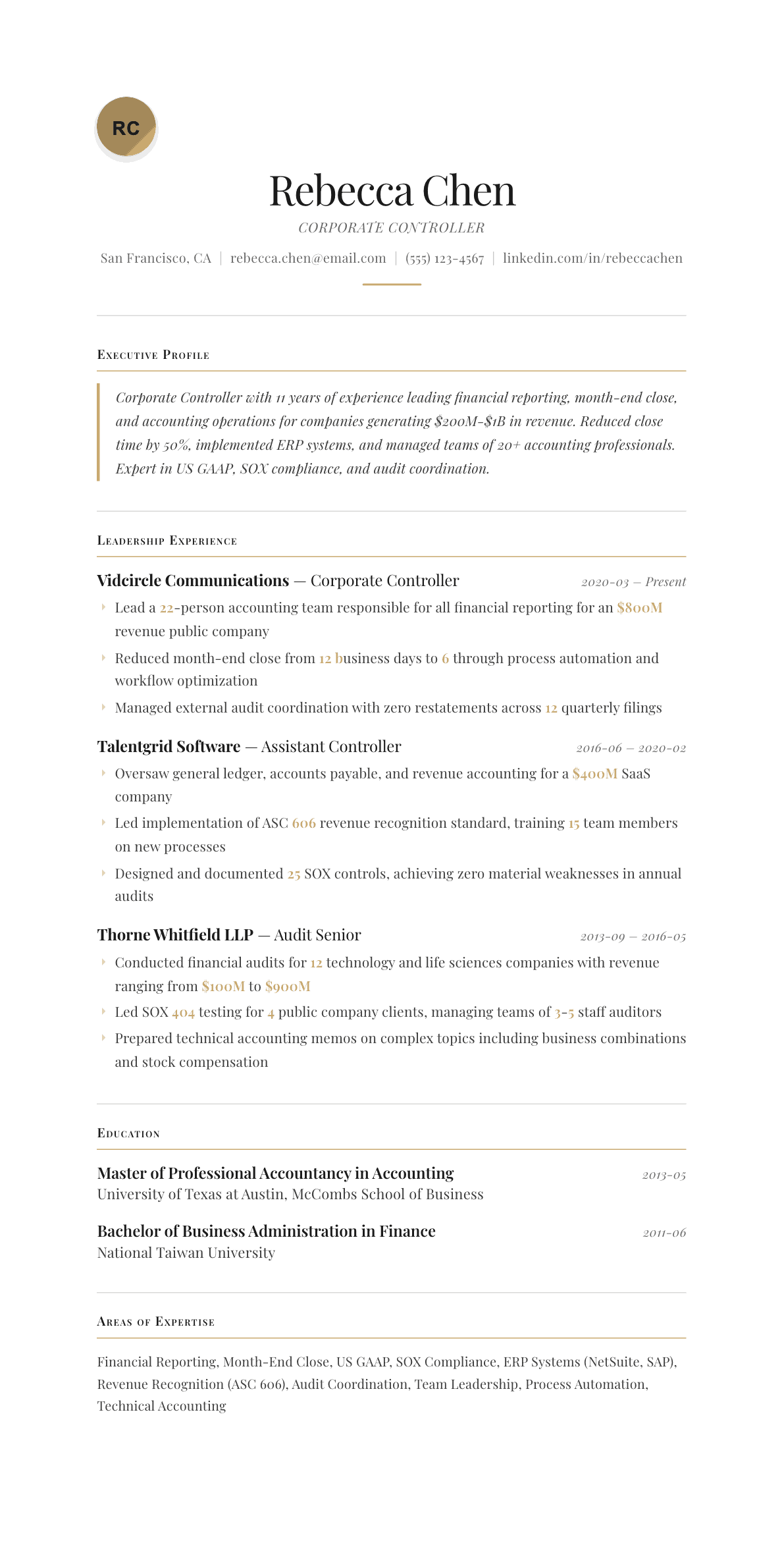
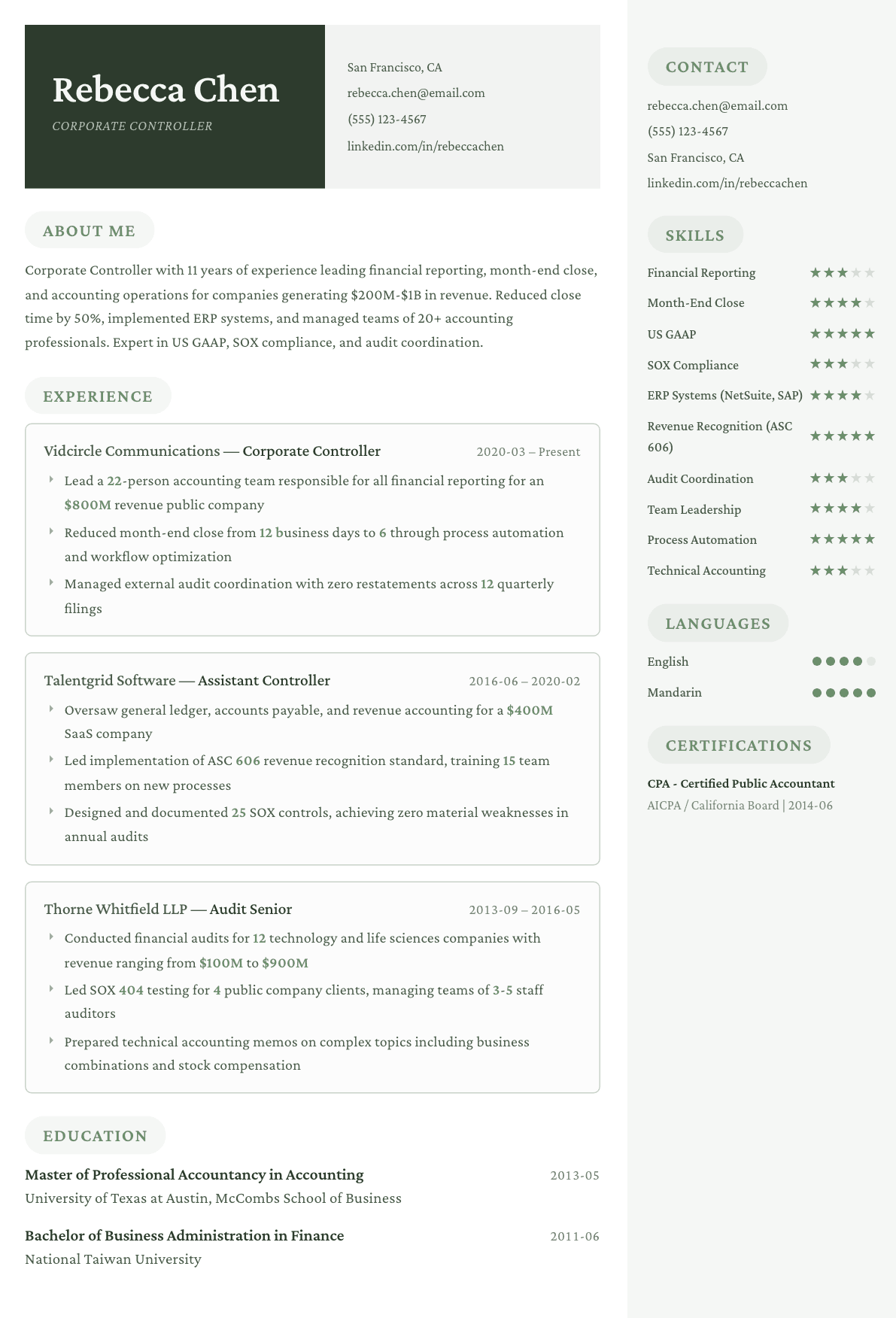
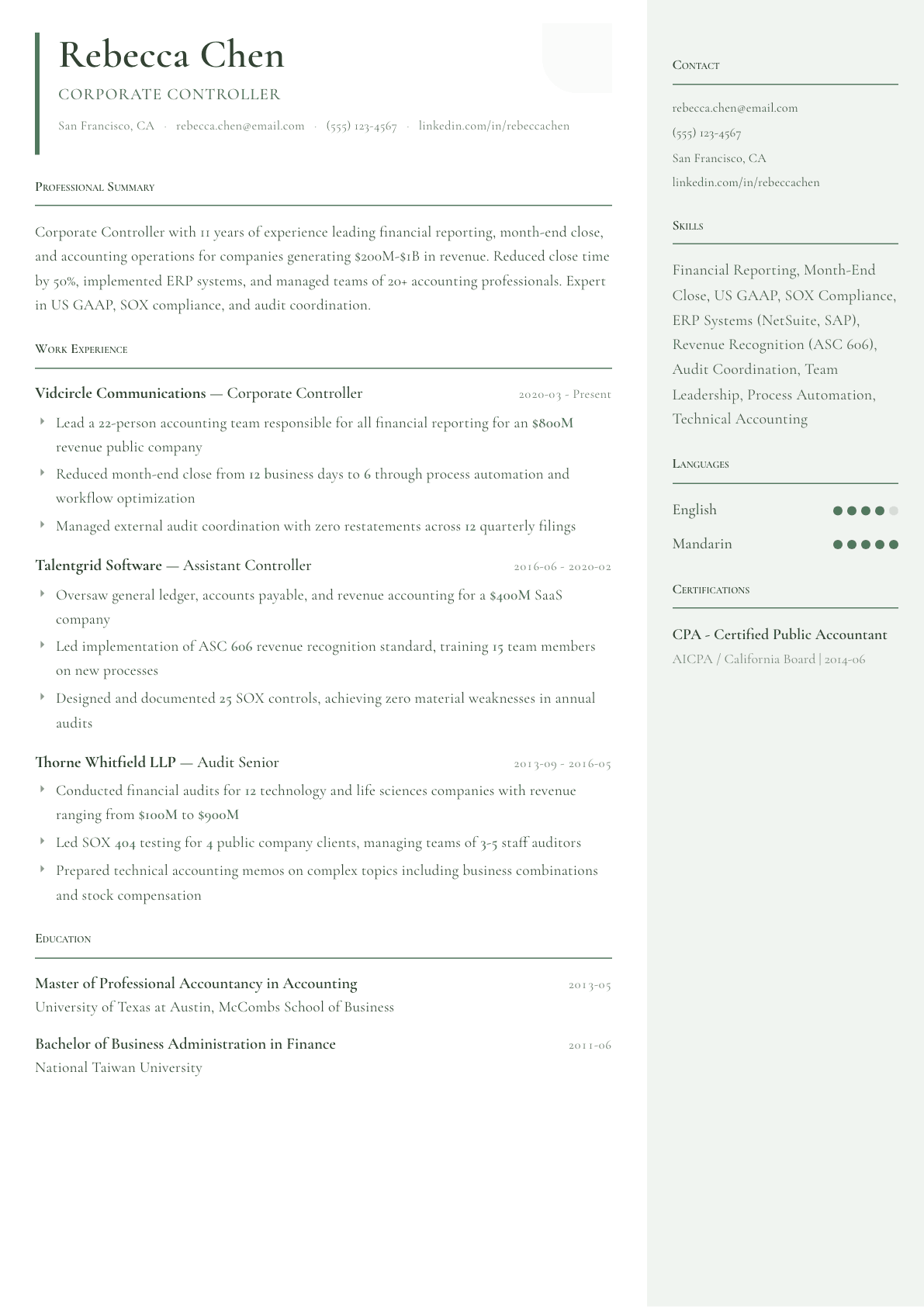
Example Controller summary
CPA and Corporate Controller with 11 years of experience leading financial reporting and accounting operations for public technology companies with $200M-$800M in revenue. Reduced close time by 50% and maintained zero audit restatements across 12 quarterly filings. Seeking a VP Finance or CFO role to drive financial operations at a high-growth company.
Skills to list on a Controller resume
- Financial Reporting
- Month-End / Quarter Close
- US GAAP
- SOX Compliance
- ERP Systems
- Revenue Recognition
- Audit Coordination
- Team Leadership
- Process Automation
- Technical Accounting
- Consolidations
- Internal Controls
- Budget vs. Actual Analysis
What actually gets this resume read
- Highlight close process improvements with specific timeline reductions.
- Quantify team size, company revenue, and number of entities or subsidiaries managed.
- Show expertise in technical accounting: revenue recognition, lease accounting, business combinations.
- Include ERP system experience (NetSuite, SAP, Oracle) and automation initiatives.
- Demonstrate audit coordination and SOX compliance management.
- CPA designation is expected at this level; display it prominently.
How to write a controller resume
A controller is hired to make the numbers arrive on time and be right. The chief financial officer or chief executive reading the resume is testing two things: whether you have owned a close of comparable complexity, and whether the accounting function under you was a source of surprises. Everything on the page should serve one of those two questions.
Complexity is the word doing the work. Entity count, currencies, consolidation, revenue model, inventory, whether the company is audited and by whom, whether it reports to a lender or a sponsor or the public, and the size of the team you led are the facts that let a reader place your close next to theirs. A controller resume without those facts is unreadable at the level it is applying for.
This guide covers section order and the company context line, how to write close ownership, technical accounting and system work, three summaries from assistant controller through corporate controller, and the questions controllers ask when they move from public accounting or into a finance leadership seat.
Format: company context first, then what you closed
Two pages is normal for a controller with a decade of experience. Reverse-chronological, single column, restrained. Under each employer write a context line before the bullets: industry, revenue scale, ownership, entity count, currencies, employee count, audit firm tier and the size of the accounting team reporting to you.
Put the CPA in the header and keep the education section short. At this level the technical credential and the scope line do the qualifying, and space is better spent on close ownership and technical accounting than on coursework.
- Header: name with CPA, city and state, phone, email.
- Order: summary, professional experience with context lines, systems, technical accounting, credentials, education.
- Context line per role: revenue, ownership, entities, currencies, audit status, team size.
Summary: the close you own and the standard you close to
A controller summary should state the close, the framework, the systems and the team in one breath. Closing a multi entity consolidated set of books under US GAAP in NetSuite with a team of six is a complete positioning statement, and it beats any sentence about being a strategic finance leader.
Add the recurring event that defines your year. An external audit with no adjustments, a lender reporting package delivered monthly, a sponsor board pack, or a public filing calendar tells the reader which pressure you are used to working under.
Experience: close, controls, technical accounting, systems
Close ownership is the first territory. Give the day count, what changed under you, and the mechanism: a close checklist with owners, standardized reconciliations, automated accruals, an intercompany process, cutoff discipline with operations. Reducing a close is the most quoted controller accomplishment on earth, so the mechanism is what makes yours believable.
Controls and audit are the second. Say what you built rather than what existed: a segregation of duties review, a delegation of authority matrix, documented process narratives, a SOX control set for a company approaching public reporting, or a first audit for a company that had never had one. Then give the audit outcome, including adjustments and management letter comments.
Technical accounting is the third. Revenue recognition under ASC 606, leases under ASC 842, business combinations and purchase price allocation, stock compensation, impairment testing, and foreign currency translation are the areas where a controller earns their title. Name the memo you wrote and whether the position held through audit.
System and process work is the fourth. An enterprise system implementation or migration, a subledger rollout, an automated reconciliation tool, or a chart of accounts redesign are large projects, and a controller who has led one is a materially different hire from one who has lived inside a stable system.
Team, and the part of the job that is management
A controller job is a management job. State the structure: how many direct reports, what functions sat under you, whether accounts payable, payroll, treasury operations or tax reported in, and how you covered the close when someone left. Hiring and developing accountants is a genuine differentiator in a market where accounting hiring is hard.
Show the interface with the rest of the business too. Working with sales operations on contract terms, with the systems team on integrations, with human resources on payroll accruals, and with the finance planning group on the actuals to plan bridge is what stops the accounting team becoming a back office nobody talks to.
Systems and keywords a controller posting will contain
Name the general ledger and everything attached to it: NetSuite, SAP, Oracle, Microsoft Dynamics 365, Sage Intacct, Workday Financials, plus BlackLine or FloQast for reconciliation and close management, Avalara or Vertex for tax, Coupa or Bill for payables, and the consolidation and reporting layer.
Mirror the standard phrasing once in the skills area and once in a bullet: month end close, consolidation, financial reporting, technical accounting, internal controls, audit coordination, revenue recognition, general ledger, accounting policy, and team leadership.
Controller resume summary examples
Assistant controller
Assistant controller and CPA with 7 years across public audit and industry, managing three accountants through a two entity close in Sage Intacct. Owns reconciliations, accruals, the audit request list and the monthly reporting package, and prepares technical memos for the controller to review.
Controller, private company
Controller for a private equity backed services company with 180 million dollars in revenue and four legal entities, leading a team of six through a consolidated US GAAP close in NetSuite. Delivers the monthly lender package, manages the annual audit, and closed the books in eight days last quarter.
Corporate controller
Corporate controller for a public technology company, leading an accounting organization of 22 across general accounting, revenue, payroll and technical accounting. Owns the quarterly reporting calendar, the SOX control set for the financial close, and a consolidation covering nine entities in four currencies.
Work experience bullets: before and after
Before: Managed the monthly close process.
After: Ran a consolidated close for five entities in three currencies, cutting it from fourteen to eight business days by moving reconciliations into BlackLine and assigning a named owner to every checklist item.
Entity count, currencies, the day change and the mechanism make a close improvement credible instead of decorative.
Before: Coordinated the annual audit with external auditors.
After: Managed the annual audit end to end, delivered the request list before fieldwork opened, and closed the audit with no adjusting entries and one management letter comment on inventory counts.
The audit outcome is the controller scoreboard, and stating adjustments and comments is what makes the claim checkable.
Before: Implemented a new ERP system.
After: Led the migration from QuickBooks to NetSuite for four entities, designed the chart of accounts and intercompany structure, and closed the first month on the new system without a delay to the reporting deadline.
Naming the design decisions and the first close on the new system shows project ownership, not attendance at a project.
Before: Handled technical accounting issues.
After: Wrote the ASC 842 lease accounting position and transition schedules for 26 leases across three countries, built the ongoing amortization model, and carried the treatment through audit unchanged.
A named standard, the population and the audit outcome distinguish real technical work from a passing familiarity with it.
Before: Supervised the accounting team.
After: Built the accounting team from four to nine, added a revenue accountant and a payroll specialist, cross trained the group so the close survives an absence, and promoted two staff to senior within two years.
Structure, key roles, resilience and promotions turn supervision into evidence of an organization you actually built.
Hard skills
- Multi-entity consolidation and intercompany eliminations
- US GAAP technical accounting and memo writing
- Month-end and quarter-end close management
- Revenue recognition under ASC 606
- Lease accounting under ASC 842
- Foreign currency translation
- External audit management
- Internal controls and SOX program
- ERP implementation and migration
- Financial statement and lender reporting packages
- NetSuite, SAP, Oracle and Sage Intacct
- BlackLine and FloQast close management
Soft skills
- Hiring and retaining accountants
- Holding a deadline without burning the team
- Explaining accounting to operators
- Negotiating with auditors
- Escalating a problem before it lands
Certifications worth listing
- Certified Public Accountant (CPA) (State Board of Accountancy, administered by NASBA and the AICPA)
- Certified Management Accountant (CMA) (Institute of Management Accountants)
- Chartered Global Management Accountant (CGMA) (AICPA and CIMA)
- Certified Internal Auditor (CIA) (Institute of Internal Auditors)
Mistakes that cost controller candidates the interview
- Leaving out the company context line, which makes the close described impossible to compare with the one being hired for.
- Claiming a faster close without the mechanism, the most common unverifiable statement in the whole discipline.
- Keeping staff accountant bullets in a controller resume, which suggests the work was never handed to a team.
- Skipping the audit outcome, when adjustments and management letter comments are the clearest quality evidence available.
- Naming technical standards in a skills list with nothing in the experience section showing you applied them.
- Ignoring the team entirely, even though hiring, structure and coverage are half of what a controller is judged on.
Controller resume questions
What does a hiring manager look for first on a controller resume?
Comparable close complexity. Entity count, currencies, consolidation, revenue model and audit status let them judge whether your close resembles theirs. Team size comes next, because a controller who has never managed accountants is a different candidate entirely.
How do I go from public accounting senior manager to controller?
Translate audit into ownership. Emphasize the technical accounting you researched, the close processes you evaluated across clients, the system environments you saw, and any secondment where you prepared rather than audited statements. State the move plainly in the summary.
Should a controller resume include an ERP implementation?
Yes, prominently. System projects are among the largest and riskiest things an accounting team does, and a controller who has designed a chart of accounts and closed the first month on a new platform is trusted with change others avoid.
Is the CPA required to be a controller?
It is expected in most companies that carry an external audit, and increasingly listed as required at corporate controller level. Without it, compensate with clear technical accounting ownership, audit results and a Certified Management Accountant credential.
How do I show close quality rather than just close speed?
Pair the day count with quality signals: audit adjustments, restatements avoided, reconciliation aging, unposted items at close, and the number of post close corrections. Speed alone invites the suspicion that something was skipped to hit the date.
Related resume examples
- CFO Resume example
- Accountant Resume example
- Auditor Resume example
- Accounting Manager Resume example
- Financial Controller Resume example
- CPA Resume example