Employment Lawyer Resume Examples: the lines they read
Write an Employment Lawyer Resume That Shows Both Sides
By Mustafa Tarabya, founder of CVBooster · Published · Updated
Employment lawyer resume examples with discrimination, wage and hour and agency keywords, plus a guide to advice and litigation work.
Sample resumes for a employment lawyer
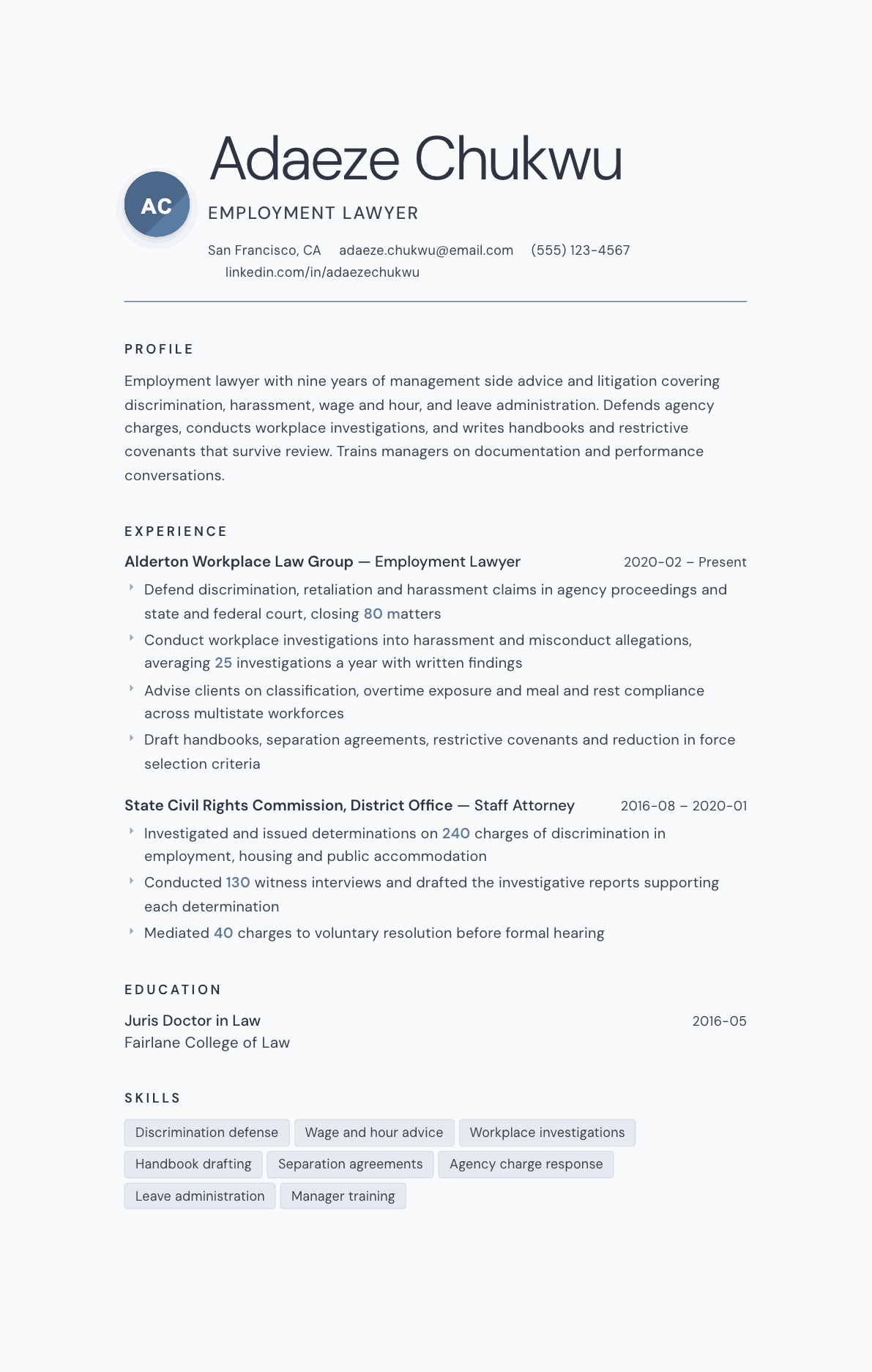
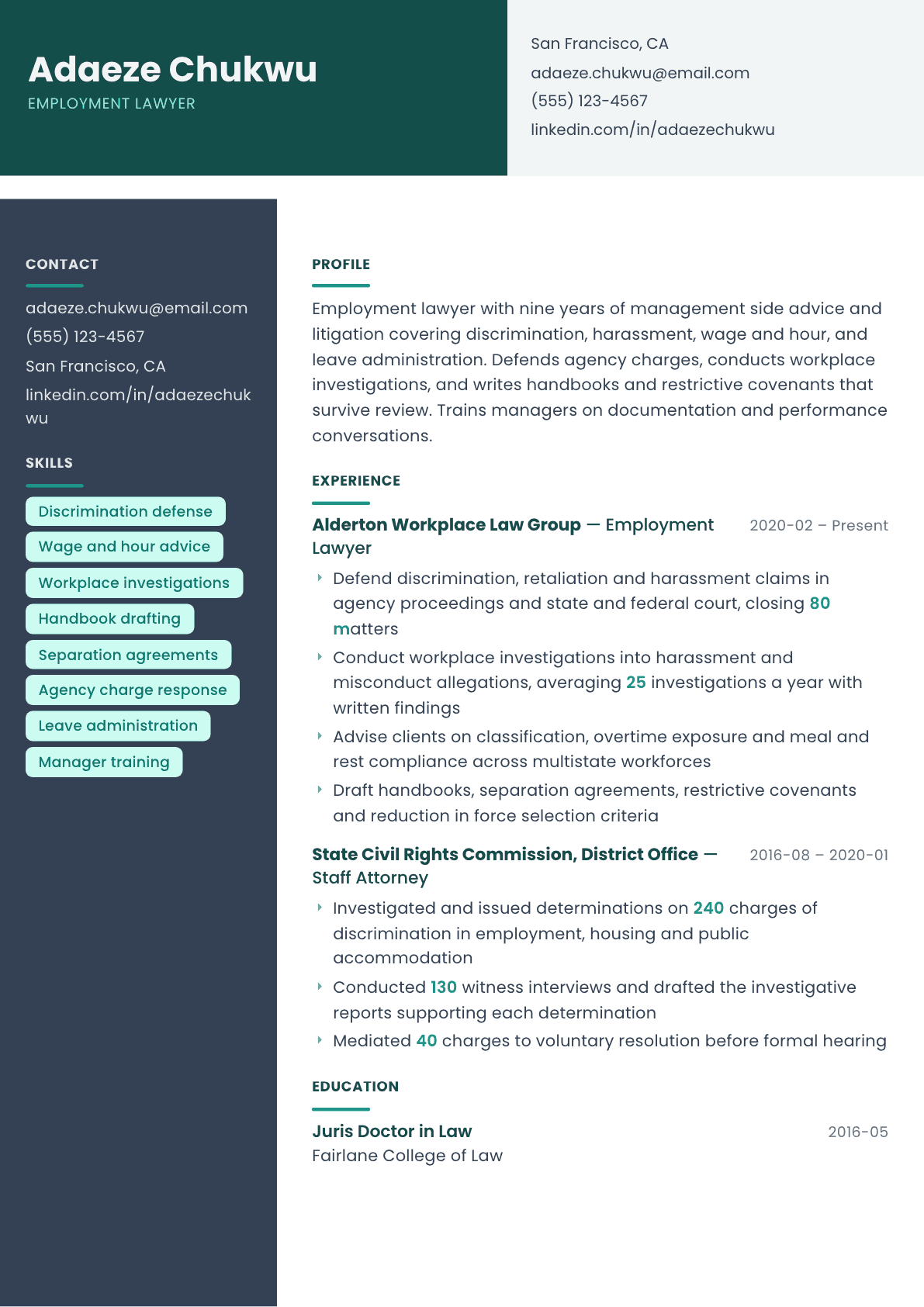
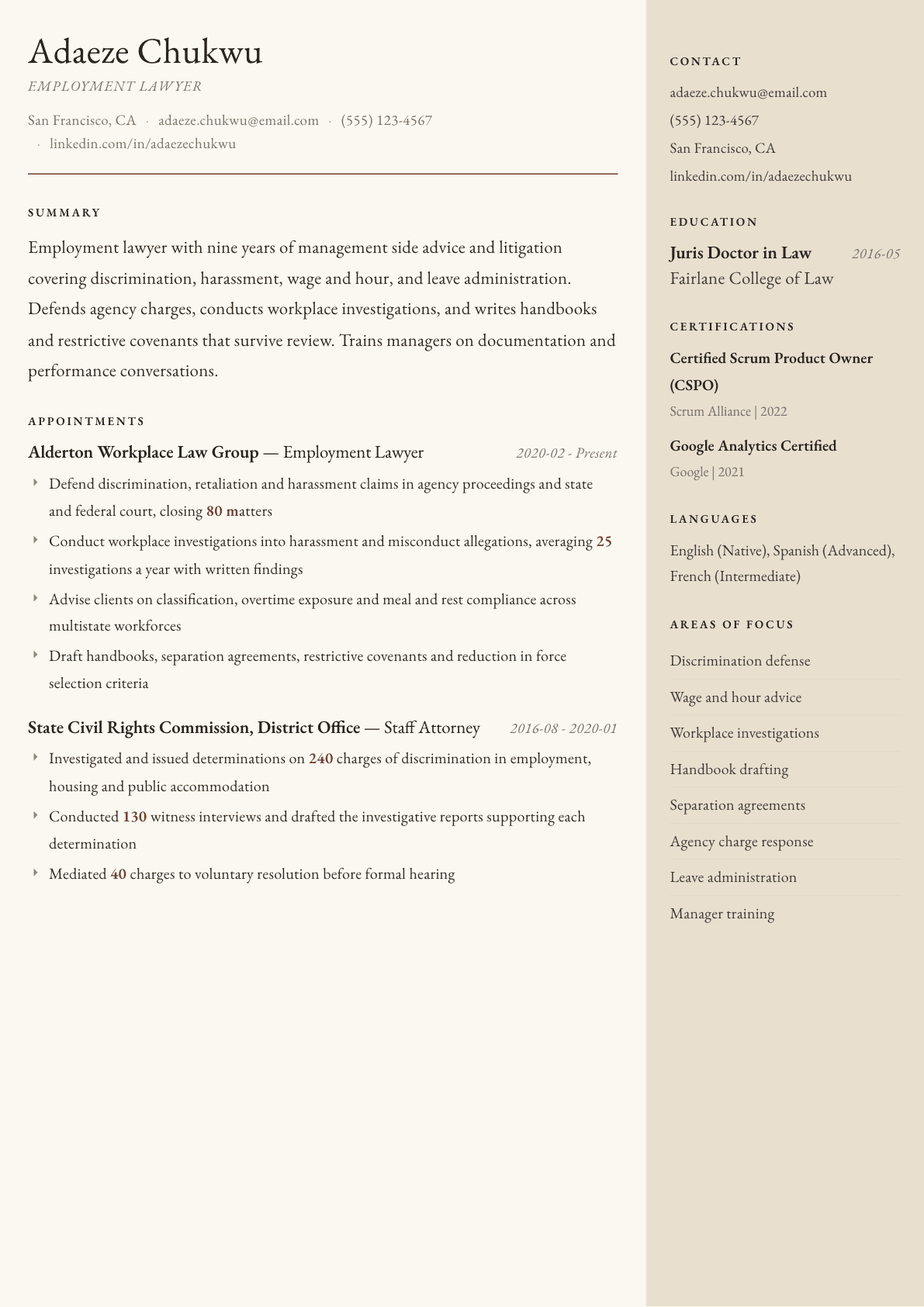
The same employment lawyer content laid out in three CVBooster templates, so you can see what the finished document looks like before you write a word.
Example Employment Lawyer summary
Employment lawyer with nine years of management side advice and litigation across discrimination, harassment, wage and hour, and leave administration. Defends agency charges through position statements and mediation, runs workplace investigations that hold up under scrutiny, and drafts handbooks and separation agreements. Former civil rights agency staff attorney with a working view of how a charge is actually investigated.
Skills to list on a Employment Lawyer resume
- Discrimination and retaliation defense
- Harassment claim response
- Wage and hour compliance
- Worker classification
- Leave and accommodation advice
- Workplace investigations
- Position statement drafting
- Handbook and policy drafting
- Separation and release agreements
- Restrictive covenants
- Reduction in force planning
- Collective action defense
- Mediation advocacy
- Manager and HR training
What actually gets this resume read
- Say whether you work management side, plaintiff side or both, because that single fact governs whether a firm reads on.
- List the statutes and areas you handle by name so the applicant tracking system matches the posting language.
- Show the advice half of the practice, not only litigation: handbooks, investigations, classification and leave questions.
- Give agency experience explicitly, including position statements, mediations and on site investigations.
- Quantify investigations conducted, charges defended and matters resolved before formal hearing or trial.
- Mention multistate work and any wage rules you have applied outside your home state, since employers value that reach.
How to write a employment lawyer resume
An employment lawyer resume has to answer a question the posting rarely asks directly: are you an advice lawyer, a litigator, or genuinely both. Firms and in house teams staff those differently. The counseling side answers manager questions all day and drafts policy. The litigation side defends charges and lawsuits. A resume that shows only one half will be read as capable of only one half.
The second question is side. Management side, plaintiff side or neutral, and whether you have agency experience. An employment lawyer who has investigated charges from inside a civil rights agency understands what an investigator looks for, and that background changes how a position statement gets written. Say which chair you have sat in.
This guide covers how to organize a practice that runs across counseling, investigations, agency work and litigation, how to write about sensitive investigations without disclosing anything, and how to present multistate compliance work, which is often the deciding factor for in house roles.
Declare side, forum and the advice to litigation split
Put a two line orientation at the top: which side you represent, the forums where you appear, and roughly how your time divides between counseling and contested matters. Reviewers stop guessing and start evaluating, which is the whole purpose of a summary.
List agency practice explicitly. Charge response before a state civil rights commission or a federal equal opportunity agency, wage claims before a labor department, unemployment hearings and occupational safety citations are each distinct processes with their own rhythm.
- Side represented and client types: employer, employee, union, public sector.
- Forums: state and federal courts, administrative agencies, arbitration panels.
- Split between counseling and contested work.
- States where you advise, since wage and leave rules differ sharply.
Write the counseling practice as a real practice
Advice work is invisible on most resumes because it produces no docket entries. Make it visible by naming the recurring questions you handle: discipline and termination decisions, accommodation requests, leave interaction problems, classification and overtime exposure, reductions in force, and reasonable suspicion testing.
Add the documents you produce. Handbooks, standalone policies, job descriptions reviewed for essential functions, separation and release agreements, restrictive covenants, arbitration agreements, and selection criteria for a workforce reduction. Volume helps here, because it shows the advice was operational and not occasional.
Training belongs in this section too. Manager training on documentation, harassment prevention sessions, and onboarding for a newly acquired workforce are billable work product and they demonstrate that clients trust you in front of their people.
Investigations, described without disclosing anything
Workplace investigations are a growing part of the practice and a distinct skill. Give the volume, the categories of allegation at a general level, and the deliverable: interview memoranda, a written findings report, credibility determinations, and recommendations to the client on remediation.
Never describe an individual investigation. Describe the method instead: witness sequencing, documentary collection, handling of anonymous complaints, preserving privilege where the client intends to assert it, and the decision about whether the report will be used as a defense. That method description tells a reader you have done this repeatedly.
Contested work: charges, single plaintiff cases and collective actions
Separate the tiers, because they are staffed separately. Agency charges and position statements sit at one level. Single plaintiff discrimination and retaliation suits sit above that. Class and collective wage actions are a different animal again, involving conditional certification, notice administration and damages modeling across a group.
Give counts for each tier and add the disposition types you have obtained: no probable cause determinations, dismissals, summary judgment, decertification, resolution at mediation. Also note arbitration practice, since employers with arbitration programs need lawyers comfortable in that forum.
Multistate compliance and the in house angle
In house employment roles hire for reach. Say which states you have advised in and which rules you have applied outside your admission state, such as pay transparency requirements, sick leave ordinances, meal and rest standards, and final pay timing. That reach is often what separates two otherwise similar candidates.
Add the operational partners you work with: human resources leadership, benefits, payroll, safety, and labor relations if the workforce is represented. An employment lawyer who has sat with payroll to fix a rounding practice is describing exactly the value an in house team wants.
Employment Lawyer resume summary examples
Junior employment associate
Employment lawyer in the third year of practice on the management side, drafting position statements for agency charges and handling discovery on single plaintiff discrimination suits. Has conducted eight workplace investigations with written findings and reviewed handbooks for two multistate employers. Admitted in one state.
Nine years in
Management side employment lawyer with nine years of advice and litigation covering discrimination, harassment, wage and hour, and leave administration. Defends agency charges, runs about 25 workplace investigations a year, and drafts handbooks, separation agreements and reduction in force selection criteria for multistate employers.
Head of employment law
Senior employment counsel leading the workplace law function for a multistate employer, owning policy, investigations, agency response and outside counsel management. Advises executives on restructuring and executive separations, and partners with payroll and human resources on classification and pay practice remediation.
Work experience bullets: before and after
Before: Defended employers in discrimination cases.
After: Defended discrimination, retaliation and harassment claims in agency proceedings and state and federal court, closing 80 matters through determination, dismissal or mediated resolution.
Naming the claim types, the forums and the dispositions turns a category into a measurable practice.
Before: Conducted workplace investigations.
After: Conducted roughly 25 investigations a year into harassment and misconduct allegations, producing interview memoranda, credibility findings and written remediation recommendations.
The volume and the deliverables show a repeatable method rather than an occasional assignment.
Before: Advised clients on wage and hour issues.
After: Advised multistate employers on worker classification, overtime exposure and meal and rest compliance, and worked with payroll to remediate a rounding practice.
The operational fix proves the advice reached implementation instead of stopping at a memorandum.
Before: Drafted employment documents.
After: Drafted handbooks, separation agreements, restrictive covenants and reduction in force selection criteria, and revised job descriptions around essential functions.
Listing the documents makes the counseling practice visible where a general phrase leaves it invisible.
Before: Handled agency charges for employers.
After: Investigated and issued determinations on 240 charges of discrimination while at a state agency, conducting 130 witness interviews and drafting the supporting reports.
Agency side experience is a differentiator, and the interview and report counts make it concrete.
Hard skills
- Discrimination and retaliation defense
- Harassment claim response
- Workplace investigations
- Position statement drafting
- Wage and hour compliance advice
- Worker classification analysis
- Leave and accommodation counseling
- Handbook and policy drafting
- Separation and release agreements
- Restrictive covenant drafting
- Reduction in force planning
- Collective and class action defense
- Arbitration advocacy
- Manager and human resources training
Soft skills
- Discretion with sensitive matters
- Interviewing reluctant witnesses
- Practical risk advice to executives
- Working alongside human resources
- Written clarity for non lawyers
- Neutrality during fact finding
Certifications worth listing
- State Bar Admission (State Bar Association)
- Admission to the United States District Court (United States District Court)
- Board Certification in Labor and Employment Law (State Board of Legal Specialization)
- Senior Professional in Human Resources (SPHR) (HR Certification Institute)
- SHRM Senior Certified Professional (SHRM-SCP) (Society for Human Resource Management)
Mistakes that cost employment lawyer candidates the interview
- Leaving out the side you represent, which is the first filter a firm or an in house team applies.
- Showing only litigation when most employment roles also expect daily counseling and policy drafting.
- Describing an individual investigation in detail rather than the method you follow across all of them.
- Merging agency charges, single plaintiff suits and collective actions into one number that hides your range.
- Skipping the states where you have advised, when multistate reach is a common hiring requirement.
- Writing that you provide practical advice without any example of advice that changed a client practice.
Employment Lawyer resume questions
Should an employment lawyer resume show both counseling and litigation?
Yes, and it should show them separately with their own volumes. Most postings expect both, and a resume weighted entirely toward one half tends to be read as evidence that the candidate cannot do the other half well.
How do I write about investigations without breaching confidentiality?
Describe the process rather than any matter. Volume per year, allegation categories at a general level, witness sequencing, document collection, credibility findings and the written deliverable. That shows repeated practice while disclosing nothing about a specific complaint.
Does agency experience help on the employer side?
Considerably. Having investigated charges from inside a commission teaches you what an investigator weighs and how a determination is written, which makes your position statements more targeted. Present it with the volume of charges and interviews you handled.
What should I emphasize for an in house employment counsel role?
Multistate reach, speed of practical advice, comfort with human resources and payroll partners, outside counsel management, and policy ownership. In house teams hire for breadth and judgment more than for depth in a single litigation phase.
How do I present plaintiff side employment experience to a management side firm?
Frame it as knowing how the other side builds a case: the theories that survive dismissal, the documents that become exhibits, and the timing of a demand. Then show the counseling work you can do, since that is the half a defense firm will question.