Legal Counsel Resume Examples: free ATS score and gap list
Shape a Legal Counsel Resume Around Business Risk
By Mustafa Tarabya, founder of CVBooster · Published · Updated
Legal counsel resume example with commercial and regulatory keywords, plus a writing guide for lawyers advising a business day to day.
Sample resumes for a legal counsel
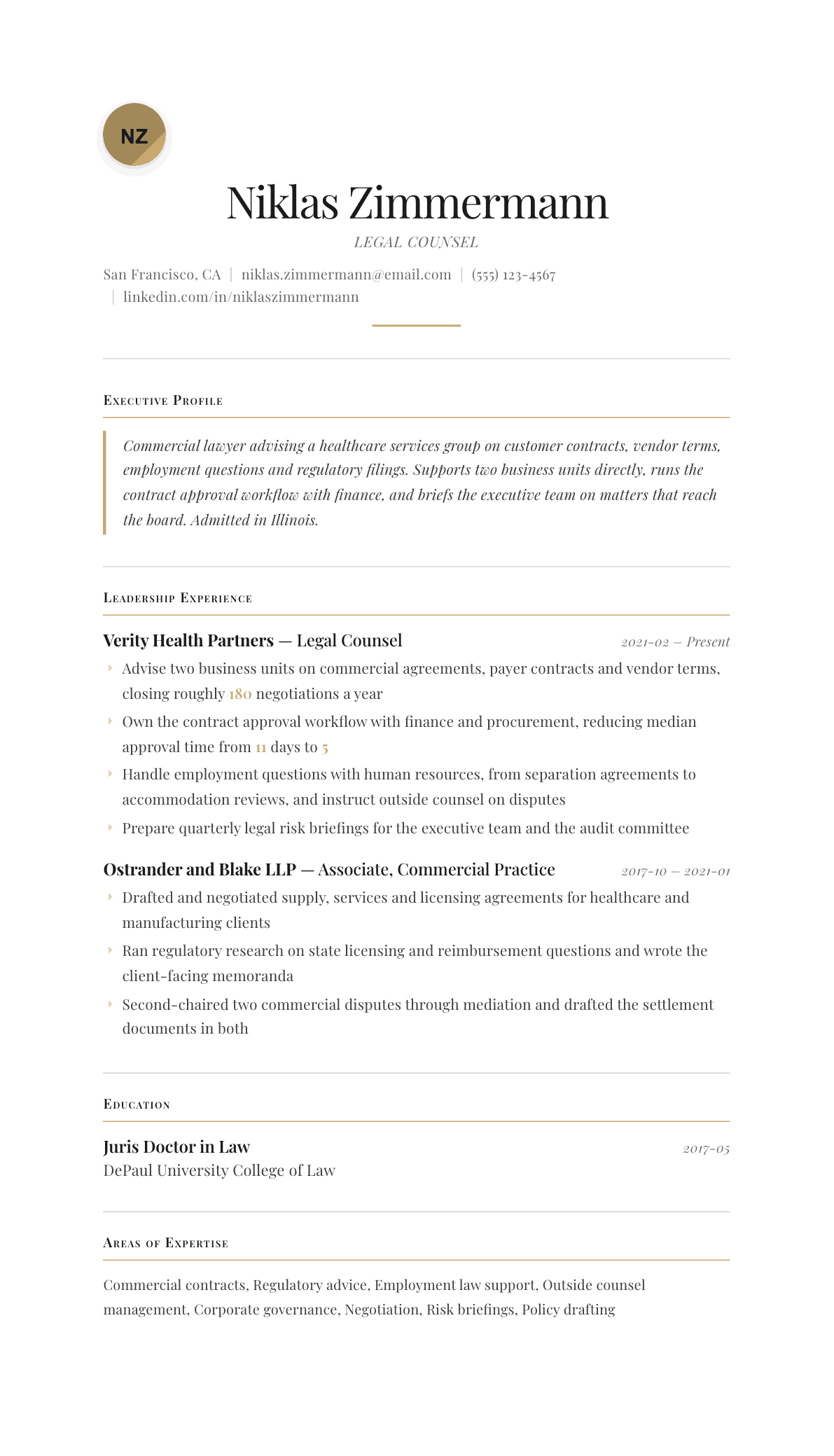
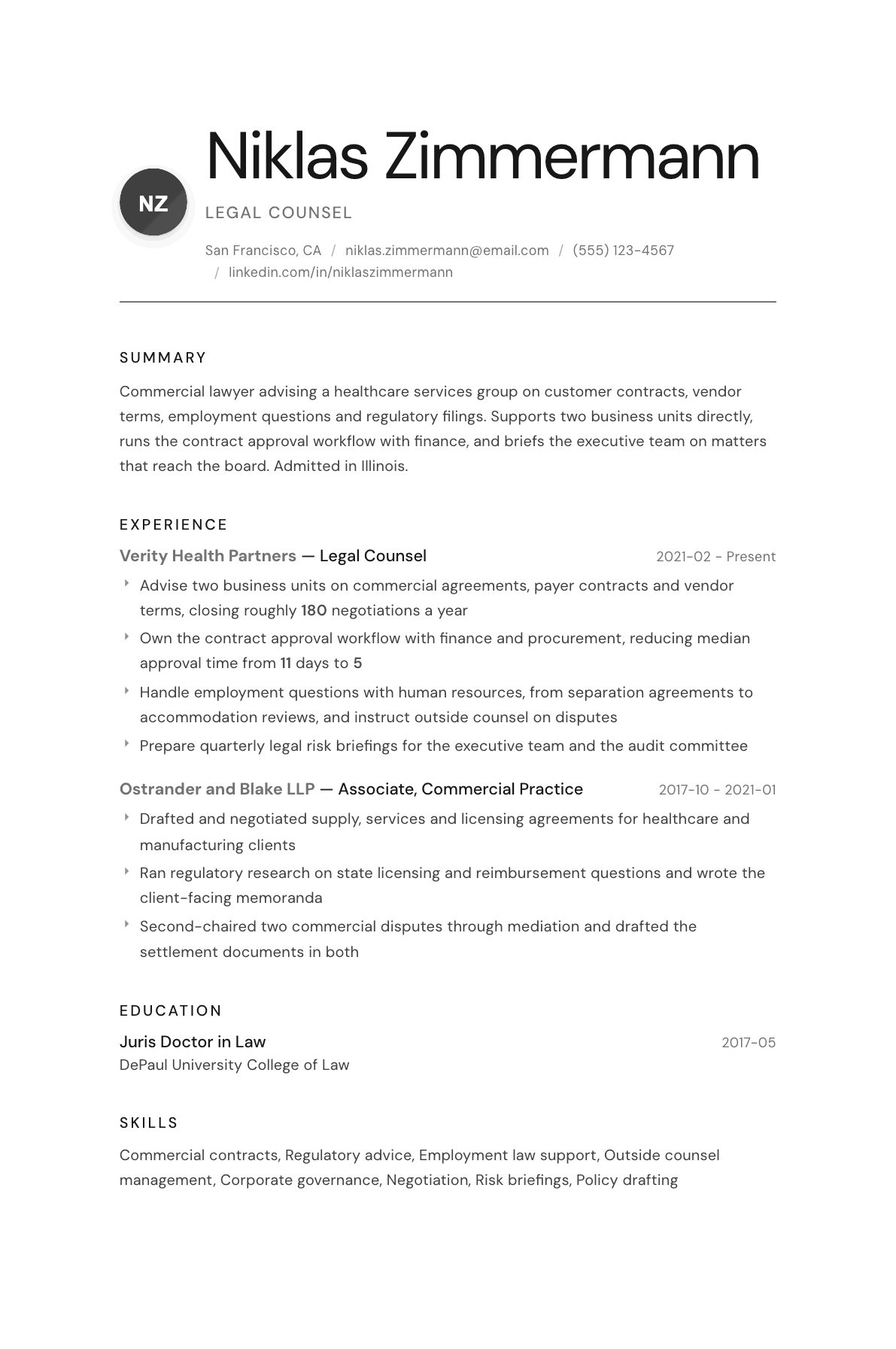
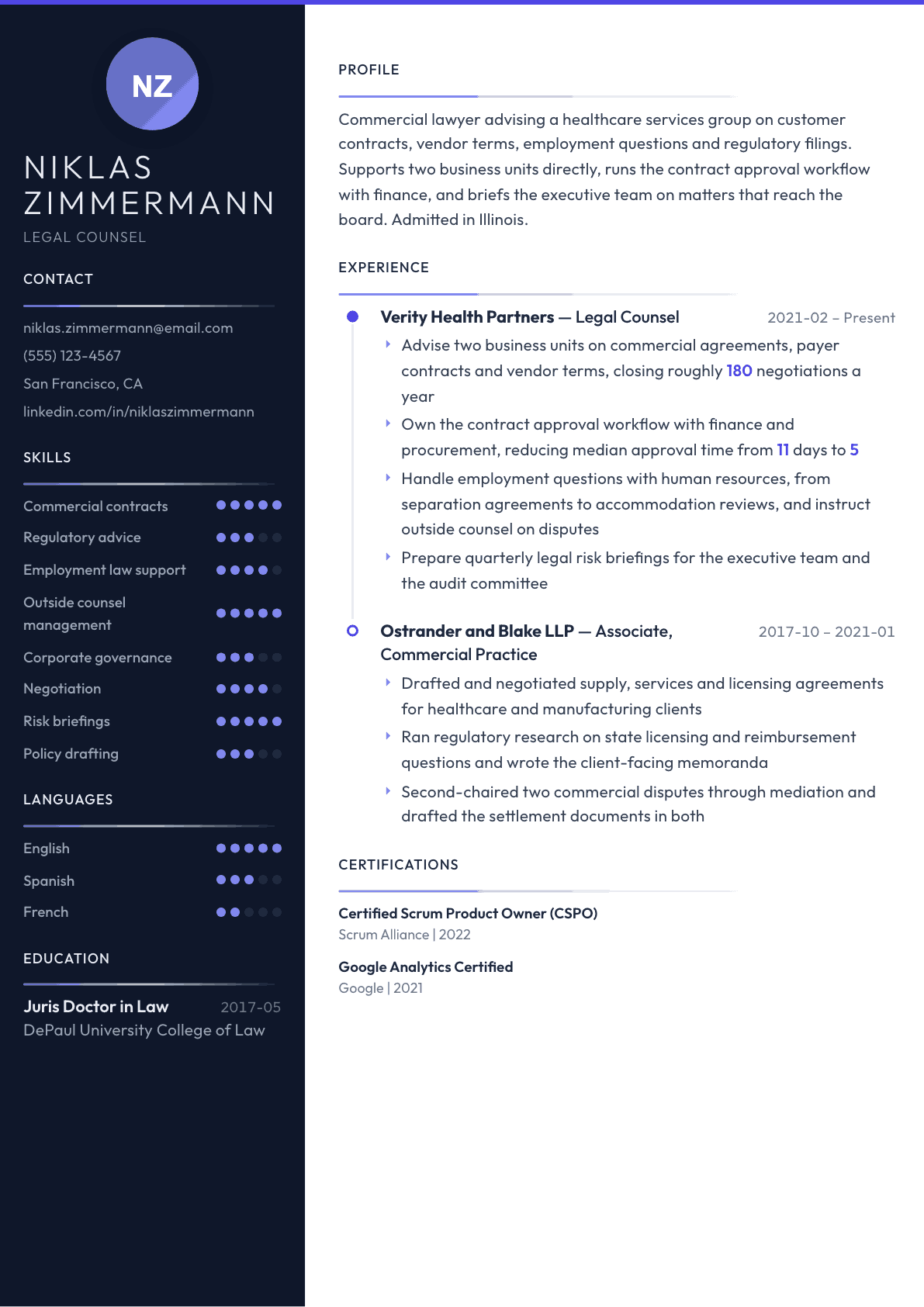
The same legal counsel content laid out in three CVBooster templates, so you can see what the finished document looks like before you write a word.
Example Legal Counsel summary
Legal counsel with seven years across a commercial practice and a company legal department, advising operating units on contracts, regulation and employment questions. Closes a heavy negotiation load without slowing sales, instructs outside counsel on disputes, and briefs executives on the risks that matter. Admitted in Illinois and comfortable as the only lawyer in the room.
Skills to list on a Legal Counsel resume
- Commercial contract negotiation
- Regulatory advice
- Employment law support
- Corporate governance
- Data protection advice
- Dispute management
- Outside counsel management
- Policy and playbook drafting
- Risk assessment
- Board and committee reporting
- Licensing agreements
- Vendor and procurement terms
- Contract lifecycle systems
- Legal training delivery
What actually gets this resume read
- Put your bar admission and the state in the header, because a company legal posting filters on it before anything else.
- Describe the business you advise: sector, size and revenue model, since counsel work is judged by the risk it carries.
- Split advisory work from contract work, as hiring managers want to know which half of the week you spend where.
- Name the internal clients you support by function, because a counsel who has partnered with sales reads differently from one who has not.
- Show how you use outside counsel: which matters go out, how you scope them and how the budget is controlled.
- Keep firm experience but reframe it as business advice, since a company reader cares about outcomes rather than billable hours.
How to write a legal counsel resume
A legal counsel resume is read by a general counsel who is short of time and about to hand someone real business risk. She wants three things confirmed in the first fifteen seconds: that you are admitted somewhere she can verify, that you have advised a business rather than only drafted for one, and that the commercial areas you have covered match the ones keeping her awake. Anything that delays those three answers costs you the read.
The trap for law firm candidates is describing matters instead of advice. A firm resume lists deals, clients and practice areas. A counsel resume has to show judgment applied inside a company: which risks you accepted, which contract positions you held, which questions you answered without escalating, and how the business kept moving while you did it.
This guide covers how to structure the page for a company legal reader, how to write summaries at associate, counsel and senior counsel level, how to turn firm bullets into business advice bullets, and the questions lawyers ask when they move from private practice into a legal department.
Format: admission first, then the business you advised
Put your bar admission and jurisdiction in the header line, directly after your name. Legal department postings filter on active admission, and recruiters who cannot find it in the first pass often stop there. If you hold more than one admission, list them all with the states.
Then reverse chronological experience. For every employer, give one line of context before the bullets: what the company does, roughly how large it is, and the size of the legal team. A lawyer who was the second legal hire at a growing company and a lawyer who was one of forty in a mature department did completely different jobs under the same title.
- Header: name, degree, bar admissions with states, city, phone, email.
- Order: summary, experience with a business context line per employer, education, admissions, additional credentials.
- Two pages are normal for counsel roles once you have both firm and company experience.
Summary: coverage areas, internal clients, and level of autonomy
Name the subject areas you own: commercial contracts, employment, privacy, regulatory, intellectual property, disputes. Then the internal clients you support by function, because advising a sales organization is a different discipline from advising engineering or clinical operations. Then say what you handle alone and where outside counsel takes over.
Autonomy is the quiet signal a general counsel is reading for. A counsel who states plainly that she is the sole lawyer for two business units has answered a question that three paragraphs of adjectives cannot.
Experience: advice, negotiation and the risks you carried
Lead each role with the advisory work, since that is what distinguishes counsel from a contract manager. Describe the recurring questions you answer, the decisions you sign off on, and the situations where you said no and made the alternative work.
Then the contract work with numbers: agreement types, annual negotiation volume, cycle time, and any playbook or template set you authored. Volume proves you can carry load, and cycle time proves you did not become the bottleneck the sales team complains about.
Add the risk and dispute picture: matters you managed, how outside counsel was scoped and budgeted, regulatory interactions you handled, and what you reported to the executive team or the board. Governance and board exposure move a resume from mid-level to senior faster than any other line.
Translating firm experience for a company reader
Keep the firm roles, but rewrite them around the client outcome instead of the matter description. Drafted and negotiated a supply agreement becomes negotiated supply terms that protected a manufacturing client from a single-source dependency. The subject matter is identical and the reader now sees commercial thinking.
Drop billable hour references, partner names and matter codes. Keep the sectors, because industry knowledge transfers directly and a healthcare company will look for a lawyer who already knows its regulatory shape.
Credentials, keywords and what to leave off
List admissions with the state and the status. Add privacy, compliance or contract credentials if you hold them, with the issuing body. Leave off law school honors once you are past the early years, and leave off moot court entirely at counsel level.
Postings for counsel repeat a predictable set of terms: commercial agreements, contract negotiation, regulatory compliance, employment matters, corporate governance, risk mitigation, outside counsel management, data protection. Use the phrasing of the posting once in the summary and once where you did the work.
Legal Counsel resume summary examples
Associate moving in-house
Commercial associate with three years at a mid-size firm, admitted in Texas, moving into a company legal role. Drafts and negotiates supply, services and licensing agreements, advises clients on vendor risk, and has second-chaired two commercial disputes through mediation. Comfortable as the first point of contact for business questions.
Counsel, sole support for a business unit
Legal counsel advising two operating units of a healthcare services group on commercial contracts, employment questions and regulatory filings. Closes roughly 180 negotiations a year, owns the approval workflow with finance and procurement, and instructs outside counsel on disputes. Admitted in Illinois and reports directly to the general counsel.
Senior counsel
Senior legal counsel with eleven years across a commercial practice and two company legal departments, covering contracts, privacy, employment and regulatory work. Built the contract playbook and delegation framework now used by three commercial teams, manages an outside counsel panel, and briefs the audit committee quarterly on legal risk.
Work experience bullets: before and after
Before: Provided legal advice to internal stakeholders.
After: Acted as the sole legal contact for two operating units, answering roughly 15 business questions a week on contracts, marketing claims and employment matters without routing them to outside counsel.
Scope, cadence and the cost avoided make the advisory role concrete instead of a job description.
Before: Negotiated a range of commercial contracts.
After: Negotiated about 180 customer, vendor and payer agreements a year, holding the standard liability and indemnity positions in all but the six matters escalated to the general counsel.
Volume plus an escalation figure shows both capacity and consistency on risk positions.
Before: Improved the contract process.
After: Rebuilt the contract approval workflow with finance and procurement, cutting median approval time from 11 days to 5 while keeping the same sign-off thresholds.
A measured improvement that preserved controls answers the objection a general counsel would raise.
Before: Managed outside counsel on disputes.
After: Scoped and budgeted three commercial disputes with outside counsel, set the reporting cadence and settlement authority in advance, and resolved two before the pleadings stage.
Describing how the relationship was managed proves control of spend and strategy, not just instruction.
Before: Reported to senior management on legal issues.
After: Prepared quarterly legal risk briefings for the executive team and the audit committee, covering dispute exposure, regulatory change and contract concentration.
Naming the audience and the topics shows board-level exposure that most counsel resumes leave implicit.
Hard skills
- Commercial contract negotiation
- Contract playbooks and templates
- Regulatory advice
- Employment law support
- Data protection advice
- Corporate governance
- Dispute and litigation management
- Outside counsel scoping and budgeting
- Intellectual property licensing
- Policy drafting
- Risk assessment and escalation frameworks
- Board and committee reporting
- Legal training for business teams
- Contract lifecycle systems
Soft skills
- Commercial judgment
- Saying no with an alternative
- Explaining risk to non-lawyers
- Working at speed with incomplete facts
- Stakeholder trust
- Negotiation under relationship pressure
Certifications worth listing
- Certified Information Privacy Professional, United States (CIPP/US) (International Association of Privacy Professionals)
- Certified Compliance and Ethics Professional (CCEP) (Compliance Certification Board)
Mistakes that cost legal counsel candidates the interview
- Hiding the bar admission below the education section where a recruiter filtering for it will not look.
- Listing matters the way a firm biography does, with no sign of the business decision behind each one.
- Leaving out company size, sector and legal team size, which is the context every bullet depends on.
- Claiming broad subject coverage that thins out under questioning, such as privacy expertise built on one policy review.
- Writing nothing about outside counsel management, which is a core part of the counsel role at most companies.
- Keeping law school honors and moot court on the page years after they stopped being relevant.
- Describing speed improvements without saying which controls stayed in place, which reads as risk taking.
Legal Counsel resume questions
How do I move from a law firm to a legal counsel role?
Rewrite each matter as a business outcome, keep the industries you served, and add anything that looks like internal advice: secondments, client-site work, or advising a client executive directly. State the move as a deliberate choice in the summary rather than leaving it unexplained.
Where should bar admission go on a legal counsel resume?
In the header, right after your name, with the state and current status. Repeat it in an admissions line near the bottom with the year if you wish. Recruiters screen on active admission, and a buried entry costs you a first pass.
How long should a legal counsel resume be?
Two pages is standard once you have both firm and company experience. One page is fine for a junior associate making the move. Beyond two pages the reader starts skimming, and the risk briefings and governance work at the end are exactly what gets skipped.
Should I list contract volume on my resume?
Yes, if you can state it honestly. Annual negotiation volume tells a general counsel whether you can absorb the load in her department. Pair it with an escalation ratio or a cycle time so the number reads as capacity rather than as a boast.
What if I have never reported to a board?
Do not invent it. Show the closest real thing: briefing an executive sponsor, presenting to a risk committee, or writing the legal section of a management report. Framed accurately, that still signals readiness for the reporting a senior counsel role requires.