Lawyer Resume Examples: what a hiring manager reads first
Make Your Case with a Winning Lawyer Resume
By Mustafa Tarabya, founder of CVBooster · Published · Updated
Lawyer resume examples with expert tips, ATS keywords, and professional templates. See exactly what a winning corporate attorney resume looks like.
Sample resumes for a lawyer
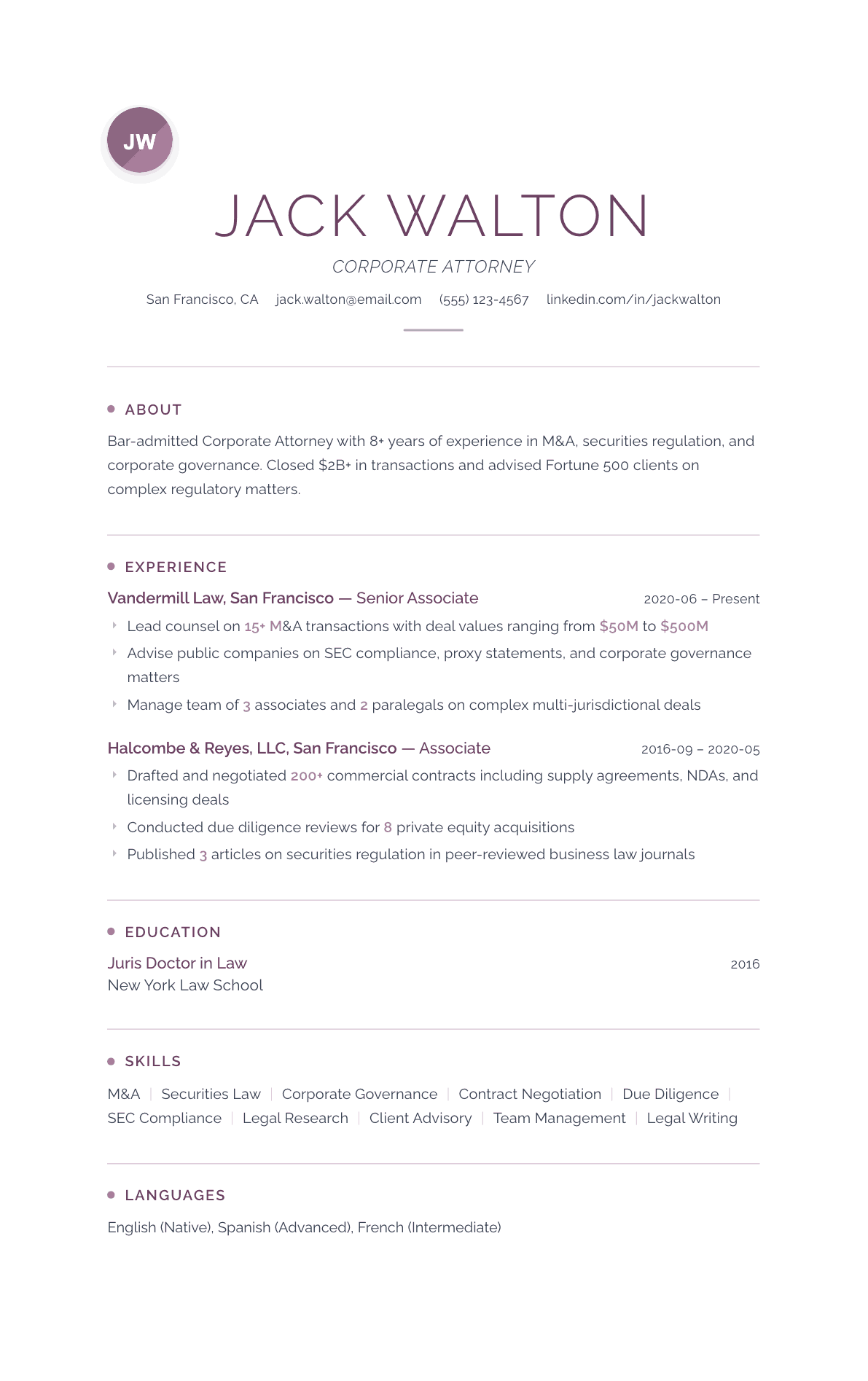
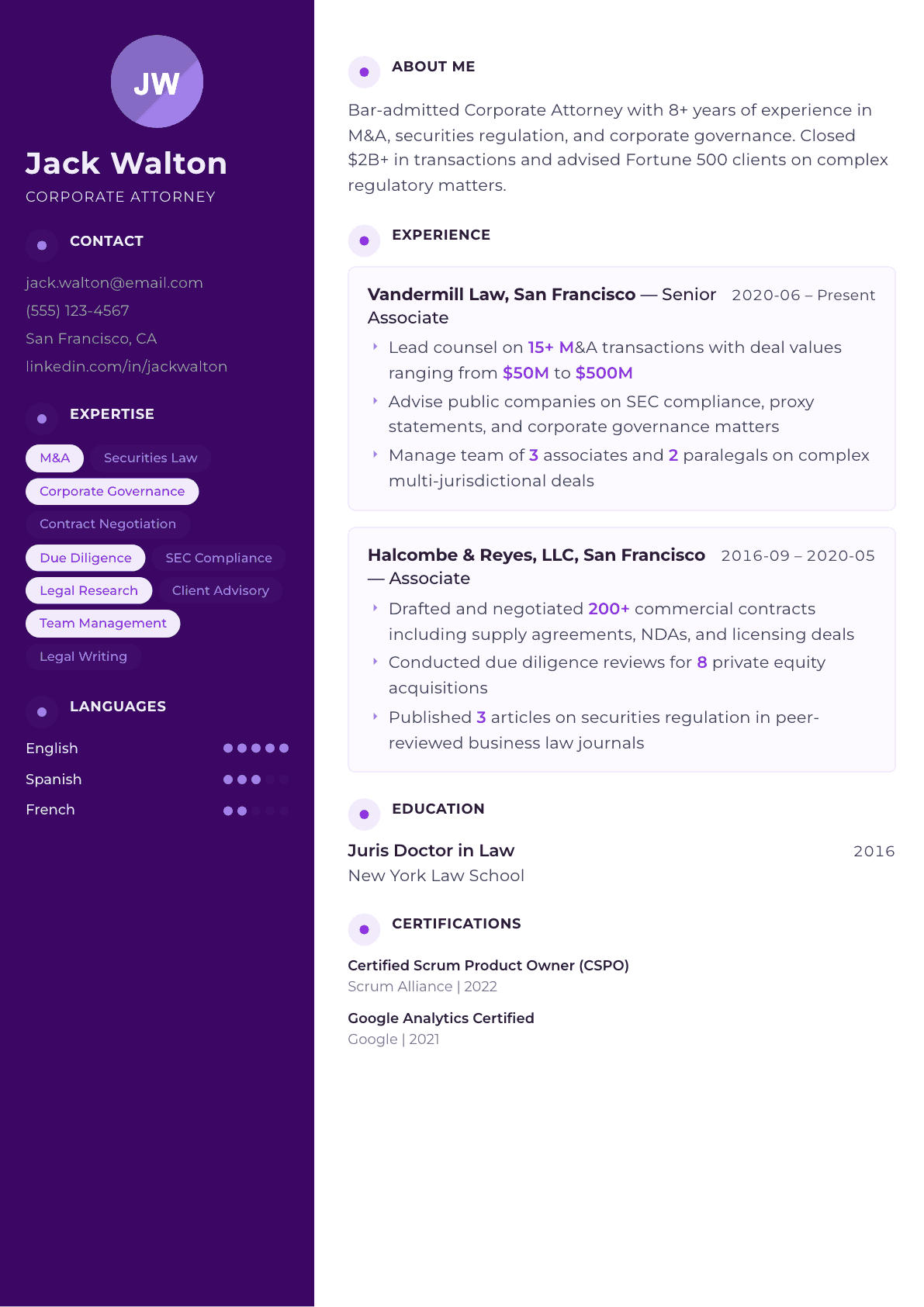
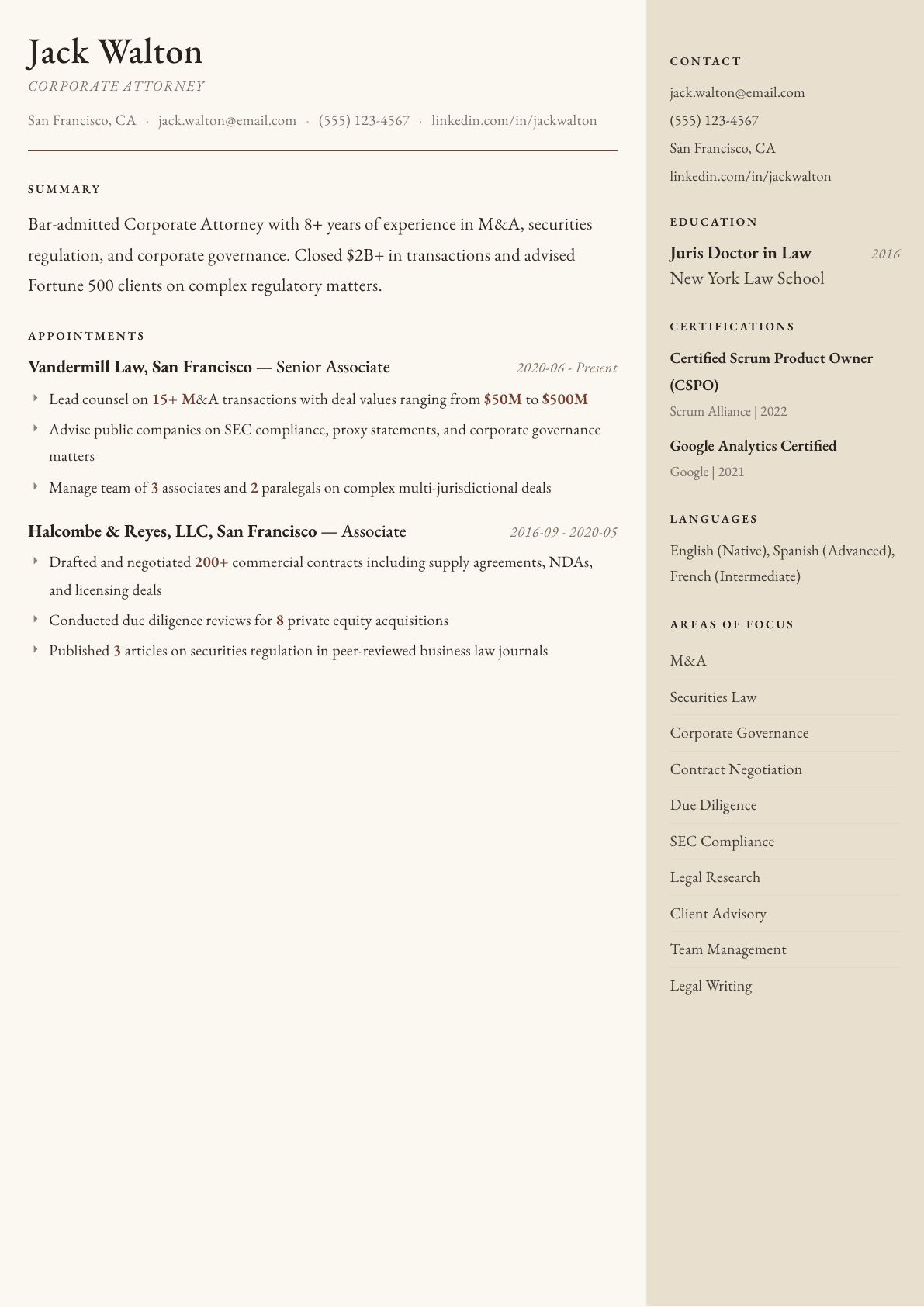
The same lawyer content laid out in three CVBooster templates, so you can see what the finished document looks like before you write a word.
Example Lawyer summary
Corporate attorney, bar admitted, 8 years, currently lead counsel on M&A deals from $50M to $500M and adviser to public company boards on SEC reporting and governance. Supervises three associates and two paralegals, and came up drafting and negotiating 200 commercial agreements.
Skills to list on a Lawyer resume
- M&A
- Securities Law
- Corporate Governance
- Contract Negotiation
- Due Diligence
- SEC Compliance
- Legal Research
- Client Advisory
- Team Management
- Legal Writing
What actually gets this resume read
- List bar admissions and jurisdictions prominently.
- Quantify deal values, transaction counts, and client portfolio size.
- Include publications, speaking engagements, and professional associations.
- Show progression from associate to senior roles.
- Highlight specialized practice areas and industry expertise.
How to write a lawyer resume
A lawyer resume is read against a very specific question: can this person be handed a matter next month without supervision that costs the firm more than the work is worth. Hiring partners and legal recruiters answer it from four signals: where you are admitted, what kind of matters you have carried, whether the work was substantive or support, and whether the story of your career has gaps or lateral moves that need explaining.
Legal hiring is also unusually credential-sensitive. Law school, class rank if it was strong, journal, clerkship and bar admissions carry weight for longer into a career than equivalent credentials do in other fields, and the convention is that they appear in a fixed place. A resume that reorders them for visual effect reads as unfamiliar with the profession.
This guide covers the section order the legal market expects, how to describe matters without breaching confidentiality, summaries for a first-year associate through a partner, and how to make bullets show judgment rather than list document types.
Format: the conventions are the point
Reverse-chronological, one column, no graphics, no photo, no skills bar charts. Legal hiring is conservative for a reason: the reader is checking whether you understand professional norms, and the resume is the first sample of your judgment she sees. One page through roughly the eighth year of practice is still common, and two pages is unremarkable after that.
Bar admissions go near the top with the state and the year of admission, and any inactive status stated honestly. Court admissions, such as federal district courts, courts of appeals or the Supreme Court, get their own line when they are relevant to the work.
- Header: name, city, phone, email, and bar admissions with jurisdiction.
- Section order: summary, admissions, experience, representative matters, education, publications and speaking, bar and community service.
- Recent graduates and judicial clerks put education first, with journal, moot court, class rank if top of the class, and the clerkship.
Summary: practice area, forum, seniority
Three lines that answer what you do, for whom, and at what level of independence. Name the practice: commercial litigation, mergers and acquisitions, employment counseling and defense, real estate finance, white collar defense, regulatory. Then the client type, since representing publicly traded companies is a different practice from representing founders or individuals.
Finish with the thing you want the reader to hire you for. First chair at a bench trial, running the closing checklist on middle-market deals, or arguing dispositive motions are all concrete claims. Skip the sentence about being a results-driven attorney with excellent research and writing skills, which appears on nearly every resume in the pile and distinguishes none of them.
Experience: matters, not tasks
For each position, give the firm or organization, the practice group, and the type and size of matter you carried. Then bullets that show ownership. The reader is drawing a line between attorneys who ran a file and attorneys who supported one, so the verbs matter: argued, negotiated, took, drafted and filed, tried, closed, advised.
Describe matters by type and scale rather than by client name. A dispute over a supply agreement between manufacturers, an acquisition of a regional services business, or an internal investigation into expense reporting are all recognizable to another lawyer and identify nobody. When a matter is public, such as a reported opinion or an announced transaction, you may name it.
Include the operational reality of practice as well. Managing a discovery workstream across multiple custodians, supervising junior associates and paralegals, coordinating experts, and running a billing and budget conversation with a client are all things partners need done and rarely find on a resume.
Credentials: education, clerkships and admissions
Give the law school, the degree and honors, then journal, moot court or clinic. A judicial clerkship gets its own entry with the judge and the court, because it is treated as substantive experience rather than schooling. Undergraduate degree stays on the resume permanently in legal practice, and a technical or accounting background is worth naming because it routes you toward specific work.
Bar admissions must be current and accurate. If you are admitted in a state where you no longer practice, say active or inactive rather than leaving it ambiguous, since a firm will verify it.
Keywords, systems and the applicant tracking system
Large firms and in-house departments run resumes through screening software before a lawyer reads them, so mirror the posting language once in the summary and once in a bullet: the practice area, the forum, the transaction or dispute type, and the industry. Add the tools legal work actually runs on, including the research platforms, the document review and electronic discovery systems, the document management system, and the contract lifecycle tool if you have worked in-house.
Keep the language plain. A resume dense with archaic legal phrasing signals that your client memos will be dense too, and the partner reading it is imagining how a general counsel would receive your writing.
Lawyer resume summary examples
First-year associate
Attorney admitted in Illinois, graduated with honors and a law review note on arbitration clauses, and clerked for a federal district judge. Drafted 14 bench memoranda on dispositive motions and observed six civil trials. Seeking a commercial litigation associate position.
Six years in
Commercial litigation attorney with six years defending contract, warranty and business tort claims for manufacturing and distribution clients. Argued 20 dispositive and discovery motions, took 35 depositions, and first-chaired two bench trials. Manages discovery workstreams across multiple custodians and supervises two junior associates.
Partner
Partner leading a corporate practice focused on middle-market acquisitions and private financings, closing roughly 12 transactions a year for private equity sponsors and founder-owned businesses. Chairs the firm associate development committee, and originates a substantial share of the group active matters through banker and accountant referrals.
Work experience bullets: before and after
Before: Assisted with litigation matters from start to finish.
After: Carried 18 active commercial disputes from complaint through resolution, drafting pleadings, arguing discovery motions, taking party and expert depositions and negotiating settlements at mediation.
A caseload count and the named stages prove you ran files rather than helped on them.
Before: Drafted and reviewed contracts for clients.
After: Drafted and negotiated master services agreements, supply contracts and reseller agreements for manufacturing clients, resolving indemnity, limitation of liability and intellectual property ownership terms.
Naming the agreement types and the negotiated provisions shows where your judgment was actually applied.
Before: Performed legal research and wrote memoranda.
After: Researched and wrote 30 client memoranda on choice of law, arbitration enforceability and statutory damages, two of which became the basis for successful motions to dismiss.
Volume plus an outcome converts routine research into demonstrable influence on results.
Before: Worked on corporate transactions with the deal team.
After: Ran the closing checklist on nine middle-market acquisitions, coordinating diligence across five workstreams, drafting disclosure schedules and managing signature collection through closing.
Owning the checklist and the workstreams is the specific role a corporate partner is trying to fill.
Before: Supervised junior team members.
After: Supervised two associates and three paralegals on document review across roughly four hundred thousand documents, setting review protocols, running quality checks and reporting privilege log progress to the client weekly.
Concrete team size, scope and reporting cadence show management rather than seniority by default.
Hard skills
- Civil litigation and motion practice
- Deposition and trial preparation
- Contract drafting and negotiation
- Legal research and writing
- Discovery management and electronic discovery
- Regulatory compliance advice
- Mergers and acquisitions diligence
- Mediation and settlement negotiation
- Corporate governance
- Internal investigations
- Appellate briefing
- Client billing and matter budgeting
Soft skills
- Client counseling
- Written advocacy
- Negotiation
- Issue spotting under time pressure
- Team supervision
- Ethical judgment
Certifications worth listing
- State bar admission (State bar admitting authorities)
- Admission to United States District Courts and Courts of Appeals (Federal courts)
- Board Certification in a practice specialty (State bar legal specialization boards)
Mistakes that cost lawyer candidates the interview
- Using a designed template with columns, icons or a photograph, which signals to a hiring partner that you have not read a legal resume before.
- Listing document types you touched instead of matters you carried, so the reader cannot tell your level of independence.
- Omitting bar admission jurisdictions or leaving inactive status unstated, both of which a firm verifies and neither of which survives being wrong.
- Naming clients or including facts specific enough to identify a matter that was never made public.
- Leaving unexplained gaps or a rapid sequence of lateral moves with no context, which becomes the first interview question either way.
- Filling the summary with adjectives about being detail-oriented and results-driven rather than naming the practice, the forum and the client type.
Lawyer resume questions
How long should a lawyer resume be?
One page is still the norm through roughly eight years of practice, and two pages is expected after that once you have representative matters, publications and bar service. Anything longer belongs in a separate matters list you bring to the interview.
Should I keep my law school GPA and class rank on the resume?
Keep them while they help and while you are junior. Top of the class standing, law review and order of the coif stay useful for several years, but once you have carried real matters the experience section becomes the reason you are called.
How do I write about matters without breaching confidentiality?
Describe the dispute or transaction by type, industry and scale rather than by party. Public matters, such as reported opinions or announced transactions, may be named directly, and everything else stays generic enough that no client is identifiable.
Does a judicial clerkship go under education or experience?
Under experience, with the judge and the court named, because the legal market treats it as substantive practice. Add a line on what you drafted, such as bench memoranda and draft opinions, and the subject matter of the docket.
How do I explain leaving a firm after a short time?
Give the dates honestly on the resume and prepare a short, neutral explanation for the interview: a group departure, a practice shift, or a move for a specific kind of work. Hiding the position creates a gap that reads worse than the move itself.