Corporate Lawyer Resume Examples: the lines they read
Build a Corporate Lawyer Resume That Commands Respect
By Mustafa Tarabya, founder of CVBooster · Published · Updated
Create a polished corporate lawyer resume highlighting your M&A experience, transactional expertise, and business acumen with professional legal templates.
Sample resumes for a corporate lawyer
The same corporate lawyer content laid out in three CVBooster templates, so you can see what the finished document looks like before you write a word.
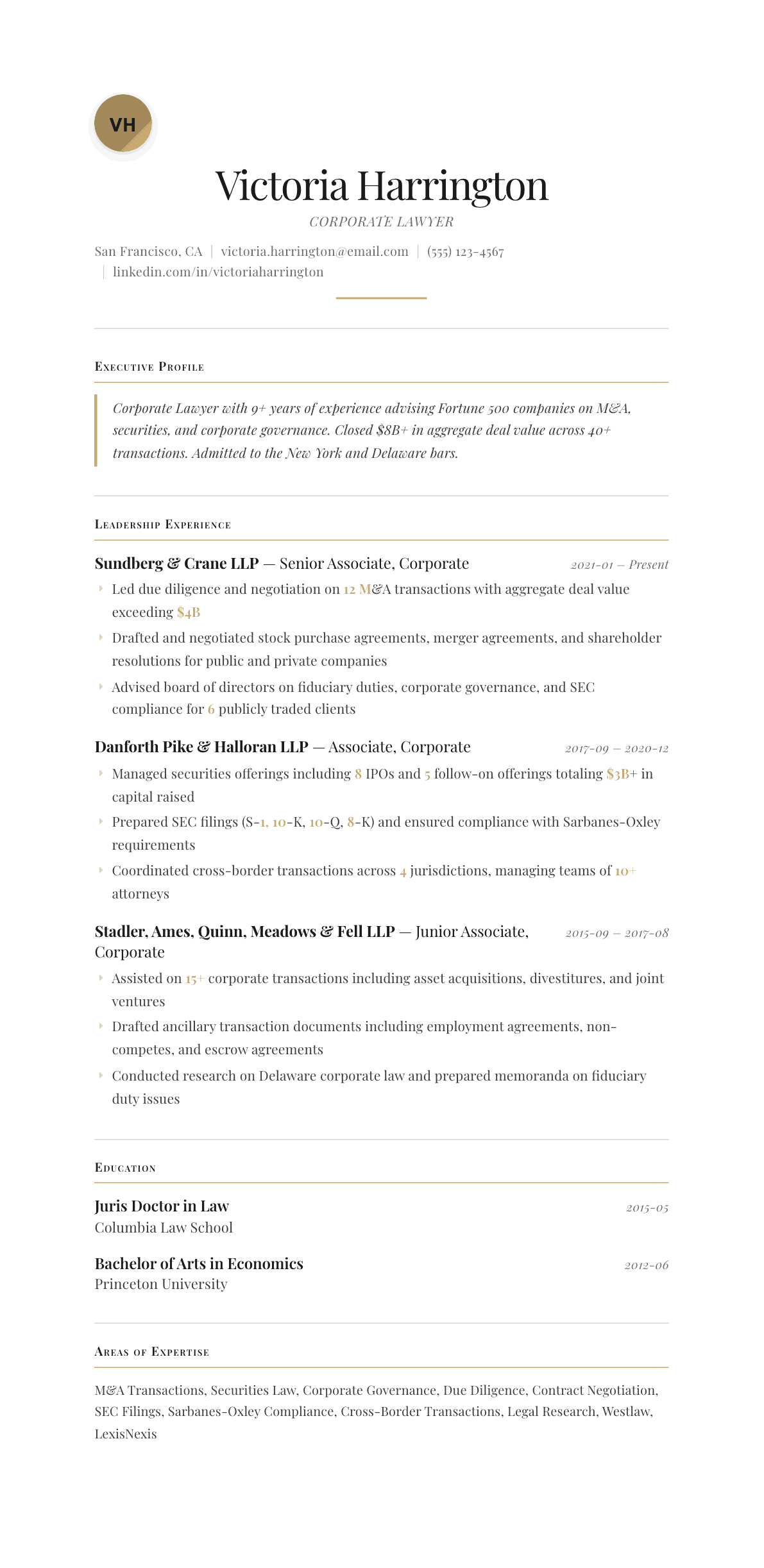
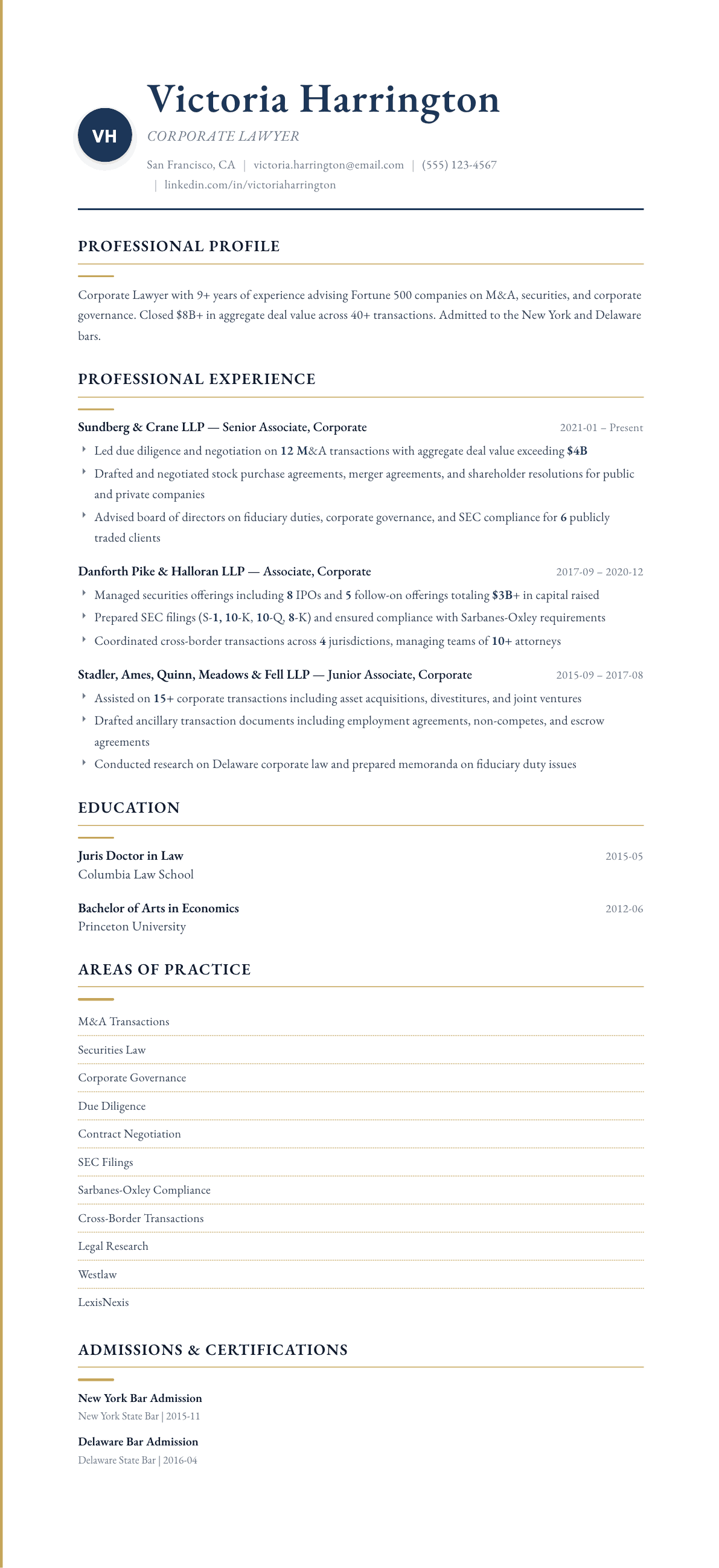
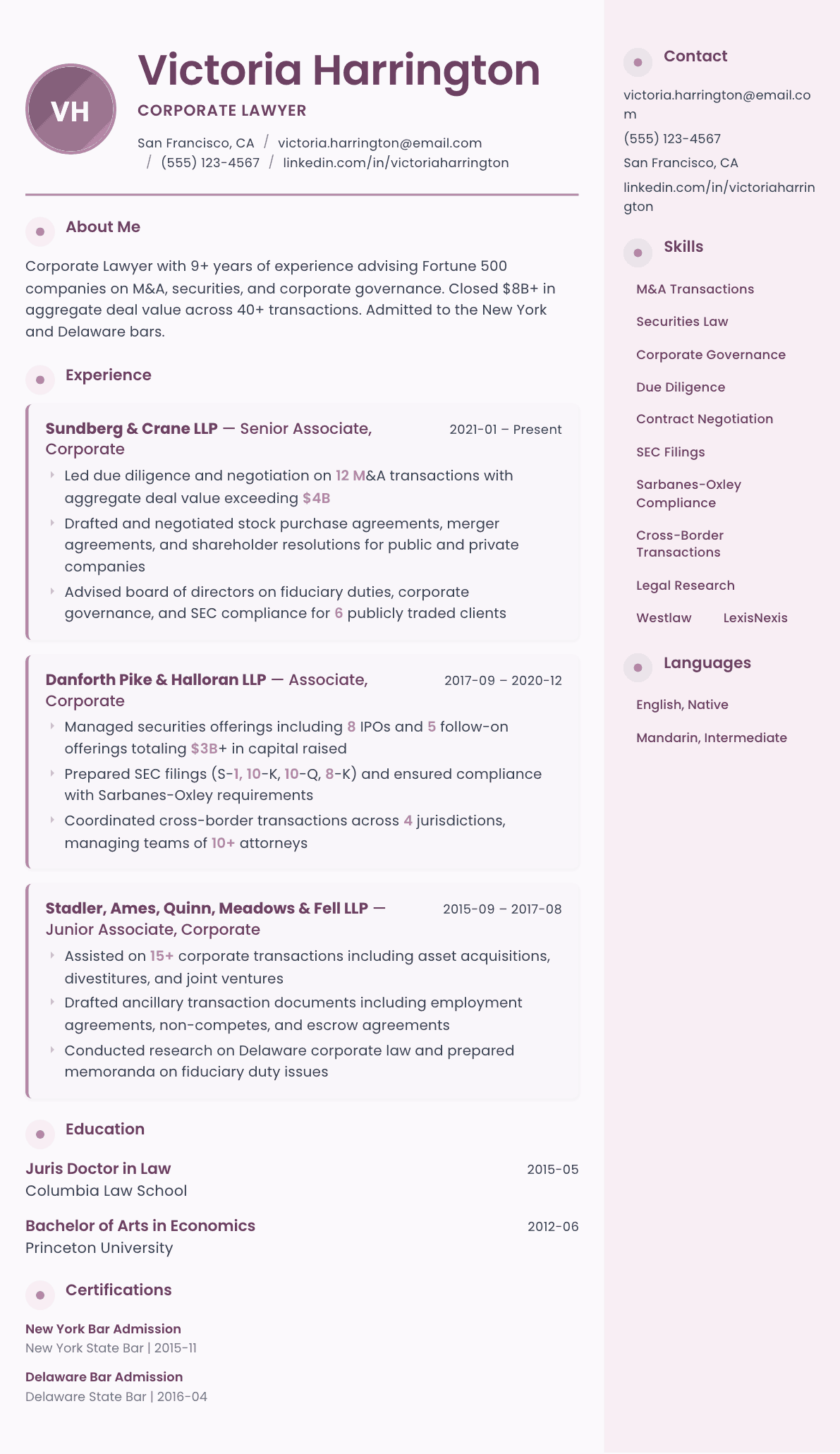
Example Corporate Lawyer summary
Corporate Lawyer with 9 years at large corporate firms advising on M&A, securities offerings, and board governance. Closed $8B+ in aggregate deal value across 40+ transactions and worked 8 IPOs from S-1 through pricing. Admitted in New York and Delaware, targeting a senior counsel or partner-track seat.
Skills to list on a Corporate Lawyer resume
- M&A Transactions
- Securities Law
- Corporate Governance
- Due Diligence
- Contract Negotiation
- SEC Compliance
- Sarbanes-Oxley
- Cross-Border Transactions
- Legal Research
- Westlaw
- LexisNexis
- Capital Markets
- Private Equity
- Board Advisory
What actually gets this resume read
- Lead with aggregate deal value handled -- dollar amounts immediately communicate your seniority level.
- Specify transaction types: M&A, IPOs, private placements, restructurings, joint ventures.
- List bar admissions and jurisdictions prominently -- they are required for most legal positions.
- Include firm names and practice group details; BigLaw experience carries significant weight.
- Quantify where possible: number of deals, capital raised, team size managed, filing deadlines met.
- Keep formatting conservative -- legal recruiters expect traditional, clean layouts.
How to write a corporate lawyer resume
A corporate lawyer resume is read by hiring partners, legal recruiters and general counsel who all evaluate the same short list of facts: your bar admissions, your law school and class standing if you are junior, the transactions you have worked on, and the level of responsibility you carried inside them. Everything else on the page is supporting material.
The deal sheet is the heart of the application. Firms and in-house teams want to see transaction types, deal structures, counterparty sophistication and your specific role, because the difference between running a diligence workstream and running the deal is the difference between two very different hires. Candidates who describe transactions only by size leave the most important question unanswered.
This guide covers the section order legal recruiters expect, how to build a deal sheet that survives a partner's read, three summaries from junior associate to in-house lead, before-and-after bullets, and the questions lawyers ask when moving between firm practice and a company legal department.
Format: bar admissions high, education where seniority dictates
Legal resumes are conservative for a reason, and this is not the field to experiment with layout. Reverse-chronological, single column, one serif or clean sans typeface, no graphics. One page is expected for junior associates and two is normal once you have a substantial transaction history or in-house leadership.
Bar admissions belong near the top with the jurisdictions and the year of admission, because they are a hard eligibility filter. Education sits above experience for the first few years out of law school, including journal membership, honors and any moot or transactional competition, then moves below experience once your deal record speaks for itself.
- Header: name, city, phone, email, and bar admissions if space allows.
- Order for juniors: summary, education, bar admissions, experience, representative matters.
- Order for seniors: summary, experience, representative matters, bar admissions, education.
The deal sheet: structure, role, and what made the deal hard
Represent each matter with the client type, the transaction structure and your role. Stock purchase, asset purchase, merger, carve-out, minority investment, joint venture, recapitalization and public offering all imply different documents and different problems, and naming the structure is what tells a reader you did the work rather than watched it.
Then say what you personally handled. Drafting the purchase agreement, negotiating the indemnity package, running the diligence workstream on commercial contracts, preparing the disclosure schedules, managing the closing checklist, coordinating specialist teams, or handling the post-closing integration matters. Partners read for exactly this, because it determines what they can staff you on.
The strongest matter entries include the complication. A regulatory approval on a tight timeline, a distressed seller, a cross-border structure with two sets of counsel, an earnout dispute that had to be papered carefully, or a diligence finding that reshaped the price adjustment. Complications show judgment in a way that transaction volume cannot.
Governance, securities and the advisory half of the practice
Corporate practice is not only transactional. Board advice, entity formation and maintenance, shareholder agreements, equity plans, officer and director duties, conflicts, and periodic reporting for public companies fill a large share of most corporate lawyers' time. If your practice includes securities work, name the filings you have prepared and the compliance obligations you have handled.
For in-house candidates, the advisory work often matters more than the deals. Show the business partnering: which functions you supported, what you did to reduce recurring legal friction, what templates and playbooks you built, and how you managed outside counsel and their budgets. In-house hiring managers are buying judgment and commercial usefulness, not just technical excellence.
- Name the entity and governance work: board minutes, resolutions, equity plans, corporate records.
- For public company practice, name the filings and the compliance framework you worked within.
- For in-house roles, show outside counsel management and the internal processes you built.
Firm to in-house, and the translation that has to happen
A firm resume that goes to a company legal department unedited usually fails, because it reads as technical depth with no commercial framing. In-house readers want to see that you can give a fast, practical answer, take a position on risk, and work inside a budget. Rewrite matter descriptions to lead with the business outcome and keep the legal mechanics second.
Going the other way, from in-house back to a firm, the problem reverses. Show technical depth, the complexity of the documents you handled personally, and any matters where you led rather than instructed. Firms will also look for whether you can generate or support client relationships, so business development contributions are worth a line.
Keywords corporate legal postings reuse
The recurring vocabulary includes mergers and acquisitions, due diligence, purchase agreements, corporate governance, securities compliance, disclosure schedules, joint ventures, private equity, venture financing, cross-border transactions and outside counsel management. Use the posting phrasing once in your summary and once inside a matter description.
Be precise about practice area labels. General corporate, mergers and acquisitions, capital markets, private equity, emerging companies and fund formation are separate hiring lanes with separate partners doing the hiring, and describing yourself accurately gets you in front of the right one.
Corporate Lawyer resume summary examples
Junior associate
Second-year corporate associate admitted in New York, with experience across eight acquisitions and two venture financings. Runs commercial contract diligence workstreams, prepares disclosure schedules and closing checklists, and drafts ancillary documents. Law review editor with a concentration in business law.
Senior associate
Corporate lawyer with six years advising private equity sponsors and growth companies on acquisitions, carve-outs and minority investments. Has drafted and negotiated purchase agreements on 20 closed transactions, led diligence teams of four, and managed cross-border closings with counsel in three jurisdictions.
In-house lead
Corporate counsel with eleven years, moving from firm practice to lead the legal function for a company of 600 employees. Owns acquisitions, governance and equity administration, built the contracting playbook used by sales and procurement, and cut outside counsel spend by 30% while closing five acquisitions.
Work experience bullets: before and after
Before: Worked on mergers and acquisitions for corporate clients.
After: Advised a private equity sponsor on the stock purchase of a regional services business, drafting the purchase agreement and negotiating the indemnity and escrow package.
The structure, the client type and your specific drafting role tell a partner exactly what you can be staffed on.
Before: Performed due diligence on transactions.
After: Led the commercial contracts diligence workstream across 400 agreements, surfacing change of control and exclusivity provisions that reshaped the closing conditions.
Leading a workstream with a finding that changed the deal shows judgment, not document review volume.
Before: Advised the board on governance matters.
After: Advised the board of a company on fiduciary duties in a conflicted transaction, prepared the special committee resolutions and the disclosure record supporting the process.
Naming the conflict, the committee and the record produced demonstrates real governance practice.
Before: Handled securities filings and compliance.
After: Prepared periodic and current reports for two public company clients and ran the disclosure controls process with finance and the auditors ahead of each filing deadline.
Naming the filing types and the process you ran shows ownership rather than support work.
Before: Managed relationships with outside law firms.
After: Managed four outside firms against agreed budgets and matter scopes, brought routine commercial work in-house, and lowered annual external legal spend by 30%.
Budget discipline with a measured saving is the in-house achievement most legal departments hire for.
Hard skills
- Mergers and acquisitions
- Purchase agreement drafting and negotiation
- Legal due diligence
- Disclosure schedules and closing mechanics
- Corporate governance and board advice
- Entity formation and maintenance
- Securities compliance and periodic reporting
- Venture and growth equity financings
- Joint ventures and shareholder agreements
- Commercial contract drafting
- Cross-border transaction coordination
- Outside counsel and budget management
Soft skills
- Commercial judgment under deadline
- Negotiation and counterparty management
- Concise written advice
- Client and stakeholder communication
- Supervising junior lawyers
- Risk framing for non-lawyers
Certifications worth listing
- Admission to the State Bar (State Bar Association)
- Certified Compliance and Ethics Professional (CCEP) (Compliance Certification Board)
- Certified Information Privacy Professional, United States (CIPP/US) (International Association of Privacy Professionals)
Mistakes that cost corporate lawyer candidates the interview
- Describing transactions only by size, so a reader cannot tell what you personally drafted or negotiated.
- Omitting the deal structure, which is the first thing a corporate partner reads a matter list for.
- Leaving bar admissions off the first page when they are a hard eligibility filter for the role.
- Sending a firm-style matter list to an in-house team without any commercial framing or budget awareness.
- Keeping law school honors at the top of the page many years into practice, above the deal record.
- Using a designed template with columns and color, which reads as unserious to legal reviewers.
- Naming confidential clients or unannounced transactions rather than describing them by sector and structure.
Corporate Lawyer resume questions
Should I include a separate deal sheet with my corporate lawyer resume?
Include representative matters on the resume itself, and bring a fuller deal sheet to interviews or attach one when a recruiter asks. Keep both consistent, describe clients by sector when names are confidential, and be ready to discuss any matter listed.
How long should a corporate lawyer resume be?
One page for associates in their first few years. Two pages once you have a substantial matter record, in-house leadership or supervisory responsibility. Beyond two pages, a hiring partner will assume you cannot prioritize your own experience.
When do I move education below experience?
Around three to four years of practice, or as soon as your matter record is the more persuasive evidence. Keep law school, degree and any journal or honors, but let the transactions occupy the top of the page from that point on.
How do I write about matters that are confidential?
Describe the client by sector and approximate scale, name the transaction structure, and describe your role and the complication. This is standard practice in legal hiring, and reviewers read it as appropriate discretion rather than as vagueness.
What do in-house legal teams look for that firms do not?
Commercial speed, risk tolerance, budget control and the ability to build repeatable processes such as contract playbooks and self-service templates. Show where you gave a practical answer quickly and where you reduced recurring legal friction for a business function.