Risk Analyst Resume Examples: free ATS score and gap list
Write a Risk Analyst Resume That Shows Real Exposure Work
By Mustafa Tarabya, founder of CVBooster · Published · Updated
Risk analyst resume examples covering credit, market and operational risk, with model and reporting keywords plus a guide to quantifying your analysis.
Sample resumes for a risk analyst
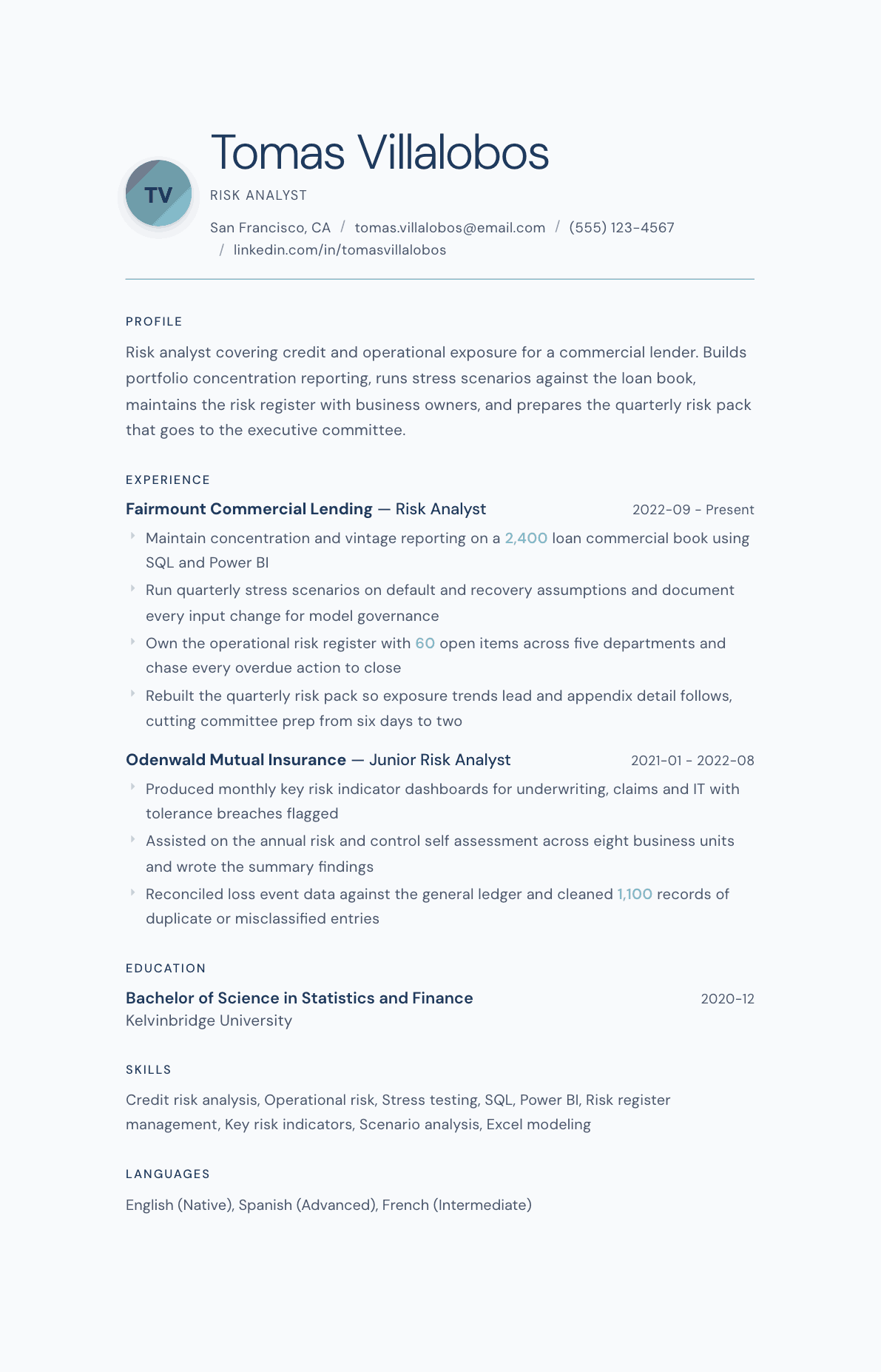
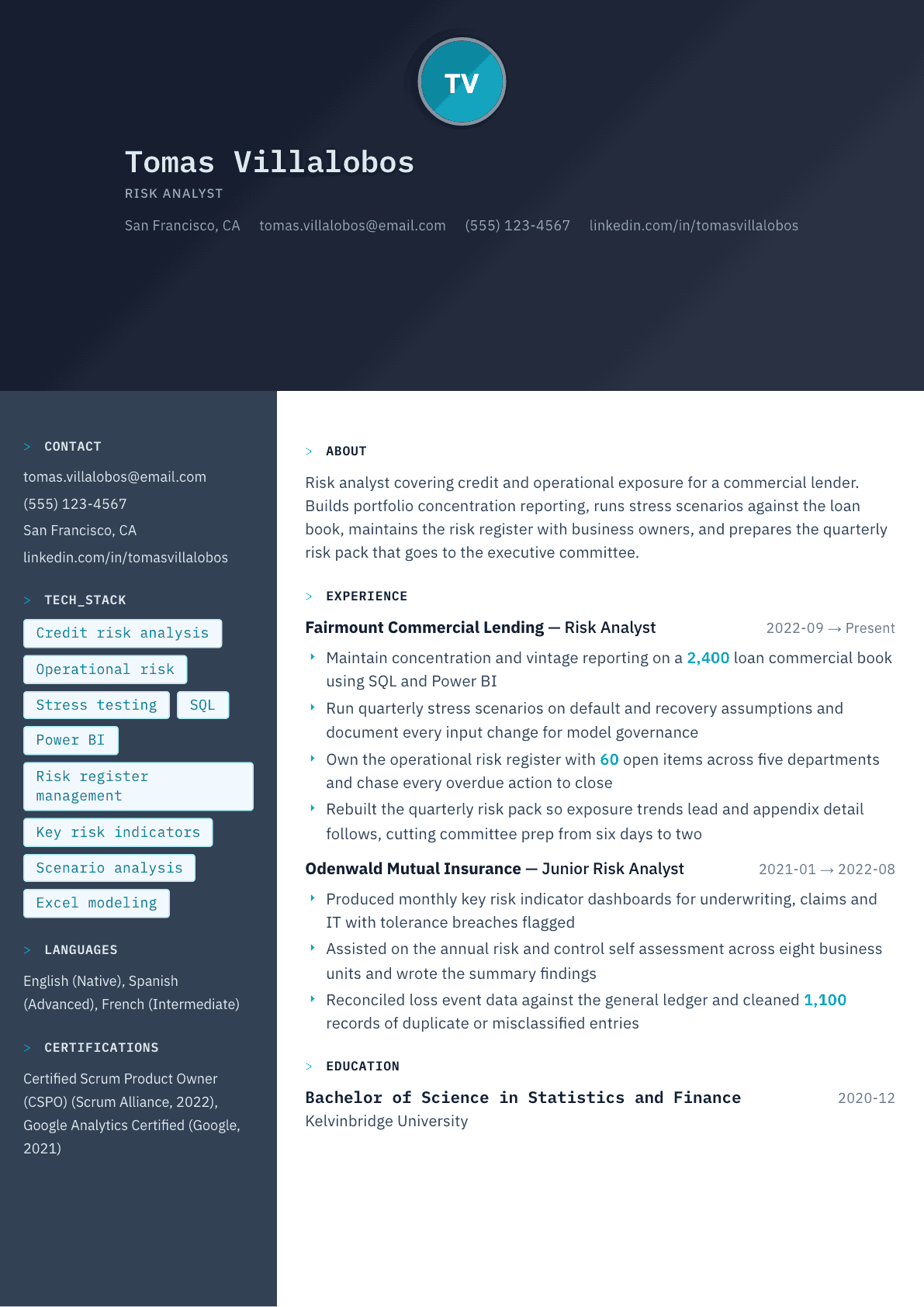
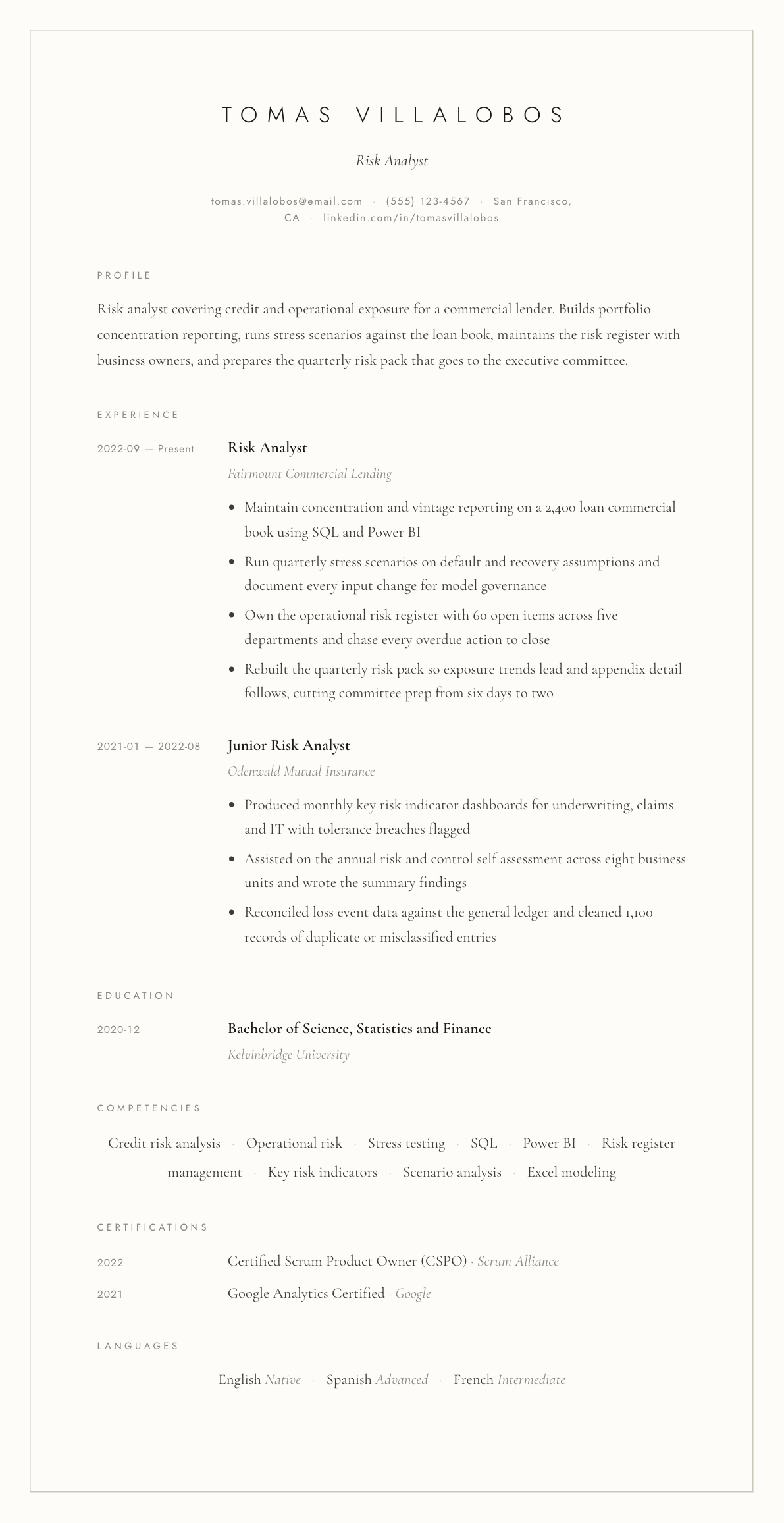
The same risk analyst content laid out in three CVBooster templates, so you can see what the finished document looks like before you write a word.
Example Risk Analyst summary
Risk analyst with three years across credit and operational risk at a commercial lender and an insurer. Maintains concentration and vintage reporting on a 2,400 loan book in SQL and Power BI, runs quarterly stress scenarios, and owns a 60 item operational risk register. Rebuilt the executive risk pack and cut preparation from six days to two. Targeting a credit risk team with model ownership.
Skills to list on a Risk Analyst resume
- Credit risk analysis
- Operational risk management
- Market risk reporting
- Stress testing
- Scenario analysis
- Key risk indicators
- Risk register maintenance
- Risk and control self assessment
- SQL
- Python
- Power BI
- Excel financial modeling
- Model documentation
- Portfolio concentration analysis
- Regulatory reporting support
What actually gets this resume read
- Say which risk you cover in the first line, because credit, market, operational and enterprise risk hire from separate candidate pools.
- Give the size of the exposure you analyzed in accounts, loans or policies rather than in money, so the scope reads clearly.
- Name the models and methods you touched: probability of default, loss given default, value at risk, scenario or sensitivity analysis.
- Show your tooling honestly, separating SQL and Python work from Excel work, since risk teams size candidates on that split.
- Include governance work such as model documentation, control self assessment and risk register upkeep, which senior reviewers look for.
- Describe who read your output, because a pack that goes to a board committee signals different judgment than a desk-level report.
How to write a risk analyst resume
Risk analyst is one of the least precise titles in finance. The same two words cover credit risk on a loan book, market risk on a trading desk, operational risk across a corporate function, model validation, and enterprise risk reporting into a board pack. A resume that does not settle the question in its first line asks the hiring manager to do the sorting, and she has forty other files.
Once the domain is clear, the reader wants two things: the analytical work you did with your own hands, and the governance work you were trusted with. Analysts who only run reports are common. Analysts who set an assumption, document it, defend it in a committee and revisit it when the portfolio moves are the ones who advance.
Below is the structure risk teams expect, three summaries for different points in a risk career, before and after bullets that fix the habitual vagueness in risk writing, and answers to the questions that come up when moving between the risk disciplines.
Format: state the domain in the first six words
Reverse chronological, one page under six years, single column so screening tools keep your dates and headings in order. The one formatting rule specific to this role is that your domain belongs in the job title line or the first clause of the summary, written the way postings write it: credit risk, operational risk, market risk, model risk or enterprise risk.
If you have crossed domains, order the experience so the target domain is the first thing read, and use a short capability block to show the rest without letting it dilute the headline.
- Header: name, city and state, phone, email, and a link to a public analysis or dashboard if you have one that is not confidential.
- Sections: summary, experience, technical stack, risk methods, education and certifications.
- Give portfolio size in units, such as loans, accounts, policies or trades, rather than in currency.
Summary: domain, portfolio, methods, audience
Four elements in three lines. The risk domain, the portfolio you analyzed and its size in units, the methods and tools you used unaided, and who consumed your output. That last element carries more weight than candidates expect, because a pack that reaches an executive committee implies a level of review your work already survived.
Avoid the summary that lists every risk type you have heard of. Breadth without depth reads as a rotation, and a credit risk team hiring for portfolio analytics will pick the candidate who obviously lives in that book.
Experience: exposure, method, governance, decision
Structure each bullet so the reader gets the exposure, the method and the consequence. Naming vintage and concentration reporting on a specific loan count tells someone more than a sentence about supporting portfolio monitoring activities, because it establishes that you know how a book is actually cut.
Stress testing and scenario work should state the assumptions you moved and how you documented them. Model governance reviewers care less about the output than about whether every input change is traceable, and saying so proves you have worked somewhere with real controls.
Governance bullets are the ones most risk analysts skip. Risk register ownership, control self assessment coordination, key risk indicator design and tolerance breach escalation all show that people trusted you to chase other departments, which is half of an operational risk job.
Finish at least one bullet with a decision. A concentration limit that was tightened, a scenario that changed an underwriting threshold, or a report format that shortened a committee cycle proves your analysis went somewhere rather than into a folder.
Technical stack: separate the query work from the spreadsheet work
Risk teams size candidates on the split between database work and spreadsheet work, so make it explicit. State what you write unaided in SQL, whether you use Python or R for anything beyond a tutorial, and what you build in Excel. Then name the visualization layer, because dashboard maintenance is a real part of the job and a reader wants to know if you can take it on.
Modeling terms should be used only where you have genuinely worked with them. Probability of default, loss given default, exposure at default, value at risk and expected shortfall are precise concepts, and an interviewer will ask which one you calibrated and how.
- Databases and query depth, including joins, window functions and any warehouse you worked against.
- Programming environments and the specific libraries or packages you rely on.
- Reporting layer, model documentation tooling, and any governance risk and compliance platform.
Keywords risk postings match on
Recurring terms include credit risk, operational risk, stress testing, scenario analysis, key risk indicators, risk appetite, risk register, risk and control self assessment, model validation, concentration analysis and regulatory reporting. Mirror the ones that are true of you, once in the summary and once inside a bullet. A term used twice where it describes real work beats a term used six times in a keyword strip, because the second reader of your file is a person who will notice.
Risk Analyst resume summary examples
First risk role
Statistics and finance graduate with an internship producing key risk indicator dashboards for underwriting and claims, plus coursework in regression and time series. Comfortable writing SQL joins unaided and building Excel models with documented assumptions. Targeting a junior credit or operational risk seat with model exposure.
Three years in
Risk analyst covering credit and operational exposure at a commercial lender. Maintains concentration and vintage reporting on a 2,400 loan book in SQL and Power BI, runs quarterly stress scenarios with documented assumption changes, and owns a 60 item operational risk register across five departments.
Senior risk analyst
Senior credit risk analyst with eight years across lending and insurance, currently owning probability of default segmentation, the quarterly stress program and the executive risk pack. Rebuilt a scoring segmentation that tightened two concentration limits, and mentors two junior analysts on model documentation standards.
Work experience bullets: before and after
Before: Supported portfolio risk monitoring and reporting activities.
After: Maintain concentration, vintage and delinquency roll rate reporting on a 2,400 loan commercial book in SQL and Power BI, refreshed monthly with variance commentary.
The specific cuts of the portfolio and the tooling show you understand how a loan book is actually analyzed.
Before: Performed stress testing on the loan portfolio.
After: Run quarterly stress scenarios across default and recovery assumptions, documenting every input change and its rationale so the model governance reviewer can trace each version.
Adding the documentation discipline proves experience in a controlled environment rather than a one-off spreadsheet exercise.
Before: Maintained the risk register for the business.
After: Own the operational risk register with 60 open items across five departments, chasing overdue actions weekly and escalating tolerance breaches to the risk committee.
Counts, departments and an escalation path show the cross-functional persistence the role really requires.
Before: Prepared reports for the risk committee.
After: Rebuilt the quarterly risk pack so exposure trends lead and appendix detail follows, cutting committee preparation from six days to two while keeping every supporting schedule intact.
A structural change plus a time saving turns report production into evidence of judgment about your audience.
Before: Cleaned up loss event data.
After: Reconciled operational loss event data against the general ledger and corrected 1,100 duplicate or misclassified records, then added a validation rule at capture to stop the pattern recurring.
Fixing the cause rather than only the symptom is the detail that separates a data cleanup from a control improvement.
Hard skills
- Credit risk analysis
- Operational risk management
- Stress testing and scenario design
- Key risk indicator development
- Risk register administration
- Risk and control self assessment
- Portfolio concentration analysis
- SQL
- Python or R analytics
- Excel financial modeling
- Power BI or Tableau reporting
- Model documentation and governance
Soft skills
- Explaining models to non-technical readers
- Persistence chasing action owners
- Skeptical review of inputs
- Committee-level presentation
- Prioritizing by materiality
- Collaboration with business owners
Certifications worth listing
- Financial Risk Manager (FRM) (Global Association of Risk Professionals)
- Professional Risk Manager (PRM) (Professional Risk Managers International Association)
- Chartered Financial Analyst (CFA) (CFA Institute)
- Certified Internal Auditor (CIA) (Institute of Internal Auditors)
Mistakes that cost risk analyst candidates the interview
- Leaving the risk domain unstated so the reader cannot tell a credit analyst from an operational risk coordinator.
- Listing modeling terms you have only read about, which unravels within two questions in a technical interview.
- Describing reports produced without ever naming who received them or what changed as a result.
- Skipping governance work such as register upkeep and control self assessment, which senior reviewers weight heavily.
- Quoting portfolio size in currency when unit counts communicate scope more clearly and avoid confidentiality problems.
- Blurring SQL fluency with spreadsheet fluency, when risk teams size candidates precisely on that distinction.
Risk Analyst resume questions
What is the difference between a risk analyst and a credit analyst?
A credit analyst usually underwrites individual borrowers and recommends decisions on specific files. A risk analyst works at portfolio level on aggregate exposure, concentration, scenarios and controls. The skills overlap, but the resumes should emphasize different evidence and different tooling.
Do I need Python to work as a risk analyst?
Not for every seat. Many operational and enterprise risk roles run on SQL, Excel and a reporting tool. Credit modeling, model validation and quantitative market risk generally expect Python or R, so match your claim to the domain you are targeting rather than overstating it.
How do I show risk work without disclosing confidential exposures?
Use unit counts, percentages and directional outcomes instead of amounts. Saying you monitored concentration across a book of a few thousand commercial loans gives a reader the scale while keeping every figure your employer would consider sensitive off the page.
Is the Financial Risk Manager credential worth listing while in progress?
Yes, with the part number and your scheduled sitting. Many risk postings name it as preferred, and a registered exam date reads as commitment. State it accurately, because an offer process will verify the credential and an implied pass ends the conversation badly.
How do I move from reporting into modeling work?
Get one bullet where you owned an assumption rather than a refresh. Volunteer for scenario calibration, back-testing or a segmentation review, then write it up with the method, the documentation and the decision it informed. Modeling teams hire reporting analysts who have already done that once.
Related resume examples
- Credit Analyst Resume example
- Financial Analyst Resume example
- Fraud Analyst Resume example
- Internal Auditor Resume example
- Pricing Analyst Resume example
- Trader Resume example