Forensic Accountant Resume Examples: what gets the call
Create a Forensic Accountant Resume That Uncovers the Truth
By Mustafa Tarabya, founder of CVBooster · Published · Updated
Build a forensic accountant resume showcasing fraud investigation, litigation support, and financial analysis expertise with case outcomes and recovery amounts.
Sample resumes for a forensic accountant
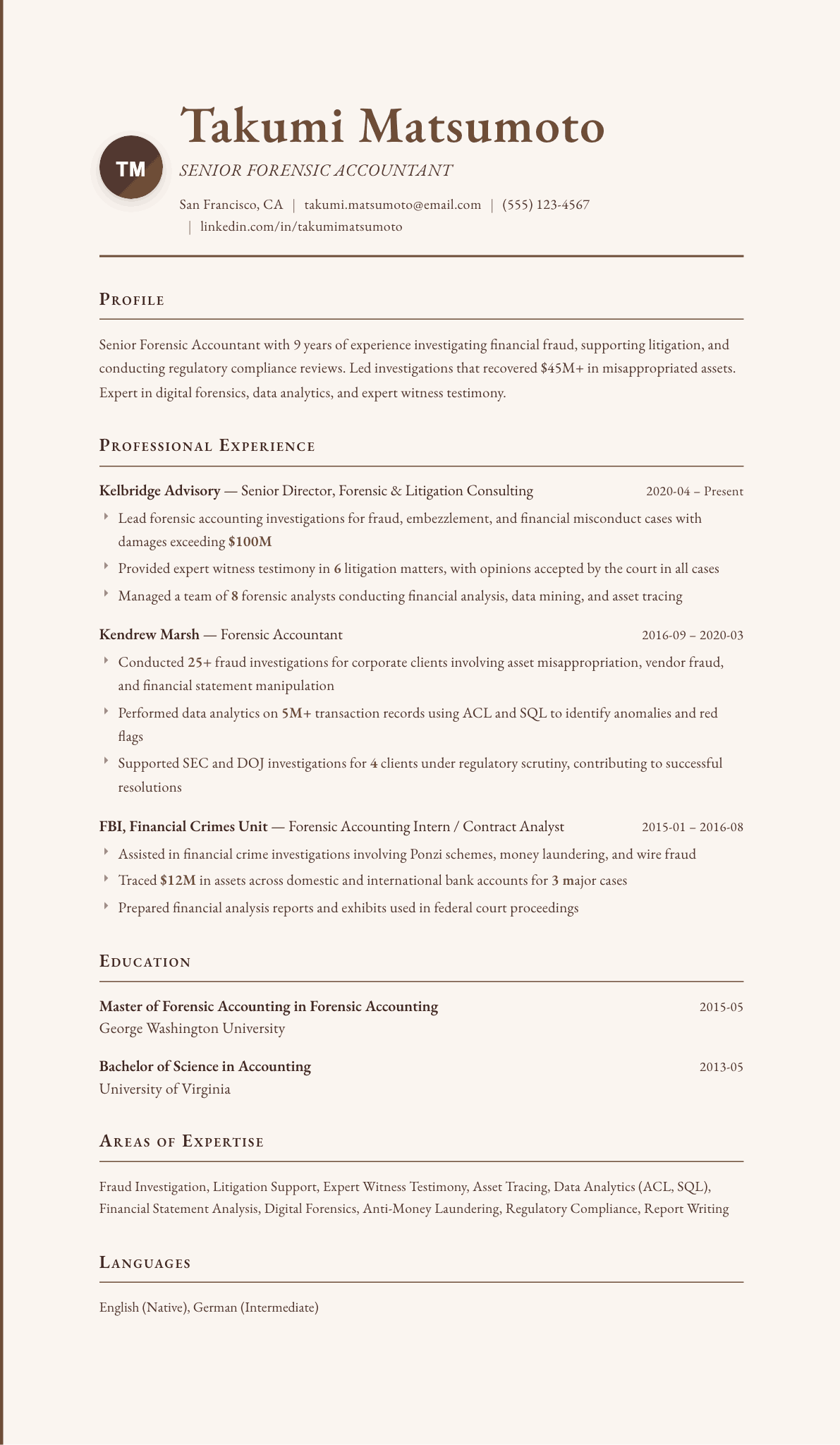
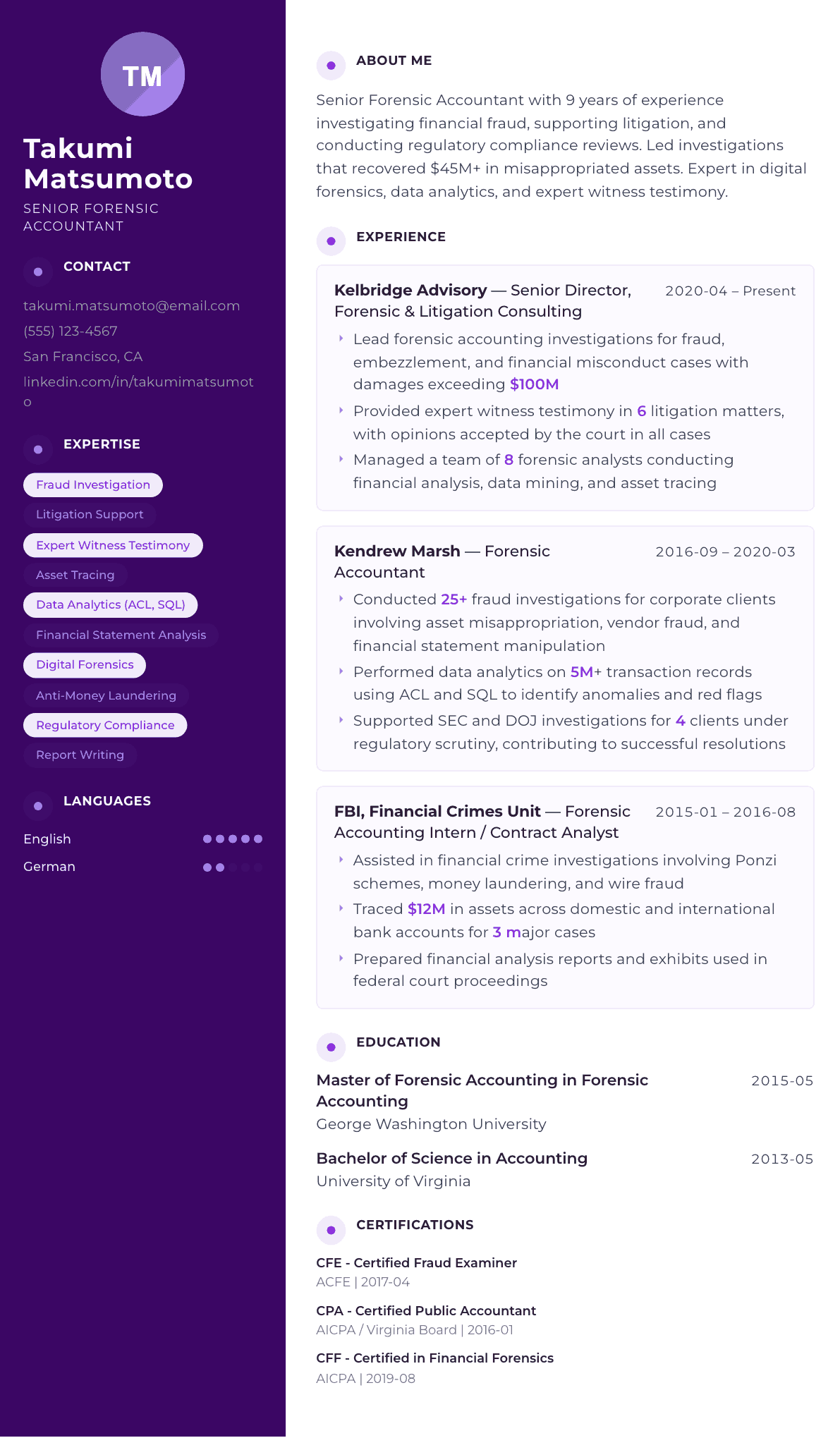
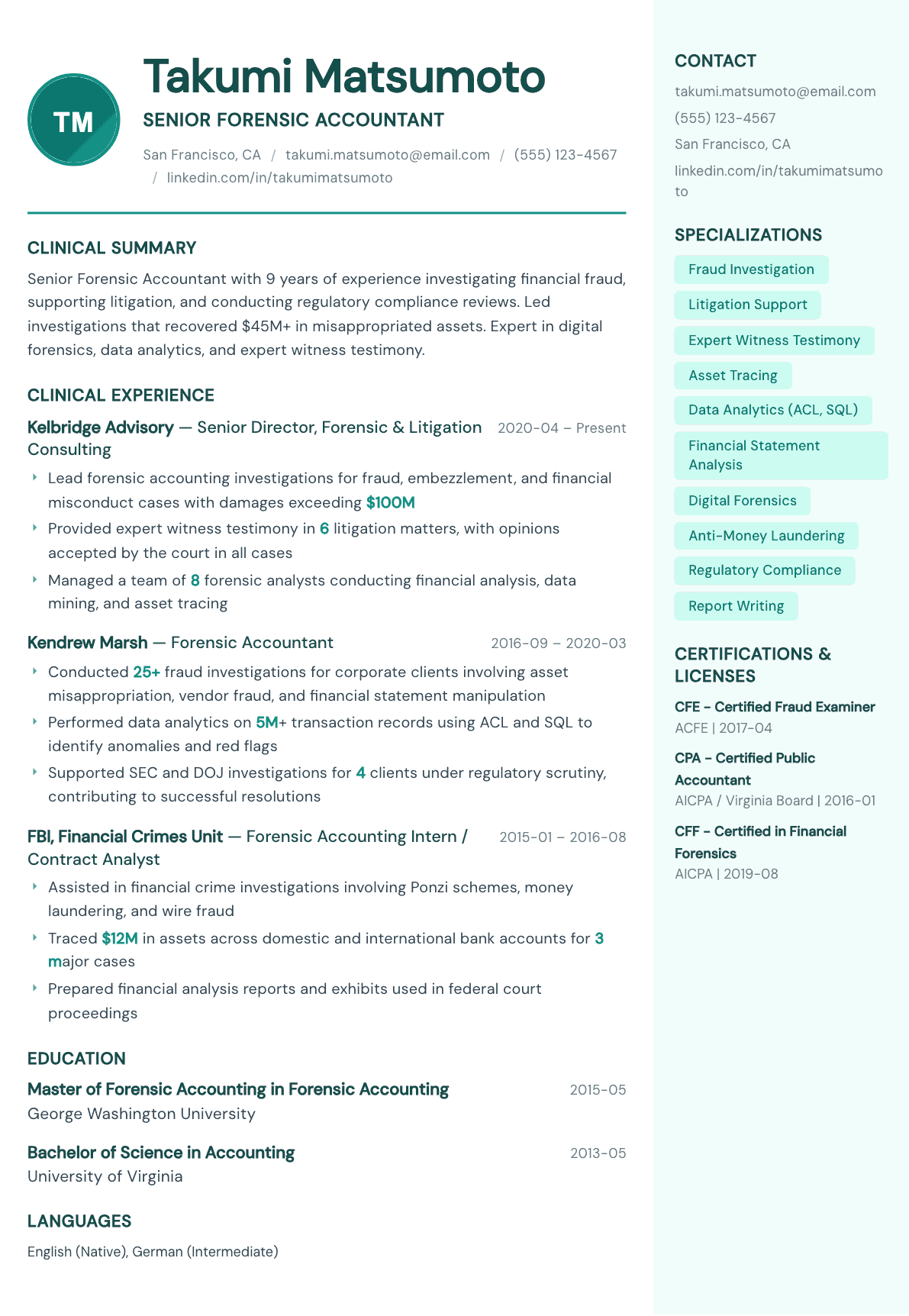
The same forensic accountant content laid out in three CVBooster templates, so you can see what the finished document looks like before you write a word.
Example Forensic Accountant summary
CFE, CPA, and Senior Forensic Accountant with 9 years of experience investigating financial fraud and supporting high-stakes litigation. Recovered $45M+ in misappropriated assets and provided expert witness testimony in 6 court matters. Seeking a Managing Director role to lead forensic investigations at a premier advisory firm.
Skills to list on a Forensic Accountant resume
- Fraud Investigation
- Litigation Support
- Expert Witness Testimony
- Asset Tracing
- Data Analytics
- ACL / IDEA
- SQL
- Financial Statement Analysis
- Digital Forensics
- Anti-Money Laundering
- Regulatory Investigations
- Report Writing
- Damage Quantification
What actually gets this resume read
- Quantify case outcomes: amounts recovered, fraud prevented, and regulatory findings resolved.
- Highlight expert witness experience including number of depositions and trial testimonies.
- Show data analytics and digital forensics capabilities with specific tools.
- Include experience with specific fraud types: asset misappropriation, financial statement fraud, corruption.
- CFE and CPA/CFF credentials are essential; display them prominently.
- Demonstrate both investigative skills and the ability to communicate findings clearly.
How to write a forensic accountant resume
Forensic accounting resumes are read by people who have to staff a matter, and matters have shapes. A partner staffing an asset misappropriation investigation at a mid market manufacturer needs someone who can interview a controller and reconstruct a bank ledger. A partner staffing a securities matter needs someone who can survive a deposition. The resume that gets called is the one that makes the shape of your past matters legible in about fifteen seconds.
That means the case types, the role you held on each engagement, the volume and format of data you worked through, the deliverable you produced, and whether your work has been tested by opposing counsel. A forensic accountant who has been cross examined is a different asset from one who has only ever written internal memos, and the resume has to say which you are without overstating it.
This guide covers how to structure the file around matter experience, three summaries from associate to managing level, before and after bullets, and the confidentiality mistakes that get forensic resumes quietly discarded.
Format: a matter experience section is the spine of the resume
Reverse chronological employment, but with a representative engagements block that does the real work. Under each employer, or in a standalone section, list anonymized matters with the industry, the allegation type, your role, the data volume and the deliverable. Two pages is normal here and three is acceptable at director level, because staffing decisions are made off matter breadth.
Put credentials in the header in the order the issuing bodies use, and keep the layout plain. Forensic work product is judged on clarity, so a cluttered resume undercuts the exact quality you are selling.
- Header: name, credential marks, city and state, phone, email.
- Order: summary, credentials, experience, representative matters, testimony record, technical skills, education.
- Anonymize every matter: industry and size, never the client name, unless it is a public filing you can point to.
Summary: case types, side of the table, testimony status
Open with the categories of work you have actually run: financial statement fraud, asset misappropriation, corruption and bribery, anti money laundering lookbacks, post acquisition disputes, business interruption claims, marital dissolution, or economic damages. These are the buckets partners staff from, and a summary that stays at the level of fraud investigation tells them nothing.
Then say whose side you have worked: plaintiff, defense, an audit committee under a special investigation, a regulator, or a monitorship. Finish with the testimony line if you have one, stated exactly: reports authored, depositions given, trial testimony given. If you have supported an expert rather than been one, say supported, because that distinction is checked.
Experience: the allegation, the data, the method, the outcome
Each matter bullet should carry four things. The allegation and the setting, so a reader can judge complexity. The evidence you worked through, in units that mean something: years of general ledger detail, bank statements across accounts and entities, mailboxes reviewed, transaction counts. The method, which is where the craft shows: journal entry testing for unusual postings, Benford analysis, bank record reconstruction, vendor master matching against payroll for ghost vendors, relative size factor screening. Then the outcome: the amount traced, the finding, the settlement position it supported, the remediation adopted.
Damages work needs its own vocabulary. Say which measure you applied, such as lost profits, diminution in value or reasonable royalty, and note if you rebutted an opposing expert report. Rebuttal work is a strong signal because it means someone trusted you to attack a professional analysis.
Be exact about your role. Led, supervised, performed and supported are four different words and the profession reads them literally.
Technical skills: the analytics stack and the evidence handling
Name the tools by their real function. Data analysis and interrogation in IDEA, ACL or Alteryx, SQL against extracted ledgers, Excel at the level of reconstructing a subledger, and visualization in Power BI or Tableau for the exhibits. If you have run scripts in Python for entity resolution or duplicate payment testing, say so, because it separates you from the reviewers.
On the evidence side, name the review platform (Relativity, Nuix) and say whether you worked alongside digital forensics on imaging and chain of custody rather than claiming the imaging yourself. Add the accounting systems you have extracted from, because pulling a clean general ledger out of SAP or NetSuite is a real skill that costs engagements time when nobody on the team has it.
Credentials, report writing and the keywords in the posting
The CFE is the baseline signal for investigative work, the CPA is expected in the United States for damages and financial statement matters, and the CFF adds the forensic specialization on top of the CPA. The CAMS matters for financial crime and lookback work. List each with the issuing body and only when it is current.
Write one line about the deliverable itself, because report writing is what firms complain about most. Say whether you have drafted expert reports, affidavits, interview memoranda, board presentations or regulator submissions. Postings repeat the same terms: fraud investigation, litigation support, asset tracing, damages quantification, forensic analysis, internal investigation, expert witness, anti money laundering, data analytics. Use the ones that are true and attach each to a matter.
Forensic Accountant resume summary examples
First forensic seat
Accounting graduate and CPA exam candidate with two years in external audit, now working fraud risk engagements: journal entry testing, duplicate payment analysis and vendor master reviews in IDEA. Comfortable in SQL and Excel at reconstruction level. Seeking an associate role in a forensic and litigation support practice.
Five years in
CFE and CPA with five years in forensic accounting across asset misappropriation and post acquisition disputes. Reconstructed ledgers for a distributor with 14 entities, traced diverted funds through six banking relationships, and drafted the schedules behind two expert reports. Seeking a manager role leading investigative fieldwork.
Director level
Forensic accounting director holding CPA, CFF and CFE, eleven years running internal investigations and economic damages engagements for audit committees and defense counsel. Authored nine expert reports, testified in three depositions and one trial, and built the practice analytics workflow now used on every engagement.
Work experience bullets: before and after
Before: Investigated fraud allegations for various clients.
After: Investigated a procurement fraud allegation at a mid market construction firm: reconciled four years of general ledger detail against bank records, matched the vendor master to payroll addresses, and identified two shell suppliers.
The setting, the evidence and the specific test show a reader exactly what you can be staffed on.
Before: Used data analytics to identify suspicious transactions.
After: Screened 1.8 million disbursement records in IDEA using duplicate payment, round dollar and weekend posting tests, narrowing the review population to 400 items that produced the two confirmed schemes.
Naming the tests and the funnel from population to finding proves method rather than tool familiarity.
Before: Assisted with expert witness testimony.
After: Prepared the damages schedules and rebuttal analysis supporting a testifying expert in a lost profits matter, and sat second chair through deposition preparation and the deposition itself.
Accurate role wording protects your credibility, and second chair experience is still worth stating plainly.
Before: Traced misappropriated assets.
After: Traced diverted funds through nine accounts across three institutions and two jurisdictions, reconstructing the flow into personal property purchases and producing the exhibit used in the freezing application.
Account and jurisdiction counts convey complexity, and naming the downstream legal use shows the work mattered.
Before: Wrote investigation reports for management.
After: Drafted investigation reports for an audit committee: findings, the evidence supporting each, control failures identified, and remediation recommendations, then presented them alongside outside counsel.
Reporting to an audit committee with counsel present is a seniority signal that management reports do not carry.
Hard skills
- Fraud investigation and scheme identification
- Asset tracing and fund flow reconstruction
- Journal entry and ledger testing
- Economic damages and lost profits analysis
- Anti money laundering lookbacks
- IDEA and ACL
- SQL and Alteryx
- Relativity document review
- Interview and evidence memoranda
- Expert report drafting
- Financial statement analysis
- General ledger extraction from SAP and NetSuite
Soft skills
- Investigative interviewing
- Skepticism without accusation
- Working under legal privilege
- Explaining a schedule to a jury audience
- Composure under cross examination
- Discretion with sensitive findings
Certifications worth listing
- Certified Fraud Examiner (CFE) (Association of Certified Fraud Examiners)
- Certified Public Accountant (CPA) (State Boards of Accountancy (AICPA Uniform CPA Exam))
- Certified in Financial Forensics (CFF) (American Institute of Certified Public Accountants)
- Certified Anti-Money Laundering Specialist (CAMS) (Association of Certified Anti-Money Laundering Specialists)
- Certified Valuation Analyst (CVA) (National Association of Certified Valuators and Analysts)
- Certified Internal Auditor (CIA) (Institute of Internal Auditors)
Mistakes that cost forensic accountant candidates the interview
- Naming clients or matters that are not public record. It signals that you would do the same with the next firm confidential engagement.
- Blurring the testimony line by writing expert witness experience when you prepared schedules for someone else who testified.
- Describing engagements as fraud investigations without the scheme type, so a partner cannot match you to a matter on the desk.
- Listing analytics tools with no test attached. A reader wants to know what you ran in IDEA, not that the license existed.
- Leaving out the deliverable. Firms are buying a defensible report, and a resume that never mentions writing one is missing the product.
- Presenting audit experience as forensic experience. Testing controls and reconstructing a concealed transaction are different jobs and readers spot the substitution.
Forensic Accountant resume questions
How do I describe engagements without breaching confidentiality?
Describe the industry, approximate size, allegation type, your role, the data volume and the method. Leave out the client, the counterparty and anything that could identify the matter. That level of detail is standard across the profession and nobody expects more.
Do I need a CPA to work as a forensic accountant?
Not for every seat. Investigative and analytics roles often hire on the CFE plus strong data skills. Damages and financial statement matters in the United States effectively require a CPA, since opposing counsel will use its absence against a testifying expert.
How should I show testimony experience on a forensic accounting resume?
Give it a short dedicated block with counts: expert reports authored, depositions given, trial and arbitration testimony given, and rebuttal reports. Add the venue type without case names. Being precise here matters more than the numbers being large.
Can I move from internal audit into forensic accounting?
Yes, and the bridge is your investigation work. Rewrite your bullets around the special reviews, the whistleblower allegations you looked into, the analytics you ran and any report that went to the audit committee, rather than the annual audit plan.
What technical skills matter most for a forensic accountant?
The ability to get a clean ledger out of an accounting system, design tests against it in IDEA, ACL, SQL or Alteryx, and turn results into an exhibit a non accountant can follow. Document review platform experience helps on larger matters.
Related resume examples
- Auditor Resume example
- Compliance Analyst Resume example
- Tax Accountant Resume example
- Anti-Money Laundering Analyst Resume example
- Revenue Analyst Resume example
- Claims Adjuster Resume example