Labor Relations Specialist Resume Examples: free score
Write a Labor Relations Specialist Resume That Shows Contract Command
By Mustafa Tarabya, founder of CVBooster · Published · Updated
Build a labor relations specialist resume with a full example, the grievance and bargaining detail employers verify, ATS keywords and a guide.
Sample resumes for a labor relations specialist
The same labor relations specialist content laid out in three CVBooster templates, so you can see what the finished document looks like before you write a word.
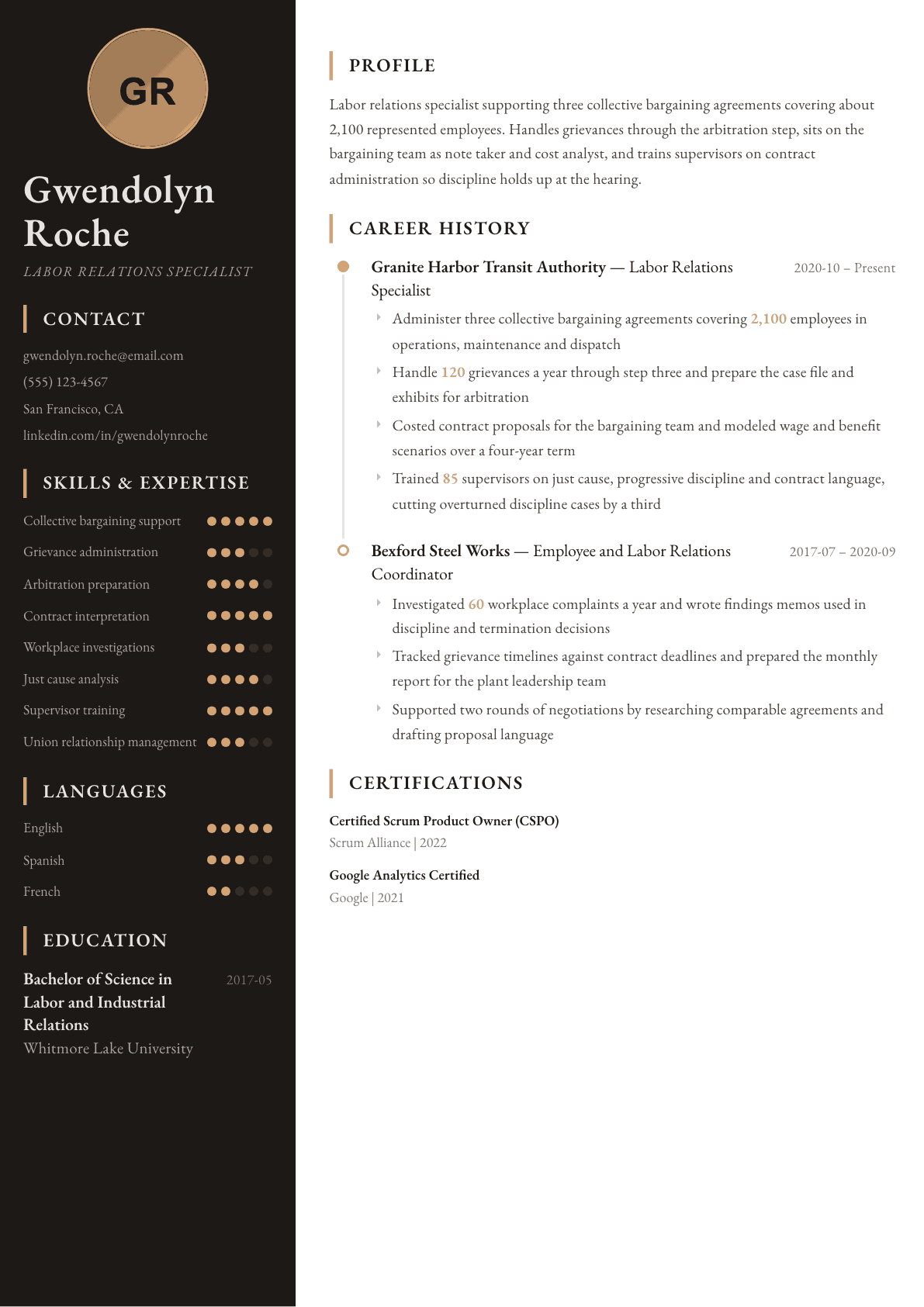
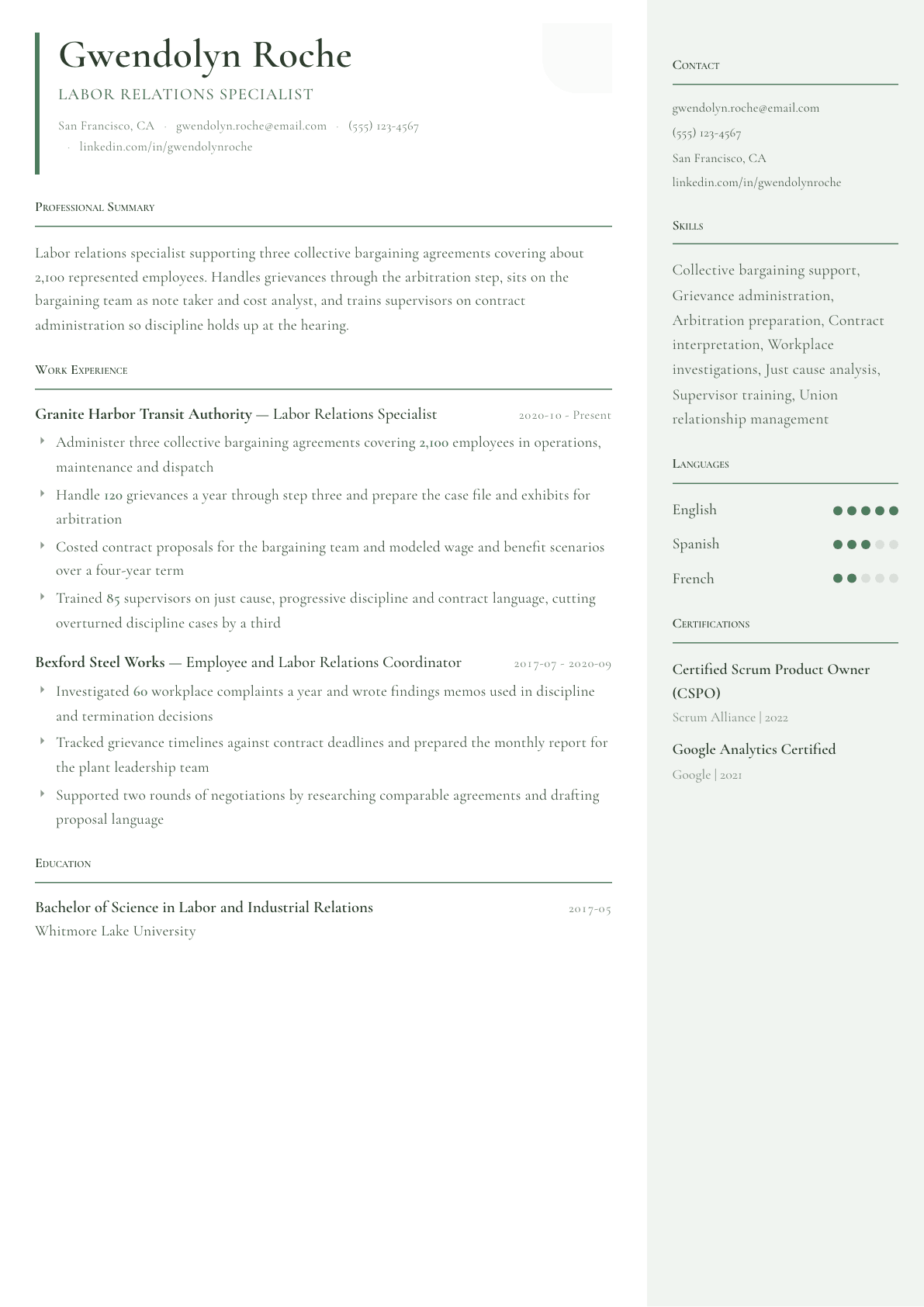
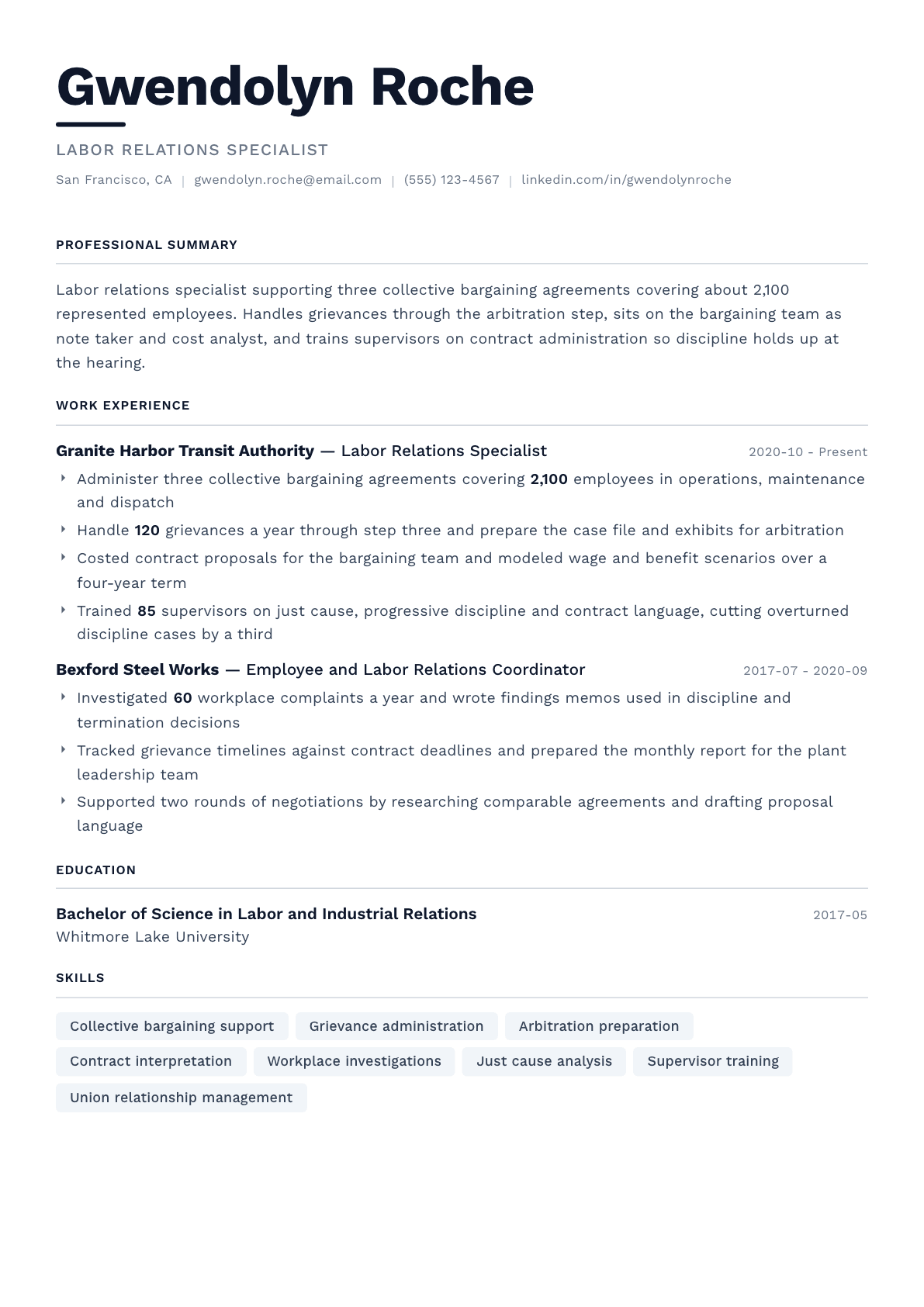
Example Labor Relations Specialist summary
Labor relations specialist administering three collective bargaining agreements that cover more than two thousand represented employees. Handles grievances through the third step, builds the exhibit file for arbitration, and costs proposals for the bargaining team across a multi-year term. Trains frontline supervisors on just cause so discipline survives review.
Skills to list on a Labor Relations Specialist resume
- Collective bargaining
- Grievance handling
- Arbitration preparation
- Contract interpretation
- Contract costing
- Workplace investigations
- Just cause and progressive discipline
- National Labor Relations Act
- Unfair labor practice response
- Union relationship management
- Supervisor training
- Mediation support
- Case file documentation
- Employee relations
What actually gets this resume read
- State how many contracts you administered and how many represented employees they covered, by department if it varies.
- Give grievance volume and the highest step you personally handled, including whether you prepared arbitration files.
- Describe your seat at the bargaining table precisely: note taker, cost analyst, spokesperson or team lead.
- Show contract costing work, because employers want a specialist who can price a proposal before it is offered.
- Include supervisor training and its result, such as fewer overturned discipline actions or faster step-one resolution.
- Name the statutes and bodies you worked under, such as the National Labor Relations Act or a state labor board.
How to write a labor relations specialist resume
A labor relations specialist is hired to keep a contract working between negotiations and to make sure the employer's decisions hold up when a union challenges them. The people reading your resume are usually a labor relations director and an operations leader who has lost an arbitration and does not want to lose another.
So the page must show contract command. How many agreements, how many represented employees, what steps of the grievance procedure you personally handled, whether you built the arbitration file, and what happened when a case went to a hearing. Vague language about maintaining positive union relationships reads as somebody who has never sat in a step-three meeting.
This guide sets out the sections this role expects, three summaries by stage, before-and-after bullets from grievance and bargaining work, credentials and study paths worth listing, and the questions that come up when specialists write about confidential casework.
Format: reverse chronological, contract scope stated under every employer
One page early in a career, two once you have carried multiple contracts. Under each employer write the contract scope before the bullets: number of agreements, the unions involved, represented headcount, the departments covered, and whether the workforce is public or private sector. That framing changes how everything below it reads.
Keep the layout plain and the language precise. This field values exact terms, so writing step three rather than a later stage of the grievance process is itself a signal that you know the procedure.
- Header: name, city and state, phone, email, plus a credential such as SHRM-SCP or SPHR if held.
- Order: summary, experience, education, certifications and training, skills.
- Public sector candidates should name the governing statute or board, since procedure differs from private sector practice.
Summary: contracts, volume, table role, training
Open with the number of agreements you administer and the represented population, then your grievance volume and the highest step you handle, then your seat at the bargaining table. Close with the supervisor training you deliver, because employers know most grievances start with a manager who applied the contract wrong.
If you have handled unfair labor practice charges, an organizing campaign or a contract that expired without a successor agreement, put it in the summary. Those experiences are hard to acquire and they separate you immediately from a generalist who covers labor as a side duty.
Grievances and arbitration: show the process, not the drama
Give annual grievance volume, the mix of issues such as discipline, overtime distribution, job posting and bidding, subcontracting or classification, and the resolution pattern: settled at which step, withdrawn, advanced. Then say what you build for a hearing: the case chronology, the exhibit file, witness preparation, and the position statement.
Do not name individuals or reproduce confidential facts. Write at the level of category and outcome. A bullet saying you prepared and presented four arbitration cases with the employer position upheld in three is credible and safe. A narrative about a specific employee is neither.
Timelines matter in this work, so show that you track them. Contract deadlines missed by the employer hand a case away regardless of the merits, and a bullet about a tracking system for step deadlines proves you know that.
Bargaining: name your seat and your numbers
Say how many rounds you have been part of and what you did in each: note taker and record keeper, cost analyst pricing proposals, drafter of contract language, subcommittee lead, or spokesperson. Employers hire for a specific gap on their team, so precision here matters more than seniority.
Costing is the skill most likely to get you the interview. Describe how you modeled wage schedules, health contribution changes, pension or retirement provisions and overtime rules across the term, and what the model changed about the employer position. Add preparation work: comparable agreement research, bargaining book assembly, and the ground rules you helped negotiate.
Training, statutes and the keywords
Frontline supervisor training is a core deliverable. Give the number of supervisors trained, the content, and the measurable effect such as fewer overturned discipline actions or faster step-one resolution. Add any contract administration guide or manager handbook you wrote.
Name the legal framework you worked under: the National Labor Relations Act in private sector work, or the state public employment relations act and board in public sector work. Keywords a posting will use include collective bargaining agreement, grievance, arbitration, just cause, progressive discipline, unfair labor practice, contract interpretation, mediation and labor management committee.
Labor Relations Specialist resume summary examples
First labor role
Employee and labor relations coordinator with three years in a unionized manufacturing plant. Investigated 60 workplace complaints a year, wrote the findings memos behind discipline decisions, and tracked grievance timelines against contract deadlines. Supported two bargaining rounds with comparable research and proposal drafting.
Contract administrator
Labor relations specialist administering three collective bargaining agreements covering 2,100 employees in operations, maintenance and dispatch. Handles 120 grievances a year through step three, prepares arbitration case files, and costs proposals for the bargaining team across a four-year term.
Lead negotiator
Senior labor relations specialist covering five agreements and two unions in a public transit authority. Served as chief spokesperson in the last round, settled a successor agreement after expiration without a work stoppage, and responds to unfair labor practice charges with outside counsel.
Work experience bullets: before and after
Before: Handled union grievances.
After: Handle 120 grievances a year through step three across discipline, overtime distribution and job bidding, settling most before advancement and documenting each disposition for precedent.
Volume, issue mix, the step you own and the precedent file show contract administration rather than complaint intake.
Before: Prepared cases for arbitration.
After: Built the arbitration file for four cases: chronology, contract language analysis, exhibit binder, witness preparation and the employer position statement submitted before hearing.
Listing the components of the file proves you did the preparation instead of handing a folder to counsel.
Before: Participated in contract negotiations.
After: Served as cost analyst on the bargaining team, modeling wage schedule, health contribution and overtime proposals across a four-year term for the employer caucus.
The named seat and the specific modeling scope tell an employer exactly which gap you can fill on their team.
Before: Trained managers on the union contract.
After: Trained 85 supervisors on just cause, progressive discipline and contract language, which cut overturned discipline actions by a third over the following year.
Headcount trained plus the downstream effect turns a training session into a labor relations result.
Before: Investigated employee complaints.
After: Conduct workplace investigations with union representation present, produce written findings tied to the contract and policy, and recommend discipline that has held on review.
Naming representation rights and the written product shows procedure a union environment actually requires.
Hard skills
- Collective bargaining agreement administration
- Grievance handling through arbitration
- Arbitration case preparation
- Contract interpretation
- Contract costing and proposal modeling
- Workplace investigations
- Just cause and progressive discipline
- Unfair labor practice response
- National Labor Relations Act practice
- Labor management committee facilitation
- Supervisor training on contract administration
- Mediation support
Soft skills
- Composure in adversarial rooms
- Precise written argument
- Active listening
- Relationship building with union officers
- Discretion
- Patience across long timelines
Certifications worth listing
- SHRM Senior Certified Professional (SHRM-SCP) (Society for Human Resource Management)
- Senior Professional in Human Resources (SPHR) (HR Certification Institute)
- Labor Relations Certificate (Cornell University ILR School)
Mistakes that cost labor relations specialist candidates the interview
- Describing union relationships as positive without a single grievance number, step or outcome to support it.
- Leaving out the represented headcount and the number of agreements, which is the scope every reader wants first.
- Naming employees or reproducing case facts, which signals poor discretion in a role built on confidentiality.
- Claiming bargaining experience without stating your seat, so a reader assumes you observed rather than contributed.
- Skipping supervisor training, when preventing grievances is valued as highly as resolving them.
- Using private sector language in a public sector application, or the reverse, when the procedures are genuinely different.
Labor Relations Specialist resume questions
How do I write about grievances without breaching confidentiality?
Work at the level of category, volume and outcome. Say how many cases, what issues they covered, at which step they resolved and what the pattern told you. Never name an employee, a union officer or facts that would identify a case to anyone inside the organization.
Do I need a law degree for labor relations?
No. Most specialists come from human resources, industrial relations or operations. A law background helps in arbitration advocacy, but employers weigh contract administration volume, bargaining experience and case preparation quality more heavily than the degree.
How do I move from HR generalist into labor relations?
Lead with any unionized environment you have worked in, the contract provisions you applied, investigations you ran and discipline you supported. Then pursue formal study such as an industrial relations certificate, and volunteer for bargaining preparation work before applying.
What should I say about arbitration losses?
Nothing case specific on the resume. Give the count of cases prepared and presented, and let interviews handle the outcomes. If asked, describing what a loss taught you about documentation or supervisor practice usually reads better than an unbroken record.
Is public sector labor experience transferable to private employers?
Largely yes, because grievance procedure, just cause analysis and costing translate directly. Be explicit about the statutory framework you worked under and note where practice differs, such as strike rules, impasse procedures and the role of a state labor board.
Related resume examples
- Employee Relations Specialist Resume example
- Human Resources Resume example
- HR Compliance Manager Resume example
- HR Business Partner Resume example
- HR Director Resume example
- HR Specialist Resume example