HR Business Partner Resume Examples: what gets the call
Human Resources Business Partner Resume Sample That Shows Real Influence
By Mustafa Tarabya, founder of CVBooster · Published · Updated
Create an impactful HRBP resume that demonstrates business acumen, strategic workforce planning, and measurable contributions to organizational success.
Sample resumes for a hr business partner
The same hr business partner content laid out in three CVBooster templates, so you can see what the finished document looks like before you write a word.
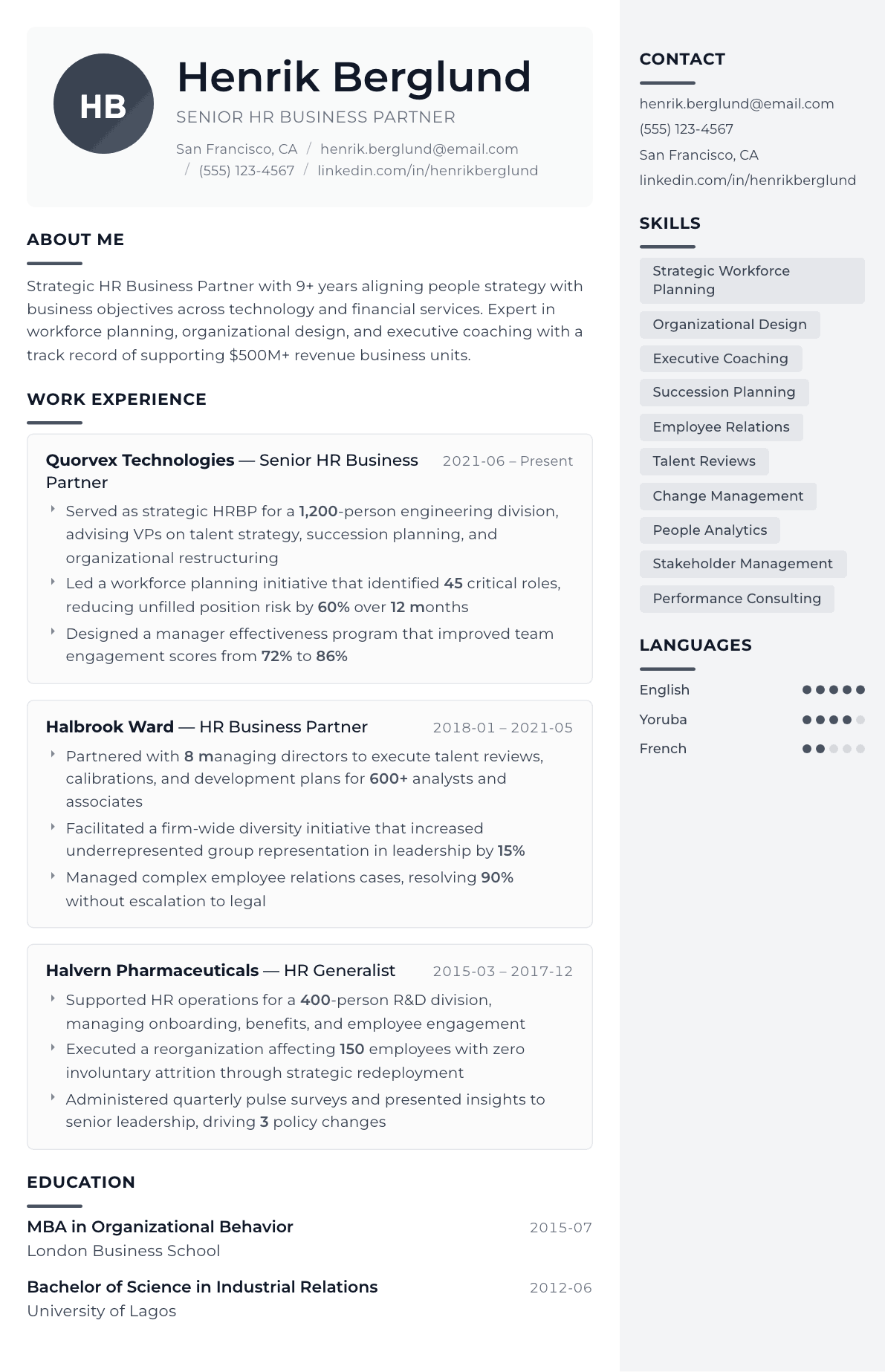
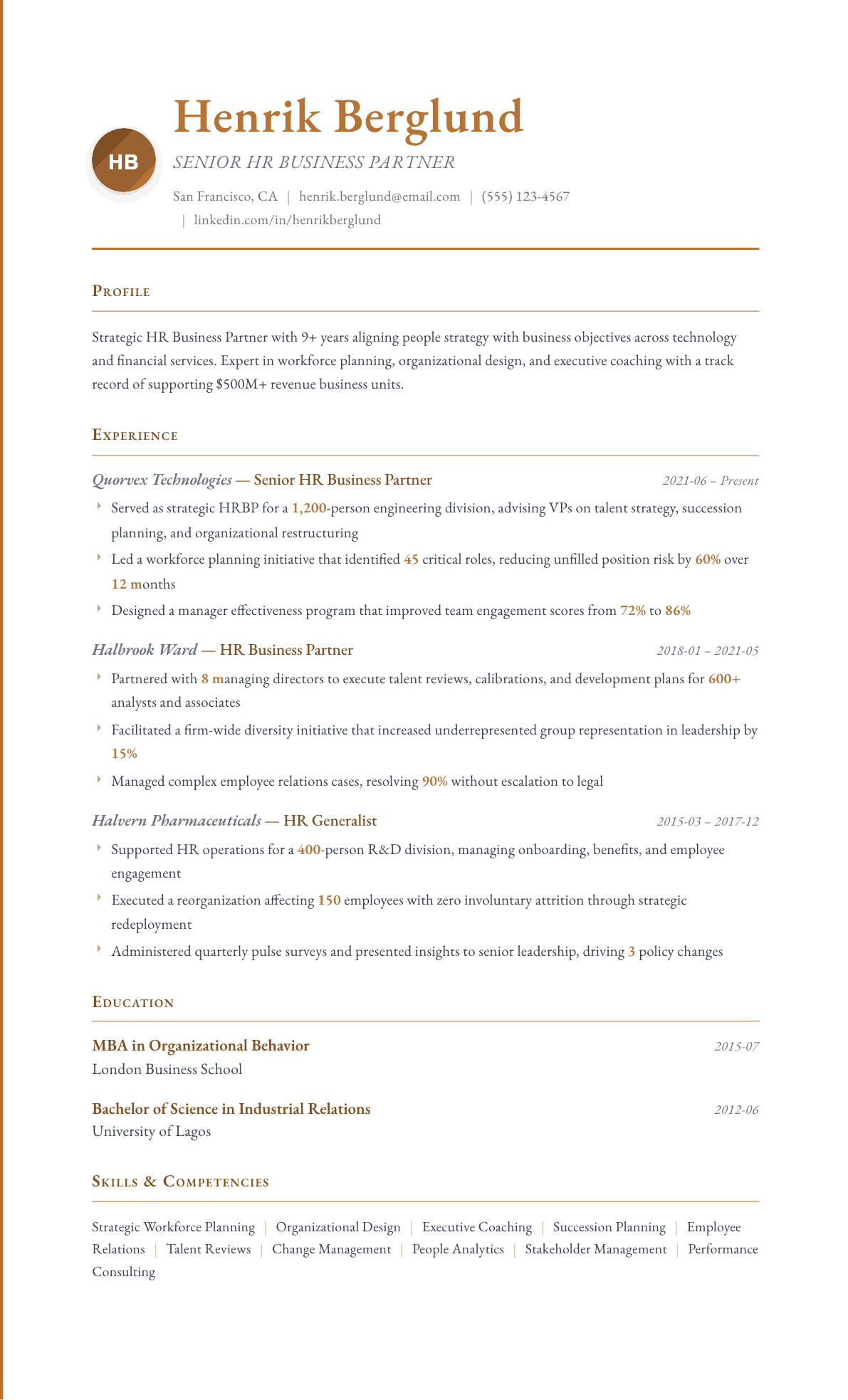
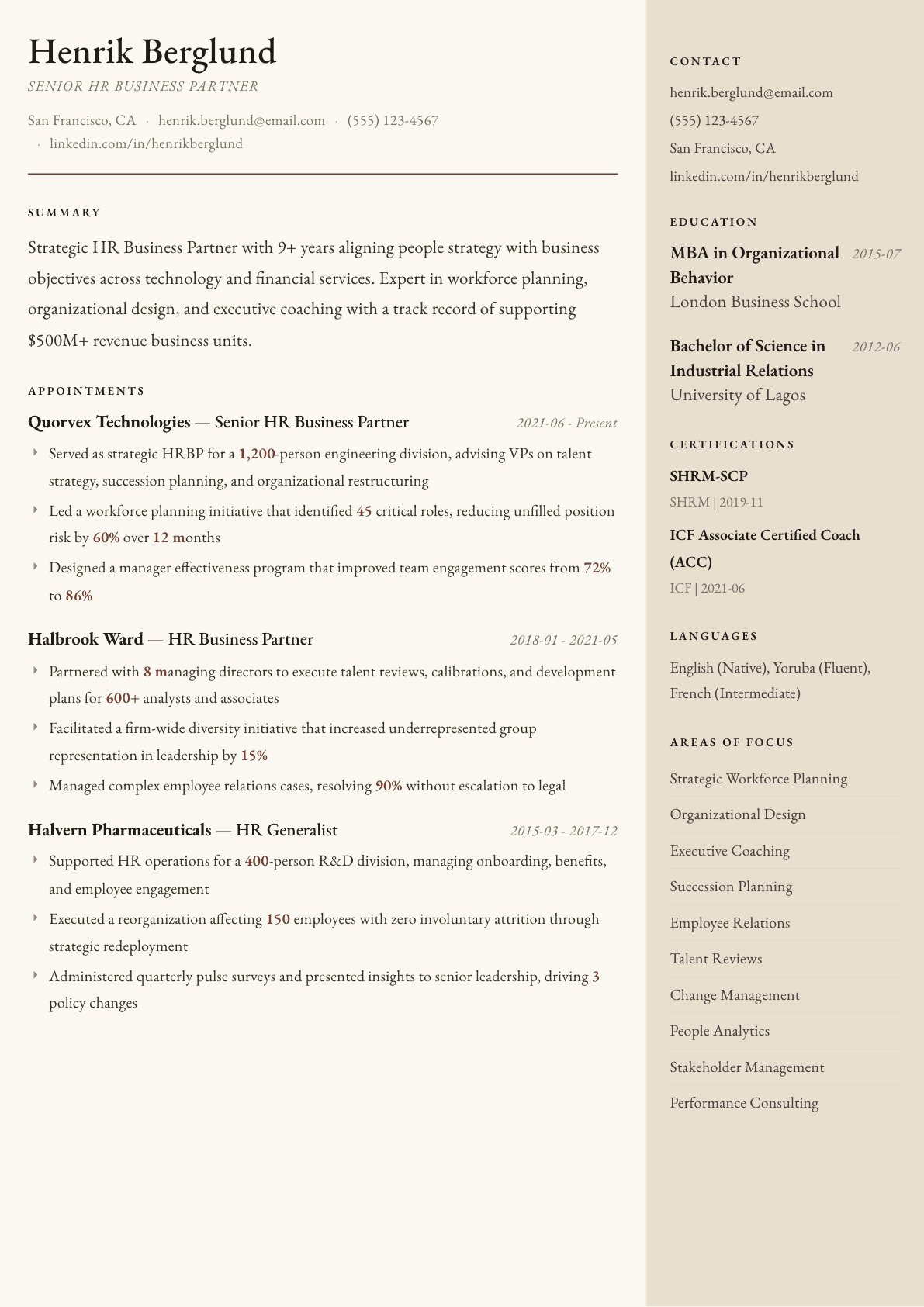
Example HR Business Partner summary
Strategic HRBP with 9 years of experience partnering with C-suite executives to align people strategy with $500M+ business objectives. Expert in workforce planning, organizational design, and executive coaching. Improved engagement scores by 14 points, reduced critical role vacancy risk by 60%, and led diversity initiatives increasing leadership representation by 15%.
Skills to list on a HR Business Partner resume
- Strategic Workforce Planning
- Organizational Design
- Executive Coaching
- Succession Planning
- Employee Relations
- Change Management
- People Analytics
- Talent Review & Calibration
- M&A Integration
- Stakeholder Management
- Diversity & Inclusion
- Performance Consulting
- Labor Relations
- Conflict Resolution
What actually gets this resume read
- Position yourself as a business leader who happens to specialize in people, not just an HR professional. Lead with business outcomes.
- Quantify your impact on business metrics: revenue supported, headcount managed, engagement score improvements, and turnover reductions.
- Highlight experience with organizational design, M&A integration, or restructuring to show strategic depth.
- Showcase executive coaching and leadership advisory relationships with concrete results.
- Demonstrate data fluency by mentioning people analytics tools, dashboards, or insights that drove decisions.
- Include cross-functional collaboration examples that go beyond traditional HR boundaries.
How to write a hr business partner resume
An HR business partner resume is read by a people leader who has watched the title get handed out to coordinators and is therefore suspicious of it. She is looking for one specific thing: proof that a business leader treated you as a peer on decisions about structure, talent and cost, rather than as the person who processed the paperwork after the decision was made.
That proof comes from the client, not the function. Which business you supported, its headcount and revenue scale, which executive you partnered with, what the business was trying to do while you were there, and which decisions you shaped. Supporting a 1,200-person engineering division through a reorganization is a different job from supporting eight managing directors through talent reviews, and the reader wants to know which one you have done.
This guide covers a human resources business partner resume sample written out for one role, how to structure the page around client scope, how to write partnering bullets that show influence rather than support, the metrics a people leader checks, three summaries at different stages, and the mistakes that make a genuine partner read as a generalist.
Format: client scope line under every title
One page under ten years, two after that. Reverse chronological, single column, no rating bars. Under each role, write a client scope line before the bullets: the business or function supported, its headcount, its geography, the level of the leaders you partnered with, and the number of managers in your population. Then the bullets.
Keep the centers of excellence relationship visible too. A business partner who works alongside dedicated talent acquisition, total rewards and learning teams has a different job from one who also delivers those services, and that distinction changes how a hiring manager reads every bullet on the page.
Here is one role from a sample written out for an invented partner, Priya Nair. Title line: Senior HR Business Partner, Halden Logistics, Dallas, TX. Client scope line: Partner to the vice president of operations for a 900-person distribution network across six sites, with 40 people managers, alongside central talent acquisition and rewards teams. Bullet one: Redesigned the site leadership structure from three layers to two, which the operations leadership team adopted ahead of peak season. Bullet two: Ran talent calibration for the 40 managers and built succession cover for every site general manager role. Bullet three: Brought monthly attrition data to the operations review and moved the retention conversation from exit interviews to the two sites driving it.
- Header: name, city and state, phone, email, and a human resources credential if you hold one.
- Order: summary, partnering experience with client scope lines, specialist capability, systems and analytics, education, certifications.
- A short line naming the functions you have supported, such as engineering, sales, manufacturing or corporate, helps because partner roles are usually advertised for a specific client group.
Summary: the client, the leader, the business problem
Three or four lines. The industries and client types you have partnered, the scale of the population, the level of leader you advise, and the two capabilities you are strongest in. Organizational design, workforce planning, talent and succession, employee relations at leadership level, and change through restructuring are the recognizable specialties.
Skip the phrase strategic partner. Every resume for this role uses it and it carries no information. Naming the executive level you advise and a decision you influenced does the same job with evidence attached.
Experience: decisions influenced, not services delivered
Write each bullet from the business outcome backwards. A reorganization is not an HR project; it is a business decision about spans, layers and cost that you shaped. Say what the leader was trying to achieve, what you recommended, and what happened. Organizational design, workforce planning, capability gaps, build against buy decisions on talent, span of control and layer reduction, and location strategy all belong here.
Then talent. Talent review and calibration, succession maps for critical roles, internal fill rate, high potential development, and hiring alongside talent acquisition for the roles the business could not fill. Then leadership: manager effectiveness programs, executive coaching, team effectiveness sessions, and the difficult conversations you handled with senior leaders.
Employee relations at partner level is a real part of the job and worth its own bullets: complex cases involving leaders, performance management for senior people, restructures and reductions handled with counsel, and the escalation judgment you exercised. Add the people analytics you actually used, because partners who bring data to a business review are treated differently from those who bring opinion.
- Organizational work: design and restructuring, span and layer analysis, role clarity, workforce planning, location and capability strategy.
- Talent work: calibration, succession planning, internal mobility, critical role risk, development plans for senior individuals.
- Leadership work: manager capability, executive coaching, team effectiveness, performance conversations at director level and above.
- Analytics: headcount and cost reporting, attrition and regretted attrition analysis, engagement and pulse insight, span and cost modeling.
Proving influence rather than support
The single strongest bullet in this role is one where a leader changed their mind. Show the recommendation, the pushback and the result. A partner who talked a business unit head out of a headcount request by rebuilding the team structure, or who held a promotion at calibration and explained why, is demonstrating exactly the judgment being hired for.
Attach a business number wherever you honestly can: cost of the structure before and after, revenue per head, time to fill a role that was blocking delivery, or attrition in the team the leader was worried about. A partner who speaks the business unit's own measures is credible in a way that engagement scores alone cannot make you.
The measures a people leader checks
Pick the ones that belong to your client group rather than to the human resources function, and give the baseline alongside the result.
- Regretted attrition and attrition in critical roles for the population you supported.
- Internal fill rate and time to fill for the roles the business needed most.
- Engagement and manager effectiveness movement for your client group, with the instrument named.
- Succession coverage for critical roles, and the number of ready-now successors identified.
- Headcount, labor cost and span of control changes delivered through a restructure.
- Employee relations matters resolved without escalation, and the retention outcome after a reorganization.
HR Business Partner resume summary examples
Junior business partner
HR business partner supporting a 400-person research and development division, running onboarding, quarterly pulse surveys and manager coaching for 30 people managers. Executed a reorganization affecting 150 employees with zero involuntary exits by redeploying staff into open roles across two sites.
Nine years in
HR business partner for a 1,200-person engineering division, advising vice presidents on organizational design, succession and workforce planning. Identified 45 critical roles and cut unfilled position risk by 60% in a year, and raised team engagement from 72% to 86% through a manager effectiveness program.
Senior partner to the executive team
Senior HR business partner to a business unit generating substantial revenue, partnering the unit president and eight direct reports on structure, succession and cost. Led a restructure that removed a management layer while retaining every leader identified as critical, and resolved 90% of leadership-level employee relations matters without legal escalation.
Work experience bullets: before and after
Before: Partnered with business leaders on HR matters.
After: Partnered the vice president of engineering and eight direct reports across a 1,200-person division on organizational design, succession planning and workforce planning for a two-year hiring plan.
Naming the leader level, the population and the three decision areas shows the altitude the partnering actually happened at.
Before: Supported a company reorganization.
After: Designed and delivered a restructure across a 1,200-person division that removed one management layer and widened average span of control, redeploying 40 employees into open roles and retaining every leader flagged as critical beforehand.
The structural change, the redeployment and the pre-identified retention list prove you shaped the design rather than administered it.
Before: Helped improve employee engagement in my client group.
After: Raised engagement in a 600-person client group from 72% to 86% over two survey cycles by rebuilding manager one-to-one expectations and requiring each leader to publish one committed action from their results.
A baseline, a result and two named mechanisms make the movement attributable rather than coincidental.
Before: Conducted talent reviews with managers.
After: Ran talent review and calibration with eight managing directors covering 600 analysts and associates, producing succession maps for 45 critical roles and lifting internal fill for senior positions.
The leaders involved, the population reviewed and the succession output show a full process rather than a set of meetings.
Before: Handled employee relations issues for my business unit.
After: Advised directors on complex performance and conduct matters involving senior employees, resolving 90% without escalation to legal and documenting each outcome to a standard counsel could rely on.
Seniority of the matters, the escalation rate and the documentation standard address the risk a people leader is screening for.
Hard skills
- Organizational design and restructuring
- Strategic workforce planning
- Talent review and succession planning
- People analytics and headcount reporting
- Change management
- Performance management at leadership level
- Complex employee relations advisory
- Compensation planning partnership
- Span of control and cost modeling
- Engagement survey action planning
- HRIS reporting and dashboards
- Employment law application
Soft skills
- Influence without authority
- Coaching senior leaders
- Constructive challenge
- Business literacy
- Confidential counsel
- Navigating competing priorities
Certifications worth listing
- SHRM Certified Professional (SHRM-CP) (Society for Human Resource Management)
- SHRM Senior Certified Professional (SHRM-SCP) (Society for Human Resource Management)
- Professional in Human Resources (PHR) (HR Certification Institute)
- Senior Professional in Human Resources (SPHR) (HR Certification Institute)
- Certified Professional in Talent Development (CPTD) (Association for Talent Development)
Mistakes that cost hr business partner candidates the interview
- Using the phrase strategic partner without a single example of a business decision you changed.
- Leaving out the client group, its headcount and the level of leader you advised, which is how these roles are matched.
- Filling the page with transactional work such as onboarding administration and policy questions, which reads as a generalist seat.
- Quoting only human resources measures. A partner is judged on the business unit's attrition, fill rate and cost, not on program counts.
- Describing a restructure as support when you designed the spans, layers and selection criteria.
- Omitting the analytics. A partner who never brings data to a business review has a weaker case than one who does.
HR Business Partner resume questions
How is an HR business partner resume different from a generalist resume?
A generalist resume is organized around services delivered, while a partner resume is organized around a client group and the decisions you influenced within it. Lead with the business supported, its size, the leaders you advised and the structural or talent outcomes you helped produce.
What if my title says generalist but I do partner work?
Keep the official title for accuracy and add a client scope line underneath describing the population and leaders you support. Then order your bullets so organizational, talent and leadership work comes first and administrative work is compressed into a single line.
Should I name the executives I partnered with?
Name the level, never the person. Vice president of engineering, unit president or eight managing directors tells the reader exactly what she needs while keeping the resume professional and avoiding any implication that you are trading on someone else's name.
What should a human resources business partner resume sample show?
A client scope line under every title, then bullets about decisions you shaped in organization design, talent and leadership, each with a business measure where you honestly have one. The sample role on this page shows the pattern: the leader you partnered, the population, the structural change and the data you brought.
Do I need a human resources certification for a business partner role?
It is not usually decisive, but it helps in competitive processes and some employers screen on it. The senior level credential from either of the two main human resources certifying bodies is the recognized signal once you are advising directors and above.
Related resume examples
- HR Manager Resume example
- Organizational Development Consultant Resume example
- Chief People Officer Resume example
- HR Director Resume example
- Chief Human Resources Officer Resume example
- Talent Development Manager Resume example