Human Resources Resume Examples: the lines they read
Build a Human Resources Manager Resume That Attracts the Right Offer
By Mustafa Tarabya, founder of CVBooster · Published · Updated
Create a professional human resources resume with talent acquisition metrics, compliance expertise, and people strategy highlights.
Sample resumes for a human resources
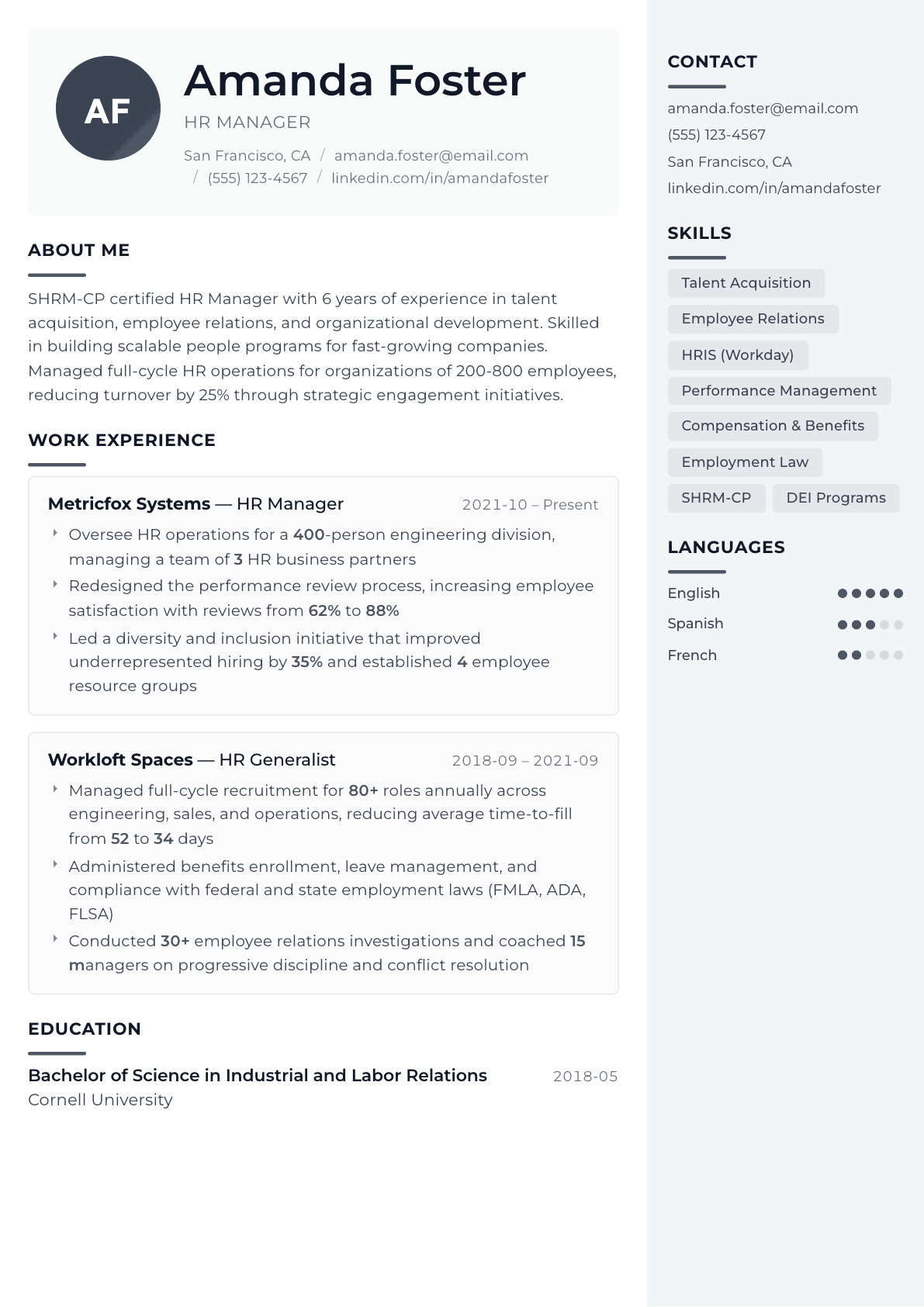
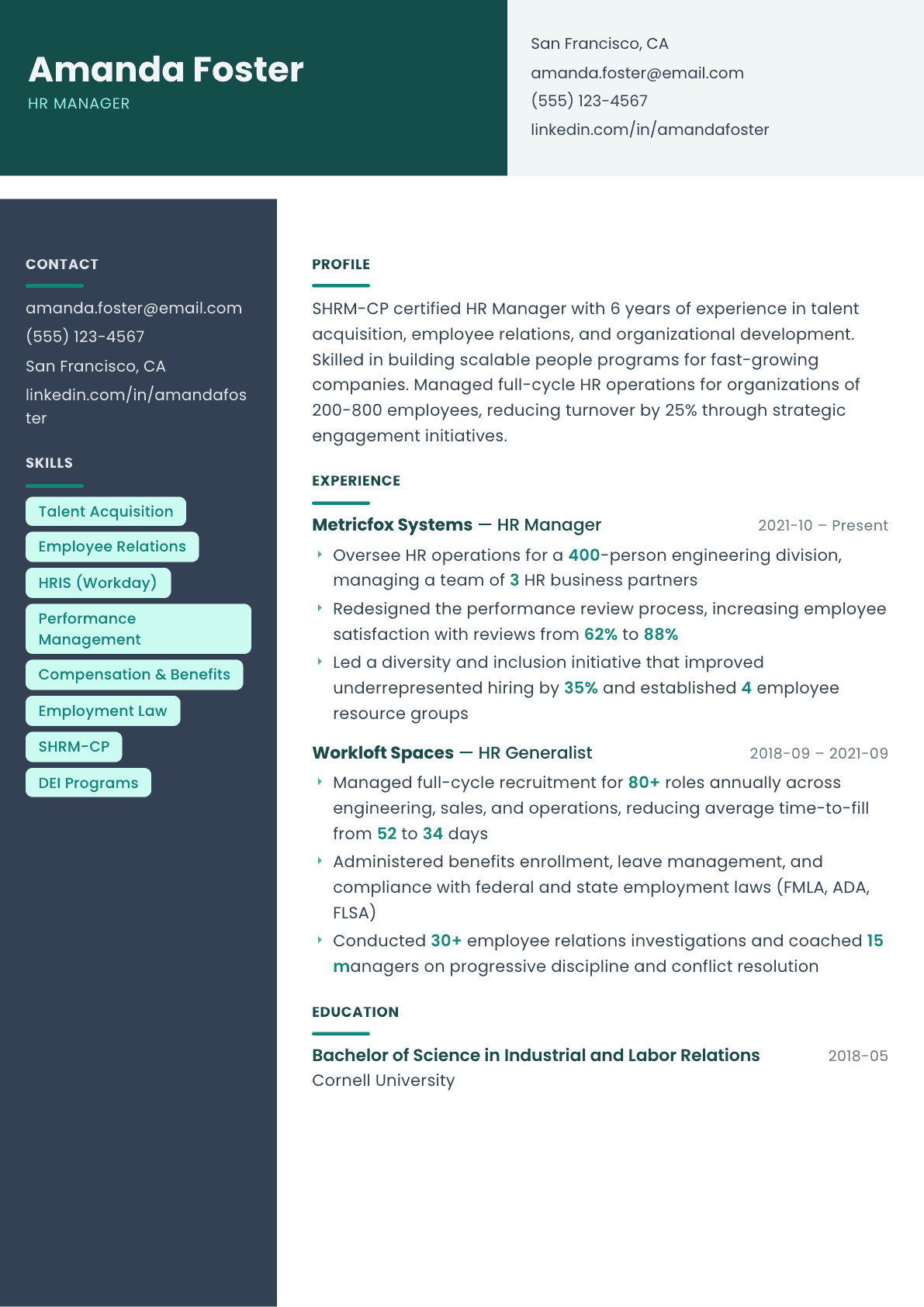
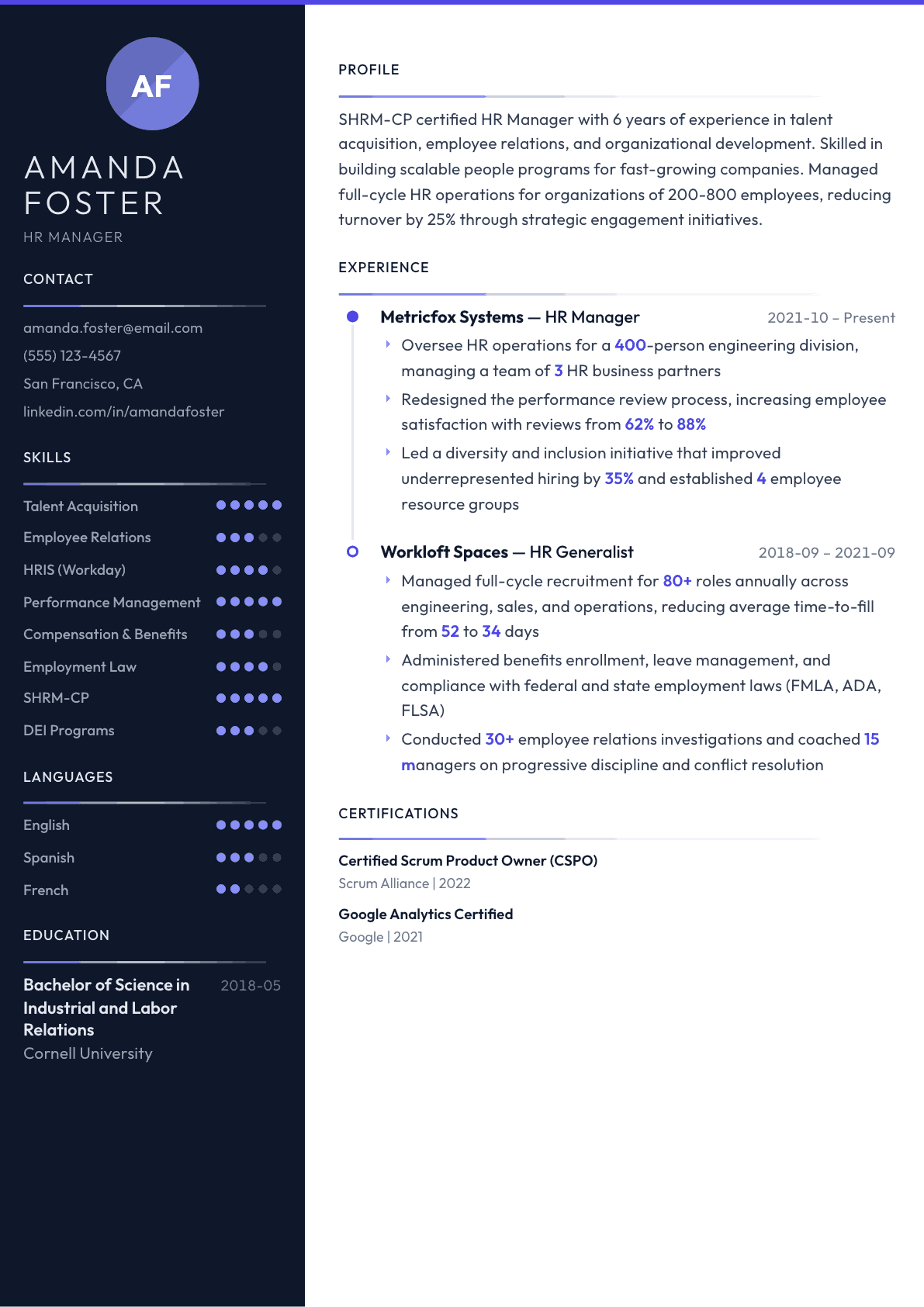
The same human resources content laid out in three CVBooster templates, so you can see what the finished document looks like before you write a word.
Example Human Resources summary
SHRM-CP certified HR manager, 6 years, currently covering a 400-person engineering division with three HR business partners reporting in. Cut time to fill from 52 days to 34 as a generalist, rebuilt performance reviews to take satisfaction from 62% to 88%, and has run more than 30 employee relations investigations.
Skills to list on a Human Resources resume
- Talent Acquisition
- Employee Relations
- HRIS (Workday)
- Performance Management
- Compensation & Benefits
- Employment Law Compliance
- DEI Programs
- Onboarding
- Training & Development
- Change Management
- Conflict Resolution
- Payroll Administration
- ATS (Greenhouse / Lever)
- Organizational Development
- SHRM-CP / PHR
What actually gets this resume read
- Quantify recruiting metrics: time-to-fill, cost-per-hire, offer acceptance rate, or retention improvements.
- List HRIS and ATS platforms by name: Workday, BambooHR, ADP, Greenhouse, Lever, or SuccessFactors.
- Highlight compliance knowledge: FMLA, ADA, FLSA, EEO, OSHA, or state-specific regulations.
- Showcase both strategic (people strategy, org design, change management) and tactical (payroll, benefits, investigations) capabilities.
- Include certifications prominently: SHRM-CP, SHRM-SCP, PHR, or SPHR.
- Demonstrate business partnership by describing how your HR programs impacted business outcomes like revenue, productivity, or retention.
How to write a human resources resume
Human resources is a wide field and a generic human resources resume is the single most common reason a strong candidate gets passed over. The person reading it needs to place you on two axes within about fifteen seconds: which part of the lifecycle you work in, and at what altitude. Recruiting, employee relations, total rewards, HR operations and organizational development are separate crafts, and an HR file that covers all of them evenly reads as someone who has done none of them deeply.
The second thing the reader checks is whether you are strategic, tactical, or honestly both. Most HR jobs need both, but they need them in a stated ratio. Payroll, benefits enrollment and investigations are tactical and prove you can run the function. People strategy, org design and change management are strategic and prove you can be trusted near the leadership table. Show both, and make clear which one you were hired for.
What follows is the section order that works for a generalist HR file, three summaries at different altitudes, five before-and-after bullets, the credentials worth listing, and the questions HR professionals ask when a broad career has to fit on two pages.
Format: pick a lane in the title line, then keep the file consistent
Put a target title directly under your name that matches the posting: HR Generalist, HR Business Partner, People Operations Manager, HR Manager. A resume headed only with your name forces the reader to guess, and a guess in a stack of applications usually goes against you.
Two pages once you have several years, reverse chronological, single column, no icons. Follow the title line with a competencies block of eight to twelve terms drawn from the posting, then experience, then education and certifications. Keep the same emphasis all the way down: if the title line says business partner, the bullets cannot be dominated by benefits enrollment administration.
- Header: name, target title, credentials such as SHRM-CP or PHR, city and state, phone, email.
- Competencies block: mirror the posting language, including compliance statutes and platform names.
- Each job gets a scope line: headcount supported, business area, direct reports, and multi-state or multi-site coverage.
Summary: the population you support and the programs you own
The strongest HR summaries name the size and shape of the employee population, the parts of the lifecycle owned, and one program built rather than maintained. A summary that promises passion for people and a collaborative approach is invisible, because every competing file makes the same promise in the same words.
If your background is broad, use the summary to impose an order on it. Say which two areas are your depth and which ones you have covered, so the reader is not left to infer. Recruiters read the summary specifically to decide which pile the resume belongs in.
Experience: compliance in one lane, programs in another
Give compliance its own bullet in every relevant role. Name the statutes you administered, FMLA leave cases, ADA interactive processes, FLSA classification, EEO reporting, OSHA recordkeeping where it applied, plus any state rules that governed your workforce. Multi-state coverage is worth stating plainly, since it changes the difficulty of the job and many employers screen for it.
Then the programs. Onboarding redesigns, performance cycles, DEI initiatives, engagement survey action planning, compensation reviews, training rollouts. For each, write what existed before, what you built, and what moved. Programs described without a before state read as job description text rather than as work you did.
Payroll and benefits administration belong in the tactical bullet, and they should stay there. They are necessary credibility for a generalist and they are not what earns an interview for a business partner role, so keep them factual and short: payroll cycles run, headcount covered, broker and carrier relationships managed, open enrollment populations.
Systems: name the HRIS and the ATS by product
HR technology names are the highest-value keywords in this field because they are unambiguous. Workday, BambooHR, ADP, SuccessFactors, Greenhouse, Lever and UKG are all searchable strings that a recruiter will filter on. Categories such as HR software and applicant tracking tools are not.
Go one level past the product name and say what you did in it. Running reports is different from configuring a business process, and posting a requisition is different from designing a structured interview kit inside the ATS. That one extra clause is often what moves a file from the maybe pile.
- HRIS with the modules and the transactions you personally processed.
- ATS with the requisition volume and whether you built scorecards or interview kits.
- Reporting: headcount, attrition, and compensation reports you produced and who consumed them.
- Payroll platform and cycle frequency if you have run or approved payroll.
Credentials and the vocabulary the screener searches
SHRM-CP, SHRM-SCP, PHR and SPHR are the credentials this field recognizes without explanation, and they are worth placing in the header rather than at the end. Specialist credentials in compensation or benefits are worth listing when the role touches total rewards, since they distinguish you in a market where most files show none.
For keywords, take them from the posting itself rather than from a generic list: talent acquisition, employee relations, performance management, compensation and benefits, employment law compliance, DEI programs, onboarding, training and development, change management, conflict resolution and organizational development. Use each once in the competencies block and prove the important ones inside a bullet.
Human resources manager resume example, start to finish
Human resources manager resumes are read for scope first: how many employees you support, who reports to you and which programs you own. Here is a complete example for an HR manager at a single site. The person and companies are invented; the order is what to copy.
Summary: Teresa Nguyen, SHRM-CP, Human Resources Manager. Manages HR for about six hundred employees at a manufacturing site with two direct reports, owning employee relations, recruiting, leave administration and compliance, and works with plant leaders on staffing and retention.
- Current role, Human Resources Manager, Corwin Manufacturing, four years: lead a team of two HR generalists for a three shift plant and its office staff.
- Investigate employee relations cases, write the findings and advise managers on discipline and documentation.
- Rebuilt hourly recruiting with the operations managers, holding interviews in the same week as the application and filling night shift openings faster.
- Administer FMLA leave, ADA accommodations and workers compensation cases with the benefits broker and the safety manager.
- Moved personnel files, onboarding and time off requests into one HRIS and trained every supervisor to use it.
- Previous role, HR Generalist, Pinecrest Health, three years: recruiting, onboarding and benefits enrollment for clinical and office staff.
- Credentials and education: SHRM-CP; BA in Psychology.
Human Resources resume summary examples
HR generalist, early career
HR Generalist with 2 years supporting a 300-person retail employer across onboarding, benefits enrollment, leave administration and biweekly payroll input. Runs FMLA cases end to end, maintains records in BambooHR, and completed the SHRM-CP credential this year.
Six years in
SHRM-CP certified HR Manager with 6 years building people programs for companies between 200 and 800 employees. Owns talent acquisition, employee relations and organizational development, and cut voluntary turnover by 25% through a redesigned engagement and onboarding program.
HR leader
Human resources leader with 14 years across technology and manufacturing, currently supporting 1,900 employees in six states with a team of five. Owns compensation planning, employee relations, workforce planning and DEI, and led the people integration of two acquisitions. SHRM-SCP certified.
Work experience bullets: before and after
Before: Handled all HR functions for the company.
After: Ran the full HR function for a 300-person employer across three states: recruiting, onboarding, benefits, leave administration, payroll input and employee relations, as the only HR professional on site.
Listing the actual scope and the fact that you were solo turns a vague claim into a picture of the workload you carried.
Before: Improved employee engagement.
After: Ran the annual engagement survey, built action plans with eight department leaders, and lifted the manager support score from 62% to 88% over two cycles by adding monthly one-to-one training.
Naming the mechanism and the two measured cycles makes an engagement claim something the interviewer can probe.
Before: Worked on diversity and inclusion.
After: Led a diversity and inclusion initiative that raised underrepresented hiring by 35%, launched four employee resource groups with executive sponsors, and added structured interview scorecards across all technical requisitions.
Programs with named artifacts and sponsorship read as durable work rather than a one-time campaign.
Before: Ensured compliance with labor laws.
After: Administered FMLA, ADA and state leave programs across three states, completed an FLSA classification review covering 40 job titles, and filed EEO-1 reporting without a correction in four consecutive cycles.
Named statutes, a scoped review and a clean filing record replace an unverifiable compliance assurance.
Before: Managed recruiting for open positions.
After: Owned full-cycle recruiting for 45 requisitions a year in Greenhouse, built structured interview kits for the five most-hired roles, and held an average time to fill of 32 days without agency support.
Requisition volume, the platform and the no-agency detail show a recruiting load an employer can price.
Hard skills
- Talent acquisition and full-cycle recruiting
- Employee relations and investigations
- HRIS administration (Workday, BambooHR, ADP)
- Applicant tracking systems (Greenhouse, Lever)
- Performance management
- Compensation and benefits administration
- Employment law compliance (FMLA, ADA, FLSA, EEO)
- Onboarding program design
- DEI program development
- Payroll administration
- Training and development
- HR reporting and workforce analytics
Soft skills
- Conflict resolution
- Coaching managers
- Confidential judgment
- Cross-functional influence
- Clear written communication
- Prioritization across competing requests
Certifications worth listing
- SHRM Certified Professional (SHRM-CP) (Society for Human Resource Management)
- SHRM Senior Certified Professional (SHRM-SCP) (Society for Human Resource Management)
- Professional in Human Resources (PHR) (HR Certification Institute)
- Senior Professional in Human Resources (SPHR) (HR Certification Institute)
- Certified Employee Benefit Specialist (CEBS) (International Foundation of Employee Benefit Plans)
- Certified Compensation Professional (CCP) (WorldatWork)
Mistakes that cost human resources candidates the interview
- Leaving the target title off the header, so the reader cannot tell whether you want a generalist, business partner or operations seat.
- Covering every HR discipline at equal depth, which reads as breadth without mastery in any of them.
- Writing about compliance in the abstract instead of naming the statutes and the cases you actually administered.
- Listing HR software generically rather than naming the HRIS and the ATS, which are the fields recruiters search on.
- Describing programs with no before state, so the reader cannot tell what you changed.
- Putting the SHRM or HRCI credential on the last line of page two where a fast screen never reaches it.
Human Resources resume questions
What should human resources manager resumes include?
A summary naming the employee population, your team size and the programs you own, then experience bullets for employee relations, recruiting, compliance and HR systems, each tied to a result. Certifications such as SHRM-CP or PHR go near the top. The complete human resources manager resume example on this page shows the order.
How do I keep a broad human resources career from looking unfocused?
Choose a target title, put it under your name, and order every bullet so the areas closest to that title come first in each job. Keep the other disciplines present but brief. Depth in two areas plus coverage elsewhere reads far stronger than equal weight everywhere.
Which HR certification is worth the most?
The one that matches your level. SHRM-CP or PHR fits early and mid-career generalists, SHRM-SCP or SPHR fits managers and above. Specialist credentials in compensation or benefits matter when the job is weighted toward total rewards.
How do I show HR impact without access to company financials?
Use the people metrics you do own: voluntary turnover with a baseline, time to fill, offer acceptance, internal promotion rate, leave case volume, and survey score movement. These are the numbers HR leadership reviews, and they are more credible than a revenue claim you cannot defend.
Is a two-page human resources resume acceptable?
Two pages is standard after roughly five years, because the scope lines, compliance detail and program history do not compress well. Keep the first half of page one carrying the strongest material, since that is the part most screens actually read.
Related resume examples
- Project Manager Resume example
- Accountant Resume example
- Customer Service Resume example
- Leave Administrator Resume example
- HR Generalist Resume example
- HR Director Resume example