Employee Relations Specialist Resume Examples: free score
Create an Employee Relations Specialist Resume That Gets Results
By Mustafa Tarabya, founder of CVBooster · Published · Updated
Build a standout Employee Relations Specialist resume highlighting conflict resolution expertise, investigation skills, and workplace policy development.
Sample resumes for a employee relations specialist
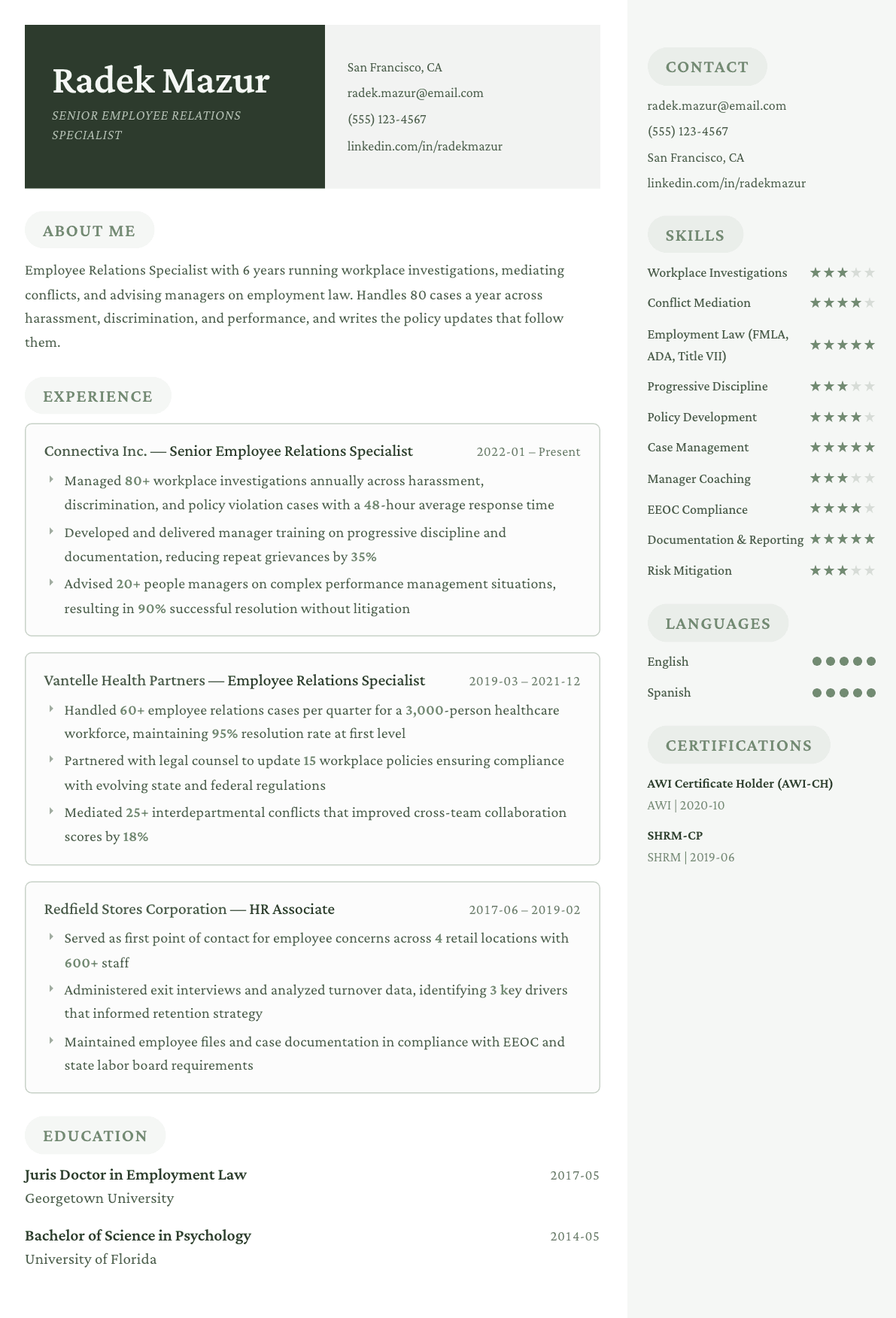
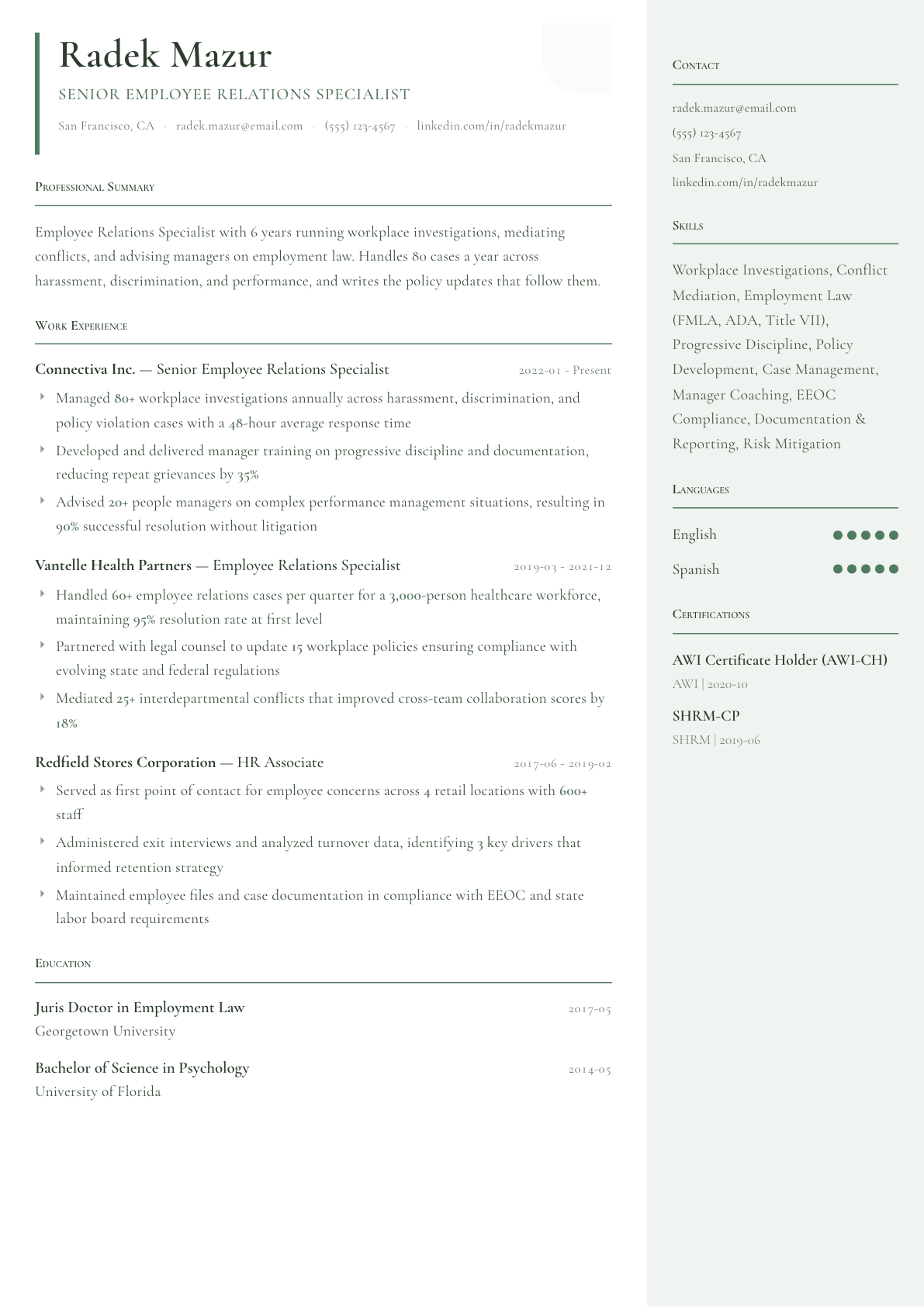
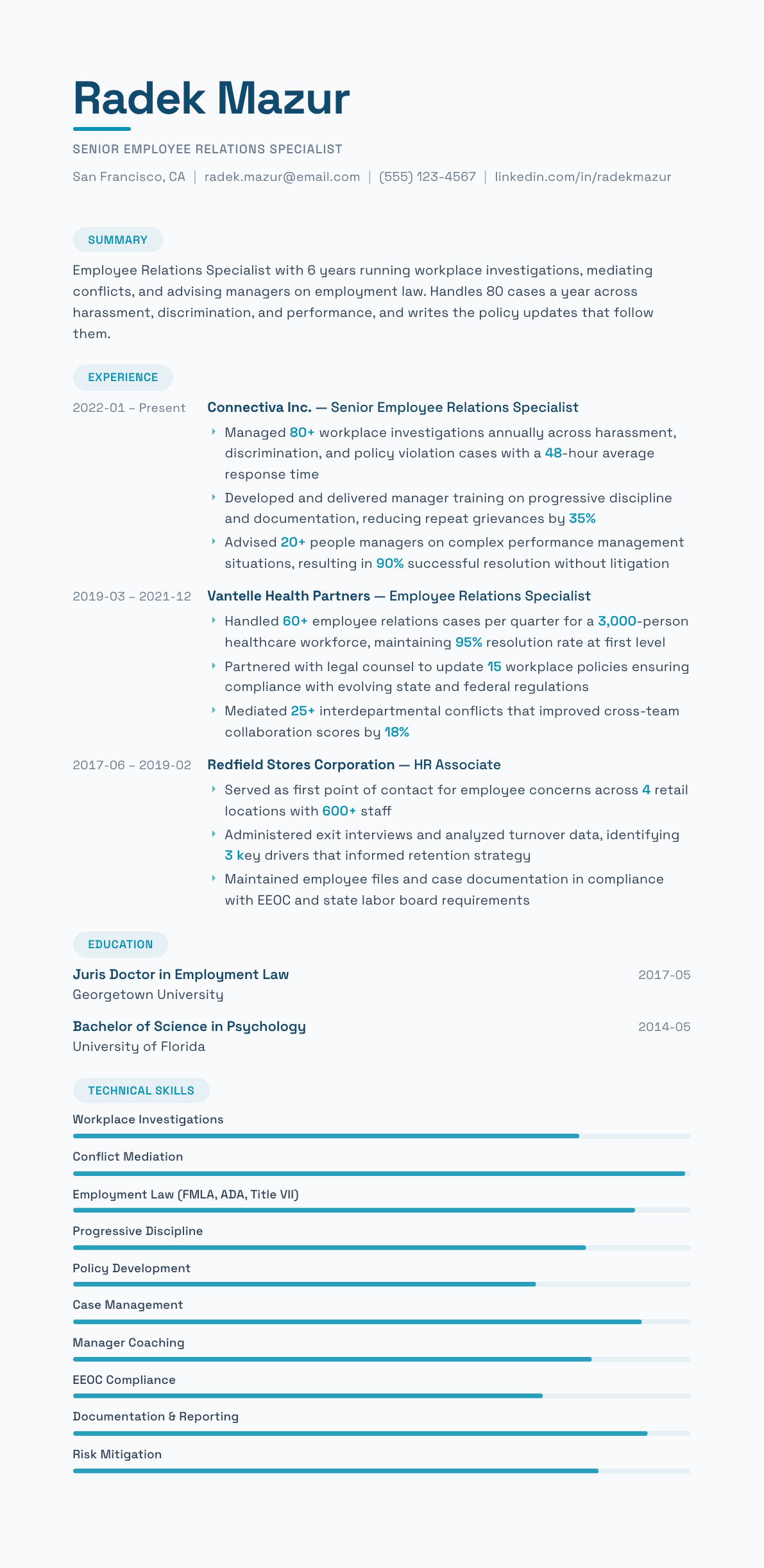
The same employee relations specialist content laid out in three CVBooster templates, so you can see what the finished document looks like before you write a word.
Example Employee Relations Specialist summary
Employee Relations Specialist handling 80 investigations a year at a 95% first-level resolution rate, with a JD in employment law behind the case work. Cut repeat grievances 35% through manager training on discipline and documentation. Looking for a senior ER role.
Skills to list on a Employee Relations Specialist resume
- Workplace Investigations
- Conflict Mediation
- Employment Law Compliance
- Progressive Discipline
- Policy Development
- Case Management
- Risk Mitigation
- Manager Coaching
- EEOC & Title VII
- ADA & FMLA
- Documentation
- Grievance Resolution
- Exit Interviews
- Labor Relations
What actually gets this resume read
- Highlight the volume and complexity of investigations managed, including resolution rates and average response times.
- Demonstrate knowledge of employment law (FMLA, ADA, Title VII, EEOC) and policy development experience.
- Showcase mediation and conflict resolution outcomes with measurable improvements in workplace climate.
- Include training delivery experience, especially manager coaching on discipline, documentation, and compliance.
- Emphasize confidentiality, impartiality, and attention to detail as core professional attributes.
How to write a employee relations specialist resume
An employee relations specialist resume is read by an employee relations lead, an HR director or in-house employment counsel, and their first concern is risk. They want a person whose investigations hold up when a lawyer reads the file, whose write-ups do not create the evidence that loses a case, and whose judgment about when to escalate is sound. Warmth is assumed. Documentation discipline is what gets screened.
That makes case work the center of this resume. Volume and mix of matters, the populations you supported, whether you were the intake point or the investigator, whether you wrote the findings and who they went to, how you worked with counsel, and how the outcomes landed. A specialist handling attendance and performance coaching in a retail workforce and one running harassment investigations for a corporate population report to different concerns even under the same title.
Below is the section order these readers use, how to describe investigations without disclosing anything you should not, the case metrics worth quoting, three summaries at different stages, and the mistakes that make a competent specialist look like an administrator.
Format: one page, population and case profile under every role
One page for most careers in this field, two once you have run a case team or covered multiple business units. Reverse chronological, plain and single column. Employee relations work is judged on precision, so a document with inconsistent formatting undercuts the claim before anyone reads a bullet.
Under each employer, write a population and case profile: employee count supported, workforce type, sites and states, whether the population was unionized, the case volume you carried and the mix of matter types. That line is what an employee relations lead uses to decide whether your experience matches her caseload.
- Header: name, city and state, phone, email, and any human resources or investigation credential you hold.
- Order: summary, employee relations experience with case profiles, employment law and policy work, systems, education, certifications.
- Anyone who has supported a unionized workforce should say so explicitly, because grievance and contract experience is a separate skill set that hiring managers look for by name.
Summary: caseload, matter types, and who you advised
Three lines. The population supported, the annual case volume, the matter types you handle, and who you advise. Advising managers is a different job from advising executives, and advising alongside counsel is different again, so be specific about the altitude you have worked at.
If you are moving in from a generalist seat, name the case work you already do: intake, fact-finding, disciplinary review, performance management coaching, accommodation conversations, terminations and exit documentation.
Experience: case work written the way counsel reads it
Structure each job around the case lifecycle. Intake and triage against a risk framework, planning the investigation, interviewing complainants, respondents and witnesses, collecting and preserving evidence, weighing credibility, writing findings against policy, recommending outcomes, and closing with the complainant. A specialist who describes that sequence is instantly recognizable as one who has run real matters.
Then advisory work. Coaching managers through progressive discipline and documentation, performance improvement plans that were written to survive review, accommodation and leave conversations, restructures and position eliminations, and the escalation calls where you told a leader no. Add the volume of managers you support and the businesses you cover.
Then the systems work that keeps a function healthy: case management tooling, trend analysis by manager or location, policy rewrites, manager training built from case themes, and the reporting you produced for leadership. Employee relations that only reacts is a cost; employee relations that feeds patterns back into training and policy is the version hiring managers want.
- Matter types: harassment and discrimination allegations, retaliation, policy violations, performance and attendance, workplace conduct, threats and safety, whistleblower and ethics referrals.
- Process: intake and triage, investigation planning, interviewing, evidence handling, credibility assessment, findings memoranda, outcome recommendation.
- Advisory: progressive discipline, performance improvement plans, accommodation dialogue, leave interaction, separations and severance conversations, restructure support.
- Systems: case management platforms, trend reporting, policy and handbook updates, manager training built from case data.
Employment law fluency without practicing law
Name the statutes you work under by the acronyms your market uses, because those are literal keyword matches: discrimination and harassment law, disability and accommodation obligations, protected leave, wage and hour rules, and the labor relations framework if the workforce is organized. Add the state specific requirements you have handled, since state law drives much of the practical work.
Be careful to write as a practitioner, not as a lawyer. The credible framing is applying policy and process under counsel guidance, escalating on defined triggers and preparing files that counsel can use. A resume that claims legal determinations invites a question you cannot answer well in the interview.
The case metrics an employee relations lead checks
This role has better numbers available than almost any other human resources specialty, and most candidates use none of them. Quote volume, cycle time and quality.
- Cases handled per year and the mix by matter type and severity tier.
- Time from intake to acknowledgment, and average days from intake to closure by tier.
- Share of matters closed at the first level without escalation to counsel or to a formal complaint.
- Findings sustained on review, and matters that proceeded to an agency charge or litigation with the outcome where you may state it.
- Managers coached and trained, and the change in repeat matters from the same manager or location.
- Policies rewritten and handbook updates delivered, with the trigger from case data.
Employee Relations Specialist resume summary examples
Employee relations coordinator
Employee relations coordinator supporting 600 staff across four retail locations, serving as first point of contact for concerns, documenting intake and preparing case files for the specialist team. Ran exit interviews and turnover analysis that identified three drivers behind a 40% first-year attrition rate.
Six years in
Employee relations specialist carrying 80 investigations a year across harassment, discrimination and policy violation matters for a 3,000-person healthcare workforce. Acknowledges every intake within 48 hours, resolves 95% of matters at the first level, and coaches 20 people managers through documentation and progressive discipline.
Senior employee relations partner
Senior employee relations partner advising directors and executives on high-risk matters, leading investigations involving senior leaders alongside in-house counsel. Rebuilt the intake and triage framework, cut average time to closure by 30%, and turned case trend analysis into a manager training program that reduced repeat grievances.
Work experience bullets: before and after
Before: Conducted workplace investigations into employee complaints.
After: Carried 80 investigations a year across harassment, discrimination, retaliation and policy violation matters for a 3,000-person workforce, planning each investigation, interviewing all parties and writing findings against policy.
Volume, matter mix, population and the stages you personally performed show what kind of caseload you can absorb.
Before: Advised managers on employee issues.
After: Coached 20 people managers through progressive discipline, documentation and performance improvement plans, taking 90% of matters to resolution without a formal complaint or legal escalation.
Naming the advisory subject matter and the escalation rate proves the coaching actually reduced risk.
Before: Updated company policies to stay compliant.
After: Rewrote 15 workplace policies with in-house counsel after a case trend review, then delivered the changes through manager briefings and a handbook release with acknowledgment tracking.
Linking the rewrite to case evidence and to a rollout shows a closed loop rather than a document edit.
Before: Resolved conflicts between employees and departments.
After: Mediated 25 interpersonal and cross-team conflicts using a structured facilitation format with written agreements, and followed up at 30 and 90 days to confirm the arrangements held.
A named method and a follow-up interval separate real mediation from a series of conversations.
Before: Maintained employee relations records and documentation.
After: Maintained case files in a case management system with a consistent evidence and retention standard, producing quarterly trend reporting by location and manager that fed the following year's training plan.
Documentation discipline plus a downstream use of the data is what an employee relations lead is screening for.
Hard skills
- Workplace investigations
- Investigative interviewing
- Findings memoranda and documentation
- Intake and risk triage
- Progressive discipline advisory
- Performance improvement plan design
- Accommodation and leave interaction
- Policy and handbook development
- Grievance and collective agreement handling
- Case management systems
- Case trend analysis and reporting
- Separation and severance process
Soft skills
- Neutrality under pressure
- Credibility assessment
- Confidentiality
- Difficult conversations with senior leaders
- Active listening in interviews
- Written precision
Certifications worth listing
- Professional in Human Resources (PHR) (HR Certification Institute)
- Senior Professional in Human Resources (SPHR) (HR Certification Institute)
- SHRM Certified Professional (SHRM-CP) (Society for Human Resource Management)
- AWI-CH Certificate in Workplace Investigations (Association of Workplace Investigators)
Mistakes that cost employee relations specialist candidates the interview
- Leaving out case volume and matter mix, which are the two numbers that size an employee relations job.
- Describing yourself as an employee advocate or a company defender. The credible position is neutral fact-finder who applies policy consistently.
- Naming individuals, departments or identifiable details from real cases, which signals poor confidentiality judgment immediately.
- Claiming legal determinations rather than describing process applied under counsel guidance.
- Skipping the manager coaching work, when reducing repeat matters is where a specialist creates the most value.
- Offering no cycle time or escalation figures in a role that is measured on both.
Employee Relations Specialist resume questions
How do I describe investigations without breaching confidentiality?
Describe the category, the process and the volume, never the facts. Matter type, who you interviewed by role rather than by name, the evidence handling standard, the findings format and the escalation path all demonstrate skill while keeping every real case unidentifiable.
Should I list the employment laws I work with?
Yes, by the acronyms used in your market, and add the state specific requirements you have handled. Frame it as applying the requirements in practice under counsel guidance rather than as giving legal advice, which is a distinction hiring managers listen for.
How many cases should I say I handle?
Give an annual or quarterly figure and break it by severity or matter type, because a hundred attendance matters and twenty harassment investigations represent very different workloads. If your volume was low but the matters were complex, say that instead of inflating the count.
What if my background is generalist rather than dedicated employee relations?
Extract the case work into its own block: intakes taken, investigations run, disciplinary matters advised, terminations supported, accommodations handled. Then add the population you covered and the counsel relationship, which are the two things a dedicated employee relations team screens for.
Does union experience belong on an employee relations resume?
Yes, and it should be visible. Grievance handling, contract interpretation, discipline under a collective agreement and arbitration preparation are distinct skills, and hiring managers at organized employers filter specifically for candidates who have done them.
Related resume examples
- HR Manager Resume example
- HR Business Partner Resume example
- Diversity & Inclusion Manager Resume example
- HR Generalist Resume example
- Human Resources Resume example
- Labor Relations Specialist Resume example