Loan Officer Resume Examples: free ATS score and gap list
Write a Loan Officer Resume That Shows Volume and Compliance
By Mustafa Tarabya, founder of CVBooster · Published · Updated
Loan officer resume examples with production bullets, NMLS licensing detail, underwriting keywords and a guide to what bank hiring managers check first.
Sample resumes for a loan officer
The same loan officer content laid out in three CVBooster templates, so you can see what the finished document looks like before you write a word.
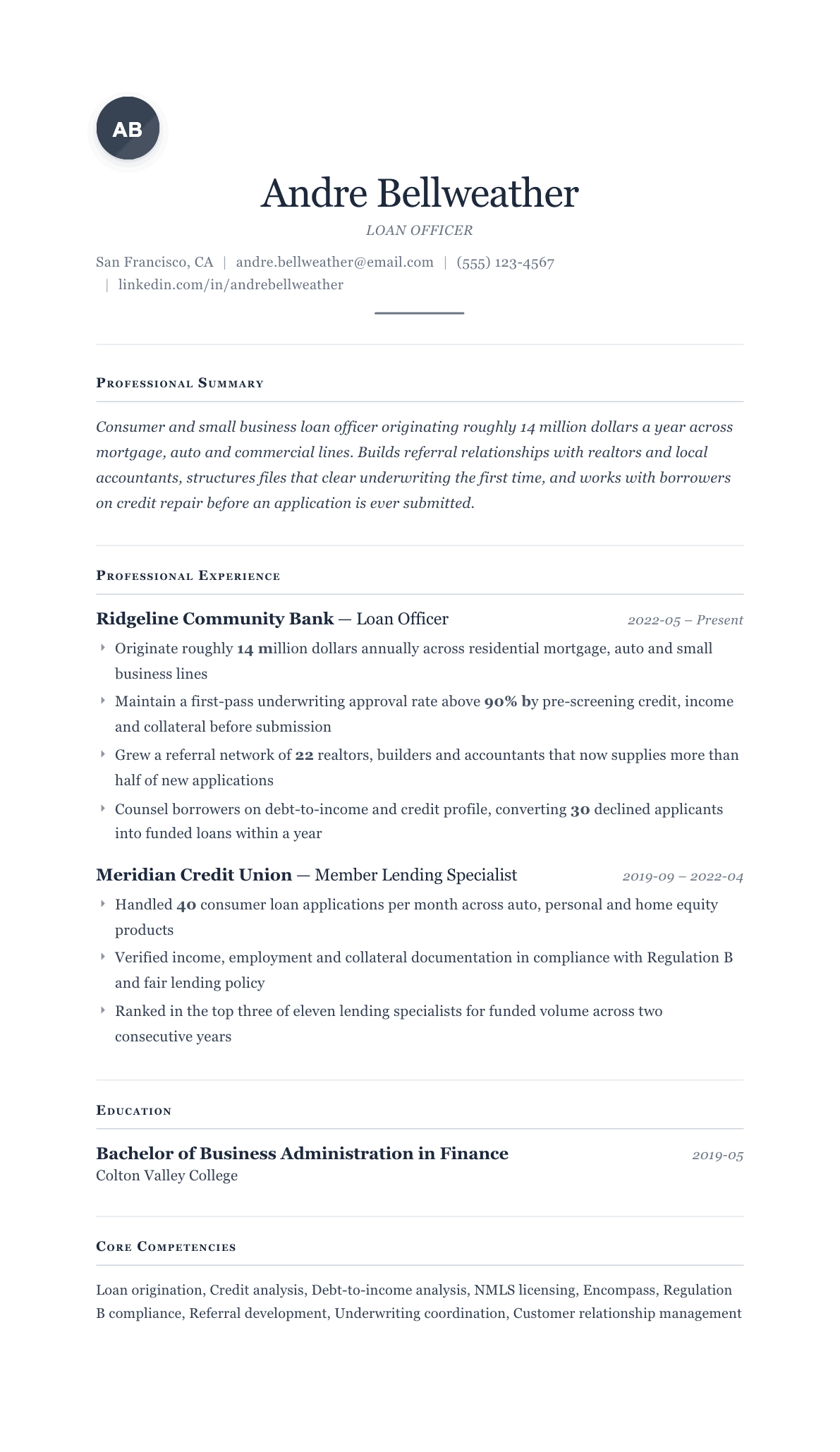
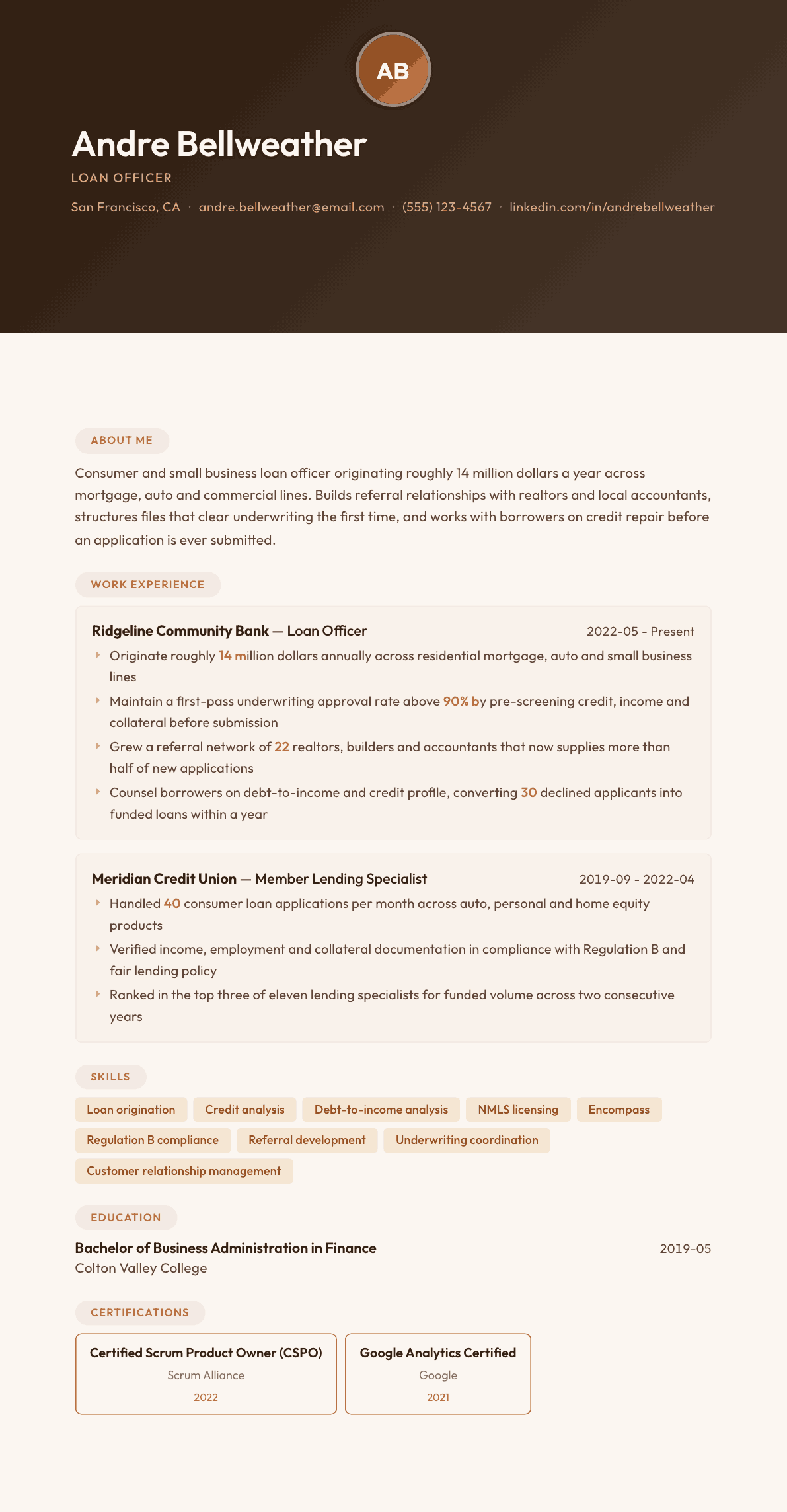
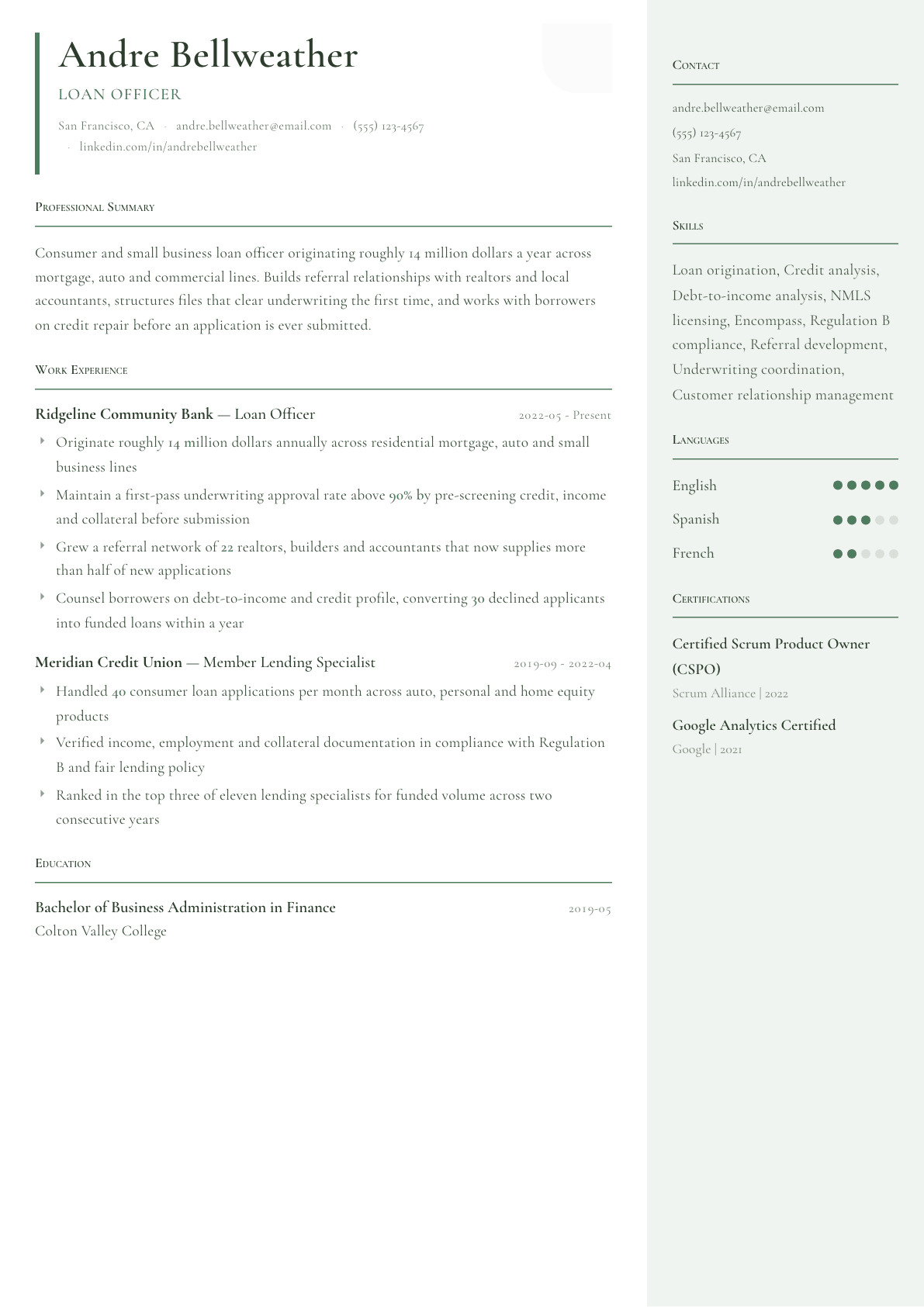
Example Loan Officer summary
Loan officer originating roughly 14 million dollars a year across residential mortgage, auto and small business products at a community bank. Keeps first-pass underwriting approval above 90% by pre-screening credit, income and collateral before the file moves. Built a referral network of 22 realtors and accountants that now drives more than half of new applications. NMLS licensed and current on fair lending and TRID requirements.
Skills to list on a Loan Officer resume
- Loan origination
- Credit analysis
- Debt-to-income analysis
- Underwriting coordination
- Mortgage lending
- Consumer lending
- Small business lending
- Encompass
- NMLS compliance
- Fair lending
- TRID disclosures
- Referral network development
- Pipeline management
- Customer relationship management
What actually gets this resume read
- Put annual funded volume and unit count in the first job, because lending managers screen on production before anything else.
- Include your NMLS identification number in the header if you originate mortgages, since it is verified on day one.
- Name the loan products you originate: conventional, FHA, VA, USDA, home equity, auto or small business.
- Show file quality with a pull-through or first-pass approval figure, not only with gross application counts.
- Describe how you source business, whether from realtor referrals, branch traffic, builders or your own database.
- Reference the compliance framework you work under, including fair lending, TRID timelines and Regulation B notices.
How to write a loan officer resume
A loan officer resume is a production document. The lending manager reading it turns straight to one question: how much did you fund, over what period, in which products. Everything else on the page supports that number or explains why it is trustworthy.
The second question is quality. Volume produced by pushing weak files through underwriting costs a lender money, so a manager also looks for pull-through, first-pass approval and the sourcing behind the applications. A loan officer who builds a referral network is worth more than one who waits for branch traffic, and the resume should make that visible.
This guide covers the section order lenders expect, how to present volume and licensing, the compliance vocabulary that reassures a regulated employer, and how to write a strong page when you are moving in from banking or sales.
Format: production up front, license in the header
One page for under ten years, two at most. Reverse chronological, with a production summary line under each employer so the reader does not have to hunt through bullets for the number.
Mortgage originators should place the Nationwide Multistate Licensing System identification number in the header beside the contact details. It is verified early in the process and putting it up front signals that you know how the industry works.
- Order: summary, experience with production lines, licenses, education, systems and skills.
- Under each employer: annual funded volume, unit count and the product mix.
- List every state you are licensed in if you originate across state lines.
Summary: volume, products, sourcing
Three sentences. Annual production, the products you originate, and where the business comes from. A line reading originating roughly 14 million dollars a year across residential mortgage, auto and small business lines at a community bank does the work of a whole paragraph.
Add one quality signal. First-pass approval rate, pull-through, or a note that your files clear underwriting with minimal conditions all tell a manager that your volume is not built on rework.
Experience: production, quality, sourcing, compliance
Write four or five bullets per role and cover the same four themes each time. Production, stated in currency and units. Quality, stated as approval or pull-through. Sourcing, stated as the referral relationships or channels you built. Compliance, stated as the framework you work inside.
Sourcing bullets are the most differentiating and the most often omitted. Naming a network of realtors, builders, accountants and attorneys, and the share of applications it generates, tells the manager you can produce in a new market rather than only in the branch you already sit in.
Skip bullets that describe the job itself. Assisted customers with loan applications is true of every loan officer and buys no space.
- Say how you pre-screen credit, income and collateral before a file goes to underwriting.
- Mention borrower counseling where you turned a decline into a funded loan later.
- Include cross-sell into deposit or business accounts if the bank measures it.
Products, systems and compliance vocabulary
Name the products precisely: conventional, government backed, home equity, construction, auto, unsecured personal and small business lending. Naming a specific agency program tells a lender which underwriting guidelines you already know.
Name the origination system too, whether Encompass, Byte, Calyx Point, nCino or a proprietary platform, along with the customer relationship system you manage your pipeline in.
Compliance language belongs on a lending resume. Fair lending, the disclosure timing rules that govern residential lending, adverse action notices and equal credit opportunity requirements are all terms a regulated employer is relieved to see, because a producer who ignores them creates examination risk.
Switching in from banking, real estate or sales
Lead with the transferable half. Branch bankers should show consumer lending applications, credit conversations and referral generation. Real estate professionals should show the transaction knowledge and the existing agent relationships, which are genuinely valuable to a lender hiring for a purchase market.
Then close the credibility gap explicitly. Name the licensing you hold or the examination you have scheduled, and describe any credit analysis work you have done, because the objection you have to answer is whether you can read a file rather than whether you can sell.
Loan Officer resume summary examples
New to lending
Branch banker moving into consumer lending, handling 40 loan applications a month across auto, personal and home equity products. Verified income, employment and collateral documentation against fair lending policy and ranked in the top three of eleven specialists for funded volume. Licensing examination scheduled.
Three years originating
Loan officer funding roughly 14 million dollars a year across residential mortgage, auto and small business products at a community bank. Keeps first-pass underwriting approval high by pre-screening credit, income and collateral before submission, and built a referral network of 22 realtors and accountants supplying most new applications.
Senior producer
Senior loan officer and top producer in a regional market, running a self-generated pipeline built on builder and realtor relationships. Mentors three junior originators on file structuring and condition management, and partners with underwriting on policy exceptions for self-employed and portfolio borrowers.
Work experience bullets: before and after
Before: Originated loans for bank customers.
After: Originate roughly 14 million dollars annually across residential mortgage, auto and small business lines, averaging 11 funded units a month.
Production is the first number a lending manager looks for, and stating it in currency and units answers the screen immediately.
Before: Maintained good relationships with underwriting.
After: Hold first-pass underwriting approval above 90% by pre-screening credit, income and collateral and structuring the file before it is submitted.
It converts a soft relationship claim into a quality metric the underwriting team can confirm.
Before: Built a referral network in the local market.
After: Grew a referral network of 22 realtors, builders and accountants that now supplies more than half of new applications without branch marketing support.
Sizing the network and its share of production proves you can generate business rather than receive it.
Before: Helped customers who did not qualify.
After: Counsel declined applicants on debt-to-income and credit profile, converting 30 of them into funded loans within a year through a structured follow-up plan.
A recovery pipeline is real revenue that most originators leave on the table, so quantifying it stands out.
Before: Followed lending regulations and bank policy.
After: Deliver disclosures inside the required timing windows and issue adverse action notices within the regulatory deadline, with no findings in the last two internal audits.
Naming the specific obligations and the audit outcome makes compliance a verified result instead of a promise.
Hard skills
- Loan origination
- Credit analysis
- Debt-to-income and loan-to-value analysis
- Income and asset documentation review
- Mortgage and consumer loan products
- Small business lending
- Encompass or similar origination systems
- Disclosure and adverse action compliance
- Fair lending practice
- Pipeline management
- Pre-qualification and pre-approval
- Referral network development
Soft skills
- Consultative selling
- Borrower education
- Follow-up discipline
- Negotiation with underwriting
- Local relationship building
- Handling difficult declines with clarity
Certifications worth listing
- Mortgage Loan Originator License (Nationwide Multistate Licensing System and Registry)
- SAFE Mortgage Loan Originator Test (Nationwide Multistate Licensing System and Registry)
- Certified Mortgage Banker (Mortgage Bankers Association)
- Credit Business Associate (National Association of Credit Management)
Mistakes that cost loan officer candidates the interview
- Leaving annual funded volume off the page, which is the first thing a lending manager searches for.
- Reporting application counts instead of funded loans, which reads as an attempt to hide the conversion rate.
- Omitting the licensing identification number when originating mortgages, since it is verified anyway.
- Describing yourself as relationship driven without naming a single referral source or channel.
- Skipping compliance entirely, which worries any employer subject to examination.
- Listing products vaguely as loans rather than naming the programs whose guidelines you know.
Loan Officer resume questions
Do I need a license to work as a loan officer?
Residential mortgage origination requires licensing or registration under the national system, while commercial and consumer lending inside a bank often does not. Check the requirement for the product and the employer type, and state your status clearly on the resume.
How should I present volume if I only worked part of a year?
Give the actual funded amount and the period it covers rather than annualizing it. A manager can do the arithmetic and will trust the honest figure more than a projection that assumes your best months would have continued.
What counts as a good pull-through rate to put on a resume?
Rather than chasing a benchmark, state your own figure with the definition you used and the period it covers. Managers care that you measure file quality at all, because most applicants only report gross production.
Can I move from real estate sales into loan origination?
Yes, and the agent relationships you already hold are a genuine asset to a purchase focused lender. Lead with those relationships and transaction knowledge, then address credit analysis and licensing directly so the reader does not have to wonder.
Should a loan officer resume include a book of business?
Reference the sources and the share of production they generate rather than naming individual clients or partners. Employers understand what a portable network means, and naming names raises confidentiality concerns you do not need.
Related resume examples
- Mortgage Loan Officer Resume example
- Credit Analyst Resume example
- Loan Processor Resume example
- Personal Banker Resume example
- Banker Resume example
- Compliance Manager Resume example