Loan Processor Resume Examples: the lines they read
Build a Loan Processor Resume That Shows Clean File Work
By Mustafa Tarabya, founder of CVBooster · Published · Updated
Loan processor resume examples with pipeline bullets, document and disclosure keywords, and a guide to proving accuracy and turn times to lenders.
Sample resumes for a loan processor
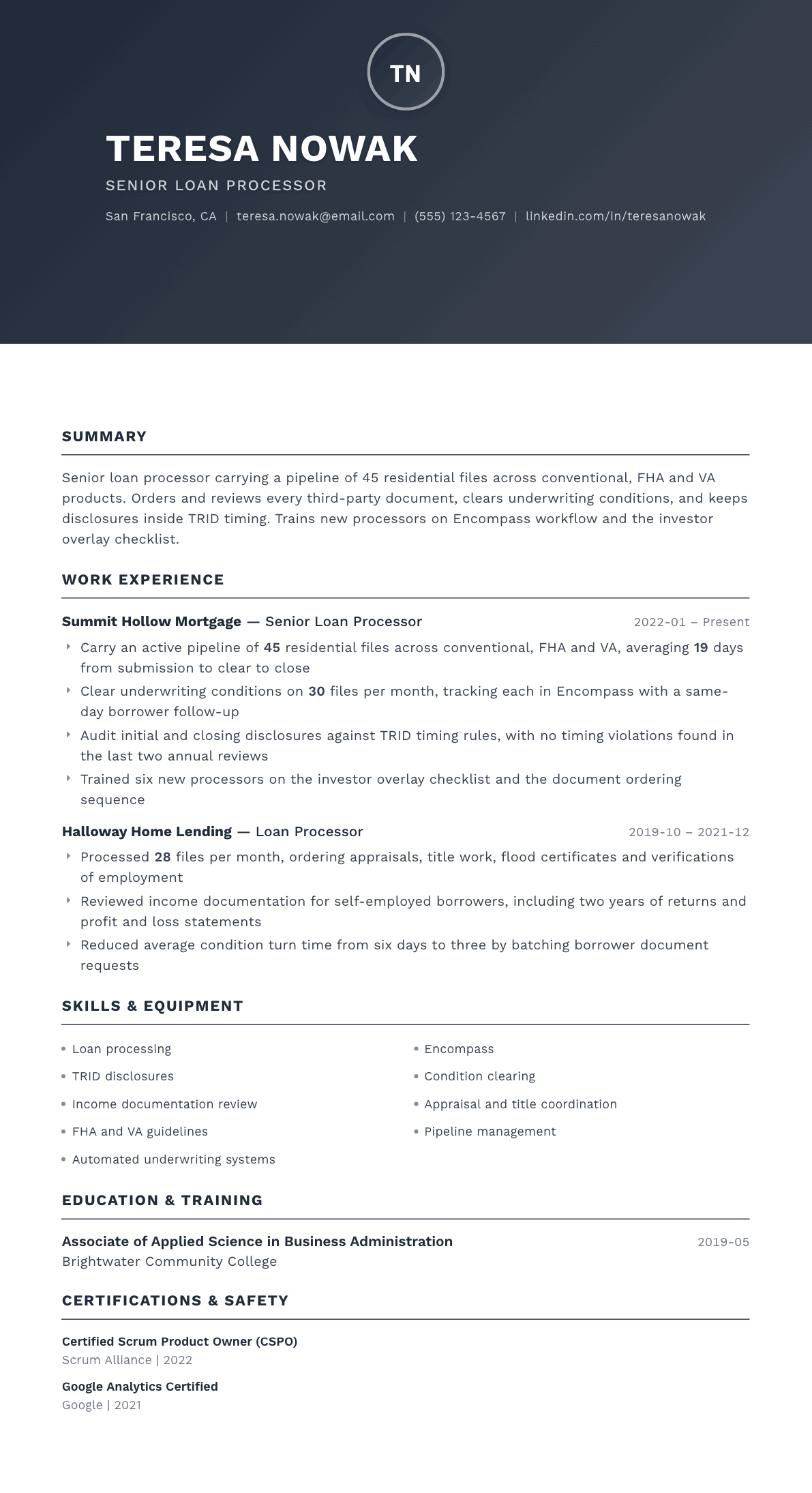
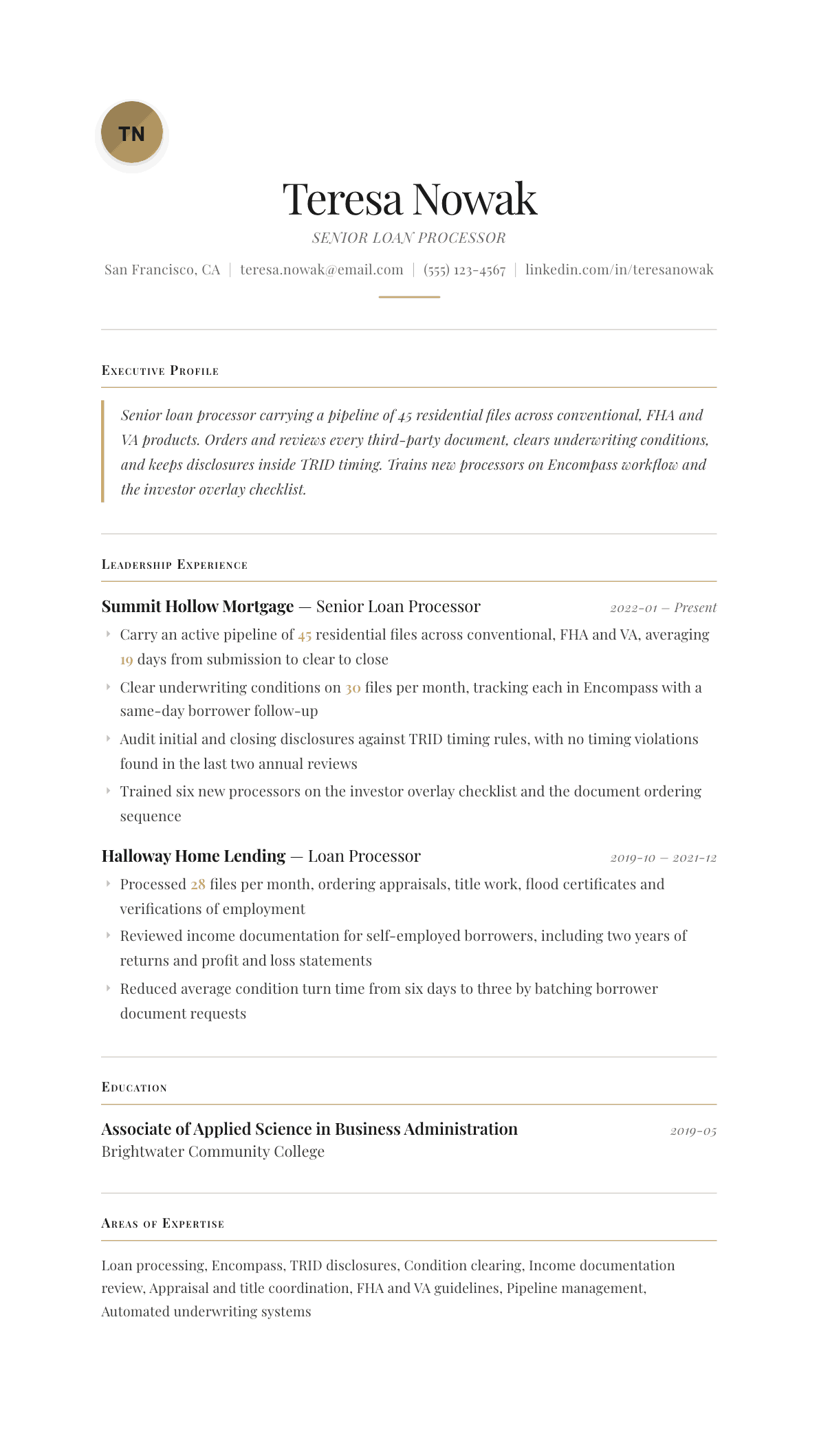
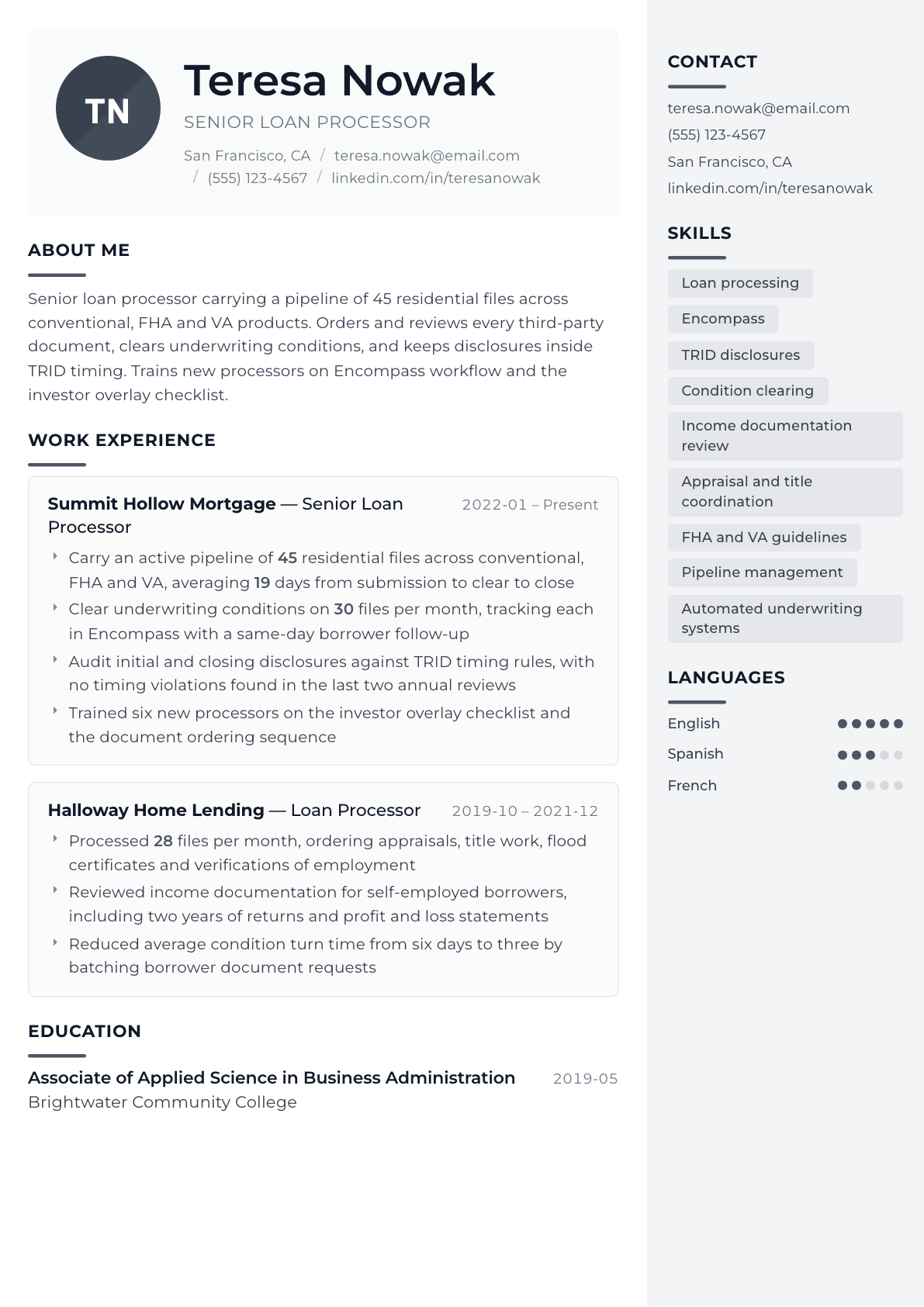
The same loan processor content laid out in three CVBooster templates, so you can see what the finished document looks like before you write a word.
Example Loan Processor summary
Senior loan processor carrying an active pipeline of 45 residential files across conventional, FHA and VA products, averaging 19 days from submission to clear to close. Clears roughly 30 underwriting conditions a month in Encompass with same-day borrower contact. Audits initial and closing disclosures against TRID timing and trains new processors on the investor overlay checklist. Seeking a senior or team lead processing role.
Skills to list on a Loan Processor resume
- Loan processing
- Pipeline management
- Condition clearing
- TRID disclosures
- Encompass
- Desktop Underwriter
- Loan Product Advisor
- Income and asset documentation
- Title and appraisal coordination
- FHA guidelines
- VA guidelines
- Verification of employment
- Investor overlays
- Borrower communication
What actually gets this resume read
- State your pipeline size and monthly closed units, because processing is a capacity job and managers hire on throughput.
- Give a turn time: submission to clear to close, or average days to clear a condition, since speed is the second filter.
- Name the loan origination system you work in, whether Encompass, Byte, Calyx Point or a proprietary platform.
- List the products and agency guidelines you know, covering conventional, FHA, VA, USDA and jumbo overlays.
- Show disclosure accuracy under TRID, which is the compliance risk a processing manager worries about most.
- Mention automated underwriting familiarity with Desktop Underwriter and Loan Product Advisor findings.
How to write a loan processor resume
Loan processing is a capacity job, and the resume is read that way. A processing manager wants to know how many files you carry at once, how fast they move, and whether they arrive at underwriting complete. Those three facts decide the interview before any skills section is read.
The second thing being assessed is compliance discipline. Disclosure timing errors on a residential file create real regulatory exposure, so a processor who can point to clean audits is worth more than one who simply closes quickly. Speed without accuracy is not a selling point in this role.
This guide covers how to state pipeline and turn times, which systems and agency guidelines to name, how to show condition clearing as an active skill, and how to build a credible page when you are moving up from a loan assistant or closing role.
Format: pipeline numbers where the eye lands first
One page unless you have more than a decade of files behind you. Reverse chronological, with a capacity line under each employer stating pipeline size, monthly closings and product mix.
Keep the systems section near the top rather than at the bottom, because a lender running a specific origination platform will screen for it. A processor who already knows the platform saves weeks of ramp time and managers weigh that heavily.
- Order: summary, experience with capacity lines, systems, education, certifications.
- Under each employer: pipeline size, monthly units closed and the product mix.
- Note whether the shop was retail, wholesale, correspondent or a credit union.
Summary: pipeline, products, turn time
Say what you carry, in what products, and how fast it moves. A line reading carrying an active pipeline of 45 residential files across conventional, government backed and jumbo products, averaging 19 days from submission to clear to close is immediately checkable and immediately useful.
Add one accuracy signal. Clean disclosure audits, a low suspense rate at underwriting, or a low condition count per file all tell a manager that your throughput does not create rework downstream.
Experience: conditions, documents, disclosures, communication
Build every role around the four things a processor actually does. Ordering and reviewing third-party documents. Clearing underwriting conditions. Managing disclosure timing. Keeping the borrower, the originator and the closing team informed.
Condition clearing deserves the strongest bullet. Give the monthly count and describe the follow-up rhythm, because a processor who contacts a borrower the same day a condition is issued closes materially faster than one who waits for the weekly review.
Document review should show judgment. Reading two years of returns for a self-employed borrower, reconciling a profit and loss statement to a bank statement deposit, or spotting a gap in an employment history are the calls that keep a file from falling apart at underwriting.
- Name the third-party orders you place: appraisal, title, flood determination, verifications.
- State your borrower contact standard, such as same-day outreach on new conditions.
- Include training or mentoring if you have onboarded newer processors.
Systems, guidelines and compliance
Name the origination platform: Encompass, Byte, Calyx Point, nCino or an internal system. Then name the automated underwriting engines you read findings from, since interpreting those findings correctly is a core processing skill rather than a clerical one.
List the agency and program guidelines you work under, including conventional agency requirements, government backed products and any investor overlays your shop applied. Overlay knowledge is valuable because it is where files most often get returned.
Address disclosure timing directly. A processor who can say that initial and closing disclosures were audited with no timing findings has stated the single compliance fact a manager most wants confirmed.
Moving up from assistant, closer or servicing
A loan assistant should lead with the documents ordered, the conditions chased and the pipeline supported, then state the products and guidelines learned. A closer should lead with disclosure accuracy and settlement coordination, which transfers cleanly.
Servicing candidates should emphasize the document and compliance fluency they already have, then be explicit about the gap: they have not yet carried a live origination pipeline. Naming the gap and the training you have taken is more persuasive than hoping the reader does not notice.
Loan Processor resume summary examples
First processing seat
Loan assistant supporting two originators, ordering appraisals, title work, flood certificates and employment verifications on roughly 25 active files. Reviewed income documents for salaried and hourly borrowers and tracked conditions daily. Completed agency guideline training and ready to carry an independent pipeline.
Three years processing
Loan processor carrying 28 residential files a month across conventional and government backed products, ordering all third-party documents and reviewing self-employed income including two years of returns and profit and loss statements. Reduced average condition turn time from six days to three by batching borrower requests.
Senior processor
Senior loan processor carrying an active pipeline of 45 files and averaging 19 days from submission to clear to close. Audits initial and closing disclosures against timing requirements with no findings in two annual reviews, and trains new processors on the investor overlay checklist and document ordering sequence.
Work experience bullets: before and after
Before: Processed residential mortgage loans.
After: Carry an active pipeline of 45 residential files across conventional, government backed and jumbo products, averaging 19 days from submission to clear to close.
Capacity and turn time are the two numbers a processing manager screens on, and both are now stated.
Before: Worked with underwriters to clear conditions.
After: Clear roughly 30 underwriting conditions a month in the origination system, contacting the borrower the same day a condition is issued rather than at the weekly pipeline review.
The count plus the follow-up standard explains how the speed is achieved instead of just claiming it.
Before: Reviewed borrower documentation.
After: Review self-employed income packages including two years of returns, a year-to-date profit and loss statement and bank statement deposits reconciled against reported revenue.
Describing the hardest document type demonstrates real underwriting judgment rather than clerical checking.
Before: Made sure disclosures were sent on time.
After: Audit initial and closing disclosures against required timing rules on every file, with no timing findings in the last two annual compliance reviews.
It converts a task into a verified compliance outcome, which is the risk a manager most wants covered.
Before: Trained new team members.
After: Trained six new processors on the investor overlay checklist, the document ordering sequence and how to read automated underwriting findings before touching the file.
Naming the curriculum shows genuine subject depth and signals readiness for a team lead role.
Hard skills
- Pipeline management
- Underwriting condition clearing
- Income and asset documentation review
- Self-employed income analysis
- Disclosure timing compliance
- Encompass or Calyx Point
- Automated underwriting findings
- Appraisal and title coordination
- Verification of employment and deposit
- Agency and government loan guidelines
- Investor overlay review
- Closing coordination
Soft skills
- Organization under volume
- Same-day follow-up habits
- Clear borrower communication
- Working with originators under pressure
- Detail checking without slowing down
- Calm handling of last minute changes
Certifications worth listing
- Certified Mortgage Processor (National Association of Mortgage Processors)
- Accredited Mortgage Professional (Mortgage Bankers Association)
- Mortgage Loan Originator License (Nationwide Multistate Licensing System and Registry)
Mistakes that cost loan processor candidates the interview
- Omitting pipeline size, which leaves a manager unable to judge whether you can handle their volume.
- Reporting only closed units with no turn time, when speed is half of what the role is measured on.
- Leaving the origination platform off the page, since many lenders screen directly on that system.
- Describing document collection as clerical work rather than showing the review judgment behind it.
- Saying nothing about disclosure timing, which is the compliance risk the role is built around.
- Claiming familiarity with every loan program instead of naming the guidelines you genuinely work under.
Loan Processor resume questions
What pipeline size should a loan processor claim?
State the number you actually carried, along with the product mix, because a pipeline of straightforward conventional files is not comparable to one full of government backed and self-employed borrowers. Managers read capacity alongside complexity, not on its own.
Do loan processors need a license?
In most cases no, because processors do not take applications or negotiate terms. Some states and some employers still require registration, particularly where the role crosses into originator activity, so confirm the requirement in your state before applying.
How do I show that my files are clean, not just fast?
Use conditions per file, suspense rate at underwriting, or the outcome of a compliance audit. Any of these tells a manager that your throughput is not being paid for by rework further down the process, which is the concern behind the question.
Is Encompass experience necessary to get hired?
It is not required but it shortens the ramp considerably, and many postings screen for it. If you have used a different platform, name it and describe the workflow you ran, since the underlying process transfers more than the software does.
How do I move from processing into underwriting?
Build evidence of credit decisions rather than document handling. Describe the guideline research you do, the exception cases you have structured and any underwriting training you have completed, then apply into junior underwriting where processing experience is genuinely valued.
Related resume examples
- Underwriter Resume example
- Mortgage Loan Officer Resume example
- Loan Officer Resume example
- Mortgage Processor Resume example
- Banker Resume example
- Insurance Underwriter Resume example