Personal Banker Resume Examples: the lines they read
Craft a Personal Banker Resume That Shows Portfolio Growth
By Mustafa Tarabya, founder of CVBooster · Published · Updated
Personal banker resume examples with deposit growth bullets, licensing detail, referral keywords and a guide to the metrics branch managers hire on.
Sample resumes for a personal banker
The same personal banker content laid out in three CVBooster templates, so you can see what the finished document looks like before you write a word.
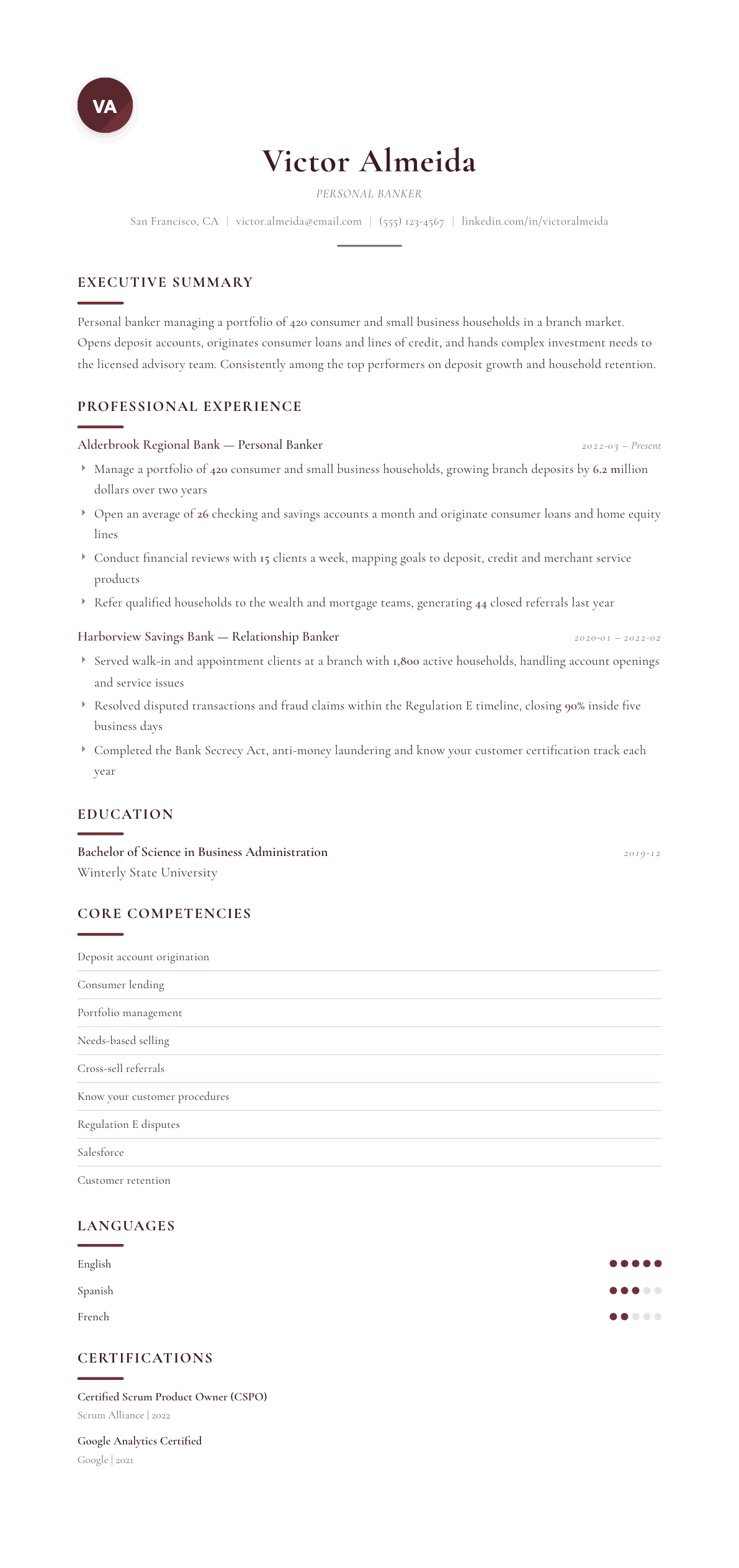
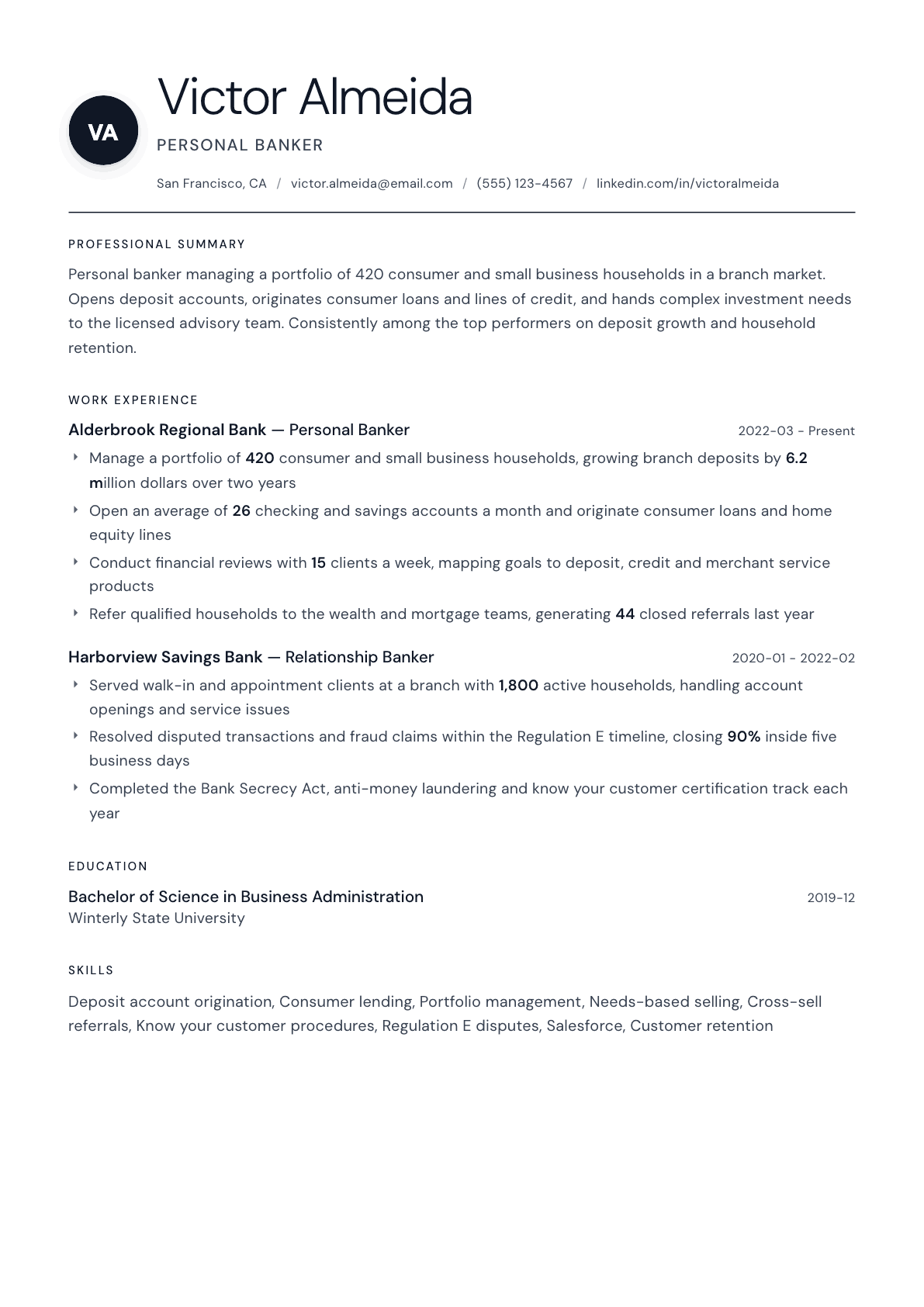
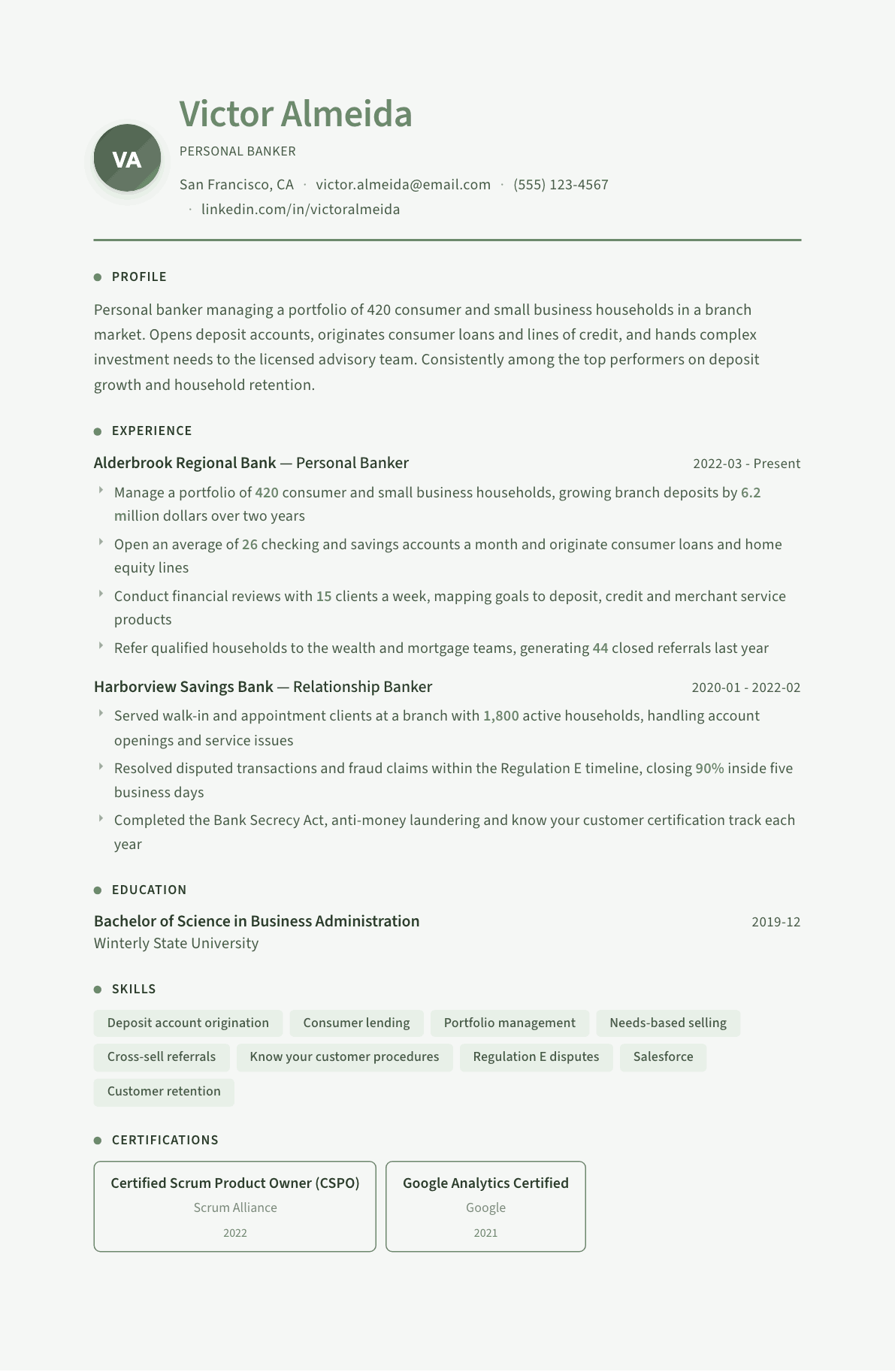
Example Personal Banker summary
Personal banker managing 420 consumer and small business households and adding 6.2 million dollars of branch deposits over two years. Opens roughly 26 accounts a month, originates consumer loans and home equity lines, and runs 15 client financial reviews a week. Sent 44 closed referrals to the wealth and mortgage teams last year. Seeking a small business banker seat with a defined commercial portfolio.
Skills to list on a Personal Banker resume
- Deposit account origination
- Consumer lending
- Portfolio management
- Needs-based selling
- Financial reviews
- Cross-selling
- Partner referrals
- Know your customer
- Bank Secrecy Act
- Regulation E disputes
- Small business banking
- Salesforce
- Client retention
- Branch operations
What actually gets this resume read
- Give portfolio size in households and deposit balances, because that is how a branch manager measures a banker.
- Show growth over a defined period rather than a static number, since the hiring question is what you added.
- Break production into deposit accounts opened, consumer loans originated and referrals closed by partner teams.
- List any securities or insurance registration you hold, including Series 6, Series 63 or a state life license.
- Name the compliance routines you follow, such as know your customer reviews and Regulation E dispute handling.
- Describe the financial review conversation you run, because needs-based selling is the skill being tested.
How to write a personal banker resume
A personal banker resume is judged on portfolio growth. The branch or district manager reading it wants to know how many households you carried, what you added to the balance sheet, and how much business you sent to lending and wealth partners. Those three numbers make the case that everything else on the page only supports.
The role sits awkwardly between service and sales, and weak resumes lean entirely on one side. A page full of service language reads as a teller who has not grown into the seat, while a page full of sales language worries a manager who has to answer for suitability and complaint volume. The strongest resumes show both.
This guide covers how to size a portfolio, how to present production without sounding like a commissioned salesperson, which registrations and compliance routines to name, and how to write the page when you are moving up from the teller line.
Format: portfolio size under every employer
One page for most candidates. Reverse chronological with a portfolio line under each employer giving household count, deposit balances and the market you served, so the reader can size your book immediately.
Keep registrations in a distinct block. A banker holding an investment or insurance registration can be deployed differently from one who cannot, and burying that inside a skills list makes it easy to miss.
- Order: summary, experience with portfolio lines, licenses, education, systems and skills.
- Under each employer: households managed, deposit balances and the product set you sold.
- Include branch context such as market type, since a rural branch and an urban one differ.
Summary: book size, growth, partner referrals
Name the portfolio, the growth you added over a stated period, and the partners you feed. A summary reading managing 420 consumer and small business households and adding 6.2 million dollars of branch deposits over two years is doing real work in one sentence.
Then name the conversation you run. Needs based financial reviews are the mechanism behind the numbers, and describing how you conduct them separates a banker with a method from one who happens to have had a good year.
Experience: production, retention, partnership, compliance
Cover four themes per role. Production, split into accounts opened, loans originated and balances added. Retention, because holding a household is worth more than winning one. Partner referrals, counted by closed referrals rather than submissions. Compliance, including the account review and dispute handling routines.
Retention is the theme candidates most often omit and managers most often value. A banker who reduced attrition in a portfolio, or who kept high value households through a rate cycle, is demonstrating something more durable than a strong opening month.
Small business banking deserves its own bullet if you did it. Treasury products, merchant services and business lines of credit are a different sale from consumer deposits, and a manager reads that as readiness for a larger seat.
- Count the financial reviews you run per week, not just the accounts they produce.
- Distinguish referrals sent from referrals closed by the partner team.
- Note any branch or district ranking, with the size of the group you ranked within.
Licenses, systems and compliance vocabulary
List each registration precisely with its status. Investment and insurance registrations are common in this seat, and a manager staffing a licensed platform will filter on them before reading anything else.
Name the systems you actually work in: the core banking platform, the customer relationship system you manage your book in, and the origination system if you take consumer loan applications.
Then show the compliance routines. Know your customer reviews, enhanced due diligence on higher risk accounts, dispute handling within the regulatory timeline and suitability documentation are the habits that keep a producing banker out of trouble, and naming them signals maturity.
Moving up from teller or service
Lead with the referral record and any account opening you already do. A teller with a consistent monthly referral count has already demonstrated the core skill of the banker seat, which is noticing an unmet need in an ordinary transaction.
Then close the two gaps a hiring manager will probe: product knowledge across deposit, credit and investment, and comfort in a scheduled appointment rather than a two minute window interaction. Name any training or job shadowing that addressed either one.
Personal Banker resume summary examples
Moving up from the teller line
Lead teller referring roughly 18 qualified customers a month to bankers for checking upgrades, savings products and consumer loans. Opens simple deposit accounts, completes annual anti-money laundering training and has shadowed the banker team through the full financial review conversation. Ready for a personal banker seat.
Three years as a banker
Personal banker managing 420 consumer and small business households and adding 6.2 million dollars of branch deposits over two years. Opens about 26 accounts a month, originates consumer loans and home equity lines, and runs 15 client financial reviews a week with a documented needs based approach.
Senior or small business banker
Senior personal banker holding the largest household book in the district, with a growing small business segment covering treasury products, merchant services and business lines of credit. Sends the highest closed referral volume to the wealth and mortgage teams and coaches two junior bankers on the review conversation.
Work experience bullets: before and after
Before: Managed a portfolio of banking customers.
After: Manage a portfolio of 420 consumer and small business households, growing branch deposit balances by 6.2 million dollars over two years.
Household count plus balance growth over a stated period is exactly how a district manager sizes a banker.
Before: Opened new accounts and sold bank products.
After: Open an average of 26 checking and savings accounts a month and originate consumer loans and home equity lines alongside the deposit relationship.
Splitting production by product shows breadth rather than a single line of easy volume.
Before: Met with clients to discuss their financial needs.
After: Conduct financial reviews with 15 clients a week, mapping stated goals to deposit, credit and merchant service products and documenting the recommendation.
The cadence and the documented method turn a vague meeting claim into a repeatable process.
Before: Referred clients to other departments.
After: Refer qualified households to the wealth and mortgage teams, generating 44 closed referrals last year rather than counting submissions.
Measuring closed referrals is the honest number, and saying so signals you know the difference.
Before: Handled customer complaints and disputes.
After: Resolve disputed transactions and fraud claims inside the regulatory timeline, closing 90% within five business days and documenting the provisional credit decision.
It ties service recovery to a compliance obligation, which is how the bank actually measures the work.
Hard skills
- Deposit account origination
- Consumer loan origination
- Portfolio and household management
- Needs based financial reviews
- Small business and treasury products
- Partner referral management
- Know your customer and enhanced due diligence
- Anti-money laundering procedures
- Dispute and fraud claim handling
- Core banking and customer relationship systems
- Client retention planning
- Branch operations support
Soft skills
- Consultative questioning
- Building long term client trust
- Explaining products in plain language
- Handling objections without pressure
- Time blocking around appointments
- Partnering across branch teams
Certifications worth listing
- Series 6 Investment Company and Variable Contracts Representative (FINRA)
- Series 63 Uniform Securities Agent State Law Examination (FINRA)
- Certified Financial Marketing Professional (American Bankers Association)
- Life and Health Insurance Producer License (State departments of insurance)
Mistakes that cost personal banker candidates the interview
- Giving no portfolio size, which leaves the reader unable to compare you with any other applicant.
- Stating a deposit balance without the period it was built over, so growth and inheritance look identical.
- Counting referrals sent rather than closed, which experienced managers discount immediately.
- Writing only service language, which reads as a teller who has not yet grown into the banker seat.
- Leaving registrations vague when a licensed platform manager screens on them first.
- Ignoring retention entirely, when holding a household is worth more than opening a new one.
Personal Banker resume questions
What is the difference between a personal banker and a relationship banker?
The titles overlap heavily and vary by institution. Relationship banker often implies a defined book with proactive outreach, while personal banker can include more walk-in service. Describe the actual work on your resume rather than relying on the title to convey it.
Do I need a securities license to be a personal banker?
Not for a purely deposit and consumer credit seat, but many banks want the investment and state law registrations so bankers can handle simple investment referrals or products. Holding them widens the roles you can be considered for.
How do I present sales numbers without sounding pushy?
Pair every production figure with the process behind it and a retention or satisfaction signal. A manager wants growth that survives the next audit and the next rate cycle, so evidence of a method reassures more than a large number alone.
How should I handle a period where I missed my goals?
Leave the shortfall off the resume and prepare an honest explanation for the interview, including what changed in the market or the branch and what you adjusted. Managers respect a banker who diagnoses a slow period rather than one who blames it away.
What is the natural next step from a personal banker role?
Common paths are small business banker, branch manager, mortgage originator or a licensed financial advisor seat. Point the resume at the one you want by emphasizing business banking, team leadership, lending volume or investment referrals accordingly.
Related resume examples
- Banker Resume example
- Financial Advisor Resume example
- Bank Teller Resume example
- Loan Officer Resume example
- Insurance Agent Resume example
- Anti-Money Laundering Analyst Resume example