Makeup Artist Resume Examples: free ATS score and gap list
Makeup Artist Resume: Makeup Resume Examples by Lane
By Mustafa Tarabya, founder of CVBooster · Published · Updated
Makeup resume examples and samples for bridal, brand counter, film and new graduate artists, with the credit format, kit line and the keywords bookers use.
Sample resumes for a makeup artist
The same makeup artist content laid out in three CVBooster templates, so you can see what the finished document looks like before you write a word.
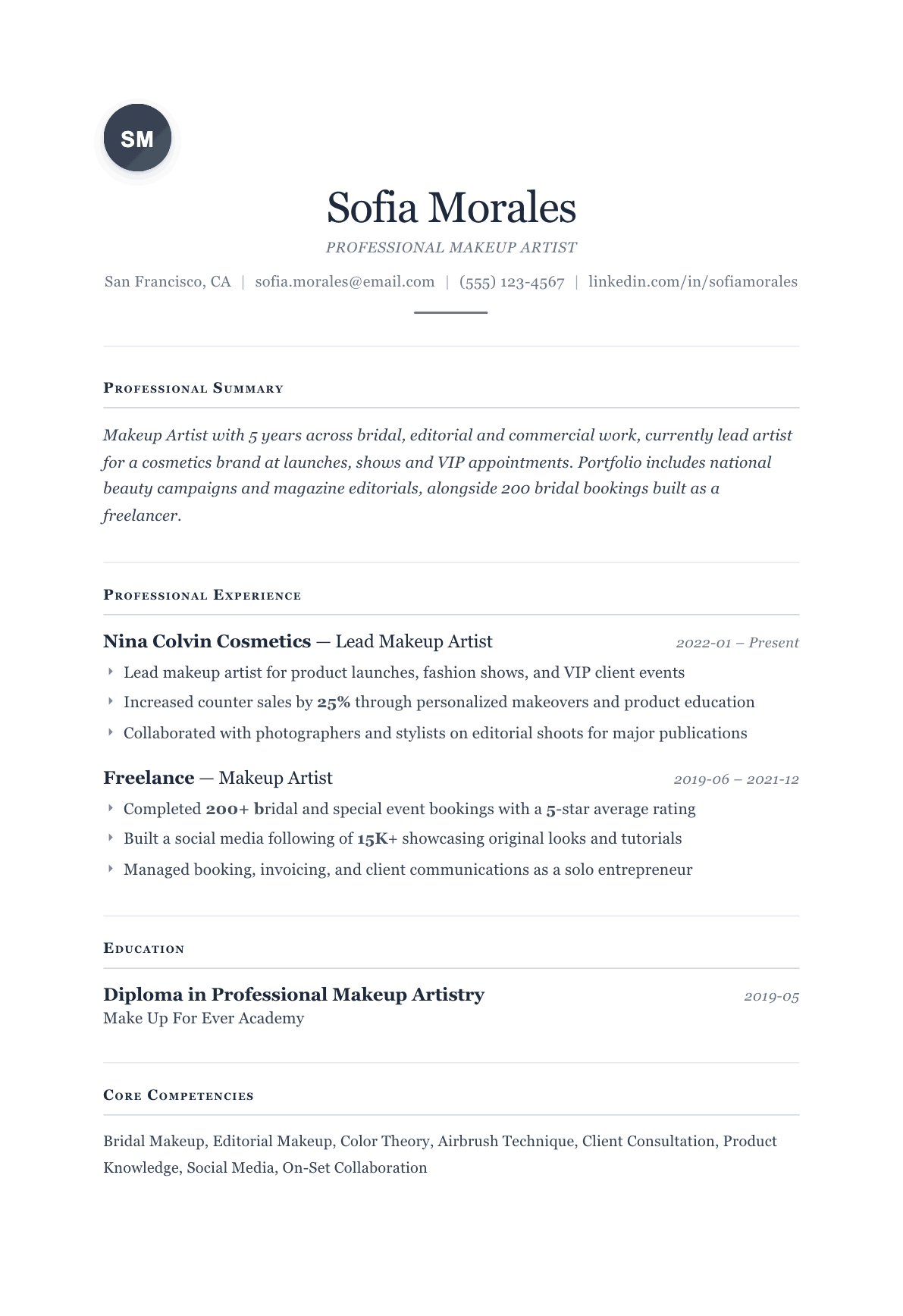
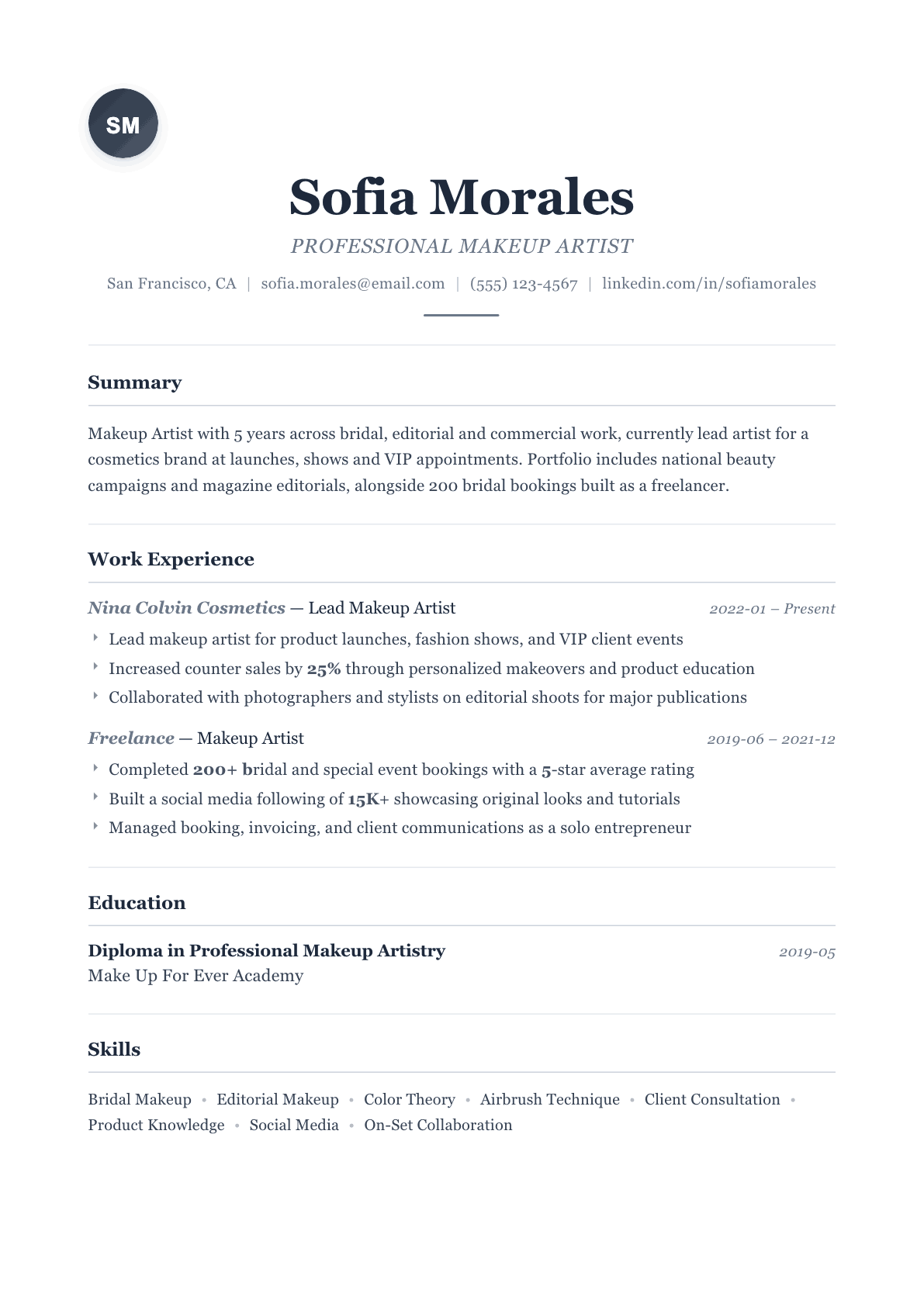
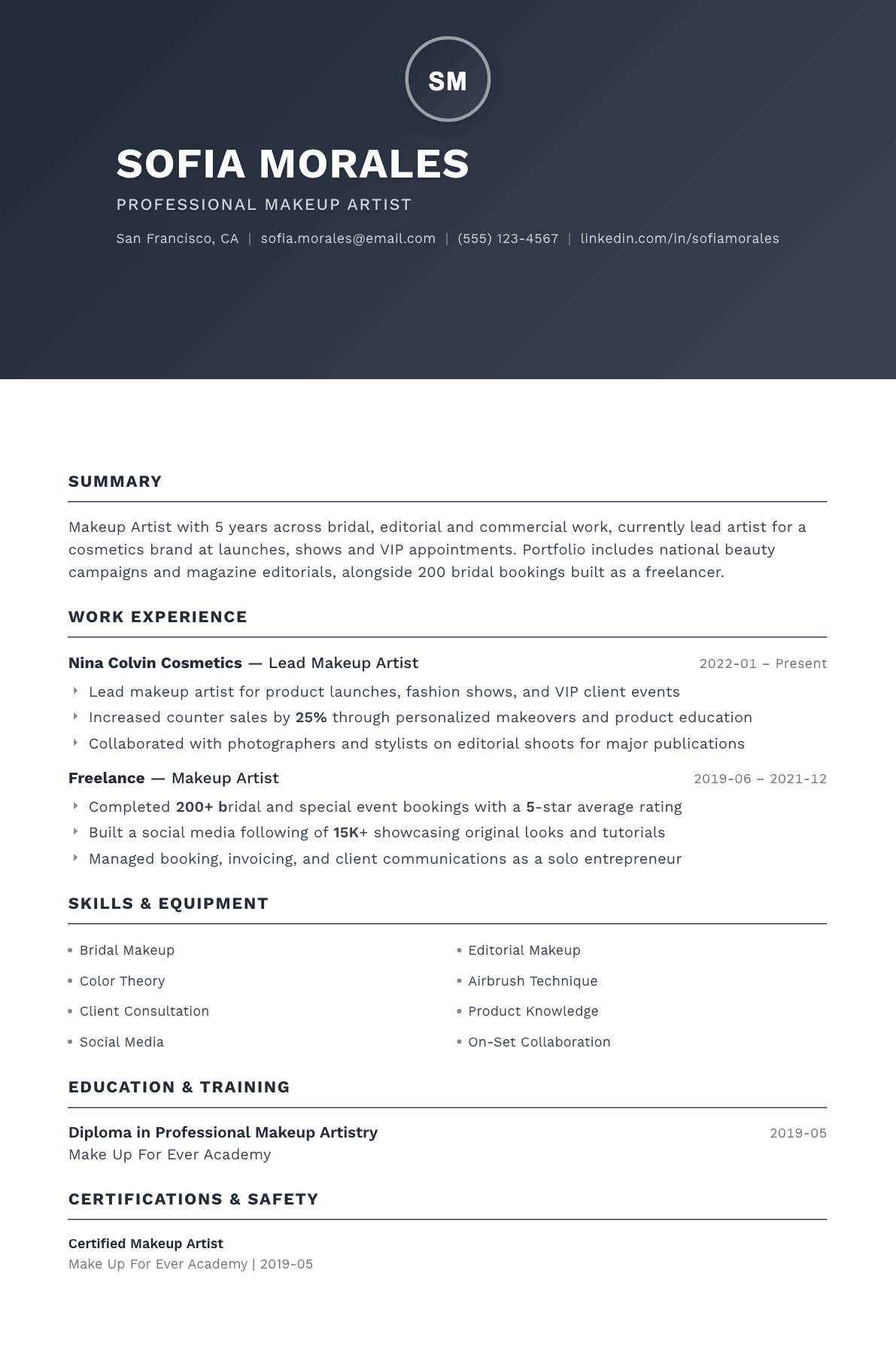
Example Makeup Artist summary
Makeup artist, 5 years, splitting time between bridal work and editorial and commercial sets. Two hundred wedding bookings at a five-star average, counter sales up 25% under a lead artist role, and a 15K following built on original looks and tutorials.
Skills to list on a Makeup Artist resume
- Bridal Makeup
- Editorial & Fashion
- Airbrush Application
- SFX Makeup
- Color Matching
- Skincare Prep
- Client Consultation
- On-Set Etiquette
- Product Knowledge
- Social Media Marketing
What actually gets this resume read
- Link to your portfolio or Instagram to showcase your work visually.
- Name the brands, publications and productions you have credits on, and say what the credit was, whether key artist, assistant or counter lead.
- Quantify bookings, sales impact, and client satisfaction scores.
- List specific techniques like airbrush, SFX, or HD makeup in your skills.
How to write a makeup artist resume
A makeup artist is hired off images first and paper second, but the paper still decides a lot. An agency booker, a beauty brand recruiter and a production coordinator all want different evidence: the booker wants credits and a kit, the brand wants counter numbers and product knowledge, the coordinator wants to know you have worked a call sheet and can hold continuity across a shoot day.
So the first decision is which of those three you are writing for. A resume built for bridal and event work reads like a service business: bookings, packages, trials, travel. A resume built for editorial, film or television reads like a credit list, with production, client and photographer named. A resume built for a cosmetics counter or a brand artistry team reads like retail, with sales and education numbers.
MUA is how the industry writes makeup artist on call sheets, booking sites and social profiles, so an MUA resume is the same document with the same rules. This guide covers the credit format that industry readers expect, how to describe your kit and sanitation without sounding like a beginner, what belongs in a summary for each of those three paths, and the questions artists ask when they move from freelance into a salaried artistry role.
Format: one page, a portfolio link at the top, credits in place of duties
Keep it to one page and put the portfolio link directly under your name, above everything else. A makeup artist resume without a visible link to the work is asking a visual employer to imagine the results. Add your city and whether you travel, because a large share of bookings are decided by whether you can be on set at call time.
For editorial, commercial and screen work, drop the paragraph-of-duties habit and use a credits format instead: project or publication, your role, the client or production company, and the photographer or department head you worked under. Group credits by category so a reader can find the type of work they are hiring for.
- Header: name, city, travel radius, phone, email, portfolio link, agency representation if you have it.
- Sections: summary, selected credits or client work, staff or counter positions, training, kit and skills.
- Bridal and event artists replace the credits block with bookings, packages and venues.
Summary: your lane, your volume and the finish you are known for
Three lines. Name the lane, the years, the volume in that lane, and the technical finish you are known for. Bridal artists are hired on reliability and skin, so a summary should carry season bookings, trial-to-booking conversion and how many faces you can complete before a ceremony time. Editorial artists are hired on taste and range, so the summary should carry the type of publication and the kind of look.
If you work more than one lane, still lead with the one the job is in. A brand artistry manager reading a summary about avant-garde runway work will not picture you behind a counter teaching a customer how to fill a brow.
Experience: what you actually did on the day
The strongest bullets describe the conditions, not the artistry adjectives. How many faces, in what time window, under what lighting, with what turnaround between looks, and who else was on the team. A coordinator hiring for a shoot needs to know that you can do six looks in a day and reset the kit between them without slowing the crew.
Name the technical work that separates artists: airbrush application, high definition and camera-ready finish, color matching across deep and fair skin tones, lash application, brow shaping, bridal skin prep, continuity across a multi-day shoot, and special effects such as bruising, aging or prosthetic application if that is genuinely part of your range.
For counter and brand roles the day is different, so the bullets are different: makeovers completed per shift, sales against target, product launch events, customer education sessions and artist training you delivered to the team.
Kit, sanitation and licensing: the block most artists skip
A professional kit list is a credential. Say that you own a full working kit, name the categories that carry weight for the work you want, and state your sanitation practice: disposable applicators, decanting from palettes with a spatula, sanitizing product surfaces, single-use mascara wands and a documented approach to working on a set with many faces.
Licensing varies by state and by workplace. Some states and many employers require a cosmetology or esthetician license before you may touch a paying client, and hotel spas and salons almost always do. If you hold one, put it near the top; if the work you want requires one, say where you stand on getting it.
Training and the words a posting uses
Name the academy or program and the artists you assisted under. In this trade assisting is training, and the name of the artist you assisted tells a booker more about your standard than a course title does. List brand and product education separately, because a cosmetics company hiring for its artistry team wants to see that you already know its line.
Mirror the vocabulary of the posting once in the summary and once in a bullet: bridal makeup, editorial, beauty, special effects, airbrush, color theory, skin preparation, on-set continuity, retail artistry, client consultation. These are the terms a hiring system scans for and the terms a human uses to sort the pile.
MUA resume examples for each lane, written out
A makeup resume sample is only useful if it matches the lane you are applying into, so here are four short makeup resume examples: freelance bridal, a brand counter, film or television, and a new academy graduate. The names, brands and productions are invented. Each opens with the portfolio link and keeps the same order: lane, credits or volume, kit and training.
Write the title line as Makeup Artist (MUA) rather than the abbreviation alone. Bookers and production coordinators use MUA every day, but a brand recruiter or a hiring system may search for the full words, and the pair covers both readers. The same goes for your profile links: an MUA handle on social media is fine in the header as long as it opens on your portfolio grid, not on personal posts.
- Freelance bridal: Alicia Moreno, Bridal and Event Makeup Artist, portfolio link in the header. Booked for about 60 weddings a season, each with a trial and a written timeline; travels with an assistant for parties of six or more; airbrush and long wear specialist; full kit sanitized between every client.
- Brand counter: Jade Thompson, Makeup Artist, Lumiere Cosmetics counter, two years. Runs about 12 makeovers a weekend, books event appointments, teaches skin prep and shade matching on the line, and trains new counter staff on the brand's application steps.
- Film and television: Kofi Mensah, Makeup Artist, member of the local makeup union. Credits listed as production, role and key artist: second unit makeup on an invented feature, daily makeup on a regional drama series, continuity photos and notes kept for every scene.
- New graduate, no paid credits yet: Priya Nair, Makeup Artist, portfolio of 20 looks from academy assessments and test shoots. Lists a 300 hour makeup academy certificate, assisting a bridal artist on 8 weddings, two student short films with continuity notes kept, and a retail beauty advisor job for customer and shade matching experience.
- Training line for any lane: academy name, the key artist you assisted and for how long, and any brand education, listed under the work rather than above it.
Makeup Artist resume summary examples
First year freelancing
Makeup artist with academy training in beauty and bridal application and 40 paid bookings in a first year of freelancing, plus 2 seasons assisting a lead artist on editorial shoots. Owns a full professional kit. Comfortable with airbrush, lash application and color matching across a wide shade range.
Established bridal artist
Bridal and event makeup artist completing 90 weddings a year across 3 counties, with a 65% trial-to-booking conversion and a 5-star average across 200 reviews. Runs a 2-artist team on large parties and finishes 6 faces inside a 3-hour window before ceremony.
Lead artist and educator
Lead makeup artist with 11 years across editorial, commercial and brand artistry. Credits include national beauty campaigns and 4 seasons of runway. Built and delivered the artistry training for a 30-person counter team and raised makeover conversion by 18% across the region.
Work experience bullets: before and after
Before: Did makeup for weddings and special events.
After: Completed 90 wedding bookings in a season, delivering 6 faces inside a 3-hour window before ceremony time with a second artist on parties above 8 people.
Volume, timing and team size prove you can hold a wedding morning schedule, which is the only thing a planner cares about.
Before: Worked on editorial photo shoots.
After: Created 8 beauty looks across a 2-day editorial shoot, holding continuity between setups and reworking each look for the studio lighting change after lunch.
Naming the number of looks and the continuity problem shows a set-experienced artist rather than an enthusiastic one.
Before: Increased sales at the makeup counter.
After: Averaged 14 makeovers per shift and converted 40% of them into multi-product sales by building a written routine for each customer during the service.
A service volume, a conversion rate and the technique behind it read as a repeatable method, not a lucky quarter.
Before: Skilled in airbrush makeup.
After: Applied airbrush foundation for high definition camera work, matching shades on set from a 12-shade decanted palette and finishing with hand-blended cream product at the hairline.
The specific technique and the reason for it show technical control instead of a listed skill.
Before: Trained junior artists.
After: Wrote and delivered a 4-week artistry curriculum on skin preparation, shade matching and brow mapping for 9 new hires across 3 store locations.
Curriculum, topics and reach turn a soft claim into a leadership record a brand can use.
Hard skills
- Bridal and event makeup
- Editorial and beauty makeup
- Airbrush application
- High definition and camera-ready finish
- Color theory and shade matching
- Skin preparation and priming
- Strip and individual lash application
- Brow shaping and mapping
- Special effects and prosthetic application
- On-set continuity
- Kit management and sanitation
- Client consultation and trials
- Retail artistry and product education
Soft skills
- Working to call time
- Calm under a wedding morning schedule
- Reading a client brief
- Collaboration with hair and wardrobe
- Discretion with public-facing clients
- Booking and follow-up
Certifications worth listing
- Cosmetology License (State Board of Cosmetology)
- Esthetician License (State Board of Cosmetology)
Mistakes that cost makeup artist candidates the interview
- Sending a resume with no portfolio link, which makes a visual employer hunt for the only evidence that matters.
- Writing duties for creative work instead of credits, so a booker cannot tell which productions and clients you have actually served.
- Listing every look you can do rather than the lane you are applying into, which reads as unfocused to a bridal planner and unserious to an editorial booker.
- Leaving out kit ownership and sanitation practice, when both are the first questions asked before you are allowed near a paying face.
- Using a heavy graphic template with images embedded, which often arrives unreadable in a corporate hiring system for brand and counter roles.
- Claiming special effects or prosthetic work on the strength of one class, since a coordinator will book you for it and find out on the day.
- Ignoring the licensing question in states and workplaces where a cosmetology or esthetician license is required to work on clients.
Makeup Artist resume questions
Do I need a license to work as a makeup artist?
It depends on the state and the workplace. Several states require a cosmetology or esthetician license to apply makeup to a paying client, and salons, spas and department store counters usually require one regardless. Freelance editorial and film work is often outside that requirement, so check your own state board.
How do I list credits on a makeup artist resume?
One line per credit: the production, publication or client, your role on it, and the photographer, director or department head. Group them by category such as editorial, commercial, bridal and film, and keep only the strongest under each heading rather than every job you have taken.
What goes on a makeup artist resume if most of my work is freelance?
Treat freelance as one continuous position with your own business name and the dates, then use bullets for booking volume, the mix of work, repeat and referral rates, and how you handle consultation, contracts and travel. Recruiters read that as running a business, not as a gap.
What do good makeup resume examples look like?
One page with a portfolio link at the top, a summary naming your lane, then credits or booking volume instead of duties, a short kit and sanitation line, and training with the artists you assisted. The four examples above show that order for bridal, brand counter, film and new graduate work. State that your kit is your own and sanitized between clients.
How do I move from freelance into a brand artistry job?
Rewrite the summary around retail and education rather than artistry alone, and pull out every bullet that shows selling, teaching and event work. Brand teams hire artists who can hold a counter, hit a target and train a team, so lead with those and keep the creative credits as supporting proof.
Related resume examples
- Esthetician Resume example
- Nail Technician Resume example
- Spa Manager Resume example
- Brow Technician Resume example
- Hairdresser Resume example
- Beauty Consultant Resume example