Hairdresser Resume Examples: free ATS score and gap list
Craft a Hairdressing Resume That Shows Real Chair Time
By Mustafa Tarabya, founder of CVBooster · Published · Updated
A hairdresser resume guide with service lists, color education, clientele numbers and retention bullets, plus keywords salons and recruiters search for.
Sample resumes for a hairdresser
The same hairdresser content laid out in three CVBooster templates, so you can see what the finished document looks like before you write a word.
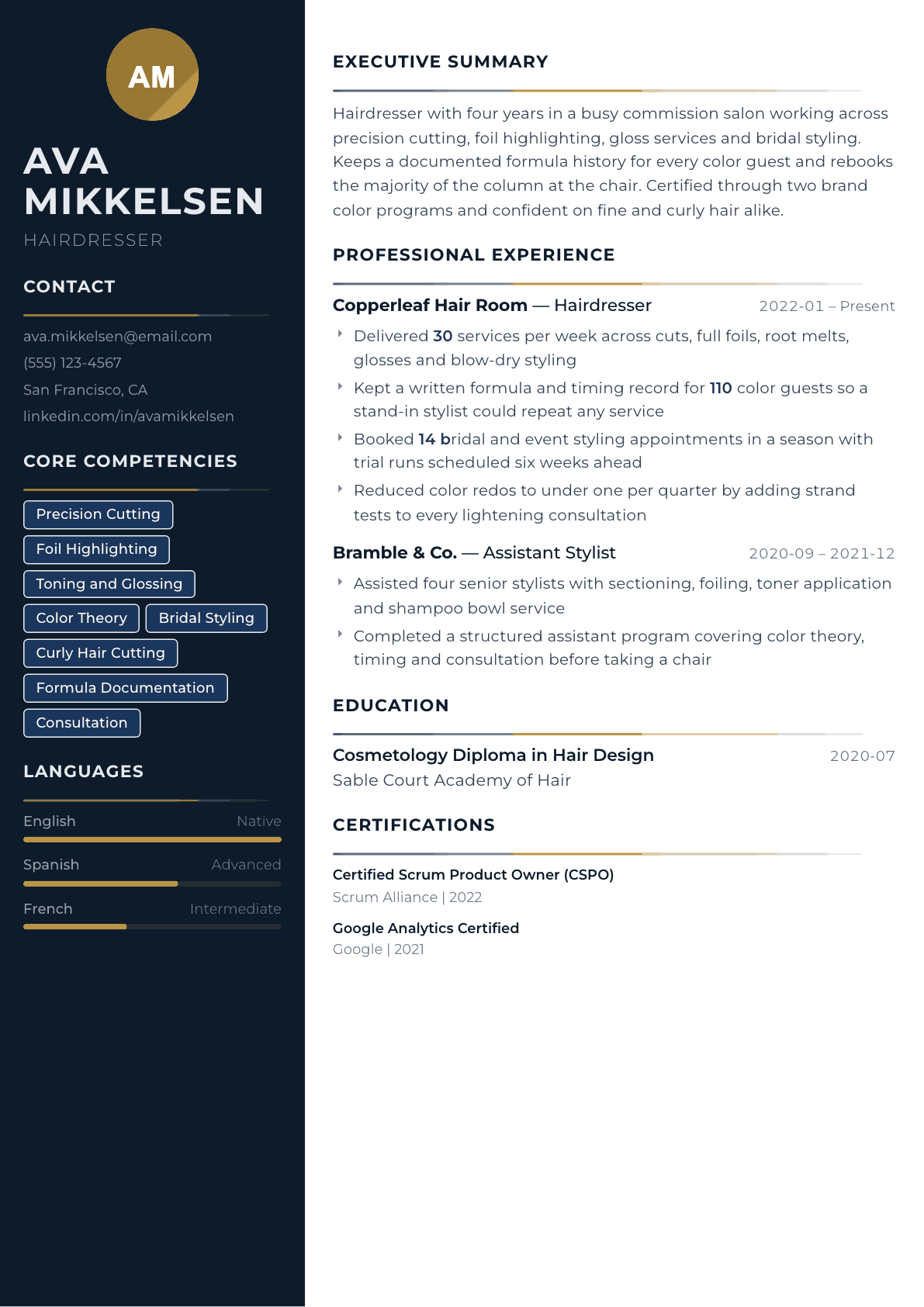
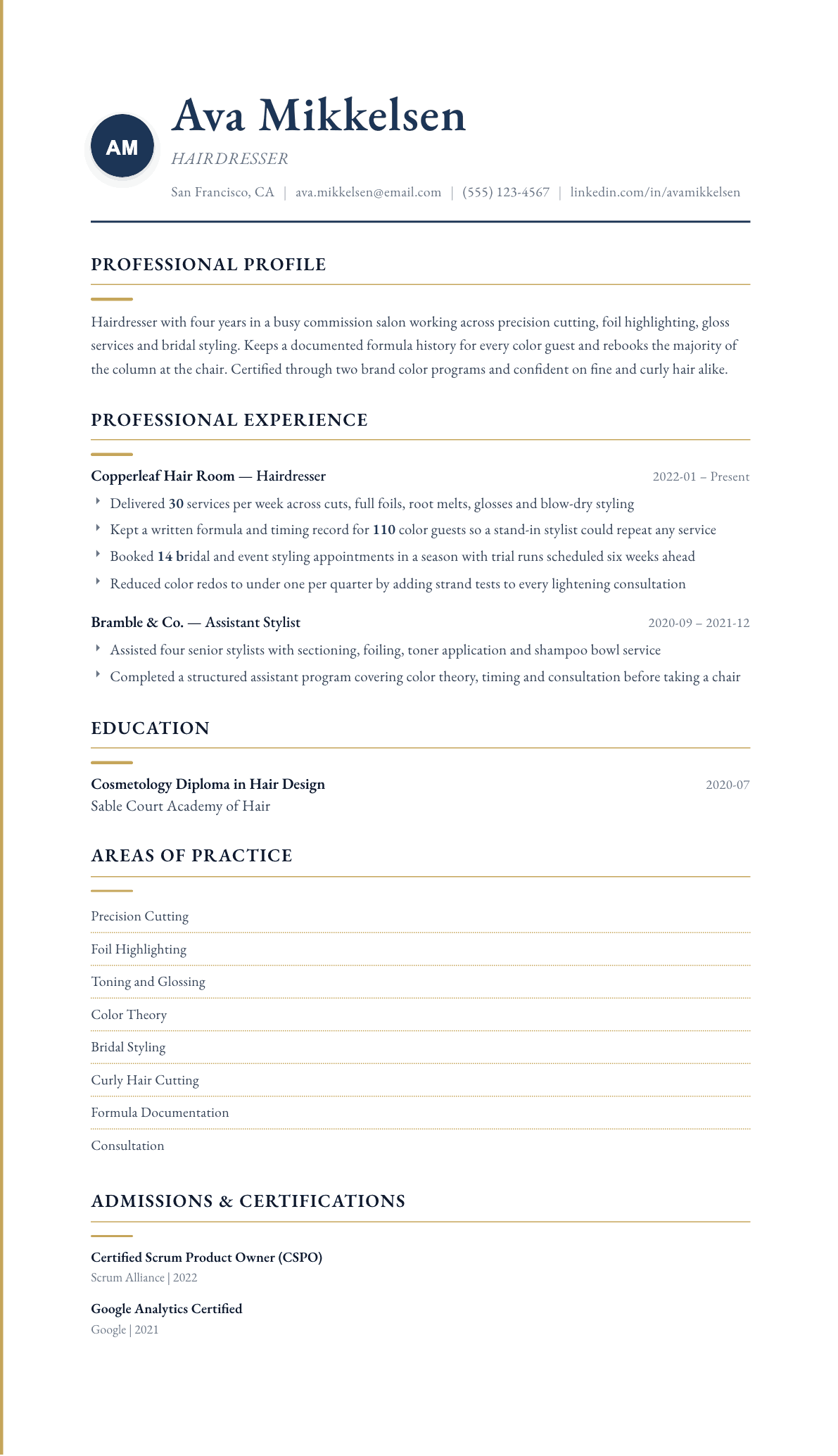
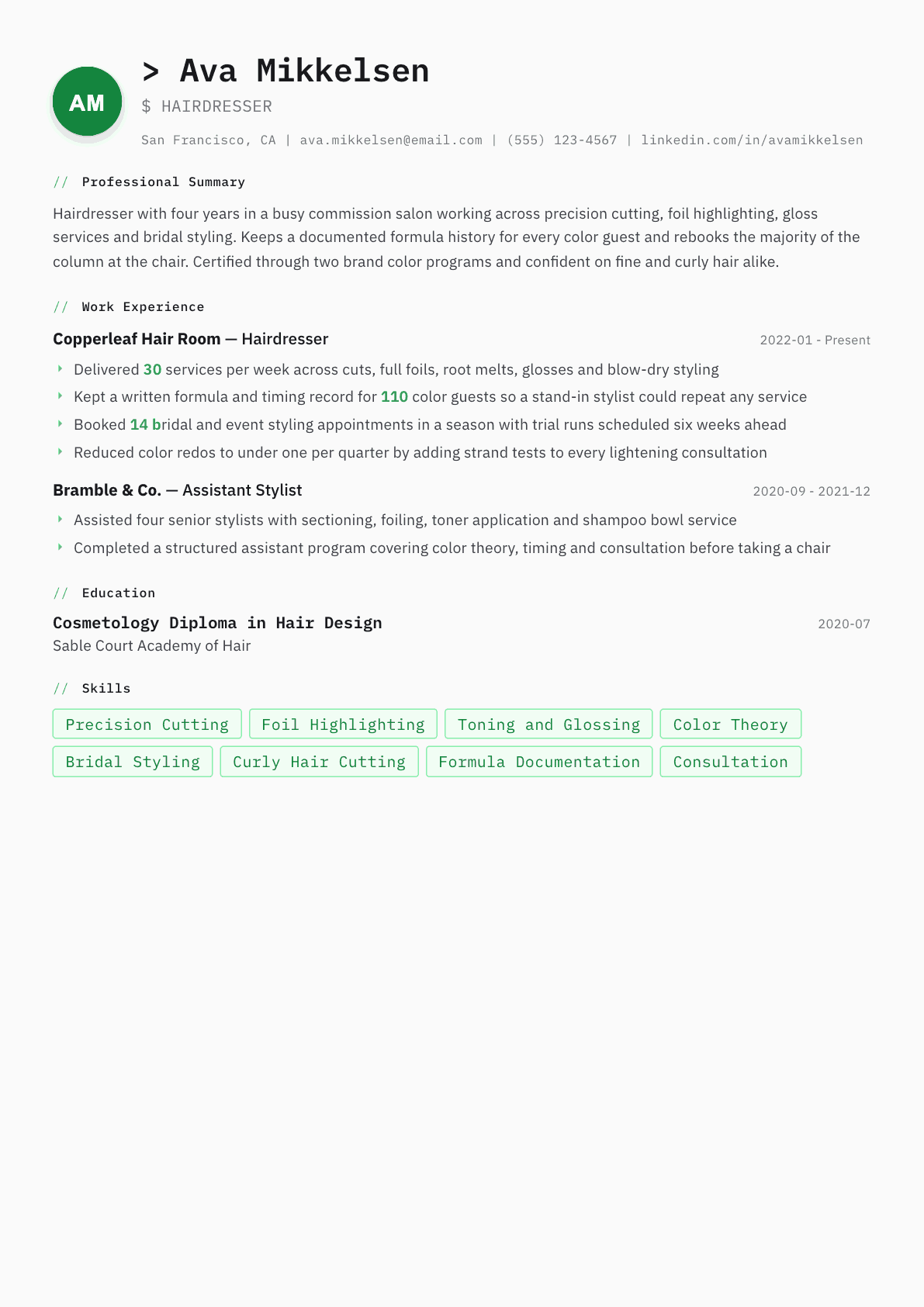
Example Hairdresser summary
Hairdresser with four years in a commission salon covering precision cutting, foil work, glossing and event styling. Documents formulas and timing for every color guest so results repeat visit after visit, and keeps corrections rare by testing before lightening. Certified through two brand color programs and comfortable across fine, coarse and curly textures. Seeking a chair in a salon with a strong color clientele.
Skills to list on a Hairdresser resume
- Precision Cutting
- Layering and Texturizing
- Foil Highlighting
- Balayage
- Root Melt and Shadow Root
- Toning and Glossing
- Color Theory
- Curly Hair Cutting
- Blow-Dry Styling
- Bridal and Event Styling
- Hair Extensions
- Strand Testing
- Formula Documentation
- Client Consultation
- Prebooking
What actually gets this resume read
- Open with your license, your years behind the chair and the hair types you cut most confidently.
- List color services by technique, foils, balayage, root melt or gloss, so a salon can match you to its menu.
- Record how many guests are on your book and how many follow you, because that travels with you to the next chair.
- Add your color education by brand and class name, since salons hire around the line they already stock.
- Include a redo or correction figure, which shows consultation discipline better than any adjective can.
- Mention bridal, event or extension work separately because those bookings carry different pricing and lead times.
How to write a hairdresser resume
A hairdresser is hired for two things that rarely appear on the resume: whether the color comes out the way the consultation promised, and whether the guest returns. Everything a salon owner reads is a proxy for those, so the page works best when it is built from technique names, repeatability and retention rather than from a service list anyone could copy.
Repeatability is the underrated half. A hairdresser who records formulas, timing and developer volume produces a result another stylist can reproduce when she is on holiday, and a guest who is never surprised is a guest who prebooks. Owners have all been burned by a stylist whose work lived entirely in her head, and they screen for the opposite. Most salons advertise the chair as a stylist job rather than a hairdresser job, and the resume is the same document under either title, so use the word the posting uses.
This guide covers how to present color technique so a trained reader believes it, what to do about your book when you move salons, how to write about bridal and extension work that runs on different lead times, a stylist resume example laid out from header to skills, and the questions hairdressers ask when they leave an assistant program for their own chair.
Format: license, hair types, then color technique
One page, single column, reverse chronological. Under your name put the license and state, the years you have had your own chair, and the hair types you cut most confidently. Texture matters: fine and straight, wavy, coily and coarse hair need different cutting and chemistry, and salons serve specific neighborhoods.
Then a technique block rather than a service menu. Foils and their placement patterns, balayage and hand painting, root melts and shadow roots, glosses and toners, corrective work, and cutting styles from precision blunt lines to dry cutting and razor texture. A trained reader separates a hairdresser from a graduate on that block alone.
- Credential line: cosmetology license, state, expiration, and the first year you took your own chair.
- Texture line naming the hair types you work with most, because that maps you to the salon's actual clientele.
- Color technique block grouped as lightening, deposit, corrective and toning work.
- Education block listing brand classes and academies with the year and the class name, newest first.
Repeatability: formulas, timing and testing
Say that you keep a written formula record, and say what is in it: the line, the shade, the developer volume, the processing time and the placement notes. Then say where it lives, whether in the guest profile inside the booking system or in a shared salon record. Owners read this as insurance against a stylist departure and as evidence you take responsibility for the result.
Testing is the other half. Strand tests before lightening, patch tests where the line requires it, and a longer consultation for anyone with previous box color or henna. Add your correction rate if you track it, because a low redo count backed by a testing habit is the most persuasive quality claim a hairdresser can make.
Experience: what filled the chair each week
Head each salon with the pace and the price point: chairs, services per week and whether it was commission, hourly plus commission or rent. Then bullets that show the actual mix. A hairdresser doing thirty services a week of which two thirds are color is a different hire from one doing thirty blowouts, and the mix determines what you are worth to the chair.
Bring in the guest-side numbers: book size, prebooking share and average ticket. Then include the operational habits that make a stylist easy to schedule around: accurate service timing, cleaning down between guests, running to time, and taking overflow when a colleague is behind.
If you assisted before taking a chair, keep that as its own role with what the program covered. Sectioning, foiling, toner application and bowl work under a senior stylist is real training and it explains why your color came out consistent from the first month.
Bridal, extensions and the appointments that book differently
Event and bridal work runs on trials, deposits and long lead times, and it fills the hours a normal column cannot. If you do it, give it separate bullets: trials performed, events booked in a season, and whether you traveled to venues or worked in the salon.
Extensions are similar, with method as the deciding detail. Say which systems you are certified on, how long a full head takes you, and how you handle maintenance appointments, because extension guests return on a fixed cycle and an owner values that predictability highly.
The book: moving it, rebuilding it, proving it
Be direct about what travels. Say how many regular guests you have, roughly how often they return, and whether a move keeps them. An owner will not fault an honest answer, but she will notice a resume that implies a following it cannot deliver.
If the book cannot come with you, sell the method instead: consultation structure, prebooking at the chair, follow-up messages after a big change, and social posts that bring in new color guests. A hairdresser who can describe how a column was built once can build one again, and that is what the owner is actually buying.
Stylist resume example: a hairdressing resume, top to bottom
This is the skeleton for a hairdresser six years in, applying to a busy commission salon. Read it as a stylist resume sample for order and density, then swap in your own salon, numbers and techniques. The same layout works for a barber or a session stylist; only the services change.
Hairstyles belong in the portfolio, not in the resume text. Name the techniques that produce them, such as foilayage, curly cutting or tape-in extensions, and let the photos carry the finished look.
- Header: Renee Castillo, Licensed Cosmetologist, state license number, phone, email and a portfolio link.
- Summary: Hairdresser with six years behind the chair, the last four at a twelve-chair commission salon. Known for blonding, gray blending and curly cuts, with a book of regulars who prebook their next visit at checkout.
- Experience: salon, city and dates, then four bullets on services booked most, the book you built and kept, retail and rebooking, and something you own in the salon such as education or color inventory.
- Education and license: cosmetology school and hours, state license, then advanced education by brand and technique.
- Skills: color formulation, lightening and toning, precision and curly cutting, extensions, consultations, and the booking system the salon uses.
Hairdresser resume summary examples
Just off the assistant program
Hairdresser completing a structured assistant program covering color theory, sectioning, foiling and toner application under four senior stylists. Licensed cosmetologist confident in blow-dry styling, single-process color and basic cutting, with a starter book of 30 guests from model nights. Seeking a junior chair with continued education.
Four years with a chair
Hairdresser with four years in a commission salon delivering 30 services a week across cuts, full foils, root melts, glosses and blow-dry styling. Keeps written formula and timing records for 110 color guests and holds redos under one a quarter through strand testing. Seeking a color-focused salon.
Senior color specialist
Senior hairdresser and color specialist carrying a fully prebooked column of corrective and dimensional color guests. Certified through two brand programs, trains assistants on lightener control and toner selection, and handles the salon's referred correction cases. Seeking a senior chair or brand educator role with a strong color clientele.
Work experience bullets: before and after
Before: Colored and styled hair for regular clients.
After: Delivered 30 services a week across full foils, root melts, glosses, precision cuts and blow-dry styling for a book of returning color guests.
Weekly volume with the technique mix tells an owner which part of her price list you fill and at what pace.
Before: Kept notes on what I used for each client.
After: Recorded the line, shade, developer volume, timing and placement for 110 color guests in the booking profile so any stylist could repeat the service.
Naming what the record contains and why it exists turns a note-taking habit into cover for the salon.
Before: Rarely had to redo a color service.
After: Reduced color redos to under one per quarter by adding strand tests and a previous-color history question to every lightening consultation.
The redo figure alone is a claim, but the testing habit behind it is the reason an owner will believe it.
Before: Did hair for weddings and special occasions.
After: Booked 14 bridal and event styling appointments in a season, with trials scheduled six weeks ahead and deposits taken at the trial.
Event work runs on lead times and deposits, so the booking structure matters as much as the styling itself.
Before: Worked as an assistant before getting my own chair.
After: Assisted four senior stylists on sectioning, foiling, toner application and bowl work through a structured program before taking a chair.
Naming the tasks and the number of stylists explains why the work was consistent from the first month on the floor.
Hard skills
- Precision and blunt cutting
- Dry cutting and texturizing
- Foil placement patterns
- Balayage and hand painting
- Root melt and shadow root
- Toning and glossing
- Corrective color
- Lightener control and developer selection
- Curly and coily hair cutting
- Blow-dry and thermal styling
- Bridal and event styling
- Hair extension methods
- Strand and patch testing
- Formula and timing documentation
Soft skills
- Consultation listening
- Managing expectations before lightening
- Running to time
- Rebooking at the chair
- Assistant coaching
- Handling a disappointed guest
Certifications worth listing
- Licensed Cosmetologist (state license) (State board of cosmetology)
- Cosmetology Instructor License (State board of cosmetology)
- Bloodborne Pathogens Certification (American Red Cross)
Mistakes that cost hairdresser candidates the interview
- Listing color services generically instead of naming the placement patterns, toners and lightening methods you use.
- Saying nothing about hair texture, which leaves an owner guessing whether you match the salon's actual clientele.
- Leaving formula documentation off the page when it is the habit that protects the salon if you ever leave.
- Claiming a large following without saying how often those guests return or whether they can follow a move.
- Burying bridal and extension work inside a general bullet when both book on different lead times and pricing.
- Listing every brand class ever attended without the year, so nobody can tell whether your technique is current.
Hairdresser resume questions
How do I show color skill on a hairdressing resume?
Name the techniques rather than the outcomes. Foil placement, balayage, root melt, gloss and corrective work each mean something specific to a trained reader, while words like beautiful dimensional color could be written by anyone.
Should I include a portfolio link?
Yes, one clean gallery link near your contact details. Owners look at photographs before calling. Keep images out of the document itself so the file parses correctly and prints without turning your work into a smudge.
What if I am leaving a salon on bad terms?
Say nothing about it on the resume. List the dates and the work honestly, prepare a short neutral answer for the interview, and let your formula records, retention numbers and technique detail carry the conversation instead.
How much does average ticket matter to a salon owner?
A great deal, because it shows whether you sell the full service. A hairdresser whose ticket includes a gloss, a treatment and home care is worth more per hour than one doing the same cuts at a lower price point.
Do I need to list every hair extension method?
List the systems you are certified on and how long a full head takes you. Extension clients return on a fixed maintenance cycle, so an owner values certified depth on one or two methods over passing familiarity with many.
Related resume examples
- Hairstylist Resume example
- Makeup Artist Resume example
- Cosmetologist Resume example
- Barber Resume example
- Brow Technician Resume example
- Lash Technician Resume example