Penetration Tester Resume Examples: the lines they read
Build a Penetration Tester Resume Around Findings and Reports
By Mustafa Tarabya, founder of CVBooster · Published · Updated
A penetration tester resume that shows engagement types, tooling, findings and report quality, with a sample resume and a detailed writing guide.
Sample resumes for a penetration tester
The same penetration tester content laid out in three CVBooster templates, so you can see what the finished document looks like before you write a word.
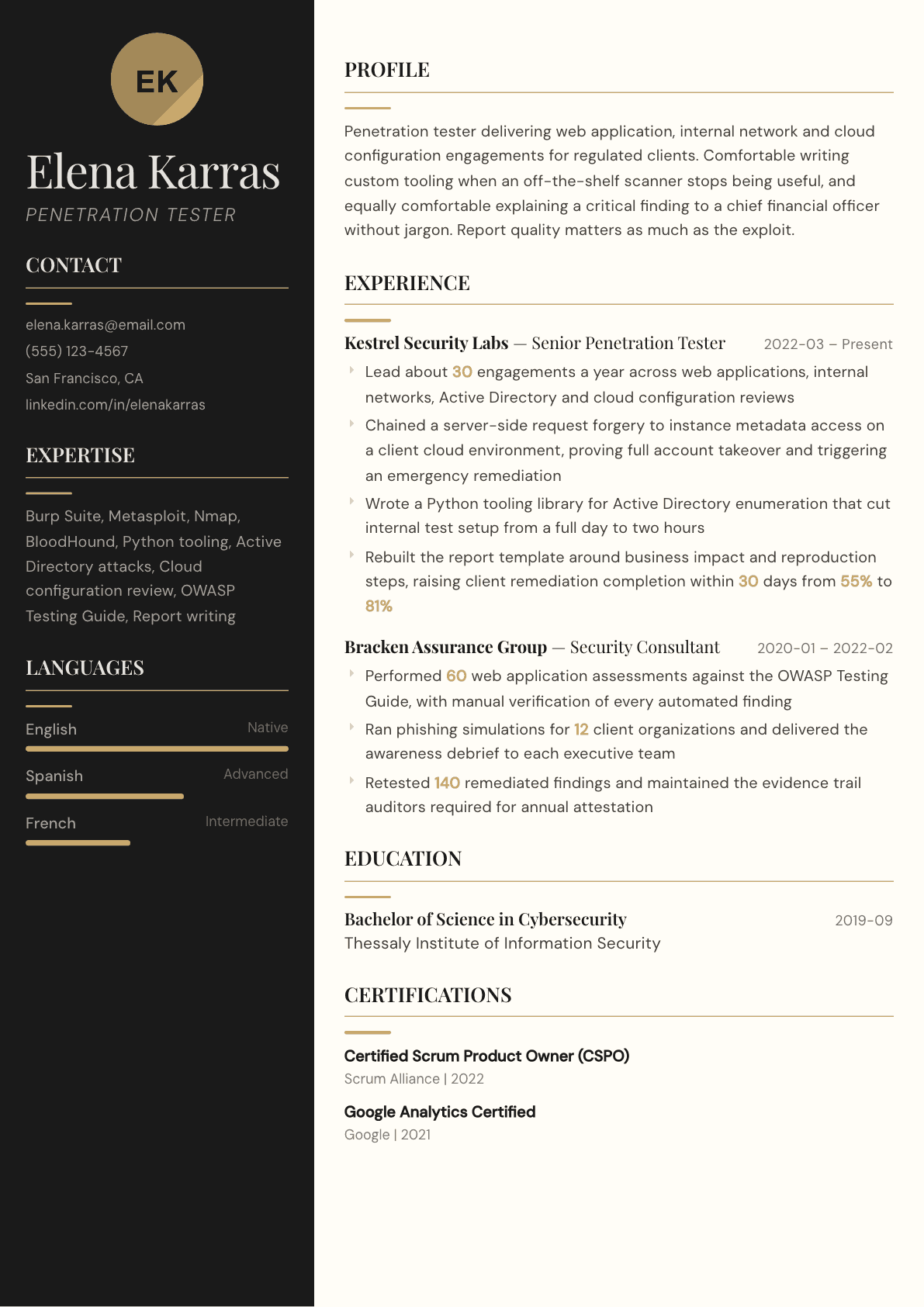
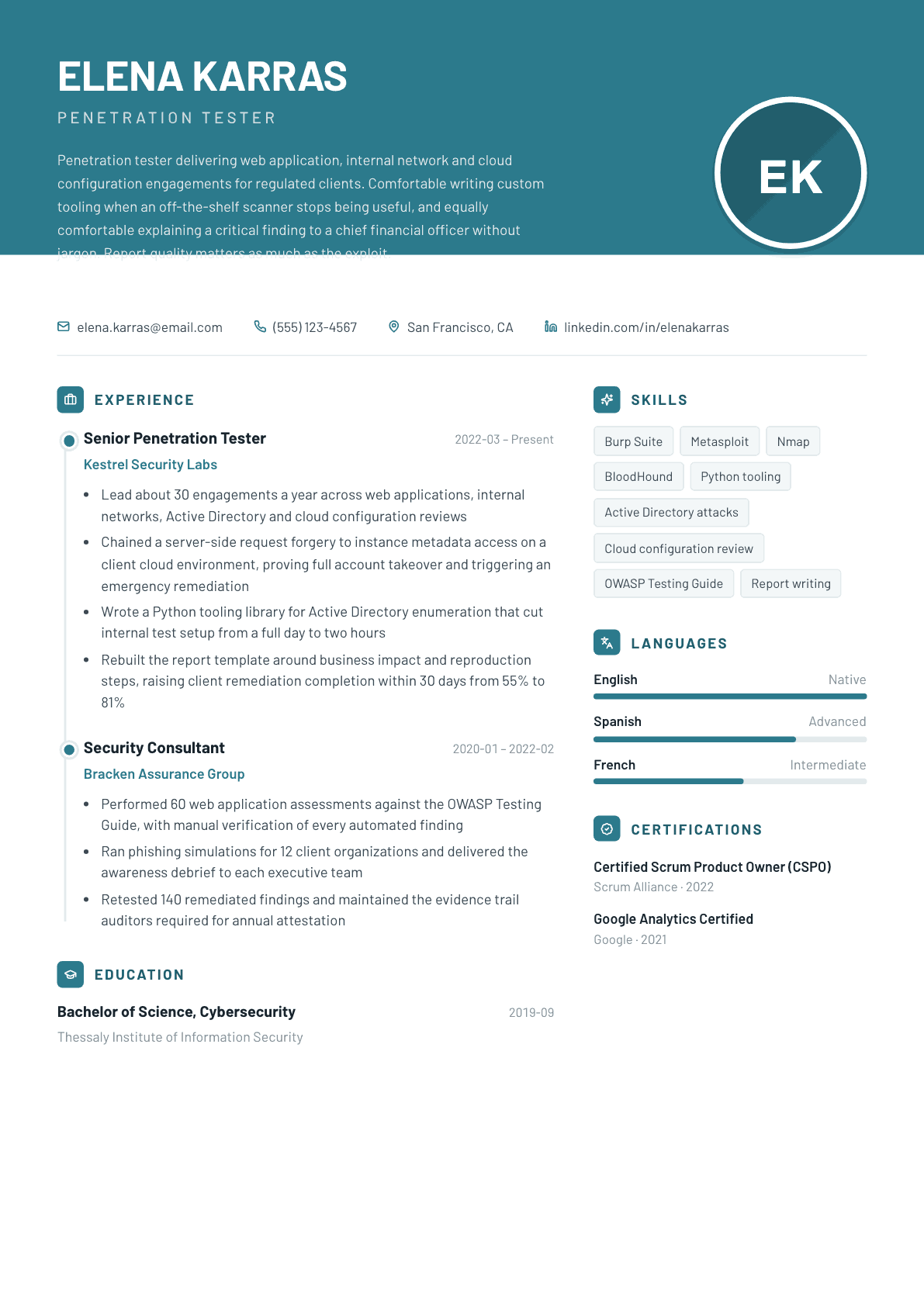
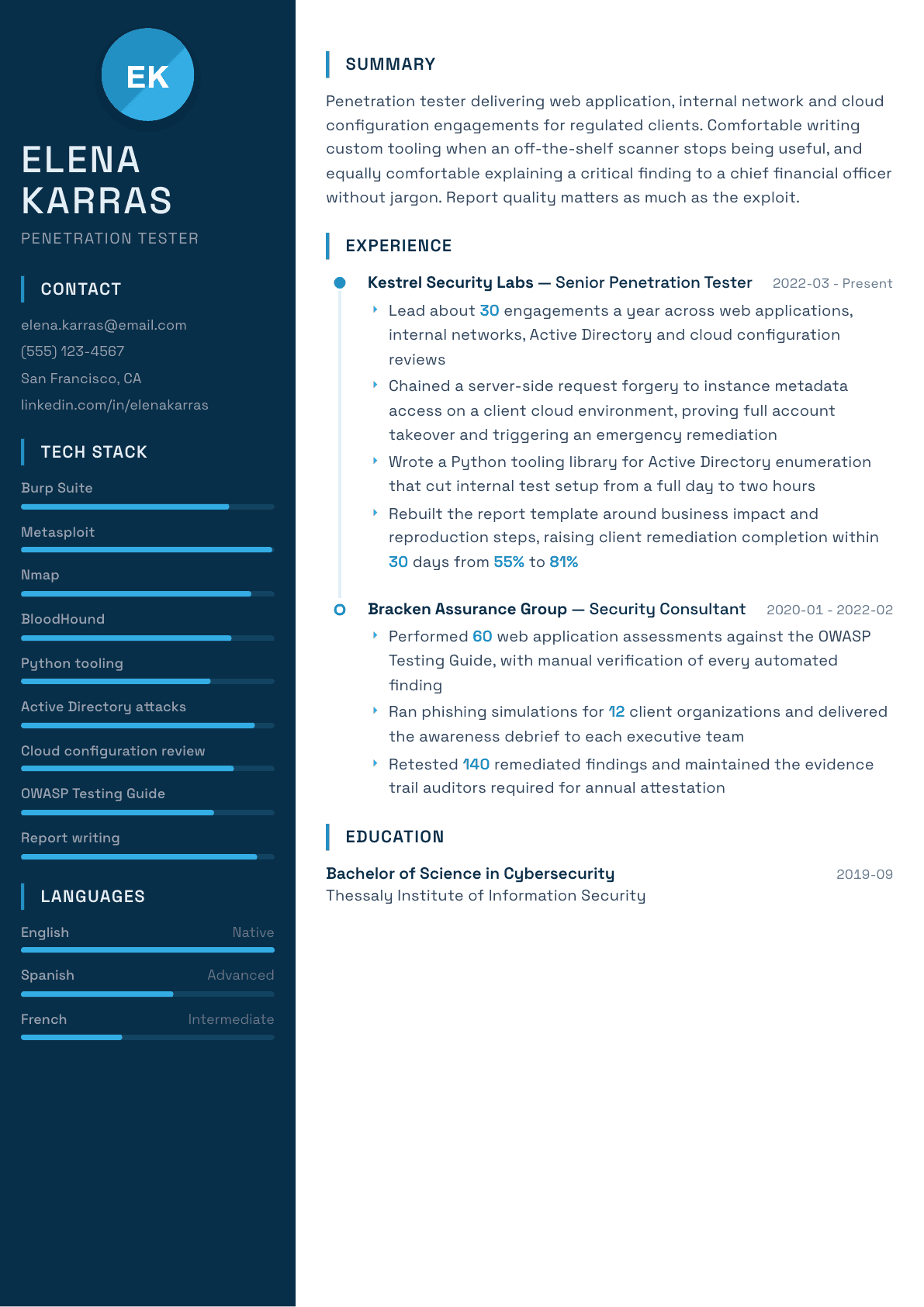
Example Penetration Tester summary
Penetration tester with six years of consulting engagements across web applications, internal networks, Active Directory and cloud configuration. Runs about thirty tests a year for regulated clients, writes custom Python tooling for enumeration, and manually verifies every automated result. Rebuilt an engagement report template around business impact and reproduction steps, which lifted client remediation completed within thirty days from 55% to 81%.
Skills to list on a Penetration Tester resume
- Web application testing
- Internal network testing
- Active Directory attack paths
- Cloud configuration review
- Burp Suite
- Metasploit
- Nmap and network enumeration
- BloodHound
- Wireshark
- Python and Bash tooling
- Social engineering and phishing
- OWASP Testing Guide
- MITRE ATT&CK
- Report writing and debriefs
- Retesting and remediation tracking
What actually gets this resume read
- Say how many engagements you run a year and what types they are, because volume and variety are how firms compare testers.
- Include one finding described end to end: the chain, the impact you proved, and how the client fixed it.
- Name the frameworks you test against, such as the OWASP Testing Guide, PTES or MITRE ATT&CK, so the scope of your work is clear.
- Report writing is half the job, so give evidence of it through remediation rates, retest volume or template work you led.
- List any custom tooling you have written, since a tester who codes stands out from one who runs a scanner.
- Keep certifications visible and exact, because OSCP and similar hands-on credentials are frequently a hard filter in this field.
How to write a penetration tester resume
The person hiring a penetration tester is buying two things: your ability to find a path into a system, and your ability to write it up so a client fixes it. Candidates tend to prove only the first. A resume packed with tool names and capture the flag rankings, with nothing about report quality, engagement volume or client debriefs, reads as hobbyist rather than consultant.
Engagement variety is the second signal. Web application, external and internal network, wireless, mobile, cloud configuration, social engineering and red team work all require different preparation, and a practice manager staffing a quarter wants to know which of those they can put you on next week.
This guide sets out how to structure the resume, three summaries by career stage, before and after bullets that replace tool lists with proven impact, and the questions testers ask when almost everything they have done sits under a nondisclosure agreement.
Format: one page early, two once engagements accumulate
Keep it plain and reverse-chronological. Add a short block under the summary listing engagement types, methodologies and tooling, in that order. Engagement types come first because staffing decisions are made on them.
Certifications belong high on the page. Hands-on credentials function as hard filters at many consultancies, and the recruiter screening the pile is often matching exact credential names rather than judging technique.
- Header: name, title, location, email, and current hands-on certifications.
- Order: summary, engagement types and tooling, experience, certifications, education, research or disclosures.
- Add a research line if you have published advisories, a tool or a conference talk.
Summary: engagement mix, client sectors, specialty
Say what you test, for whom, and what you are best at. A tester delivering roughly thirty engagements a year across web applications, internal networks and cloud configuration for financial clients is a person a practice lead can place immediately.
Name your specialty even if it narrows you. Depth in directory attack paths, application logic flaws or cloud identity abuse is more marketable than an even spread across everything.
Experience: findings, chains, and remediation outcomes
Open each role with volume and mix: engagements per year, the types, and the sectors. Then use the bullets to show technique and consequence. One bullet should describe a real attack chain in a sentence, ending with the impact you proved rather than the tool you ran.
Report and remediation work belongs in the bullets too. Rebuilding a report template, running executive debriefs, retesting fixes and tracking closure rates all demonstrate the consulting half of the job, which is exactly where junior testers are weakest.
If you have written tooling, say what it does and what it saved. A tester who automates enumeration or evidence collection is worth more per engagement, and the bullet also proves you can code.
- Volume: engagements per year, engagement types, client sectors.
- Technique: one chained finding, from initial access to proven impact.
- Consulting: report quality, debriefs, retests and remediation closure.
Methodology: name the standard you test against
Referencing an established methodology tells a reader your work is repeatable and defensible. The OWASP Testing Guide for applications, the Penetration Testing Execution Standard for broader engagements, and MITRE ATT&CK for adversary emulation are the usual anchors.
Mention scoping and rules of engagement experience if you have it. Testers who can run the pre-engagement conversation with a client, agree limits and handle out of scope discoveries responsibly are trusted with bigger accounts.
Keywords in offensive security postings
The recurring vocabulary includes web application testing, internal and external network testing, privilege escalation, lateral movement, Active Directory, cloud configuration review, social engineering, vulnerability chaining, exploit development, remediation guidance and report writing. Use the posting wording once in the tooling block and once in a bullet where a result backs it.
Penetration Tester resume summary examples
First testing role
Security analyst moving into offensive work, with two years of vulnerability management and a home lab covering web application and directory attack paths. Completed a hands-on certification and reports findings with reproduction steps and business impact. Seeking a junior penetration tester position with mentored engagements.
Four years in
Penetration tester delivering around 25 engagements a year across web applications, internal networks and phishing simulations for retail and healthcare clients. Chains findings rather than reporting them singly, and manually verifies every automated result. Writes Python tooling for enumeration and evidence collection.
Senior or lead tester
Senior penetration tester with eight years of consulting across finance and public sector clients, leading red team and cloud configuration engagements. Rebuilt the practice report template around business impact, lifting remediation completed within 30 days from 55% to 81%, and mentors three testers through their first solo engagements.
Work experience bullets: before and after
Before: Performed penetration tests using Burp Suite and Metasploit.
After: Delivered about 30 engagements a year across web applications, internal networks, directory services and cloud configuration reviews for regulated clients.
Volume, engagement types and client profile tell a practice lead where you can be staffed immediately.
Before: Found critical vulnerabilities in client systems.
After: Chained a server-side request forgery to instance metadata access, proving full cloud account takeover and triggering emergency remediation within 24 hours.
A described chain with proven impact demonstrates technique in a way that a severity label never can.
Before: Wrote penetration test reports for clients.
After: Rebuilt the engagement report template around business impact and reproduction steps, raising client remediation completed within 30 days from 55% to 81%.
Tying the report to a remediation outcome proves your writing changed client behavior.
Before: Automated some parts of testing with scripts.
After: Wrote a Python directory enumeration library that cut internal engagement setup from a full day to two hours and standardized evidence collection across the team.
Time saved and team adoption turn a scripting note into a contribution to the whole practice.
Before: Did phishing campaigns for clients.
After: Ran phishing simulations for 12 client organizations and delivered the awareness debrief to each executive team, including the pretexts that worked and why.
The debrief detail shows you can face a client leadership audience, not only run a campaign.
Hard skills
- Web application testing
- Internal and external network testing
- Active Directory attack paths
- Cloud configuration review
- Privilege escalation and lateral movement
- Burp Suite
- Metasploit
- Nmap and enumeration tooling
- BloodHound
- Wireshark and traffic analysis
- Python and Bash tooling
- Social engineering and phishing simulation
- OWASP Testing Guide and PTES
- Report writing and remediation guidance
Soft skills
- Explaining risk without jargon
- Client scoping conversations
- Restraint inside rules of engagement
- Handling sensitive findings discreetly
- Mentoring junior testers
- Writing under deadline
Certifications worth listing
- Offensive Security Certified Professional (OSCP) (OffSec)
- Offensive Security Web Expert (OSWE) (OffSec)
- GIAC Penetration Tester (GPEN) (GIAC)
- GIAC Web Application Penetration Tester (GWAPT) (GIAC)
- CompTIA PenTest+ (CompTIA)
Mistakes that cost penetration tester candidates the interview
- Listing tools instead of engagements, which leaves a practice lead unable to staff you on anything specific.
- Reporting findings by severity label alone, with no chain and no proven impact behind the rating.
- Omitting report writing and client debriefs, the half of the job that consultancies actually struggle to hire for.
- Leaning on capture the flag results as the main evidence when the role is client engagement work.
- Naming clients or leaking engagement detail, which raises an immediate professional judgment concern.
- Hiding certifications at the bottom when several employers filter applications on those exact titles.
Penetration Tester resume questions
How do I describe engagements covered by a nondisclosure agreement?
Describe the sector and the shape of the environment, never the client. A regional bank with a hybrid directory and a public payments application gives a hiring manager the context they need while keeping every identifying detail out of the document.
Is the OSCP required to get a penetration testing job?
It is not universal, but it is the credential most often used as a filter because the exam is hands on. If you lack it, compensate with documented engagement volume, published research or a tool you have written, and expect a longer path through screening.
Do capture the flag results belong on a professional resume?
They help early on, when you have little client work to show, and they should sit in a short research or competition line rather than in your experience section. Once you have paid engagements, replace them with real testing outcomes.
How much technical detail should a finding bullet include?
Enough for a technical reader to recognize the class of issue and the chain, but never enough to reproduce it against a former client. One sentence naming the initial flaw, the pivot and the impact you proved is the right depth for a resume.
Should I include a link to my research or tools?
Yes, when the work is genuinely yours and is presentable. Published advisories, a maintained tool or a conference talk carry real weight in this field, and a single line with the link near your contact details is enough to invite a look.
Related resume examples
- Cybersecurity Analyst Resume example
- Security Engineer Resume example
- Security Analyst Resume example
- Network Administrator Resume example
- SOC Analyst Resume example
- Cybersecurity Manager Resume example