Cybersecurity Analyst Resume Examples: read this first
Cyber Security Resume Template and Examples for Every Analyst Path
By Mustafa Tarabya, founder of CVBooster · Published · Updated
A cyber security resume template plus examples by specialty and a full cybersecurity analyst sample: SOC, vulnerability, incident response and detection.
Sample resumes for a cybersecurity analyst
The same cybersecurity analyst content laid out in three CVBooster templates, so you can see what the finished document looks like before you write a word.
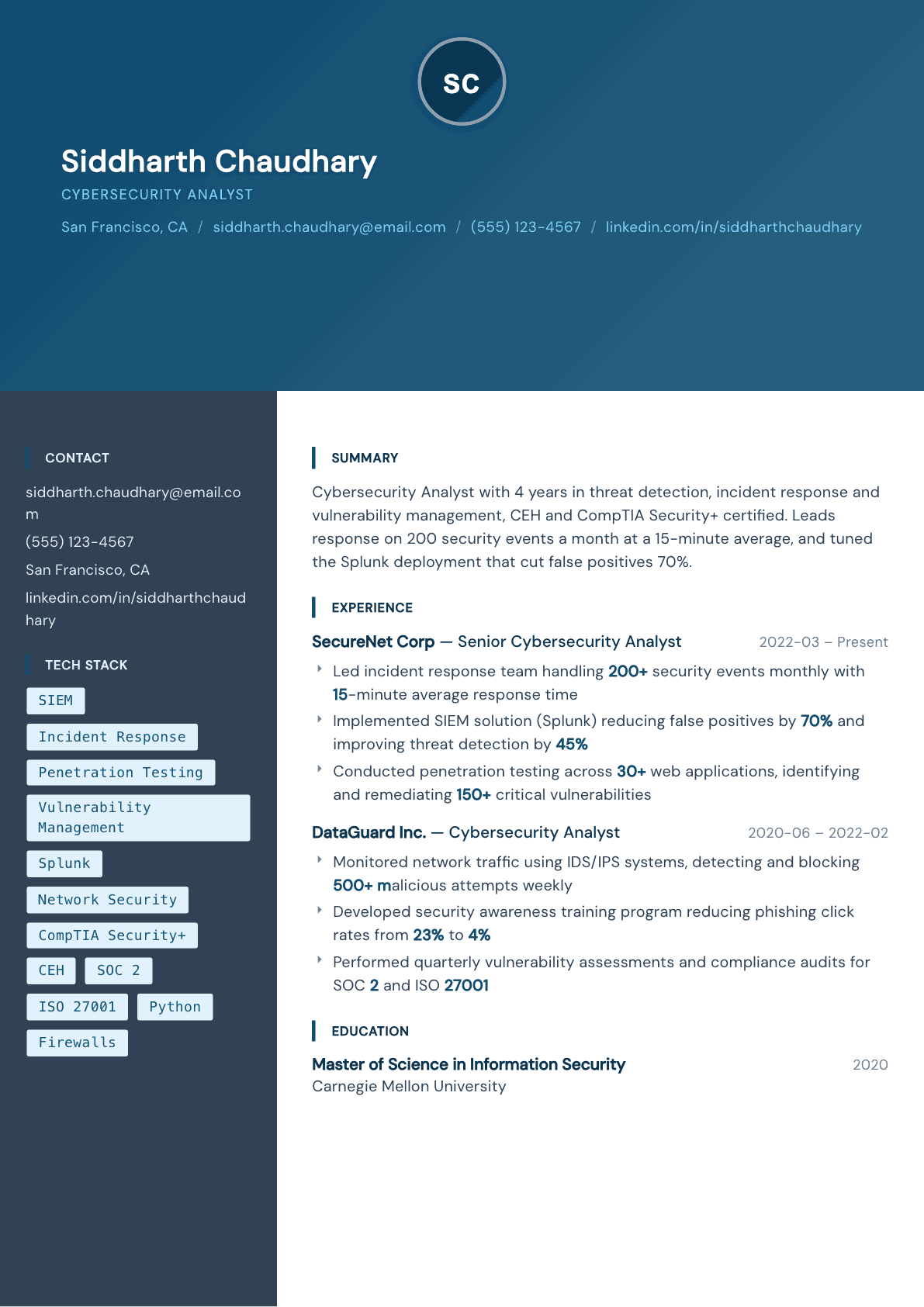
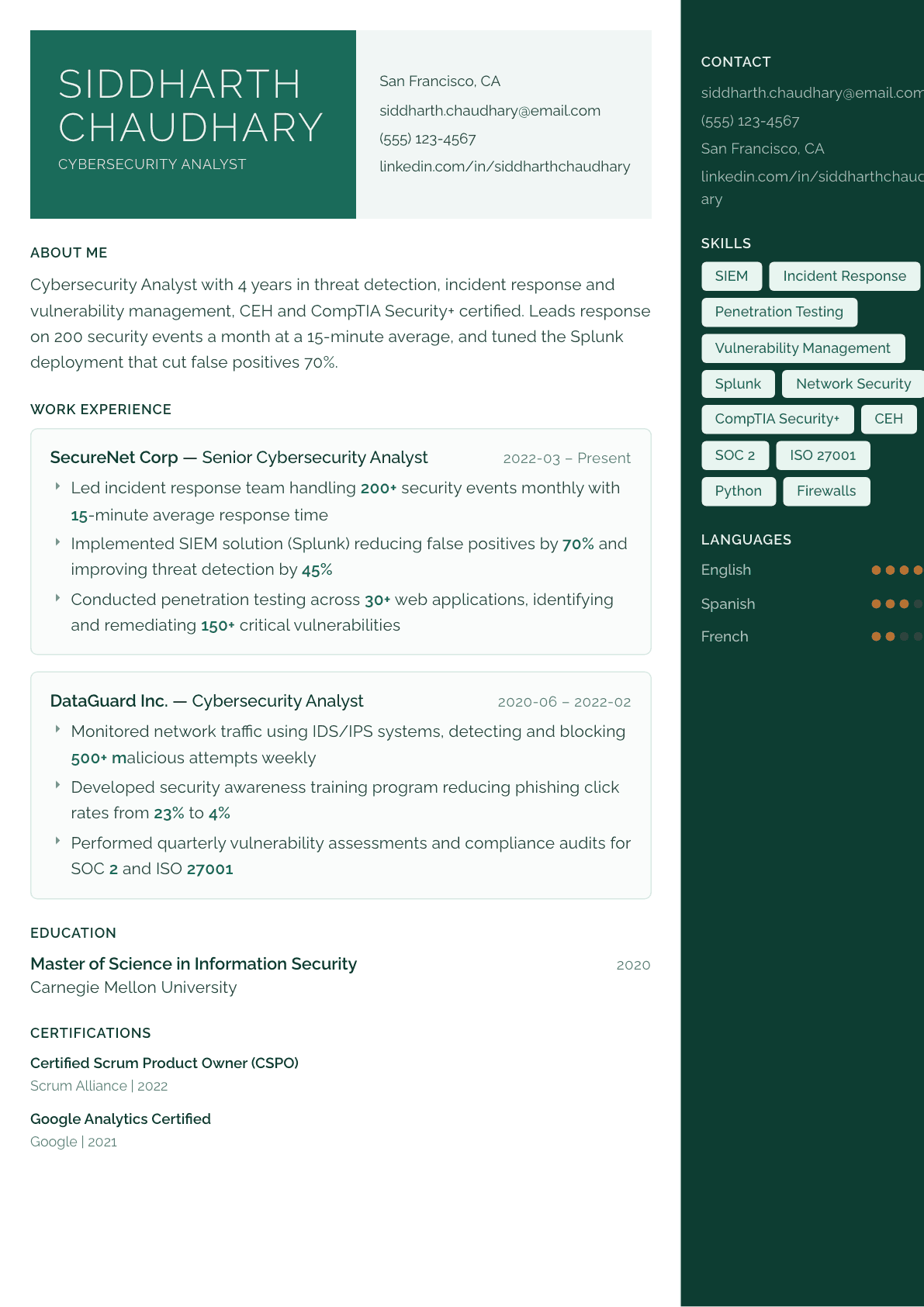
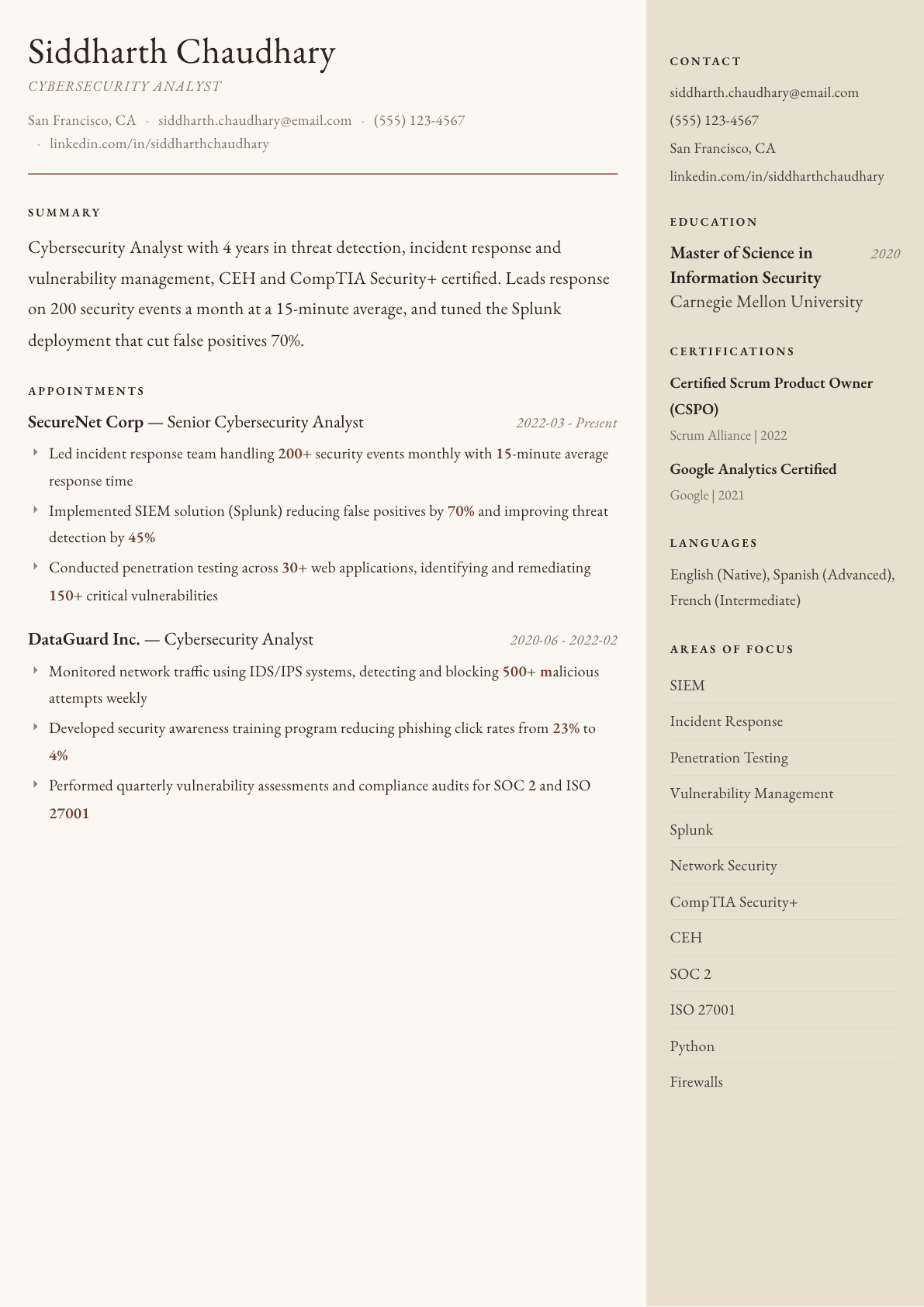
Example Cybersecurity Analyst summary
Security analyst, 4 years in a SOC, CEH and Security+ certified, handling 200 events a month with a 15-minute average response. Penetration tested 30 web applications and closed 150 critical findings, and built the awareness training that took phishing click rates from 23% to 4%.
Skills to list on a Cybersecurity Analyst resume
- SIEM
- Incident Response
- Penetration Testing
- Vulnerability Management
- Splunk
- Network Security
- CompTIA Security+
- CEH
- SOC 2
- ISO 27001
- Python
- Firewalls
What actually gets this resume read
- List the certifications you hold now and the ones in progress, and be exact, since CISSP requires five years of paid experience while Security+ and CEH do not.
- Quantify threat metrics: incidents handled, vulnerabilities found, response times.
- Show both technical depth and communication skills for reporting to leadership.
- Mention compliance frameworks you have experience with (SOC 2, HIPAA, PCI-DSS).
- Include experience with specific security tools and platforms.
How to write a cybersecurity analyst resume
A cybersecurity analyst resume is screened in two passes. A recruiter checks for the certification named in the posting, the tools, and whether you have worked a real alert queue. The security manager who reads it next wants to know how you think: can you tell a true positive from noise, do you know when to escalate, and have you ever written a detection instead of only closing tickets someone else wrote.
The trap in this field is that the job titles hide enormous differences. A tier one analyst in a managed service triaging hundreds of alerts a shift, an internal analyst running vulnerability management for one enterprise, and a threat hunter writing queries against raw telemetry all apply under the same title. If the page does not say which one you are, the reader assumes the most junior.
This guide gives you a cyber security resume template you can copy section by section, the sections a security manager actually reads, cyber security resume examples by specialty, three summaries at recognizable levels, before-and-after bullets that turn ticket counts into judgment, and the questions analysts ask when they try to move up a tier.
Cyber security resume template: one page, certifications high on the page
Reverse chronological, one column, plain text. Security hiring runs through applicant tracking systems that filter on credential strings, so write Security+, CySA+, GCIH or CISSP exactly as the issuing body does, and repeat the full name once so a human reader is never guessing.
If you hold a clearance, or you are eligible for one, put it in the header area. If you work shifts in an operations center, say so in the role line, because shift coverage is part of what the hiring manager is staffing.
- Header: name, title, location, email, certifications, clearance status if applicable.
- Order: summary, certifications, experience, technical skills, home lab or projects, education.
- Name the security information and event management platform in the role line: it is the first thing a manager checks.
- Template role line: title, employer, city, dates, then tier or scope and shift pattern, for example Tier 2 analyst, 24 hour operations center, rotating nights.
- Template skills block: four labeled rows for detection and monitoring, endpoint and network, cloud and identity, scripting and automation.
Summary: tier, environment, telemetry, and the specialty you are building
Three lines. State the tier or scope you have worked at, the size and type of environment, the main telemetry sources you have lived in, and the direction you are heading: detection engineering, incident response, vulnerability management, threat intelligence or compliance.
Skip the phrase passionate about security. The reader assumes it and it costs you a line that could have named the platform you tune and the attack technique you are best at spotting.
Experience: the queue, the escalation, and the thing you changed
Give the environment first: number of endpoints or users, industry, whether the operations center runs around the clock, and whether it is internal or a managed service with multiple clients. Then write bullets around three kinds of work. Triage: what you handled, the volume, and how you separated real activity from noise. Response: what you did when it was real, in sequence, with the containment step named. Improvement: the detection you wrote, the playbook you documented, the false positive source you eliminated.
The improvement bullets are what promote an analyst. Anyone can close alerts. Someone who tuned a rule so the queue dropped, or wrote a query that found something the existing rules missed, is describing the job one tier up.
Map your detection work to a framework the reader knows. Naming the technique you built coverage for, in the vocabulary of the MITRE ATT&CK matrix, communicates more in five words than a paragraph of description.
Tools: say what you did with each one, not that it existed
A tools list is necessary for the parser but weak on its own. Split it: platforms you administered and wrote content in, platforms you used daily as an analyst, and platforms you have touched. Splunk, Microsoft Sentinel, Elastic, CrowdStrike, Defender for Endpoint, Nessus, Qualys, Wireshark and the ticketing system all mean different things depending on which group they sit in.
Scripting belongs here too. Python or PowerShell used to enrich alerts, pull indicators, or automate a repetitive triage step is one of the clearest signals that an analyst is ready for more responsibility.
Home lab and projects: the section that rescues a thin history
If your paid experience is short, a projects block is the strongest thing on the page. Build detections in a lab, ingest telemetry, run an attack simulation and write the detection that catches it, then describe it exactly as you would a work task. Capture-the-flag placements, a documented lab build and blue team exercise write-ups all count.
Keep it concrete. The reader wants what you built, what you tested against it, and what you learned when the detection missed, not a list of virtual machines you installed.
Cyber security resume examples by specialty
A sample cyber security resume is only useful if it comes from the specialty you are applying for, because a SOC manager, a vulnerability management lead and an incident response lead read for different proof. The complete sample on this page is written for a SOC analyst. The examples below show how the headline and the first bullet change for the other common paths.
Keep the same order in every version: specialty and environment in the headline, certifications beside it, then a first bullet that shows a decision you made rather than a queue you sat in front of.
- SOC analyst, tier one: Triage of SIEM and EDR alerts for a managed security service with many client environments, documented escalations to tier two and tuning requests for noisy rules.
- Vulnerability management analyst: Owned weekly scanning for an enterprise network, ranked findings by exposure and asset criticality, and tracked remediation with system owners to closure.
- Incident response analyst: Led containment on phishing and credential compromise cases, collected host and email evidence, and wrote the timeline and lessons learned for each case.
- Detection engineer: Wrote and tested detection rules mapped to MITRE ATT&CK techniques, retired rules that only produced noise, and documented each rule for the analysts who receive the alert.
- Governance, risk and compliance analyst: Mapped controls to a security framework, gathered audit evidence from system owners and kept the risk register current between assessments.
Cybersecurity Analyst resume summary examples
First analyst role
Security+ certified analyst with 1 year on a help desk and a home lab running Elastic against simulated attacks. Wrote 15 detections mapped to ATT&CK techniques, documented triage steps for each, and completed a defensive analyst course with a hands-on practical exam.
Three years in the operations center
Cybersecurity analyst with 3 years in a 24-hour operations center covering 9,000 endpoints. Triages roughly 60 alerts per shift in Microsoft Sentinel, leads phishing response, and cut one noisy rule family 70% by rewriting the logic against real user behavior.
Senior analyst or detection lead
Senior cybersecurity analyst with 8 years across incident response and detection engineering in financial services. Owns the detection backlog and ATT&CK coverage map, led response on two confirmed intrusions, and mentors 4 tier one analysts on triage and escalation quality.
Work experience bullets: before and after
Before: Monitored security alerts and escalated issues.
After: Triaged around 60 alerts per shift in Microsoft Sentinel across endpoint, identity and email telemetry, escalating confirmed intrusions to tier two with a written timeline, affected assets and containment recommendation.
Volume, telemetry sources and the content of the escalation show the quality of your handoff, not just that you escalated.
Before: Reduced false positives in our SIEM.
After: Rewrote the impossible-travel rule to exclude sanctioned VPN egress ranges and corporate mobile device management check-ins, cutting that alert family 74% while keeping every true detection from the previous quarter replay.
Naming the tuning logic and testing against historical true positives proves the noise reduction did not hide real activity.
Before: Responded to a phishing incident.
After: Led response to a credential phishing campaign that reached 40 mailboxes: pulled the messages tenant-wide, revoked sessions and reset the 6 accounts that submitted credentials, and blocked the infrastructure at the proxy within the hour.
A sequence of containment actions with counts and timing reads as real incident work rather than a ticket note.
Before: Performed vulnerability scanning and reporting.
After: Ran authenticated Nessus scans across 2,300 hosts, prioritized by exploitability and exposure rather than raw severity, and worked with the server team to bring critical remediation from 45 days to 11.
Risk-based prioritization and a remediation time change show ownership of the outcome, not just delivery of a report.
Before: Wrote scripts to help the team.
After: Wrote a Python enrichment step that pulled reputation, asset owner and recent authentication history into every alert at ingest, removing three manual lookups per case from the triage workflow.
Naming what the automation removed makes the value obvious to a manager measuring analyst time.
Hard skills
- SIEM triage and query writing
- Microsoft Sentinel
- Splunk
- Endpoint detection and response
- Phishing analysis and email security
- Log analysis across endpoint, identity and network
- MITRE ATT&CK mapping
- Vulnerability scanning and prioritization
- Network traffic analysis
- Incident documentation and timelines
- Python and PowerShell scripting
- Threat intelligence enrichment
Soft skills
- Escalation judgment
- Concise incident writing
- Working a queue under time pressure
- Explaining risk to non-technical staff
- Handover discipline across shifts
- Curiosity about anomalies
Certifications worth listing
- CompTIA Security+ (CompTIA)
- CompTIA CySA+ (CompTIA)
- GIAC Certified Incident Handler (GCIH) (GIAC)
- GIAC Security Essentials (GSEC) (GIAC)
- Certified Information Systems Security Professional (CISSP) (ISC2)
- Microsoft Certified: Security Operations Analyst Associate (Microsoft)
- Blue Team Level 1 (Security Blue Team)
Mistakes that cost cybersecurity analyst candidates the interview
- Counting tickets closed as the headline achievement. Volume without judgment describes a queue, not an analyst.
- Listing certifications you are studying for as if you hold them. Verify-first recruiters check the credential registry.
- Leaving the SIEM platform off the page, which forces a manager to guess whether you can start without months of retraining.
- Describing an incident without the containment actions, so the reader cannot tell whether you handled it or watched it.
- Padding the tools line with products you saw a colleague use. Interviews open with a tuning question on the first tool named.
- Using cyber jargon with no environment behind it. Zero trust and defense in depth mean nothing without the estate you applied them to.
- Omitting a home lab when experience is thin, which leaves an entry-level page with nothing technical on it at all.
Cybersecurity Analyst resume questions
What certification should I get first as a cybersecurity analyst?
Security+ is the credential most job postings screen for at entry level, and CySA+ or a GIAC defensive certification is the natural second once you are working alerts daily. Choose the second one to match the specialty you want, not the one with the best marketing.
How do I get a security analyst job with only help desk experience?
Rewrite the help desk work in security terms: account lockouts, phishing reports you handled, endpoint agent troubleshooting, patch deployment. Then add a documented home lab with detections you wrote and tested, which gives the manager something technical to ask about.
What should a cyber security resume example include?
Your specialty and environment in the headline, certifications high on the page, the tools you actually worked in, and bullets that show decisions: escalations, detections written, vulnerabilities driven to closure. Capture the flag results and a home lab belong there too while your paid experience is short.
How do I describe incidents without leaking confidential information?
Use the technique and the actions rather than the victim and the outcome. Describing credential phishing against a set of mailboxes, session revocation and infrastructure blocking is standard vocabulary that exposes nothing specific about the employer.
Which cyber security resume template works with applicant tracking systems?
A single column template with standard headings, plain text and no tables, icons or skill bars. Put certifications in their own section near the top with the exact credential names, and keep tools inside the experience bullets as well as in the skills block. A designed two column layout can scramble the order a screening system reads.
Related resume examples
- IT Specialist Resume example
- Software Engineer Resume example
- DevOps Engineer Resume example
- Cybersecurity Manager Resume example
- Security Engineer Resume example
- Security Analyst Resume example