Network Administrator Resume Examples: read this first
Write a Network Administrator Resume That Names Your Topology
By Mustafa Tarabya, founder of CVBooster · Published · Updated
A network administrator resume built around switching, routing, firewalls and wireless, with a sample resume, keyword list and a full writing guide.
Sample resumes for a network administrator
The same network administrator content laid out in three CVBooster templates, so you can see what the finished document looks like before you write a word.
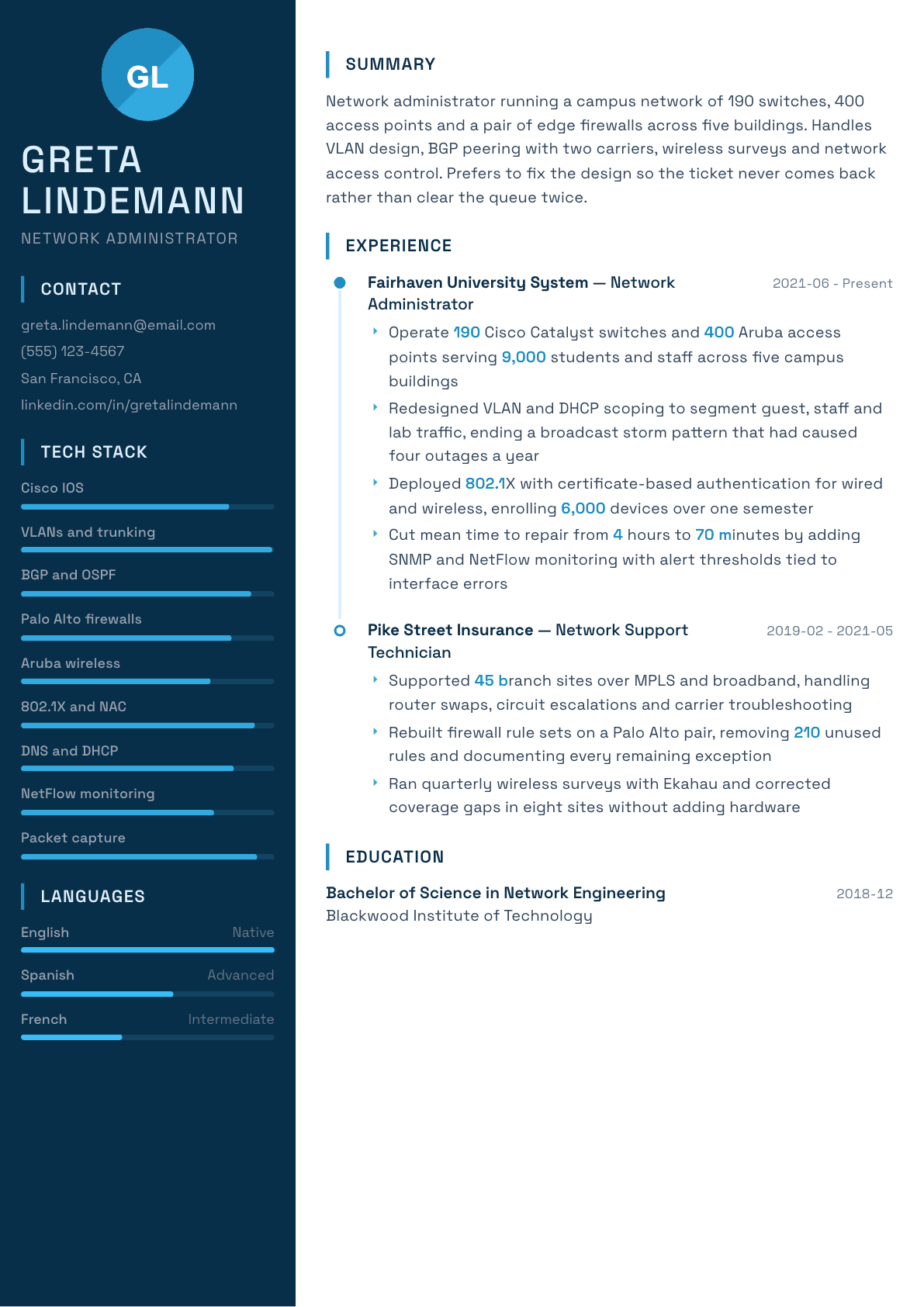
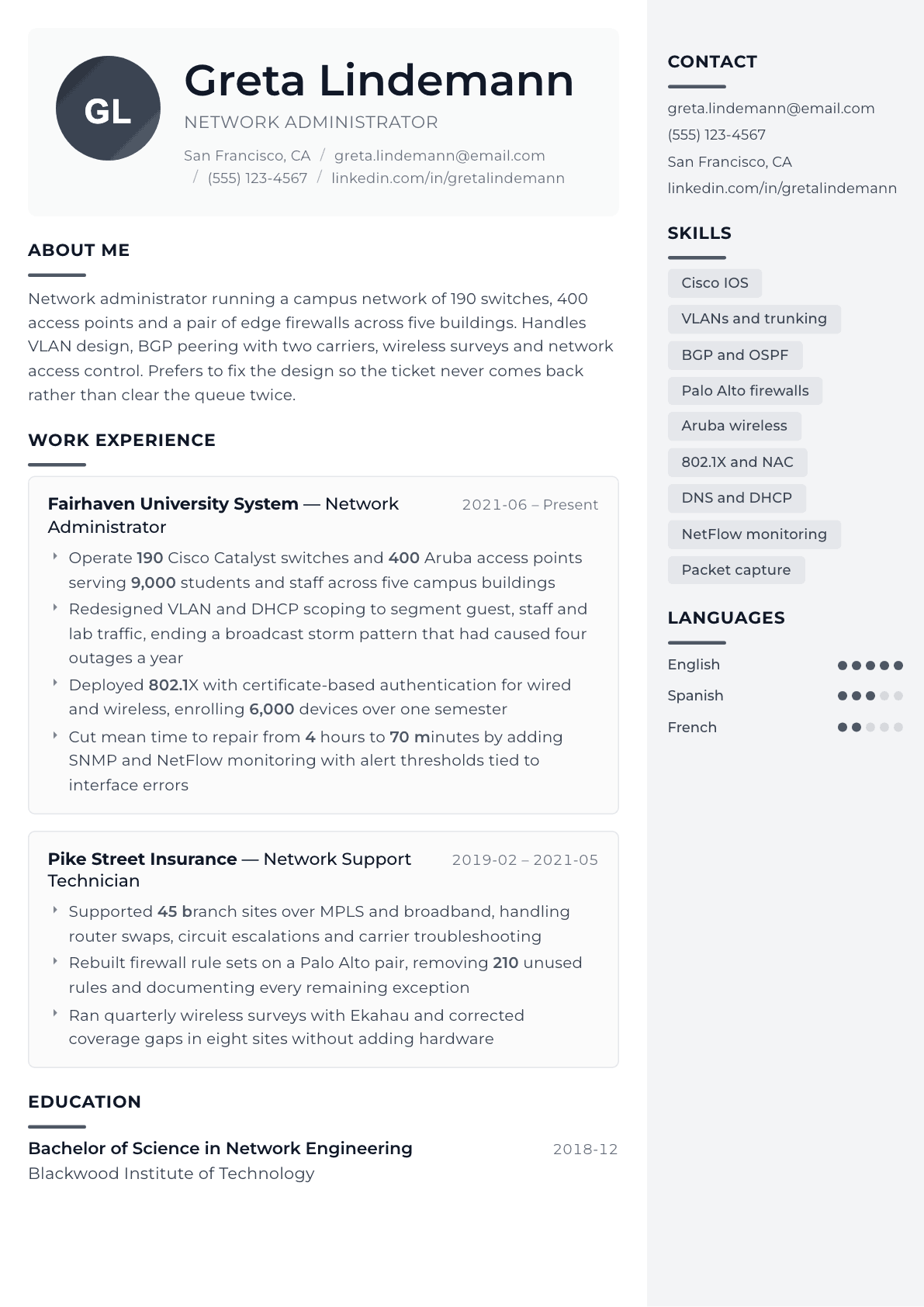
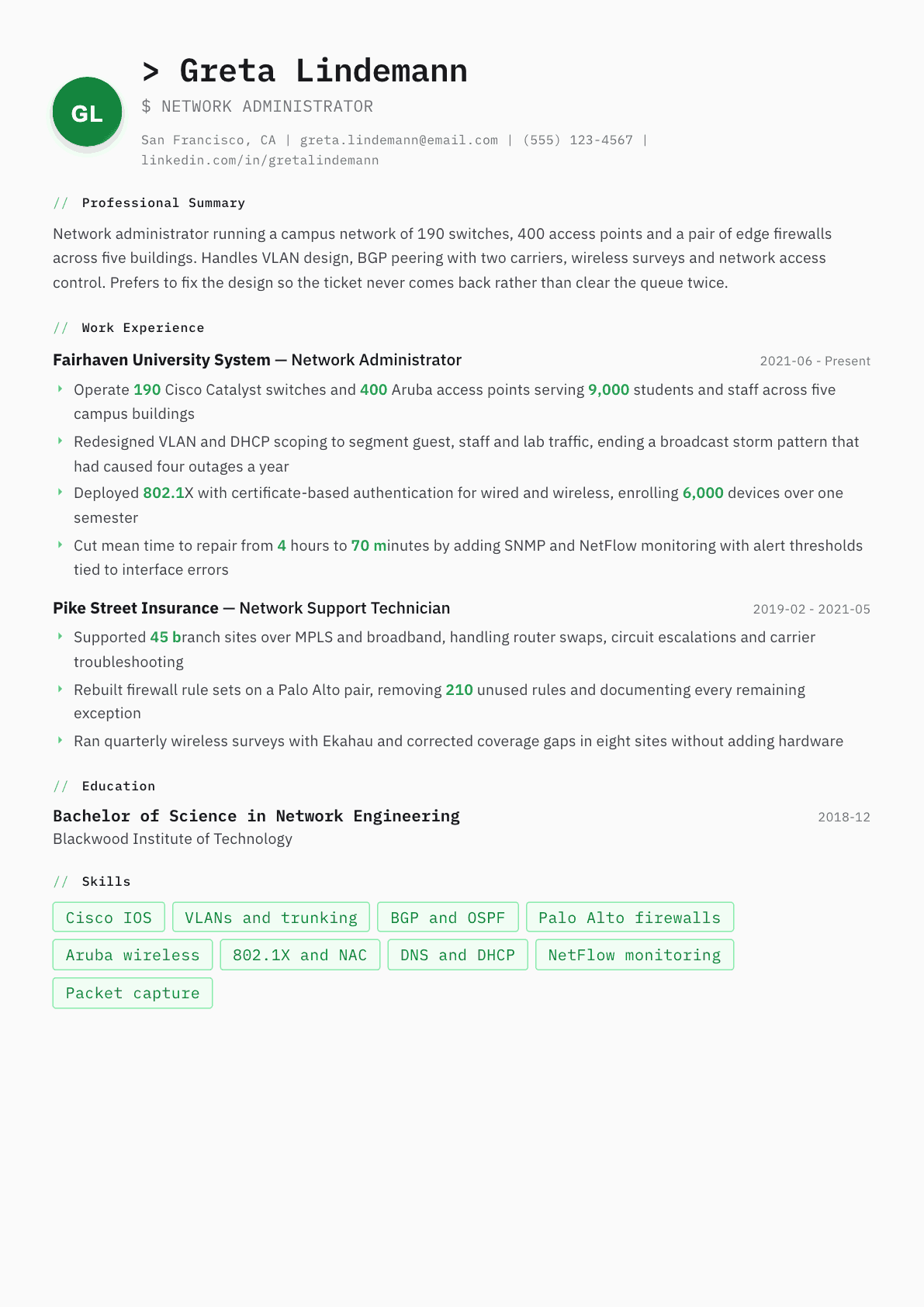
Example Network Administrator summary
Network administrator with six years running campus and branch networks for schools and insurance offices. Configures Cisco switching, BGP peering and Palo Alto firewalls, and designs VLAN segmentation that keeps guest, staff and lab traffic apart. Deployed certificate-based 802.1X to 6,000 devices and cut mean time to repair from four hours to just over one by adding flow monitoring tied to interface error thresholds.
Skills to list on a Network Administrator resume
- Cisco IOS and NX-OS
- VLAN design and trunking
- BGP
- OSPF
- Spanning tree
- Firewall administration
- VPN and IPsec
- Wireless LAN and site surveys
- 802.1X and network access control
- DNS, DHCP and IPAM
- NetFlow and SNMP monitoring
- Packet capture and analysis
- Network documentation
- Structured cabling
What actually gets this resume read
- Describe the network by its shape: device counts, site counts, user counts, carrier links and whether it is campus or branch.
- Name the vendors you have configured in production, because Cisco, Juniper, Fortinet and Palo Alto shops screen on vendor first.
- Give routing protocols real context, such as the number of BGP peers or the size of the OSPF area you maintained.
- Show one outage you diagnosed end to end, including the capture or flow data that pointed at the cause.
- Quantify firewall and access control work through rule counts, segments created or devices enrolled in 802.1X.
- Put certifications near the top of the page, since network postings often filter on CCNA or equivalent before a human reads.
How to write a network administrator resume
A network administrator resume is judged on topology, vendor and evidence. The manager reading it wants to picture your network within a few seconds: how many switches, how many access points, how many sites, which carriers, and whether it is a single campus or a hundred branches stitched together. Candidates who leave that out force the reader to assume the smallest possible answer.
Vendor matters more here than in most infrastructure roles. A team running Cisco and Palo Alto screens differently from a team running Juniper and Fortinet, because muscle memory in a command line and a policy model does not transfer instantly. Naming the platforms you have configured in production, not studied for an exam, is what gets the call.
This guide sets out the section order for the role, three summaries covering early, mid and senior careers, before and after bullets that fix the phrasing network staff fall into, and the questions that come up when you try to prove routing and security work on one page.
Format: single column, certifications visible above the fold
Keep it reverse-chronological and plain. Network postings are among the most heavily filtered in infrastructure, and a credential line placed low on the second page can cost you a match before a person ever opens the file.
Put a short technical block under the summary covering routing, switching, security, wireless and monitoring. Five lines is enough, and each line should name the platforms you have run rather than every protocol you can define.
- Header: name, title, location, phone, email, and current certifications listed on one line.
- Order: summary, technical block, experience, certifications, education.
- Group by function: routing and switching, security, wireless, services, monitoring.
Summary: the topology in two sentences
Describe the environment by its shape and size, then name your specialty. Running a five building campus with two carrier links is a different craft from supporting forty branch sites over broadband and a software defined overlay, and a manager will read one line and know which of those you have done.
Add the specialty you want to be hired for. If your strongest work is firewall policy and segmentation rather than carrier routing, say so, because the two paths lead to different teams.
Experience: design decisions beat device counts alone
Open each role with the network scope line, then write bullets about decisions rather than duties. Configured switches is a duty. Redesigning VLAN and DHCP scoping so guest, staff and lab traffic no longer share a broadcast domain is a decision, and the reader can see the reasoning behind it.
Give outages their own bullet when you diagnosed one properly. Name the symptom, the evidence you collected from flow data or a packet capture, and the design change that stopped it recurring. Network hiring managers weigh that bullet heavily because troubleshooting under pressure is the daily work.
Wireless is often the weakest section on these resumes. If you have run surveys, tuned channel plans, or corrected coverage without buying hardware, write it down with the number of sites involved.
- Scope line: switches, routers, access points, firewalls, sites, users, carrier links.
- Routing bullets: protocol, peer or area counts, and what changed after your work.
- Security bullets: rules removed, segments created, devices enrolled in access control.
Certifications: exact titles, current status
Write the full credential name and the vendor. Many network postings set a certification as a hard requirement, and an abbreviation that the filter does not recognize is a wasted application.
If a credential has lapsed, either renew it or leave it off. An expired professional level certification listed as current is the kind of detail a technical interviewer checks.
Keywords that appear in almost every posting
The recurring vocabulary is narrow: VLAN, trunking, spanning tree, BGP, OSPF, VPN, IPsec, firewall policy, wireless LAN, network access control, DNS, DHCP, IP address management, SNMP, NetFlow, quality of service, and the vendor names. Mirror the posting language once in the technical block and once inside a bullet with a number beside it.
Network Administrator resume summary examples
First network role
Service desk technician moving into network support, handling switch port and wireless issues for 700 users across three offices. Configures VLANs and access points under supervision, documents cabling and IP allocation, and holds a current CCNA. Looking for a junior network administrator position with mentoring.
Five years in
Network administrator running 120 Cisco switches, 300 access points and a firewall pair for a 6,000 user campus. Redesigned VLAN segmentation that ended a recurring broadcast storm, and deployed certificate-based 802.1X to 5,000 devices in one term. Comfortable with BGP peering across two carriers.
Senior administrator
Senior network administrator with ten years across campus and branch environments, currently responsible for 190 switches, 45 remote sites and the security edge. Owns routing policy, firewall standards and the monitoring stack, and cut mean time to repair from four hours to just over one by instrumenting interface errors.
Work experience bullets: before and after
Before: Maintained the company network and resolved connectivity issues.
After: Operated 190 Catalyst switches and 400 access points serving 9,000 users across five buildings, including VLAN design, DHCP scoping and wireless coverage.
Device, user and site counts let a manager compare your network to the one they need staffed.
Before: Worked with BGP and OSPF routing.
After: Maintained BGP peering with two carriers and a redundant OSPF core, converting a single default route design into dual-homed failover tested twice a year.
Naming the peers and the design change shows ownership rather than exposure to a protocol.
Before: Configured firewalls and VPN access.
After: Rebuilt a Palo Alto rule base, removing 210 unused rules, documenting every remaining exception, and moving remote access to certificate-based authentication.
Rule counts and the authentication change give a security bullet something measurable to stand on.
Before: Improved network monitoring.
After: Added SNMP and NetFlow collection with alerts tied to interface error and discard thresholds, cutting mean time to repair from 4 hours to 70 minutes.
The thresholds explain how the monitoring works and the repair time proves it paid off.
Before: Handled wireless issues at multiple locations.
After: Ran quarterly Ekahau surveys across eight sites and corrected coverage gaps through channel and power tuning rather than additional access points.
The survey tool and the decision to tune instead of buy demonstrate genuine wireless judgment.
Hard skills
- Cisco IOS and NX-OS
- VLAN design and trunking
- Spanning tree protocol
- BGP
- OSPF
- Firewall policy administration
- IPsec and remote access VPN
- Wireless LAN controllers and site surveys
- 802.1X and network access control
- DNS, DHCP and IP address management
- SNMP and NetFlow monitoring
- Packet capture with Wireshark
- Quality of service
- Network documentation and diagramming
Soft skills
- Structured fault isolation
- Carrier and vendor escalation
- Clear change windows and notices
- Working with security and server teams
- Explaining outages to leadership
- Patience during long capture sessions
Certifications worth listing
- Cisco Certified Network Associate (CCNA) (Cisco)
- Cisco Certified Network Professional Enterprise (CCNP Enterprise) (Cisco)
- CompTIA Network+ (CompTIA)
- Juniper Networks Certified Associate, Junos (JNCIA-Junos) (Juniper Networks)
- Aruba Certified Switching Associate (Hewlett Packard Enterprise)
Mistakes that cost network administrator candidates the interview
- Listing protocols you can define rather than platforms you have configured in a production change window.
- Omitting site and device counts, which makes a large multi-site estate read like a single office closet.
- Burying certifications on the second page when many postings filter on them before a person reads anything.
- Writing troubleshooting bullets with no root cause, so the reader cannot tell whether the fix was a reboot.
- Ignoring wireless entirely, even though it generates a large share of the tickets in most environments.
- Claiming design experience without naming a single decision, constraint or trade-off you made.
Network Administrator resume questions
Do I need a CCNA to work as a network administrator?
Not always, but it clears filters faster than anything else in this field, especially for employers running Cisco hardware. If you already have several years of hands-on switching and routing work, a professional level credential is usually the better investment.
How do I write a resume if my network is small?
Describe breadth honestly and emphasize ownership. In a small environment one person often runs switching, firewall, wireless, VPN and monitoring together, which is a real advantage. Give the user and site counts plainly and let the range of responsibility carry the page.
Should I list every vendor I have touched?
List the ones you have configured under change control and mark the rest as exposure if you mention them at all. A technical interviewer will pick a vendor from your list and ask a command-level question, so an inflated list costs more than it earns.
How much detail about outages should I include?
One outage per role is enough, described in a single bullet with the symptom, the evidence and the permanent fix. Longer accounts belong in the interview, where you can answer follow-up questions about what you ruled out along the way.
Is software defined networking experience worth adding?
Yes, when it is real. Overlay fabrics and controller-based management now appear in many branch environments, so name the platform and the number of sites you migrated. Keep classic routing, switching and security depth as the foundation underneath it.
Related resume examples
- Network Engineer Resume example
- Cybersecurity Analyst Resume example
- System Administrator Resume example
- IT Support Specialist Resume example
- Infrastructure Engineer Resume example
- Cloud Engineer Resume example