Security Engineer Resume Examples: the lines they read
Fortify Your Career with a Security Engineer Resume
By Mustafa Tarabya, founder of CVBooster · Published · Updated
Build a security engineer resume that demonstrates your expertise in protecting systems, networks, and data from cyber threats.
Sample resumes for a security engineer
The same security engineer content laid out in three CVBooster templates, so you can see what the finished document looks like before you write a word.
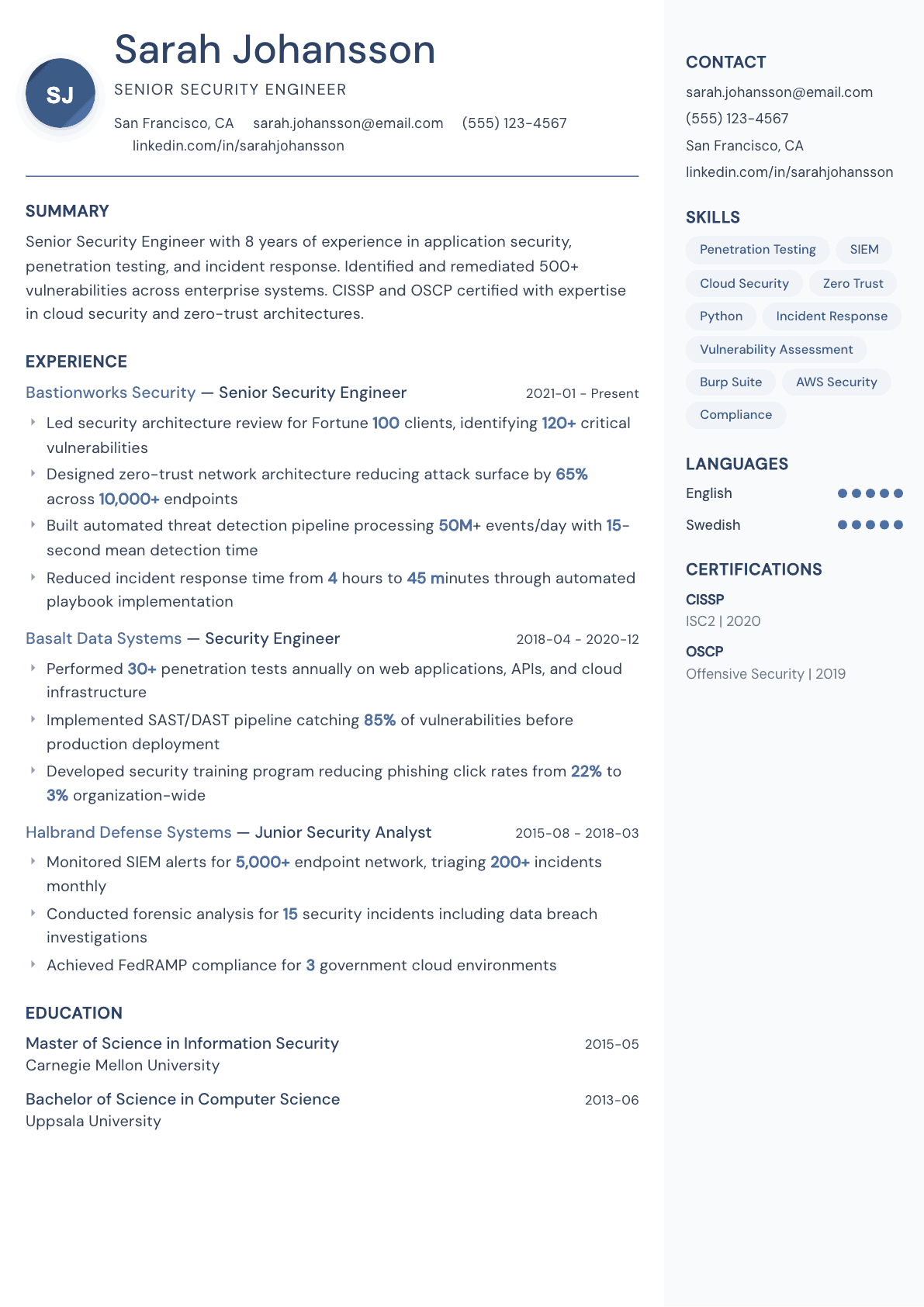
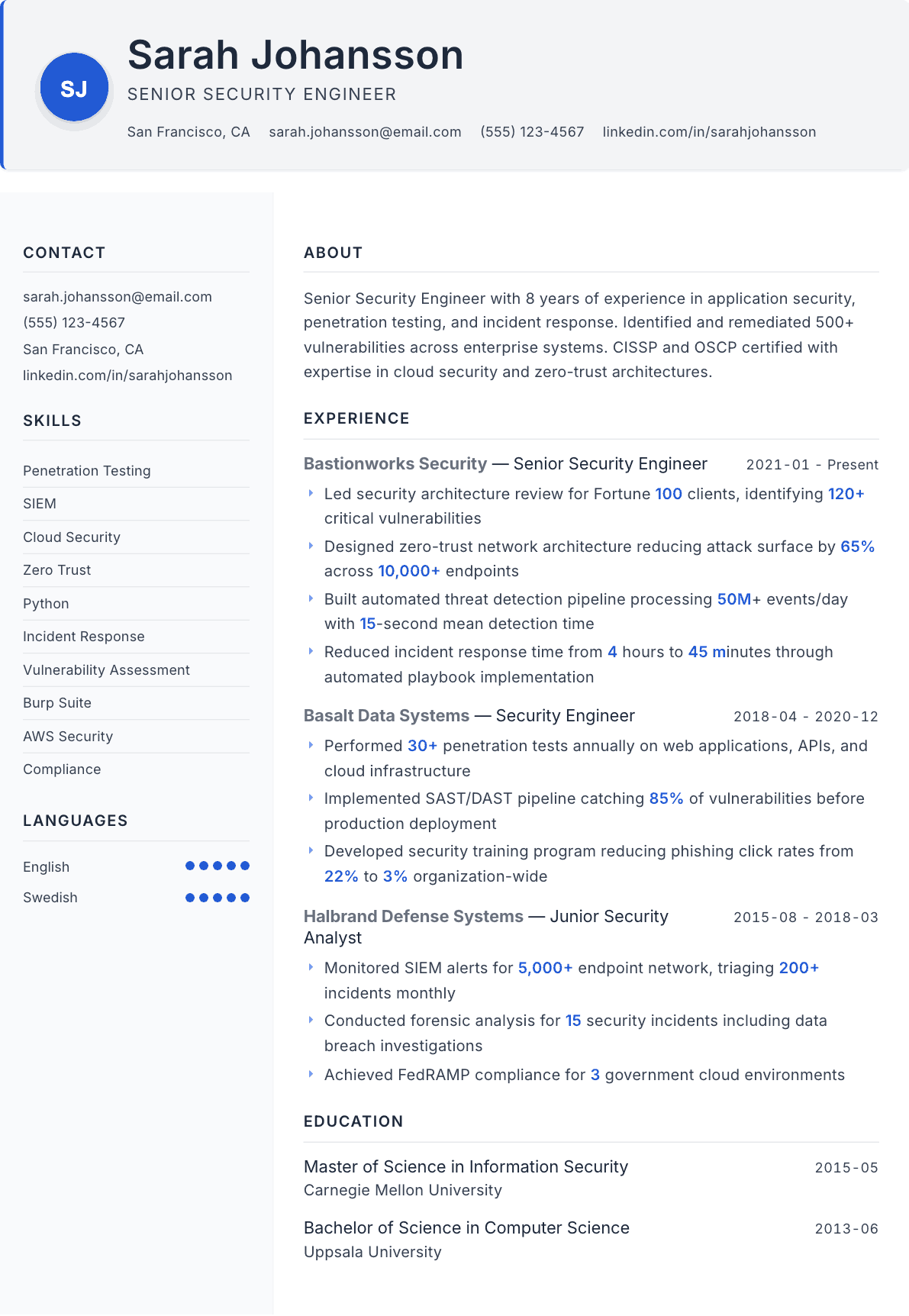
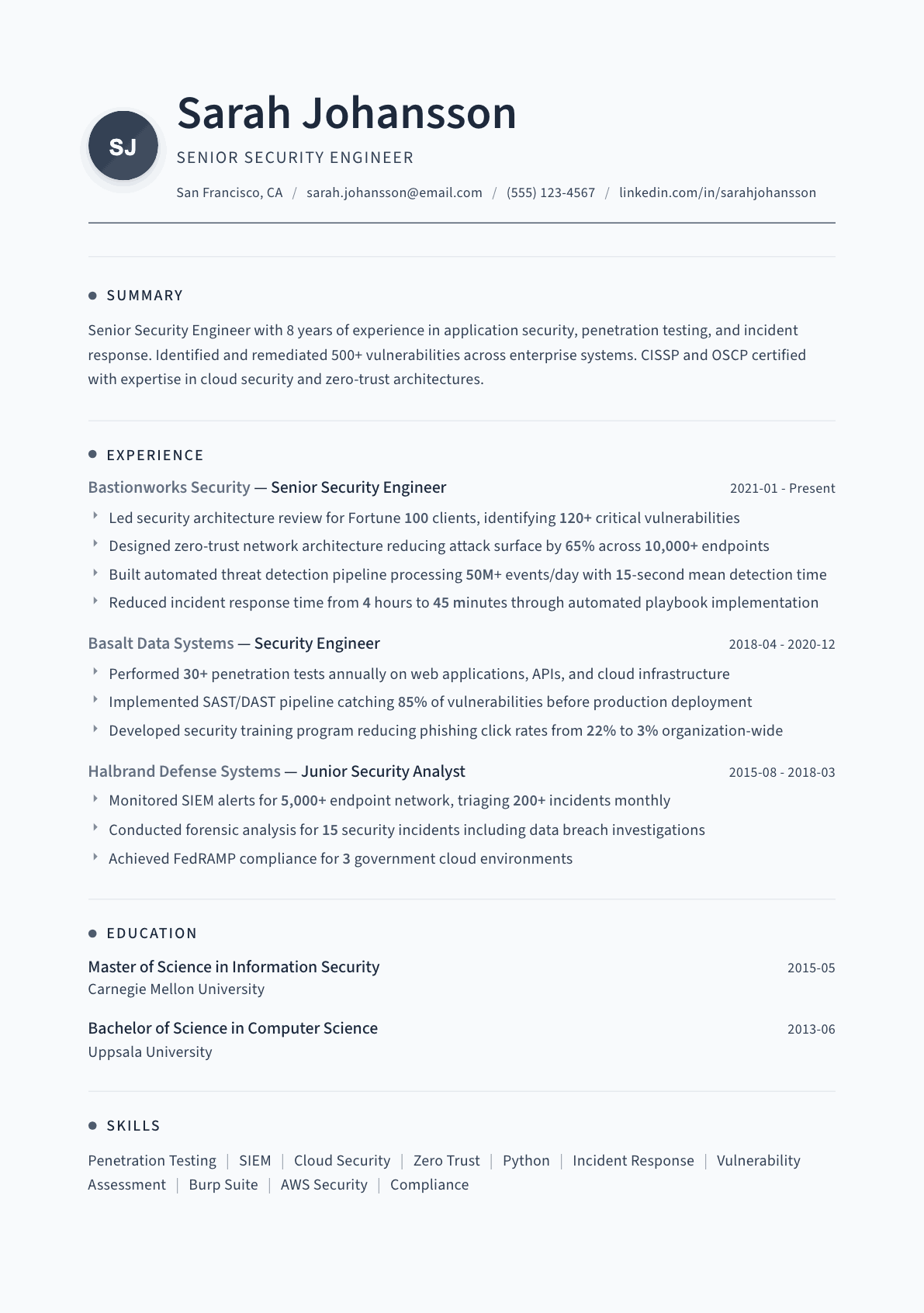
Example Security Engineer summary
CISSP and OSCP certified Security Engineer with 8 years protecting enterprise systems from cyber threats. Expert in penetration testing, cloud security, and zero-trust architecture with a track record of reducing attack surfaces by 65%.
Skills to list on a Security Engineer resume
- Penetration Testing
- SIEM
- Cloud Security
- Zero Trust
- Python
- Incident Response
- Vulnerability Assessment
- Burp Suite
- AWS Security
- Compliance
- Forensics
- Network Security
- OWASP
- Threat Modeling
What actually gets this resume read
- List security certifications prominently (CISSP, OSCP, CEH).
- Quantify vulnerabilities found and remediated.
- Highlight incident response and threat detection experience.
- Include compliance framework knowledge (SOC 2, HIPAA, FedRAMP).
- Show both offensive and defensive security skills.
How to write a security engineer resume
Security engineer is a title stretched across at least five distinct jobs: application security, cloud and infrastructure security, detection and response, offensive security, and governance-heavy compliance work. The tools, the daily rhythm and the interview loop differ completely between them. A resume that lists every security noun in the field to cover all five reads as a generalist to a recruiter and as unconvincing to any of the five hiring managers.
The second thing a security hiring manager checks is whether you have actually fixed anything. Findings are cheap. A scanner produces hundreds a week, and a report full of them proves nothing about the person who ran it. The engineers who get hired are the ones who can describe a class of vulnerability they eliminated, the control they added so it could not return, and the engineering teams they had to persuade to accept it.
This guide covers picking your lane, where certifications belong on the page, how to write about vulnerabilities and incidents without breaching confidentiality, and the difference between security work that reads as engineering and security work that reads as ticket forwarding.
Format: pick a lane, then put the credentials where they are scanned
Reverse-chronological, one page under seven years. Name the specialization in the title line under your name: application security engineer, cloud security engineer, detection engineer, offensive security engineer. Recruiters in this field are filtering hard, and a self-applied specialization helps you land in the right pile.
Certifications go in a line under the summary. This field takes them seriously because several of them require a practical exam, and clearances or specific credentials are hard filters for defense, finance and healthcare postings. Put the clearance level on the page if you hold one.
- Header: name, specialization, credentials, city, phone, email.
- Order: summary, certifications and clearance, experience, technical skills by domain, education, publications or disclosures.
- Add a section for public work if you have it: advisories, published research, capture the flag results, or tooling you released.
- Name the environment: cloud provider, scale of the estate, and whether it is regulated.
Summary: the domain, the estate, and what you removed
Name your specialization, the years, and the size and type of estate you protected: endpoints, cloud accounts, services, or lines of code under review. Then the outcome, expressed as risk removed rather than activity performed.
The strongest closing line names a vulnerability class you eliminated or a control you drove to full coverage. Removing an entire injection class through a safe query library, or bringing multi-factor authentication to every privileged path, is more convincing than a count of findings, because it shows the work reached completion.
Experience: findings are the start, controls are the story
For each significant piece of work, write the finding, the fix and the control. The finding is what you discovered, the fix is what changed in the system, and the control is what stops it from coming back: a linter rule, a policy in the pipeline, a platform default, a paved path that makes the safe option the easy one. Security engineers who stop at findings are the ones teams learn to route around.
Application security bullets should name the review method and the classes involved: threat modeling before design, code review, static analysis with the false positive rate you tuned it to, dependency and supply chain scanning, and secrets detection. Say what you did about the noise, because unusable tooling is the standard failure mode.
Detection and response bullets should name the telemetry and the outcome. Log sources onboarded, detection rules written and how you validated them, alert volume and how much of it was actionable, mean time to detect and to contain, and a specific incident where you led the containment. Attack simulation results are strong evidence that a detection worked.
Cloud security bullets should name the misconfiguration classes and the enforcement: identity and access policy design, least privilege on roles, public exposure prevention, network segmentation, key management, and whether you enforced these through policy as code rather than through review.
Writing about incidents and vulnerabilities without oversharing
You can describe your work without disclosing anything sensitive. Name the vulnerability class rather than the affected system, use relative measures instead of absolute counts where the count is sensitive, and keep customer names out unless they were public. A hiring manager will respect discretion and will be suspicious of a candidate who does not show any.
For incidents, use the response phases: detection, triage, containment, eradication, recovery and the lessons that became controls. State your own role plainly, whether you were the incident commander, the person doing forensics, or one responder in a large team. Overstating your role in an incident is easy to expose in an interview because incidents get discussed in detail.
- Use vulnerability class names such as injection, deserialization, broken access control, or server-side request forgery.
- Give time-based measures: time to detect, time to contain, time to remediate by severity.
- Describe coverage: what fraction of the estate a control reaches, not just that it exists.
- Credit the team where the work was collective, and be specific about your own contribution.
Skills: group by domain and show that you can build
Group into application security, cloud and infrastructure, detection and response, offensive, and governance. Under each, name the tools you have operated at depth rather than every product you have seen in a demo. Burp Suite, a static analysis platform, a cloud security posture tool, a security information and event management system, an endpoint detection product, and the scripting you use to glue them together.
Show that you write code. Security engineering has moved toward automation, and the ability to write a detection rule, a policy as code check, a scanner integration or a small internal tool is what separates an engineer from an analyst on paper. Name the language and something specific you built with it.
Security Engineer resume summary examples
Moving into security
Security analyst with two years triaging alerts on a 4,000 endpoint estate, now writing detection rules and Python automation for enrichment. Security+ certified with a home lab running an open source SIEM, seeking a detection engineering role on a defensive team.
Five years in
Application security engineer with five years embedded with 12 development teams. Eliminated the injection class across the main platform by moving all data access to a parameterized library, and cut static analysis false positives by 70% so developers stopped ignoring the pipeline gate.
Senior security engineer
CISSP and OSCP certified security engineer with nine years across offensive and defensive work. Runs the threat modeling and secure design review practice for 200 engineers, led containment on two major incidents as incident commander, and built the policy as code guardrails covering 60 cloud accounts.
Work experience bullets: before and after
Before: Identified and remediated security vulnerabilities.
After: Found stored cross-site scripting in the customer messaging feature during a design review, drove a fix to output encoding at the template layer, and added a linter rule so the unsafe rendering helper could not be reintroduced.
The finding, the fix and the permanent control show a vulnerability closed rather than a ticket filed.
Before: Performed penetration testing on web applications.
After: Ran authenticated tests against 14 internal applications, chained a broken access control finding into full tenant data access, and worked with the owning team through the redesign of their authorization checks.
A specific chained finding plus involvement in the remediation shows testing that led somewhere.
Before: Managed the SIEM and monitored alerts.
After: Onboarded identity, endpoint and cloud audit logs into the SIEM, wrote 60 detection rules validated with attack simulation, and cut daily alert volume by two thirds while raising the true positive rate.
Log sources, rule validation and alert quality describe detection engineering instead of alert watching.
Before: Improved cloud security posture.
After: Wrote policy as code guardrails preventing public storage buckets and wildcard identity permissions across 60 accounts, then remediated 400 existing violations with the owning teams over two quarters.
Prevention plus cleanup of the existing backlog is the pattern that actually changes a cloud estate.
Before: Responded to security incidents.
After: Acted as incident commander for a credential compromise: contained the account in 20 minutes, ran the forensic timeline across identity and endpoint logs, and closed the root cause by enforcing phishing-resistant authentication for all administrative access.
A named role, a containment time and a systemic root cause fix distinguish leading a response from participating in one.
Hard skills
- Threat modeling and secure design review
- Application security testing (SAST, DAST, manual review)
- Burp Suite and web application testing
- Cloud security (IAM policy design, guardrails, posture management)
- Policy as code and infrastructure security
- SIEM engineering and detection rule writing
- Endpoint detection and response tooling
- Incident response and digital forensics
- Vulnerability management and prioritization
- Supply chain and dependency security
- Secrets management and key handling
- Python for security automation
- Network security and segmentation
- Compliance frameworks (SOC 2, ISO 27001, PCI DSS)
Soft skills
- Persuading engineering teams to adopt controls
- Communicating risk to non-technical executives
- Calm judgment during an active incident
- Prioritizing by real exploitability, not scanner severity
- Writing findings developers can act on
Certifications worth listing
- CISSP (ISC2)
- CCSP (ISC2)
- OSCP (OffSec)
- Security+ (CompTIA)
- GIAC Certified Incident Handler (GCIH) (GIAC)
- GIAC Web Application Penetration Tester (GWAPT) (GIAC)
- AWS Certified Security - Specialty (Amazon Web Services)
- Certified Ethical Hacker (CEH) (EC-Council)
Mistakes that cost security engineer candidates the interview
- Covering all five security specializations at once, which convinces none of the five hiring managers reading for one of them.
- Reporting a count of vulnerabilities found with no evidence that any of them were fixed.
- Listing security products you have seen demonstrated alongside the ones you operated daily.
- Overstating your role in an incident, which is easy to expose because incidents get discussed in detail during interviews.
- Naming clients, systems or unfixed weaknesses in a way that a hiring manager reads as a discretion problem.
- Showing no automation or code, which places you with analysts rather than with engineers in a field that increasingly expects both.
Security Engineer resume questions
Which security certifications should I put on my resume?
Match them to the lane. CISSP and CCSP carry weight in enterprise and management-track roles, OSCP and the GIAC penetration testing credentials in offensive work, GCIH and vendor detection certifications in response work, and cloud provider security specialties for cloud roles. List the clearance too if you hold one.
How do I describe security work without disclosing sensitive details?
Name the vulnerability class instead of the system, use relative rather than absolute figures where counts are sensitive, and keep employer customer names off the page unless the work was public. Discretion is itself a hiring signal in this field, and a manager will notice its absence faster than its presence.
How do I move from IT or system administration into security engineering?
Reframe the security-adjacent work you already do: patching, identity and access administration, hardening, logging and backup integrity. Add one demonstrable specialization, such as a home detection lab or documented findings from a bug bounty program, and pick a lane rather than applying to everything with the word security in the title.
Are bug bounty results worth listing?
Yes, when they are substantive. Give the platform, your reputation or ranking, and the classes of vulnerability you have been paid for. Two well described chained findings say more about your ability than a long list of low severity reports, and they let a hiring manager evaluate real technique.
Does a security engineer need to write code?
Increasingly yes. Detection rules, policy as code, scanner integrations and automation of triage are now core to the role, and the ability to read the application code you are reviewing is central to application security. Name the language and one concrete thing you built with it.
Related resume examples
- Cybersecurity Analyst Resume example
- Cloud Security Engineer Resume example
- Network Engineer Resume example
- Cybersecurity Manager Resume example
- Penetration Tester Resume example
- SOC Analyst Resume example