Purchasing Clerk Resume Examples: the lines they read
Write a Purchasing Clerk Resume Buyers Trust With Orders
By Mustafa Tarabya, founder of CVBooster · Published · Updated
Purchasing clerk resume examples, a sample buying history, ATS keywords for ERP and vendor work, plus a full writing guide.
Sample resumes for a purchasing clerk
The same purchasing clerk content laid out in three CVBooster templates, so you can see what the finished document looks like before you write a word.
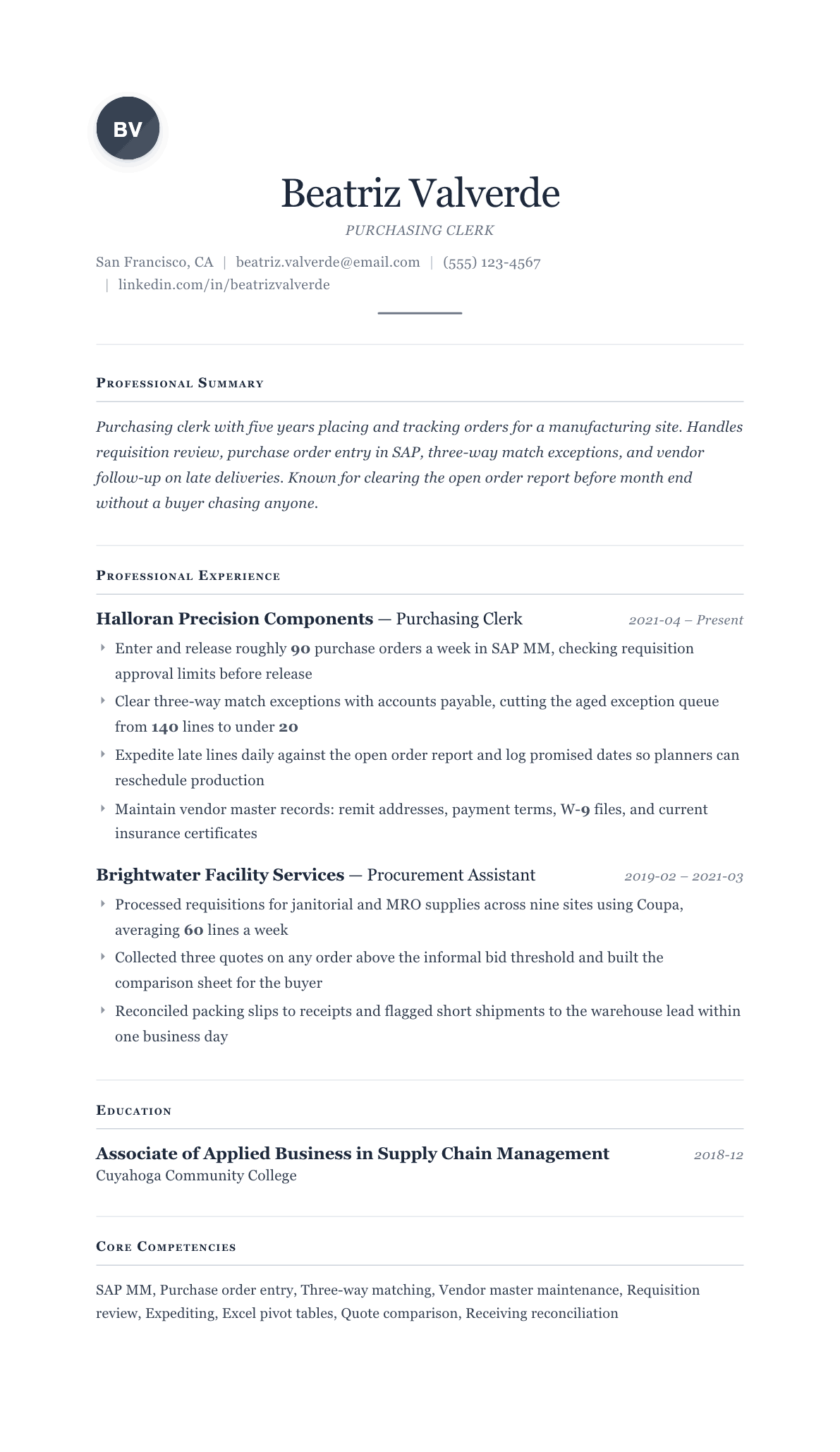
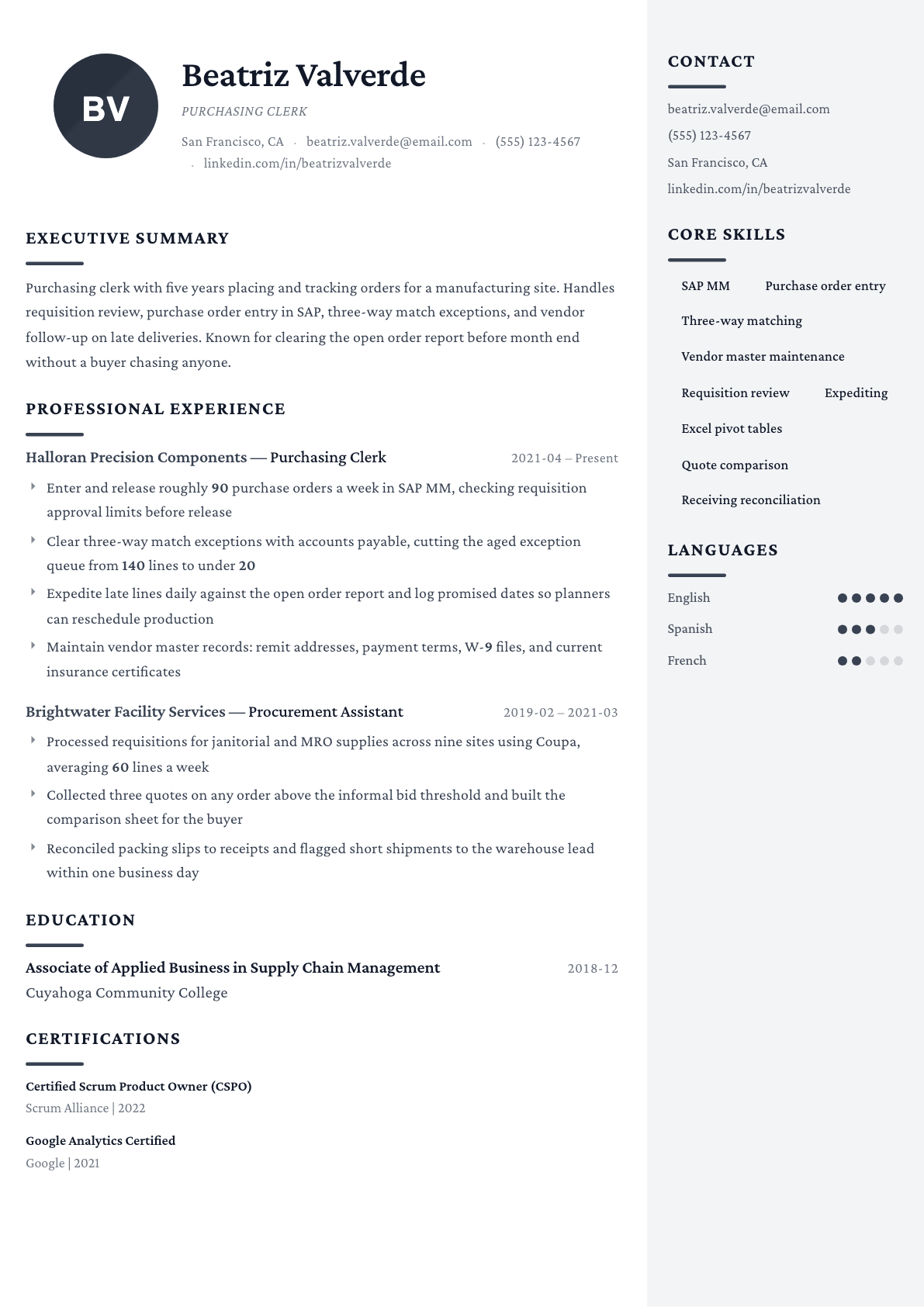
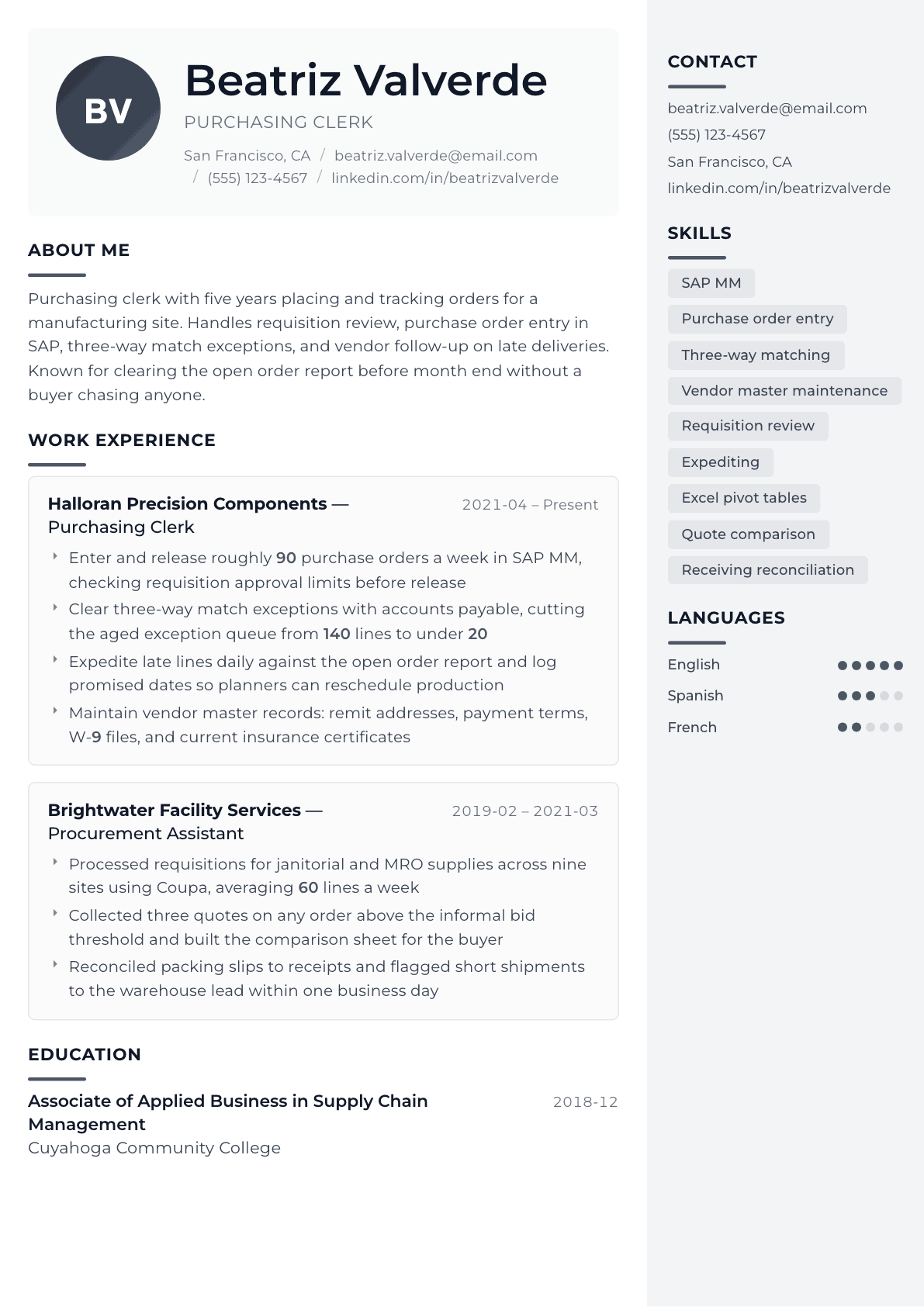
Example Purchasing Clerk summary
Detail-driven purchasing clerk with five years of purchase order entry, expediting and vendor file work in a manufacturing environment. Releases about 90 orders a week in SAP MM, clears three-way match exceptions with accounts payable, and keeps the open order report current so planners are never surprised by a late line. Associate degree in supply chain management.
Skills to list on a Purchasing Clerk resume
- Purchase order processing
- Requisition review
- Three-way match
- Vendor master data
- Expediting
- Request for quotation
- SAP MM
- Coupa
- Oracle Procurement
- NetSuite
- Inventory reconciliation
- Excel and VLOOKUP
- Receiving and packing slips
- Contract pricing verification
- Supplier communication
What actually gets this resume read
- Name the purchasing system you work in, whether SAP, Oracle, Coupa, NetSuite or Epicor, because buyers filter resumes on it.
- Give the volume you handle: purchase orders released per week, lines touched, or the number of active vendors you cover.
- Show that you understand the three-way match, since exception clearing is the daily reality of the job.
- Separate what you owned from what a buyer owned, because clerks who claim negotiation they never did lose credibility fast.
- Mention the categories you bought, such as MRO, packaging, raw materials or facility services, so the reader places you.
- Put accuracy evidence in a bullet: aged exceptions cleared, receipts reconciled, or a vendor file audit you passed.
How to write a purchasing clerk resume
A purchasing clerk resume is screened by a buyer or a purchasing supervisor who has one question in mind: can this person be handed the requisition queue on Monday without breaking the flow of material into the plant. That question is answered by three things on the page, the purchasing system you work in, the volume you carry, and whether you understand the three-way match. Everything else is decoration.
The trap most applicants fall into is writing the job as generic office work. Bullets like ordered supplies and communicated with vendors describe a receptionist with a credit card, not a clerk who releases purchase orders against approval limits, chases promised dates, and clears exceptions with accounts payable before month end. Buyers can tell the difference in the first six seconds.
This guide covers the section order a purchasing supervisor expects, how to name systems and categories so the applicant tracking system and the human both find them, three summary examples at different stages, before and after bullets, and the questions clerks ask when they sit down to rewrite the file.
Format: one page, reverse chronological, system named in the header area
Purchasing is a volume job, so keep the resume to a single page until you pass roughly eight years or add buyer level responsibility. Reverse chronological order is expected because a supervisor wants to see continuous order desk time, and a gap of eight months in a procurement history invites a question you would rather answer in the interview than in the screen.
Skip the two-column template with icons. Purchase order data is boring and so should your layout be. Plain headings, one font, dates on the right. The one visual choice worth making is a short technical line directly under your contact details listing the buying systems you have worked in, because a screener filtering for SAP or Coupa often never scrolls past the top third.
- Header: name, city and state, phone, email, and a one line systems strip such as SAP MM, Coupa, NetSuite, Excel.
- Section order: summary, purchasing systems and skills, experience, education, certifications if you hold one.
- Each job needs the industry in parentheses, for example precision machining or facility services, since the categories differ completely.
Summary: volume, system, categories, and the exception you clear
Three or four lines. Give the years on a purchasing desk, the number of purchase orders you release in a normal week, the system you release them in, and the commodity categories you buy. A supervisor sizes you instantly from that: ninety orders a week in SAP for a machining plant is a very different clerk from twenty orders a month of office supplies.
Close the summary with the thing you keep clean. Aged three-way match exceptions, the open order report, or the vendor master file are the three most common answers, and any of them tells the reader that you finish work rather than pass it downstream. Avoid detail oriented and team player, which appear on every resume in the stack and therefore carry no information.
Experience: requisition in, purchase order out, exception cleared
Structure each job around the order lifecycle the reader knows by heart. Requisition review and approval limits, purchase order entry and release, acknowledgment and promised date capture, expediting, receiving reconciliation, and match exception clearing with accounts payable. Four or five bullets per role is enough, and each one should carry a number, a system, or a document type.
Be honest about the line between clerk and buyer. If you collected three quotes and built the comparison sheet while the buyer chose the supplier and negotiated the price, write it that way. Claiming negotiation you did not run is the single fastest way to lose credibility in a purchasing interview, because the first question will be what levers you used and the answer will not exist.
Reserve one bullet in your most recent job for accuracy evidence. An aged exception queue you took from a hundred and forty lines to under twenty, a vendor file audit you passed, or receipts reconciled with no unresolved variance are the proof points a supervisor believes, because they are measurable and they map to a report she already runs.
- Name the commodity set: MRO, raw material, packaging, capital equipment, janitorial, subcontract services.
- Give order volume per week and active vendor count, not just years of experience.
- Include one bullet on data work: vendor master maintenance, contract price loading, or item master cleanup.
Skills and systems: the section the filter actually reads
Group the skills rather than dumping fifteen phrases in a row. One group for enterprise systems, one for purchasing process terms, one for spreadsheet and reporting ability. Under systems, name the exact module where you can, since SAP MM reads as real experience while SAP alone reads as a guess. Under process, use the vocabulary of the field: requisition review, three-way match, request for quotation, expediting, receiving reconciliation, contract price verification.
Spreadsheet ability deserves a specific claim. Pivot tables and lookup functions on an open order extract is exactly what a clerk does when the report from the system is unreadable, and saying so separates you from an applicant who writes proficient in Microsoft Office and means they can open a file.
Education, certifications and the keywords to mirror
An associate degree in supply chain or business is common and worth listing with the field of study. A degree is not required in most postings, so if you do not have one, lead the education block with coursework, a purchasing certificate, or the internal system training you completed, and let your volume numbers carry the resume instead.
For keywords, read the posting and mirror its nouns once in the skills block and once inside a bullet where the work actually happened. Purchasing postings recycle the same terms, so expect purchase order processing, requisition, supplier follow up, open order report, three-way match, receiving discrepancy, vendor master, and the name of the enterprise system. Mirror them in your own sentences rather than pasting a keyword block, because a buyer reads the file straight after the software does.
Purchasing Clerk resume summary examples
First purchasing desk
Supply chain associate degree graduate with an eight-month internship on a procurement desk, entering roughly 30 purchase orders a week in NetSuite and matching packing slips to receipts. Comfortable with requisition review, quote comparison sheets and Excel lookups. Seeking a purchasing clerk role in manufacturing.
Five years in
Purchasing clerk with five years on a manufacturing order desk, releasing about 90 purchase orders a week in SAP MM across MRO and raw material. Clears three-way match exceptions with accounts payable and cut the aged exception queue from 140 lines to under 20. Maintains the vendor master file.
Senior clerk moving toward buyer
Senior purchasing clerk with nine years across two plants, covering order release, expediting and vendor master control for roughly 300 active suppliers in SAP and Coupa. Runs the open order report review with planners, builds quote comparisons for the buying team, and trained four clerks on approval limits and match exceptions.
Work experience bullets: before and after
Before: Placed purchase orders for the company.
After: Entered and released about 90 purchase orders a week in SAP MM, verifying requisition approval limits and delivery dates before every release.
Volume, the exact module and the control step turn a job description line into evidence of a working order desk.
Before: Worked with accounts payable on invoice issues.
After: Cleared three-way match exceptions with accounts payable daily, taking the aged exception queue from 140 open lines to under 20 and keeping it there through month end close.
Naming the three-way match and the queue movement proves you understand where purchasing and finance actually collide.
Before: Followed up with vendors about late orders.
After: Expedited late lines against the open order report each morning, logged revised promised dates in the system, and flagged slipping material to production planners the same day.
The report, the cadence and the downstream handoff show a routine a supervisor can rely on rather than occasional phone calls.
Before: Maintained vendor information.
After: Maintained vendor master records for roughly 300 suppliers: remit addresses, payment terms, tax forms and current insurance certificates, and passed an internal data audit with no exceptions.
The record types and the audit result convert a soft claim into checkable data hygiene.
Before: Got quotes from suppliers.
After: Collected three quotes on every order above the informal bid threshold and built the comparison sheet on price, lead time and freight terms for the buyer to award.
It states the threshold rule and stops exactly where the buyer took over, which is what makes the claim credible.
Hard skills
- Purchase order entry and release
- Requisition review and approval limits
- Three-way match exception clearing
- Vendor master data maintenance
- Expediting and promised date tracking
- Request for quotation and quote comparison
- SAP MM
- Coupa
- Oracle Procurement
- NetSuite
- Receiving and packing slip reconciliation
- Contract price verification
- Excel pivot tables and lookups
- Open order reporting
Soft skills
- Supplier follow through
- Written communication with plant teams
- Accuracy under repetition
- Escalation judgment
- Queue prioritization
- Cross-department coordination
Certifications worth listing
- Certified in Planning and Inventory Management (CPIM) (ASCM)
- Certified Supply Chain Professional (CSCP) (ASCM)
- Certified Professional in Supply Management (CPSM) (Institute for Supply Management)
- Certified Professional Public Buyer (CPPB) (Universal Public Procurement Certification Council)
Mistakes that cost purchasing clerk candidates the interview
- Writing ordered supplies and materials with no system, volume or category, which reads as an office errand rather than a purchasing desk.
- Claiming supplier negotiation and cost savings that a buyer actually owned, a claim that collapses in the first interview question.
- Leaving out the three-way match entirely, when exception clearing is most of the daily work in a clerk role.
- Listing Microsoft Office as a skill instead of the enterprise system, so a filter searching for SAP or Coupa never surfaces the file.
- Burying the vendor master and item data work, which is the part of the job that quietly protects every downstream report.
- Using a graphical two-column layout that scrambles dates and job titles when the applicant tracking system parses the file.
Purchasing Clerk resume questions
Do I need a degree to get a purchasing clerk job?
Usually not. Many postings ask for a high school diploma plus order desk experience, and an associate degree in supply chain or business is a preference rather than a requirement. Volume numbers, a named enterprise system and clean match exception work carry more weight in the screen.
How do I show purchasing volume if my employer never tracked it?
Estimate honestly from what you can reconstruct: orders released in a typical week, lines on the open order report, or the number of active suppliers you covered. Write about and a round number rather than a false precise figure, and be ready to explain how you arrived at it.
Should I list every purchasing system I have touched?
List the ones you worked in daily and say what you did in each. A system you saw in a training class belongs in a training line, not the skills strip, because a supervisor will ask you to describe the release screen and the answer needs to be real.
What is the difference between a purchasing clerk and a buyer on a resume?
A clerk processes requisitions, releases orders, expedites and clears exceptions. A buyer selects suppliers, negotiates price and terms, and owns the category. Keep your bullets on your side of that line and label any buyer support work as support, which builds trust rather than suspicion.
How do I move from purchasing clerk to buyer with this resume?
Lead with the analytical pieces: quote comparisons you built, contract prices you verified, spend or usage reports you pulled, and supplier performance data you tracked. Then add a purchasing certification in progress so the reader sees deliberate movement rather than a hopeful title change.
Related resume examples
- Procurement Manager Resume example
- Data Entry Clerk Resume example
- Procurement Specialist Resume example
- Inventory Clerk Resume example
- Order Processing Specialist Resume example
- Operations Assistant Resume example