Procurement Manager Resume Examples: what gets the call
Build a Procurement Manager Resume That Negotiates Its Way In
By Mustafa Tarabya, founder of CVBooster · Published · Updated
Create a procurement manager resume highlighting strategic sourcing, cost savings, and supplier relationship management with clear financial impact.
Sample resumes for a procurement manager
The same procurement manager content laid out in three CVBooster templates, so you can see what the finished document looks like before you write a word.
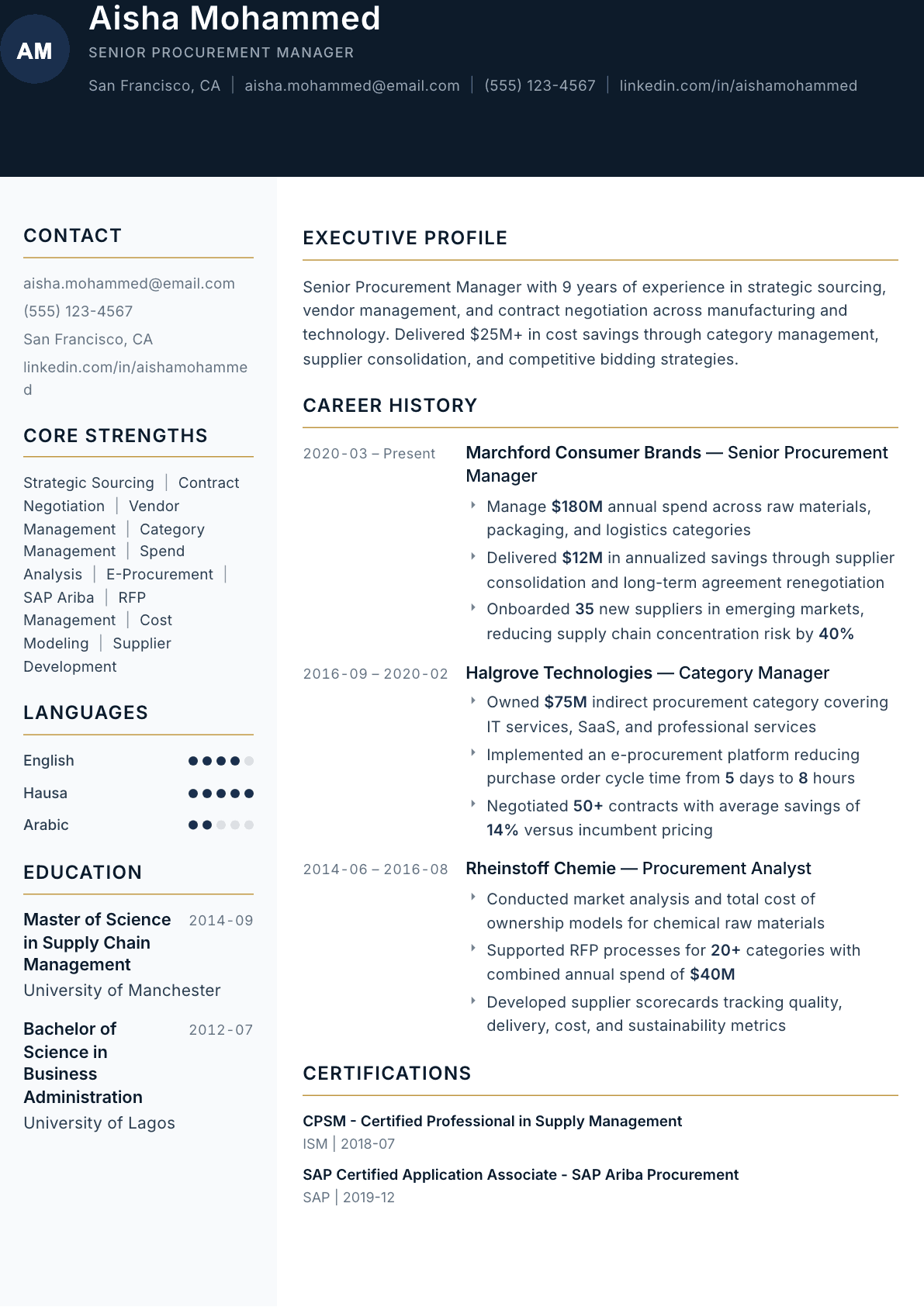
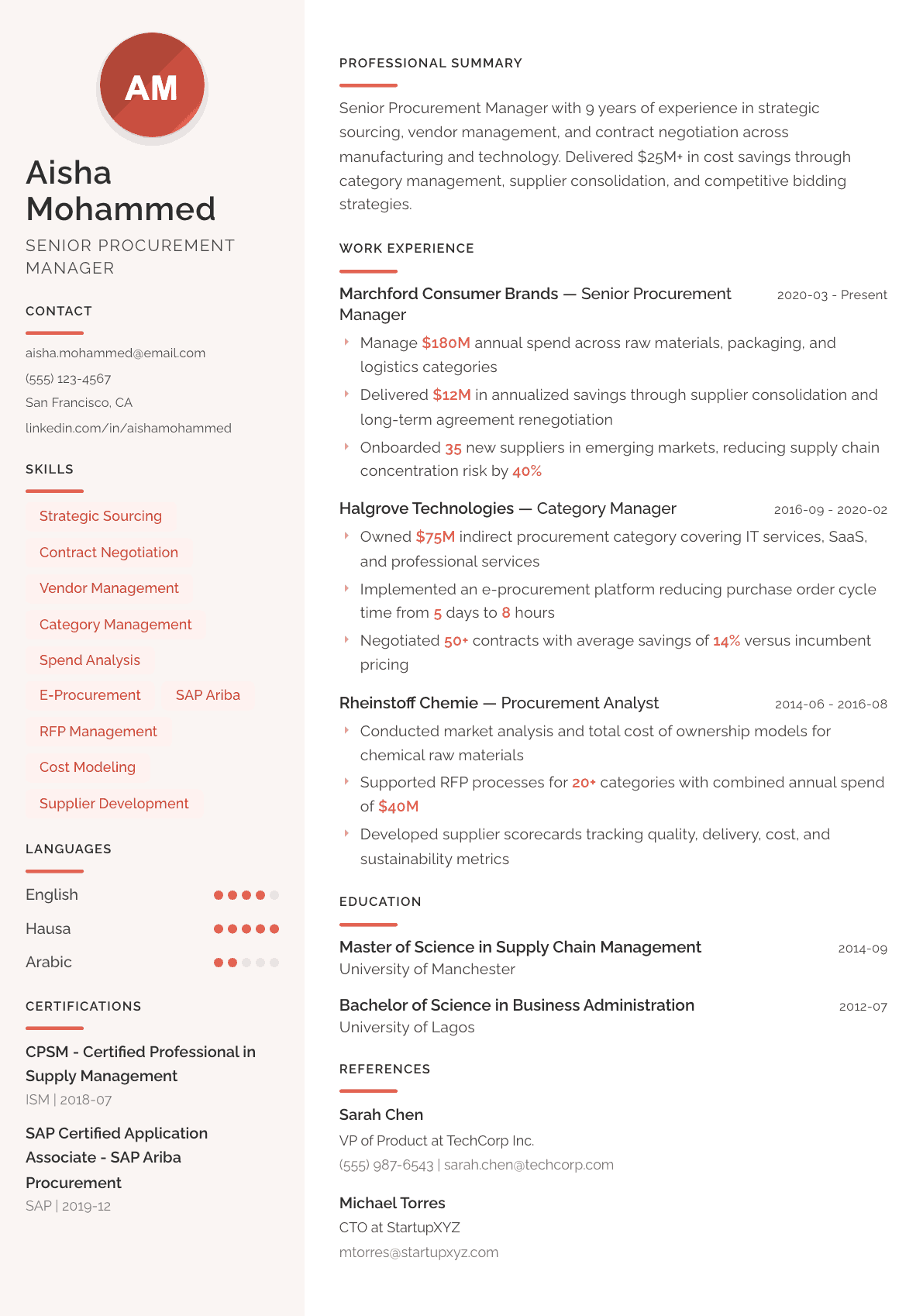
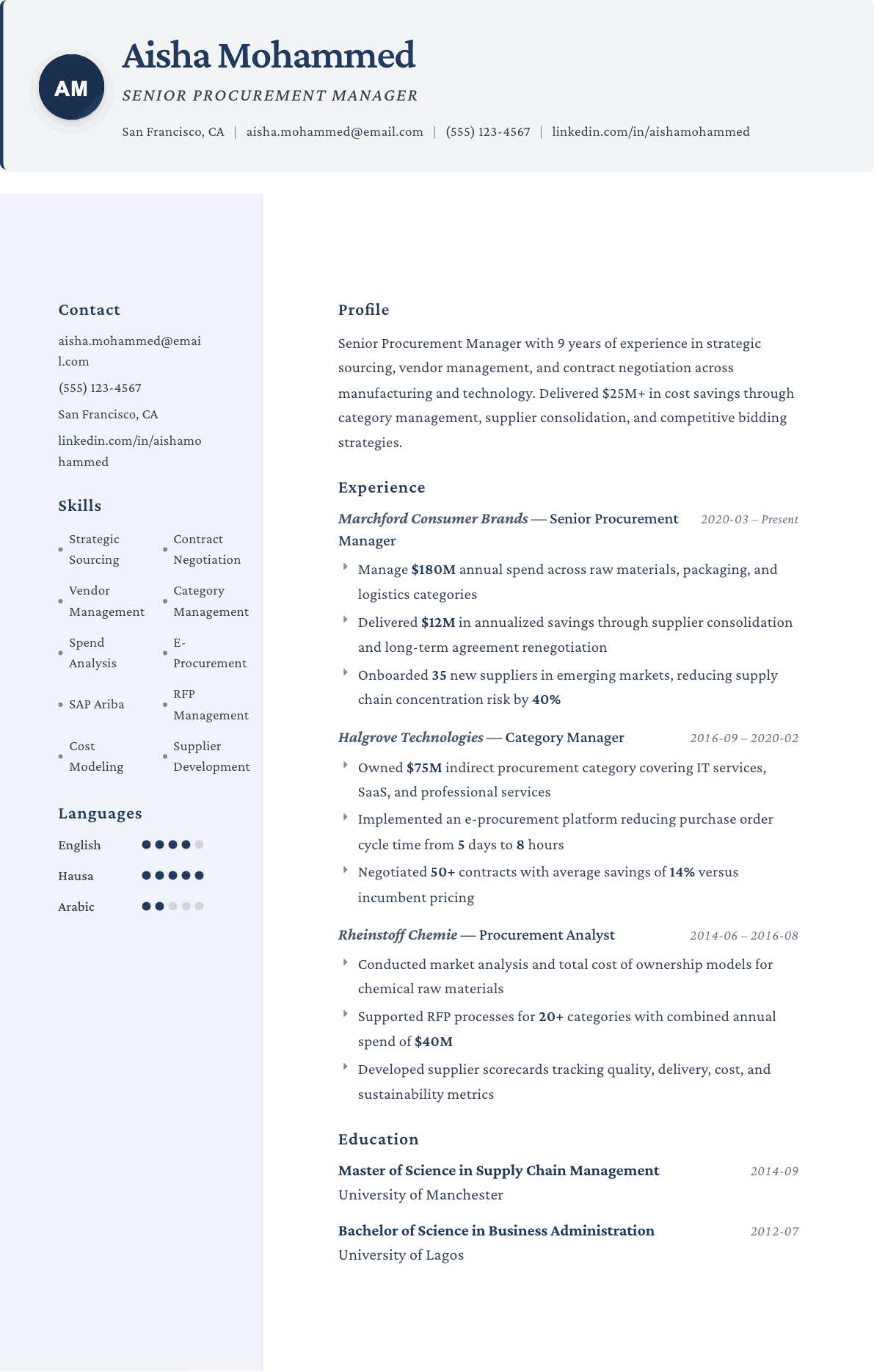
Example Procurement Manager summary
Senior Procurement Manager with 9 years of experience managing $180M+ in annual spend across manufacturing and technology. Delivered $25M in cost savings through strategic sourcing, supplier consolidation, and competitive bidding. CPSM-certified with expertise in SAP Ariba and category management. Seeking a Director of Procurement role to lead sourcing strategy at a global organization.
Skills to list on a Procurement Manager resume
- Strategic Sourcing
- Contract Negotiation
- Vendor Management
- Category Management
- Spend Analysis
- E-Procurement
- SAP Ariba
- Coupa
- RFP / RFQ Management
- Cost Modeling
- Supplier Development
- Sustainability Sourcing
- Risk Management
What actually gets this resume read
- Quantify spend under management, cost savings achieved, and number of contracts negotiated.
- Highlight specific procurement tools and platforms: SAP Ariba, Coupa, Oracle Procurement.
- Show experience across direct and indirect procurement categories.
- Include supplier diversification, sustainability, and risk management initiatives.
- Demonstrate both strategic (category management) and tactical (RFP, PO) capabilities.
- Certifications like CPSM, CIPS, or CPP add significant credibility.
How to write a procurement manager resume
Procurement resumes are read by a chief procurement officer or a category director who wants to know two things before anything else: how much spend you have carried, and whether the savings you claim were ever validated by finance. Everything else on the page is context for those two answers.
The reason validation matters so much is that this is the one function where the headline number is easy to inflate. A negotiated rate reduction against a list price that nobody paid is not a saving. A hiring manager who has run a savings governance process will read your file with that suspicion already loaded, so name the baseline, name the methodology, and say who signed the number off.
This guide covers how to present spend and category scope, how to write about sourcing events and contract outcomes, summaries for a buyer, a category manager and a procurement leader, and the questions procurement professionals ask when moving between indirect and direct spend or into a regulated public buying environment.
Format: spend, categories, suppliers, systems
Reverse chronological, one page for buyers and category specialists, two for managers and above. Under each role, put a scope line with the annual spend under management expressed as a magnitude, the categories you owned, the number of active suppliers, the regions covered, and whether the spend was direct or indirect. That line is the ranking mechanism a procurement leader uses across a stack of files.
Then a systems line. Source to pay platforms are not interchangeable, and a company running a particular suite screens for people who have run sourcing events, contract repositories and purchase requisition workflows inside it. Name the platform, the modules you used, and any implementation you were part of.
- Scope line: spend magnitude, category list, supplier count, geography, direct or indirect.
- Systems line: the source to pay suite, the contract lifecycle tool, the enterprise resource planning system, the spend analytics tool.
- Bullets: sourcing events run, contracts negotiated, savings validated, supplier risk work.
- A compliance line where relevant: public procurement rules, trade compliance, supplier codes of conduct.
Savings claims that survive scrutiny
Write savings the way a savings governance committee writes them. State the baseline and where it came from: prior year actual spend, the incumbent contract rate, or a should cost model you built. State the type of saving: hard cost reduction against a like for like baseline, cost avoidance against a proposed increase, or a working capital gain from payment terms. Then say who validated it, usually the finance business partner for that cost center.
Percentages are more useful than absolute figures in a resume because they travel across organizations of different sizes. A double digit reduction on a category with a described baseline tells a reader more than a large absolute number they cannot place. Give the category and the baseline period, then the percentage.
Sourcing events, negotiation and the contract itself
Show the whole sourcing cycle rather than the auction. A strong bullet moves through the spend analysis that found the opportunity, the requirements you gathered from the internal stakeholder, the supplier market you tested, the number of bidders, the evaluation model, and the commercial terms you closed. The evaluation model matters: a weighted scorecard covering price, service level, risk and sustainability tells a reader you were not simply buying on price.
Then write the contract outcomes. Service level agreements with credits attached, indexation clauses, volume rebates, price ratchets, exit and transition assistance provisions, liability caps, and payment terms. Procurement leaders hire for commercial drafting judgment, and naming the clauses you actually negotiated is the fastest way to prove you have it.
Supplier management and risk, the second half of the job
Sourcing gets the attention, but supplier performance management is where a procurement manager either protects the organization or does not. Write the governance you ran: quarterly business reviews, supplier scorecards, the escalation path when a supplier missed service levels, and the recovery of a critical supplier that was failing.
Risk work belongs here too, and it is increasingly what senior postings screen on: supplier financial health monitoring, single source exposure and dual sourcing, business continuity plans, conflict minerals and modern slavery diligence, information security assessments for technology suppliers, and supplier sustainability audits. Name the framework or standard you worked to rather than describing risk in the abstract.
Keywords and tailoring for direct versus indirect roles
Postings repeat a stable vocabulary: strategic sourcing, category management, spend analysis, request for proposal, request for quotation, total cost of ownership, should cost modeling, supplier relationship management, contract lifecycle management, tail spend, and savings realization. Place each once where you have real evidence.
Then tailor to the spend type. Direct procurement postings expect bill of materials knowledge, supplier quality involvement, engineering change handling, tooling and capacity commitments, and material index exposure. Indirect postings expect professional services, technology, facilities, marketing and travel categories, stakeholder management and demand challenge. A file that reads entirely indirect will not convince a manufacturer hiring for a raw materials category.
Procurement Manager resume summary examples
Buyer, first procurement role
Buyer with two years in indirect procurement covering facilities and office services for a five site business. Ran eleven request for quotation events in Coupa, consolidated 34 suppliers to nine across cleaning and waste, and delivered a 12% reduction against the prior year baseline.
Category manager
Category manager owning professional services and technology spend of roughly 80 million a year across four European entities. Rebuilt the contractor rate card, cut agency margin by 6 points, and led the contract lifecycle migration that brought 620 agreements into a single searchable repository.
Head of procurement
Procurement leader with fourteen years across direct and indirect spend in manufacturing, currently accountable for a nine person team and the full source to pay process. Built the savings governance model with finance, dual sourced two single source components, and reduced supplier onboarding time from six weeks to nine days.
Work experience bullets: before and after
Before: Negotiated contracts with suppliers to reduce costs.
After: Negotiated a three year facilities services agreement across five sites, replacing an incumbent rate with a benchmarked rate card, adding service credits against response time, and delivering a 12% reduction validated by the finance business partner.
The term, the mechanism, the clause and the validation turn a generic negotiation claim into an auditable result.
Before: Managed the RFP process for a large category.
After: Ran a request for proposal across nine bidders for the logistics category, built a weighted scorecard covering price, on time delivery, carbon reporting and financial stability, and led the evaluation panel through supplier selection in eleven weeks.
Naming the bidder count and the evaluation weights shows a defensible process rather than a decision already made.
Before: Reduced the number of suppliers.
After: Consolidated 34 cleaning and waste suppliers to nine after a spend cube analysis found duplicate coverage at eleven sites, then transitioned all sites without a service interruption.
The analysis that justified consolidation and the clean transition are what a procurement director needs to see.
Before: Worked on supplier risk management.
After: Introduced quarterly financial health screening for the top 40 suppliers by spend, identified two at risk of insolvency, and qualified alternate sources for both before either failed.
A prevented failure is concrete evidence of risk work, where a process description alone is not.
Before: Implemented a new procurement system.
After: Led the buyer side of a source to pay implementation, mapping four legacy approval workflows into one, training 130 requisitioners across three countries, and raising purchase order compliance from 58% to 91% in two quarters.
Compliance is the metric that proves a procurement system rollout actually changed buying behavior.
Hard skills
- Strategic sourcing
- Category management
- Spend analysis and spend cube modeling
- Should cost and total cost of ownership modeling
- Request for proposal and request for quotation management
- Contract negotiation and drafting
- Contract lifecycle management
- Supplier performance scorecards
- Supplier risk and business continuity assessment
- SAP Ariba and Coupa
- Enterprise resource planning purchasing modules
- Savings governance and validation
- Sustainable and diverse sourcing
Soft skills
- Commercial negotiation
- Challenging internal demand
- Stakeholder influence without authority
- Handling supplier escalation
- Cross cultural supplier relationships
Certifications worth listing
- Certified Professional in Supply Management (CPSM) (Institute for Supply Management)
- MCIPS Chartered Procurement and Supply Professional (Chartered Institute of Procurement and Supply)
- Certified Supply Chain Professional (CSCP) (Association for Supply Chain Management)
- Certified Professional in Supplier Diversity (CPSD) (Institute for Supply Management)
- SAP Ariba Procurement Certification (SAP)
Mistakes that cost procurement manager candidates the interview
- Quoting a savings number with no baseline, no saving type and nobody in finance who validated it.
- Leaving out the spend under management, which is the first figure a procurement leader looks for.
- Describing sourcing events without the bidder count or the evaluation criteria, so the process looks predetermined.
- Ignoring supplier performance and risk work, which is half the role at manager level and above.
- Applying to a direct materials role with a file that shows only indirect categories and no engineering interface.
- Naming a source to pay platform you have only approved requisitions in rather than run sourcing events in.
Procurement Manager resume questions
How should I present cost savings on a procurement resume?
Give the category, the baseline and its period, the type of saving, and the percentage rather than a raw figure. Add who validated it. A hiring manager who runs their own savings governance will trust a modest validated number far more than a large unexplained one.
Does spend under management or team size matter more?
Spend under management ranks first because it sizes the commercial responsibility you have carried. Team size matters at head of procurement level and above, where the posting is about building a function. List both, and add supplier count, since a fragmented base is harder to manage than a concentrated one.
How do I move from indirect procurement into direct materials?
Lead with anything that touches production: supplier quality involvement, capacity or tooling commitments, index linked pricing, long lead time planning, or work alongside engineering. Then name the manufacturing environment you want, and be honest about the categories you have not yet owned.
What should a public sector procurement resume include that a private one does not?
The regulatory framework you buy under, the tender portals you have published through, the evaluation and scoring documentation you maintained, and any challenge or audit your process survived. Public buying is judged on defensibility of process as much as on outcome, so make the process discipline visible.
Is a procurement certification worth listing?
Yes, near the top, with the issuing body. Recognized credentials from the professional bodies clear screening filters at larger organizations and signal a shared vocabulary on ethics and process. Pair the credential with the category work that proves you apply it.
Related resume examples
- Supply Chain Manager Resume example
- Logistics Manager Resume example
- Operations Manager Resume example
- Vendor Manager Resume example
- Procurement Specialist Resume example
- Purchasing Manager Resume example