Procurement Specialist Resume Examples: read this first
Write a Procurement Specialist Resume That Wins the Screen
By Mustafa Tarabya, founder of CVBooster · Published · Updated
Procurement specialist resume examples, sourcing and purchase order bullets, ATS keywords and a step-by-step guide to writing each section.
Sample resumes for a procurement specialist
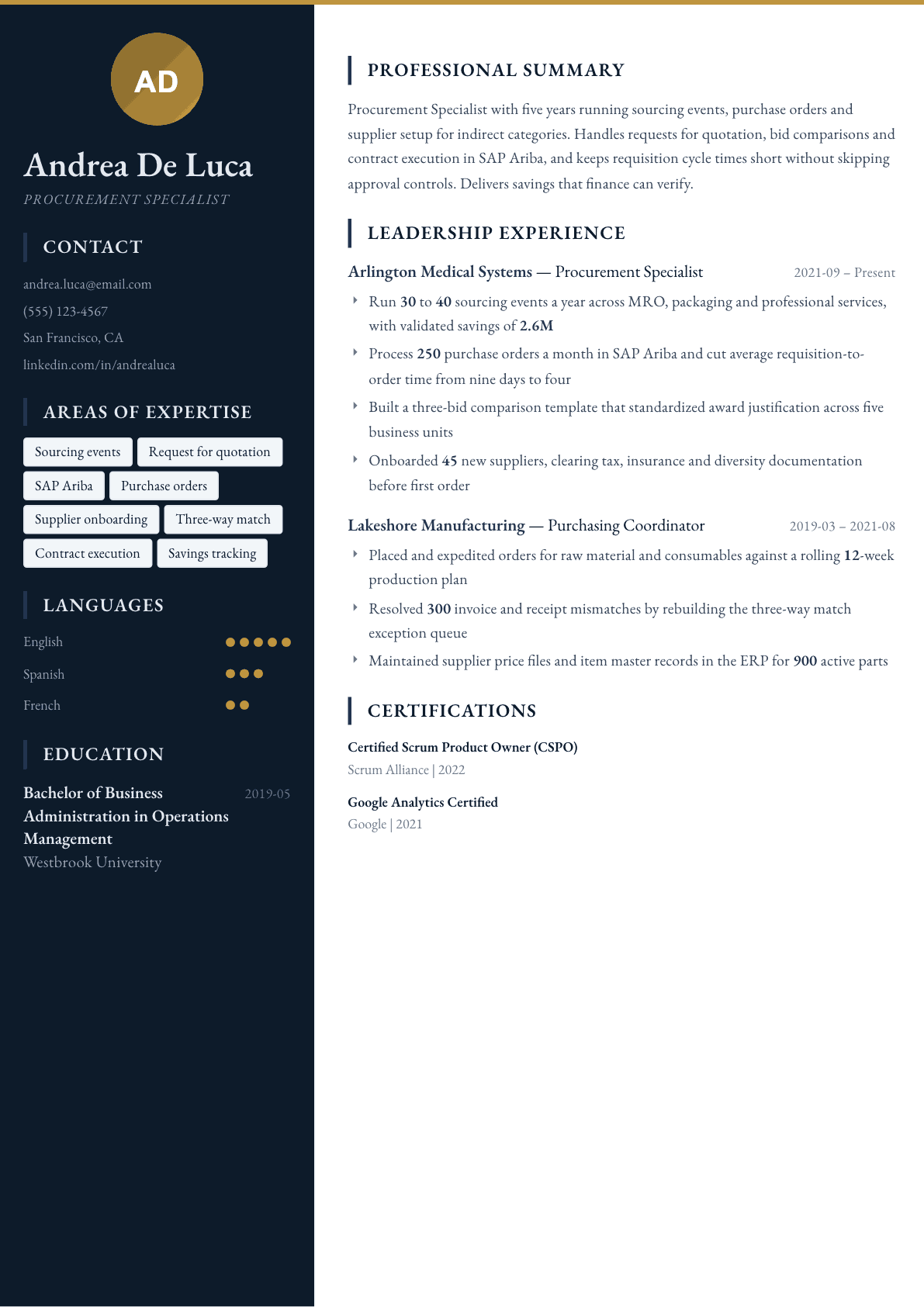
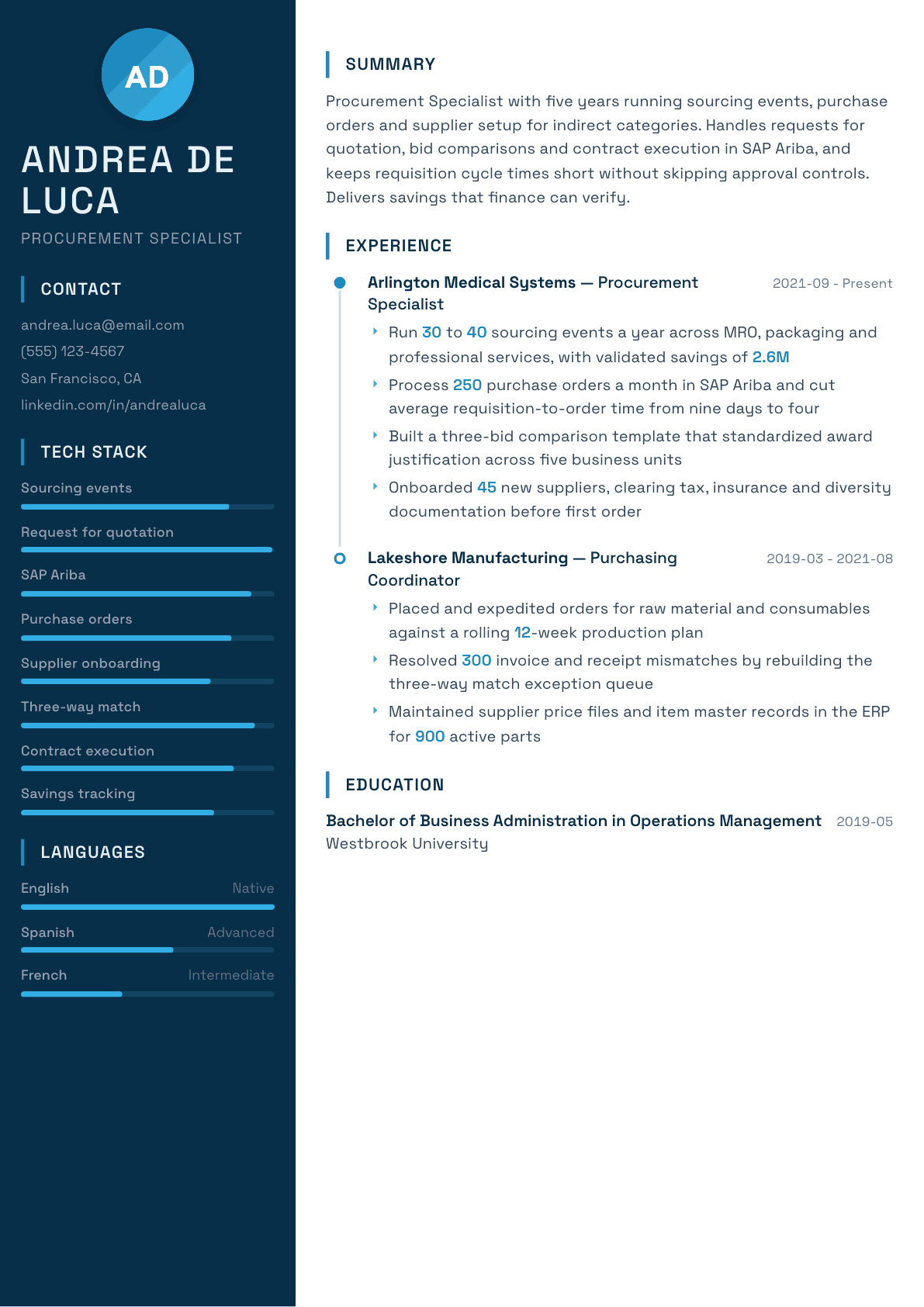
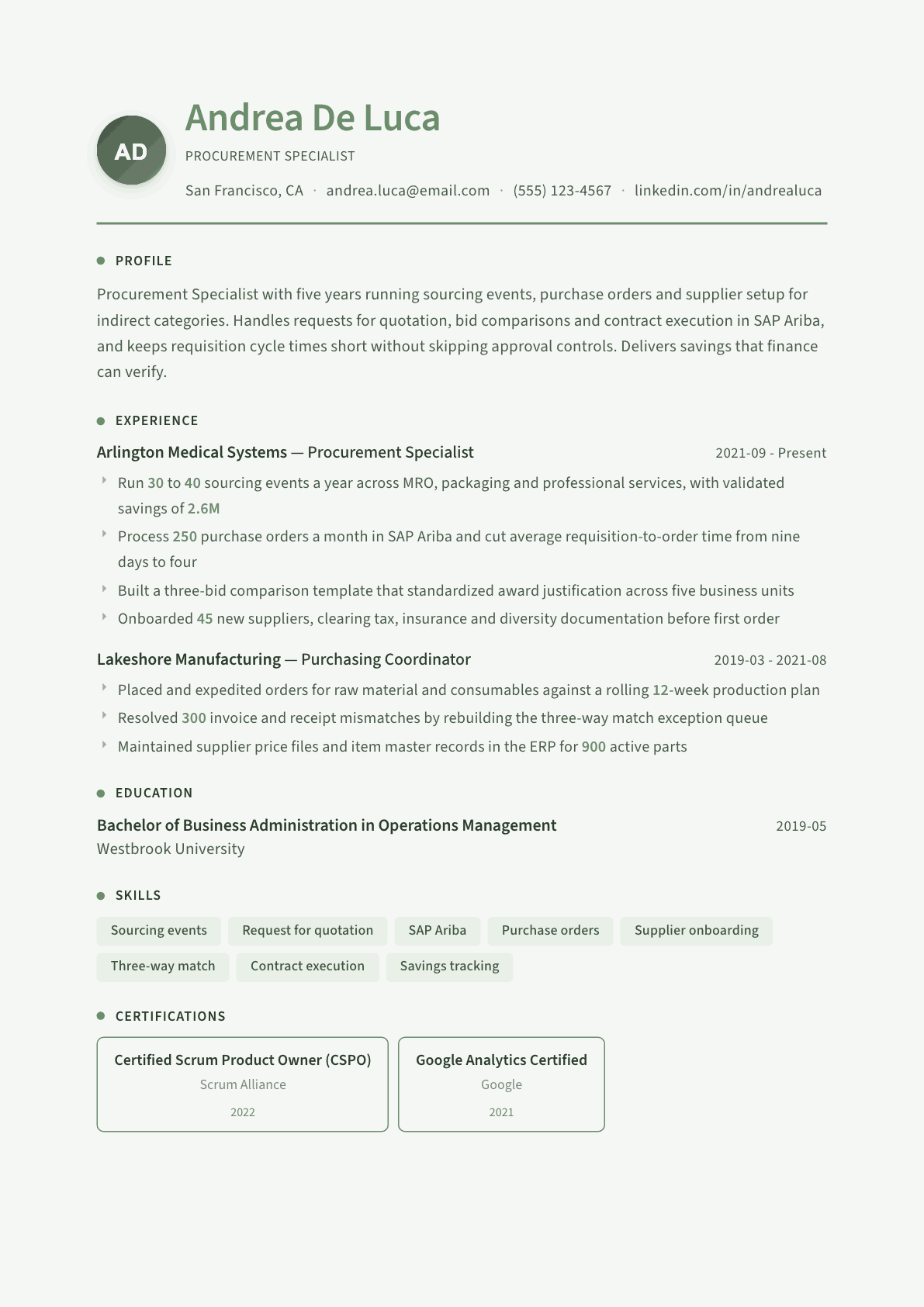
The same procurement specialist content laid out in three CVBooster templates, so you can see what the finished document looks like before you write a word.
Example Procurement Specialist summary
Procurement Specialist with five years sourcing MRO, packaging and professional services for a healthcare manufacturer. Runs 30 to 40 competitive events a year in SAP Ariba, processes 250 purchase orders a month, and cut requisition-to-order time from nine days to four. Delivered 2.6M in savings validated by finance and onboarded 45 suppliers with complete documentation.
Skills to list on a Procurement Specialist resume
- Strategic sourcing
- Request for proposal
- Request for quotation
- Purchase order processing
- SAP Ariba
- Coupa
- Supplier onboarding
- Contract administration
- Spend analysis
- Cost savings tracking
- Three-way match
- ERP item master
- Negotiation
- Supplier qualification
- Procure-to-pay
What actually gets this resume read
- State the categories you buy, because indirect, MRO and direct material sourcing are screened as different skill sets.
- Give purchase order volume per month and requisition cycle time, the two numbers a procurement manager checks first.
- Name the procure-to-pay system you work in, whether SAP Ariba, Coupa, Oracle, Jaggaer or a homegrown ERP module.
- Describe a sourcing event end to end: scope, bidders invited, evaluation criteria, award and the savings finance validated.
- Show compliance work such as three-bid rules, approval thresholds, supplier documentation and audit support.
- Say whether savings were hard cost reductions or cost avoidance, since hiring managers ask that in the first interview.
How to write a procurement specialist resume
The procurement specialist screen is fast and mechanical. A procurement manager scanning a stack wants three facts inside the first ten seconds: which categories you buy, which procure to pay system you work in, and how much volume passes through your hands each month. If those are missing, the file gets set aside no matter how well the rest is written.
The second read is about control. Procurement exists to get the right thing at a defensible price with an audit trail behind it. That means competitive bidding, documented awards, approval thresholds and clean supplier records. A resume that only talks about relationships and savings, with nothing about process discipline, worries the person who has to answer to internal audit.
What follows is the structure that works for this role, examples of bullets that survive a manager who has run sourcing events herself, and the questions specialists ask when they are trying to step up into a sourcing or category role.
Format: category and system in the top third of the page
Reverse chronological order, single column, and no graphics. Procurement teams run applicant tracking systems tuned to match category and platform terms, so put those terms in text where the parser can read them.
Directly beneath each title, add a scope line: categories bought, annual spend touched, purchase order volume and the system of record. That line answers the three screening questions before the reader reaches your first bullet.
- Header: name, city and state, phone, email, and the categories you buy.
- Section order: summary, procurement systems, experience, education, certifications.
- One page for under eight years. Detail belongs in bullets, not in a paragraph under the job title.
Summary: categories, volume, cycle time, savings
Three to four lines. Say what you buy, in what system, at what volume, and the two numbers that define a specialist: cycle time from requisition to order, and savings that finance signed off on.
Be precise about whether your spend is indirect or direct. Indirect covers professional services, marketing, facilities, information technology and maintenance items. Direct covers materials that go into a product. Hiring managers filter on this hard because the negotiation and planning skills differ.
Experience: run a sourcing event on the page
The strongest bullet a procurement specialist can write walks a competitive event from start to finish in one line: scope defined, suppliers invited, evaluation criteria set, award made, savings validated. Include the number of bidders and the basis of the award, because award justification is what an auditor pulls.
Then show the transactional discipline underneath it. Purchase orders processed per month, requisition to order cycle time, backlog cleared, exceptions resolved. These numbers are what separate a specialist who keeps a business running from one who only handles projects.
Add supplier lifecycle work. Onboarding with tax, banking, insurance and diversity documentation, supplier record accuracy in the enterprise system, and price file maintenance. It is unglamorous and every procurement manager knows it is where the pain lives.
Finish with one bullet on stakeholder work: a business unit you taught to submit complete requisitions, a specification you challenged, or a maverick spending pattern you brought back under contract.
Systems: procure to pay is a keyword and a credential
Name the suite you work in and what you do inside it. Sourcing modules, catalog and punchout management, contract repositories, invoice matching and supplier portals are separate skills, and a specialist who has configured a catalog is more valuable than one who has only raised orders.
If your organization runs an enterprise system rather than a dedicated procurement suite, say which one and which module. Procurement teams migrate constantly and hire for the transferable pattern more than for the exact logo.
- Procurement suites: SAP Ariba, Coupa, Jaggaer, Zip, GEP Smart.
- Enterprise systems: SAP, Oracle, NetSuite, Microsoft Dynamics, Epicor.
- Supporting tools: contract repositories, Excel bid comparison models, Power BI spend dashboards.
Keywords the procurement filter looks for
Recurring terms include strategic sourcing, request for quotation, request for proposal, purchase requisition, purchase order, three way match, supplier onboarding, spend analysis, cost avoidance, contract compliance and maverick spend. Mirror the posting exactly on the category words, since a manufacturer searching for MRO will not match on maintenance supplies.
Write the terms into real sentences. A specialist who says three way match inside a bullet about clearing an exception queue proves the knowledge; a specialist who lists it in a skills block only proves familiarity with the phrase.
Procurement Specialist resume summary examples
First procurement role
Purchasing coordinator with two years placing and expediting orders against a rolling production plan. Processes 150 orders a month in NetSuite, maintains price files for 900 active parts, and cleared a backlog of 300 invoice mismatches. Studying for a supply management credential and seeking a full procurement specialist role.
Five years in
Procurement Specialist covering MRO, packaging and professional services for a healthcare manufacturer. Runs 30 to 40 competitive events a year in SAP Ariba, processes 250 purchase orders a month, and cut requisition to order time from nine days to four while delivering savings finance validated.
Senior specialist moving to sourcing
Senior Procurement Specialist leading indirect sourcing across five business units, with category strategies for facilities, travel and professional services. Redesigned the three bid and award documentation standard now used company wide, and mentors two analysts through their first competitive events.
Work experience bullets: before and after
Before: Handled sourcing and purchasing for various categories.
After: Ran 30 to 40 competitive sourcing events a year across MRO, packaging and professional services, delivering 2.6M in savings validated by finance.
Volume, named categories and a validated savings figure replace the word various, which tells the reader nothing.
Before: Processed purchase orders in the system.
After: Processed 250 purchase orders a month in SAP Ariba and cut average requisition to order time from nine days to four by reworking the approval routing.
A transactional duty becomes an achievement once volume, system and a cycle time improvement are attached.
Before: Onboarded new suppliers.
After: Onboarded 45 suppliers with complete tax, insurance and banking documentation before first order, eliminating the payment holds that had delayed two production runs.
The consequence prevented shows why supplier record discipline matters instead of listing it as a task.
Before: Compared quotes from suppliers before buying.
After: Built a three bid comparison template covering price, lead time, warranty and total cost, standardizing award justification across five business units.
It shows the evaluation criteria and the reach of the fix, which is what a sourcing manager wants to hire.
Before: Fixed invoice problems with accounts payable.
After: Cleared 300 three way match exceptions by correcting receipt practices at two sites and rebuilding the price tolerance rules in the enterprise system.
Naming the root causes proves you fixed the process rather than just working through a queue.
Hard skills
- Strategic sourcing
- Request for quotation and request for proposal
- Bid evaluation and award justification
- Purchase order processing
- SAP Ariba
- Coupa
- Supplier onboarding and qualification
- Spend analysis
- Three way match and invoice exceptions
- Contract administration
- Cost savings and avoidance tracking
- ERP item and price file maintenance
Soft skills
- Attention to documentation detail
- Negotiation
- Stakeholder education
- Prioritization across competing requests
- Clear written justification
- Vendor communication
Certifications worth listing
- Certified Professional in Supply Management (CPSM) (Institute for Supply Management)
- Certified Supply Chain Professional (CSCP) (ASCM)
- Certified in Planning and Inventory Management (CPIM) (ASCM)
- Certified Professional Public Buyer (CPPB) (Universal Public Procurement Certification Council)
Mistakes that cost procurement specialist candidates the interview
- Never naming the categories bought, which forces the reader to guess whether you handled services or materials.
- Leaving the procure to pay system out, when it is one of the two terms recruiters search on most.
- Claiming savings without saying whether they were hard reductions or avoided increases, and who validated them.
- Describing only projects and omitting daily order volume, which makes the workload impossible to assess.
- Skipping compliance work such as bid thresholds and award documentation, the part audit cares about.
- Using internal requisition codes and process names that mean nothing to a reader outside the company.
Procurement Specialist resume questions
What is the difference between a procurement specialist and a buyer?
A buyer usually works an order book against demand signals and focuses on availability and price. A procurement specialist owns more of the front end: competitive events, supplier qualification, contract execution and compliance. Many postings blur the two, so read the duties, not the title.
How do I quantify procurement savings honestly?
State the baseline you measured against, the new price, the volume, and who confirmed the result. Separate hard savings, which reduce a budget line, from cost avoidance, which stops an increase. Hiring managers respect the distinction and ask about it in interviews.
Should I include public sector procurement experience separately?
Yes, if you have it. Public buying runs on formal solicitations, sealed bids, protest windows and statutory thresholds. Name that experience clearly because agencies filter for it, and private employers value the documentation discipline it builds.
What if my company uses spreadsheets instead of a procurement platform?
Say so and describe what you built. A bid comparison model, a spend tracker and a supplier register maintained by hand demonstrate that you understand the process rather than only the buttons in one vendor platform.
How do I move from a procurement specialist role into category management?
Group your work by category instead of by task, and add the strategic layer: market analysis, supplier landscape, multi year plans and stakeholder alignment. Show at least one category where you set direction rather than executing someone else request.
Related resume examples
- Procurement Manager Resume example
- Supply Chain Analyst Resume example
- Purchasing Manager Resume example
- Contract Administrator Resume example
- Office Administrator Resume example
- Buyer Resume example