Real Estate Analyst Resume Examples: what gets the call
Write a Real Estate Analyst Resume That Survives the Modeling Test
By Mustafa Tarabya, founder of CVBooster · Published · Updated
Real estate analyst resume example and guide covering underwriting models, Argus cash flows, market comps, debt sizing and investment memos.
Sample resumes for a real estate analyst
The same real estate analyst content laid out in three CVBooster templates, so you can see what the finished document looks like before you write a word.
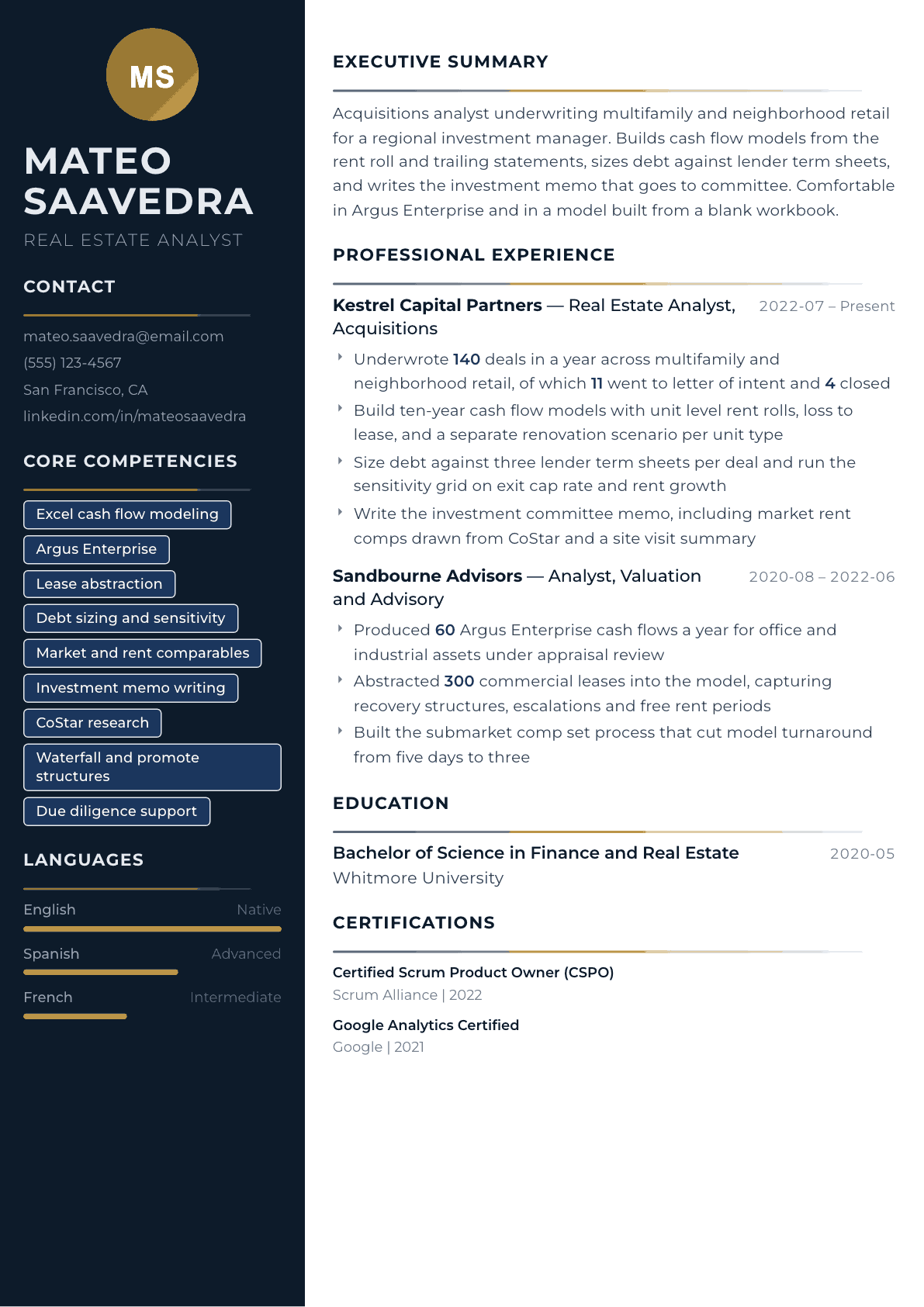
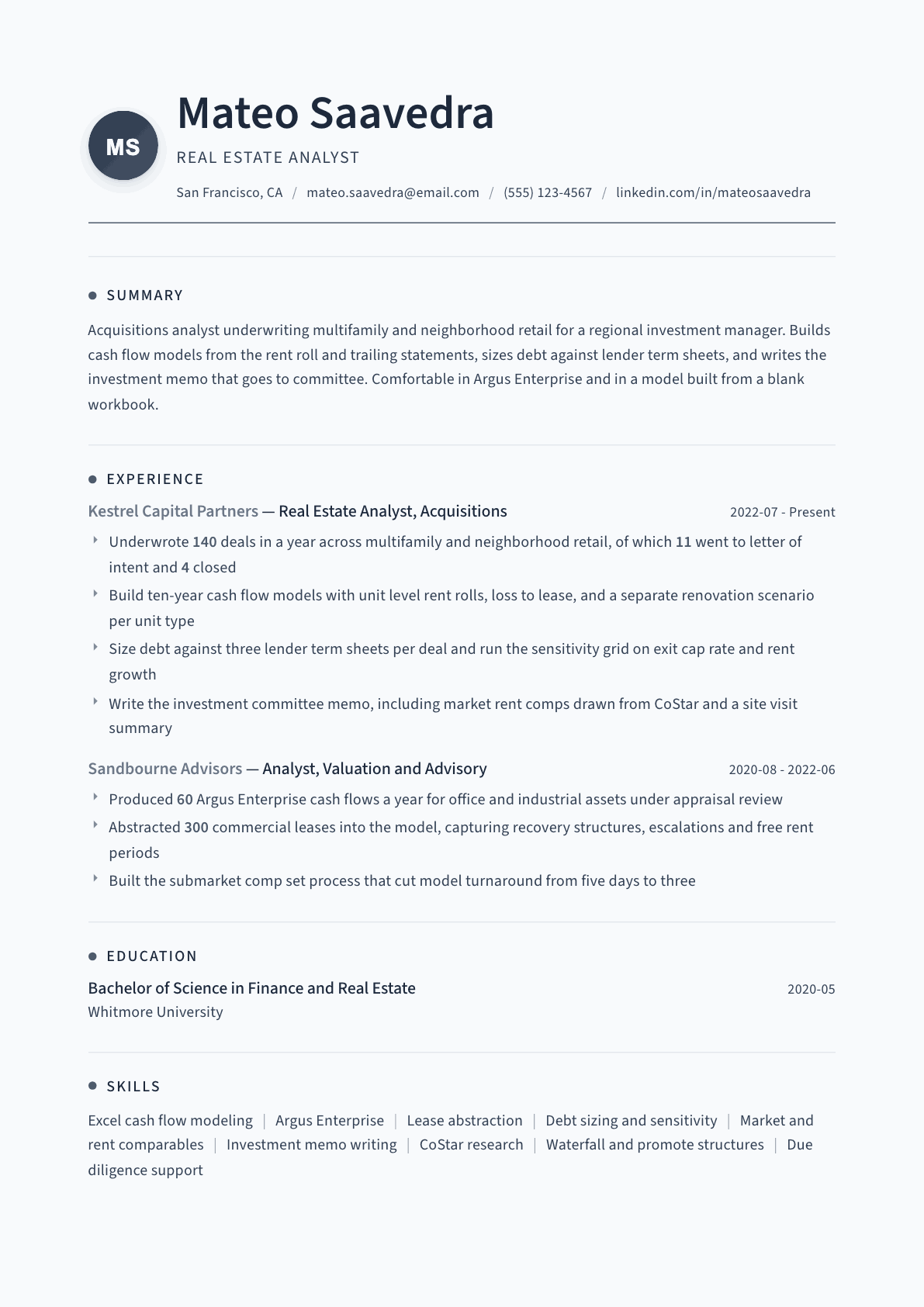
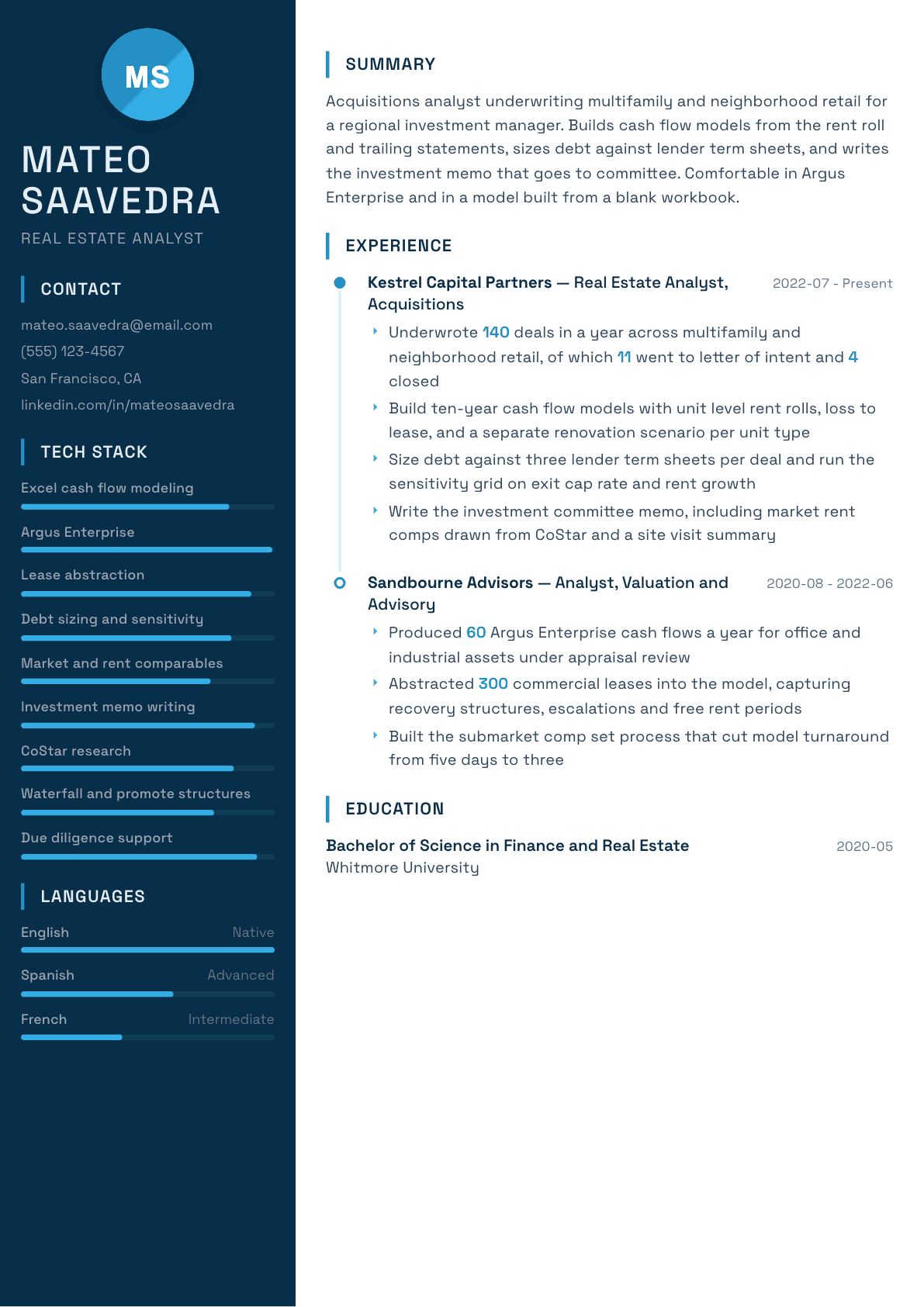
Example Real Estate Analyst summary
Real estate analyst underwriting multifamily and neighborhood retail for a regional investment manager, with roughly one hundred forty deals modeled in the most recent year and four closings behind them. Builds ten-year cash flows from unit level rent rolls with loss to lease and a renovation scenario per unit type, sizes debt against multiple lender term sheets, and writes the committee memo including market comps and site visit findings.
Skills to list on a Real Estate Analyst resume
- Discounted cash flow modeling
- Argus Enterprise
- Rent roll and trailing statement analysis
- Lease abstraction
- Debt sizing and coverage tests
- Sensitivity and scenario analysis
- Waterfall and promote modeling
- Market rent comparables
- Sales comparable analysis
- Investment committee memos
- Due diligence coordination
- CoStar and market data platforms
- Property tax and insurance underwriting
- Capital expenditure budgeting
- Portfolio reporting
What actually gets this resume read
- Say how many deals you underwrote, how many reached letter of intent and how many closed, in that order.
- Name the property types you have modeled, since multifamily, office, industrial and retail underwrite differently.
- State whether you build models from a blank workbook or work inside a firm template, because interviewers test that.
- List Argus Enterprise separately from Excel if you have it, and say how many cash flows you have produced.
- Show the debt work: sizing against term sheets, coverage and proceeds tests, and the sensitivity grid you run.
- Mention the investment memo and who read it, because writing for a committee is half the job.
How to write a real estate analyst resume
Hiring for a real estate analyst ends in a modeling test, and everyone involved knows it. The resume only has to do one job well: convince the acquisitions head that you will not embarrass yourself in a blank workbook with a rent roll, a trailing statement and ninety minutes on the clock. Every line should point at that.
The mistake candidates make is writing about deals as if they were the principal. An analyst is judged on volume of work screened, the accuracy of the model underneath it, and the clarity of the memo that goes to committee. Saying you closed a large acquisition when you built the cash flow for it invites a question you will not enjoy answering.
This guide covers how to present underwriting volume honestly, which model mechanics to name, how to separate Argus work from Excel work, and what a memo credit actually looks like on a page. Three summaries, before and after bullets, and the questions analysts ask when moving between valuation, acquisitions and asset management.
Format: one page, technical block visible, property types named early
One page until you are several years past a first analyst seat. An acquisitions head reads the top third and then jumps to the software line, so keep a compact technical block where it can be found: modeling environment, Argus if you have it, data platforms, and the property types you have underwritten. Property type is a filter, because a multifamily model and an anchored retail model share almost nothing below the revenue line.
Skip the graphics. A dense two column layout, charts of skill proficiency and a color coded competency wheel all read badly in a discipline where the deliverable is a clean workbook. A simple page with tight tabular alignment signals the same habits you will bring to a model.
- Technical block for an analyst: Excel modeling depth, Argus Enterprise, data platforms, and any SQL or Python you genuinely use.
- Property types listed by name: multifamily, neighborhood retail, office, industrial, self storage, senior housing.
- Deal funnel figures placed in the top job: screened, underwritten, letters of intent issued, closed.
- Section order that fits this role: summary, technical block, experience, education, certifications and coursework.
Summary: product, capital, funnel, and what you build from scratch
Three lines. Name the property types and the capital you work for, whether that is a private syndicator, a regional investment manager, a lender or an advisory practice. Give one funnel figure. Then say whether you build models from a blank workbook or work inside a firm template, because that sentence sets the difficulty of the test you will be handed.
If you are coming out of valuation and want acquisitions, name the crossover directly: lease abstraction depth, comparable analysis, and the Argus volume you have produced. Valuation analysts often model more properties in a year than acquisitions analysts do, and that volume is an argument if you make it explicitly.
Experience: the funnel, the model mechanics, the memo
Start every job with the funnel. Deals screened, deals fully underwritten, letters of intent issued, deals closed. Four numbers in one bullet tells an acquisitions head your throughput and your hit rate, and it prevents the awkward inflation of claiming a closing you supported rather than led.
Then get specific about the model. Unit level rent rolls and loss to lease for multifamily. Recovery structures, expense stops and free rent for commercial leases. Renovation scenarios by unit type, downtime and re-tenanting costs, capital reserves, and a sensitivity grid on exit capitalization rate and rent growth. Debt work belongs here too: sizing against term sheets, coverage and proceeds tests, and how the structure changes returns. These are the mechanics an interviewer probes, so a resume that names them starts the conversation ahead.
Finish with the memo. Say who read it, what you owned inside it, and where the qualitative work came from: submarket rent comps, a site visit, a broker conversation, property tax reassessment risk. Analysts who can write are scarce, and the memo is the only place on the resume where that shows.
Argus, Excel and the honest version of your software line
Separate the two. Excel modeling and Argus Enterprise are different skills, and an analyst who lists them as one line will be caught in the first technical screen. Give Argus a volume: cash flows produced, lease abstraction counts, property types. Give Excel a description of what you build unaided rather than a proficiency rating nobody can interpret.
Be careful with claims about coding. If you write SQL against a portfolio database or automate rent roll cleaning in Python, name the exact task. If your exposure is a course, put it under education. Overstating a technical tool in this field costs you the offer at the test stage rather than the interview stage.
Keywords, coursework and credentials that carry weight
Postings recycle a tight vocabulary: underwriting, discounted cash flow, unlevered and levered returns, exit capitalization rate, debt sizing, sensitivity analysis, rent roll, trailing twelve, lease abstraction, investment committee, due diligence. Use the terms your target subsector uses rather than a generic finance vocabulary that could belong to any analyst anywhere.
Credentials matter differently here than in brokerage. A CCIM designation, an Argus certification and progress through the CFA program are all read as real. Case competition placements, a real estate concentration and a capstone underwriting project are legitimate content for an early analyst page, and they are far better than a summary paragraph about a passion for real estate investment.
Real Estate Analyst resume summary examples
First analyst seat
Finance graduate with a real estate concentration, a capstone underwriting a 96 unit garden style acquisition, and two internships covering rent roll cleanup and comparable research. Builds ten-year cash flows in Excel from a blank workbook and completed Argus Enterprise training in 2024. Seeking an acquisitions analyst seat.
Three years in acquisitions
Acquisitions analyst underwriting multifamily and neighborhood retail, with 140 deals modeled in the past year, 11 letters of intent and 4 closings behind them. Builds unit level cash flows with loss to lease and renovation scenarios, sizes debt against three term sheets per deal, and writes the committee memo.
Senior analyst
Senior analyst covering the western portfolio, owning the underwriting model template, the quarterly valuation refresh across 26 assets and the debt sizing conversation with lenders. Trained two junior analysts on Argus lease abstraction and rebuilt the sensitivity framework the committee now sees on every deal.
Work experience bullets: before and after
Before: Underwrote multifamily and retail acquisitions.
After: Underwrote 140 multifamily and neighborhood retail deals in 2024, of which 11 advanced to a letter of intent and 4 closed, building each model from the rent roll and trailing twelve statements.
A four stage funnel with the source documents named shows throughput and stops any confusion about your role.
Before: Built financial models in Excel.
After: Built ten-year unlevered and levered cash flows with unit level rent rolls, loss to lease, a renovation scenario per unit type, and a sensitivity grid across exit capitalization rate and rent growth.
Naming the mechanics proves you build the model rather than update someone else's tabs.
Before: Worked with lenders on financing.
After: Sized debt against three lender term sheets per deal, testing coverage and proceeds constraints at each rate, and showed the committee how the structure moved levered returns before an offer went out.
The constraint tests and the decision the work informed turn coordination into analysis.
Before: Used Argus for property valuations.
After: Produced about 60 Argus Enterprise cash flows a year for office and industrial assets under appraisal review, abstracting 300 leases with recovery structures, escalations and free rent periods.
Volume, property type and abstraction depth are exactly what an Argus screen asks about.
Before: Assisted with investment committee materials.
After: Wrote the investment committee memo for every deal that reached a letter of intent, covering market rent comps, a site visit summary, property tax reassessment risk and the downside case.
Owning the memo and naming its contents shows judgment, which no model output can demonstrate on its own.
Hard skills
- Discounted cash flow modeling in Excel
- Argus Enterprise cash flows
- Rent roll and trailing twelve analysis
- Lease abstraction and recovery structures
- Debt sizing, coverage and proceeds tests
- Sensitivity and scenario analysis
- Waterfall and promote structures
- Market rent and sales comparable research
- Capital expenditure and reserve budgeting
- Investment committee memo writing
- Due diligence document review
- Portfolio and quarterly valuation reporting
Soft skills
- Saying a deal does not work when the team already likes it
- Explaining a model assumption to someone who will not open the workbook
- Version discipline when three people are touching one file
- Working a site visit for detail the seller did not volunteer
- Turning a memo around under a bid deadline without dropping the checks
Certifications worth listing
- Certified Commercial Investment Member (CCIM) (CCIM Institute)
- Argus Enterprise Certification (Altus Group)
- Chartered Financial Analyst (CFA) (CFA Institute)
Mistakes that cost real estate analyst candidates the interview
- Claiming credit for closings when your work was the model, which collapses under one follow up question in the interview.
- Merging Excel and Argus into a single software line, when a screener treats them as two separate qualifications.
- Describing models generically instead of naming loss to lease, recovery structures, reserves and the sensitivity grid.
- Leaving property types off the page, so a reader cannot tell whether your experience transfers to their portfolio.
- Overstating coding ability, which is discovered at the technical test rather than politely forgotten.
- Filling the summary with enthusiasm for real estate investment instead of the funnel, the product and the model depth.
Real Estate Analyst resume questions
How do I get an acquisitions seat from a valuation or appraisal role?
Lead with volume and lease level detail, since valuation analysts often model more assets in a year than acquisitions analysts do. Then add anything investment facing you have touched, such as return metrics, debt structures or a memo you helped write.
What do I put on the page with no full time experience yet?
A capstone or case competition model you built end to end, internship work described by the actual task, the property types you have studied, and your software depth. An acquisitions head will accept student work if it is described with the same specifics a job would carry.
Is Argus required to be a real estate analyst?
It is expected in commercial valuation and in office, retail and industrial acquisitions, and much less so in multifamily, where the work usually lives in Excel. Name what you have honestly and say whether you have completed formal training.
Should I list every deal I have worked on?
No. Give the funnel figures, then a short set of representative transactions by property type, unit or square foot count and your specific role. A long deal list without your role attached invites the reader to assume you were peripheral.
How technical should the resume look?
Technical in vocabulary and plain in design. Name the model mechanics and the data platforms precisely, then present them on a clean single column page, because the discipline values a legible workbook and the resume is the first sample of your formatting.
Related resume examples
- Real Estate Appraiser Resume example
- Mortgage Loan Officer Resume example
- Asset Manager Real Estate Resume example
- Real Estate Investor Resume example
- Acquisitions Analyst Resume example
- Commercial Real Estate Agent Resume example