Real Estate Appraiser Resume Examples: read this first
Appraise Your Career with a Standout Appraiser Resume
By Mustafa Tarabya, founder of CVBooster · Published · Updated
Create a real estate appraiser resume that demonstrates your valuation expertise, market analysis skills, and regulatory compliance.
Sample resumes for a real estate appraiser
The same real estate appraiser content laid out in three CVBooster templates, so you can see what the finished document looks like before you write a word.
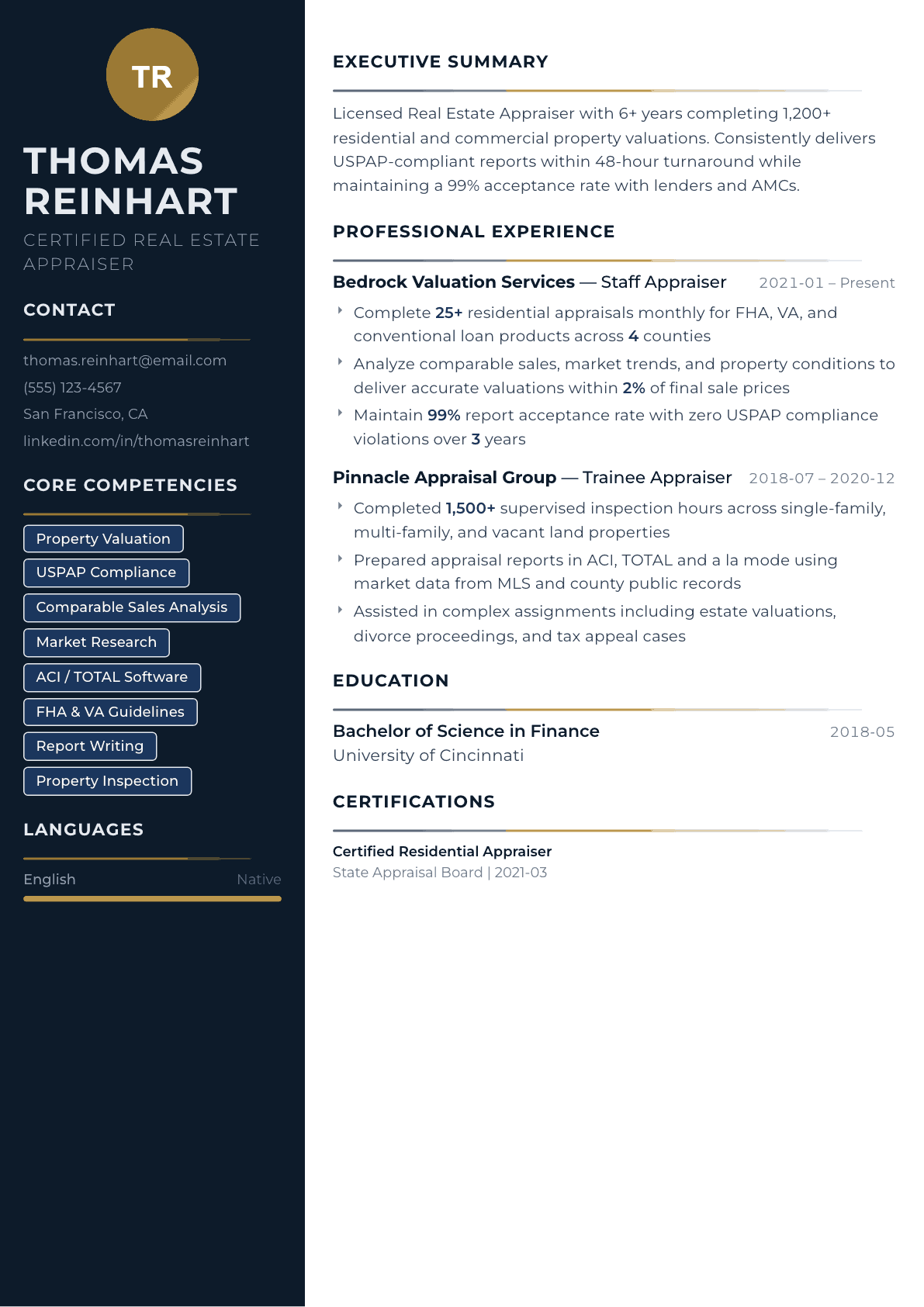
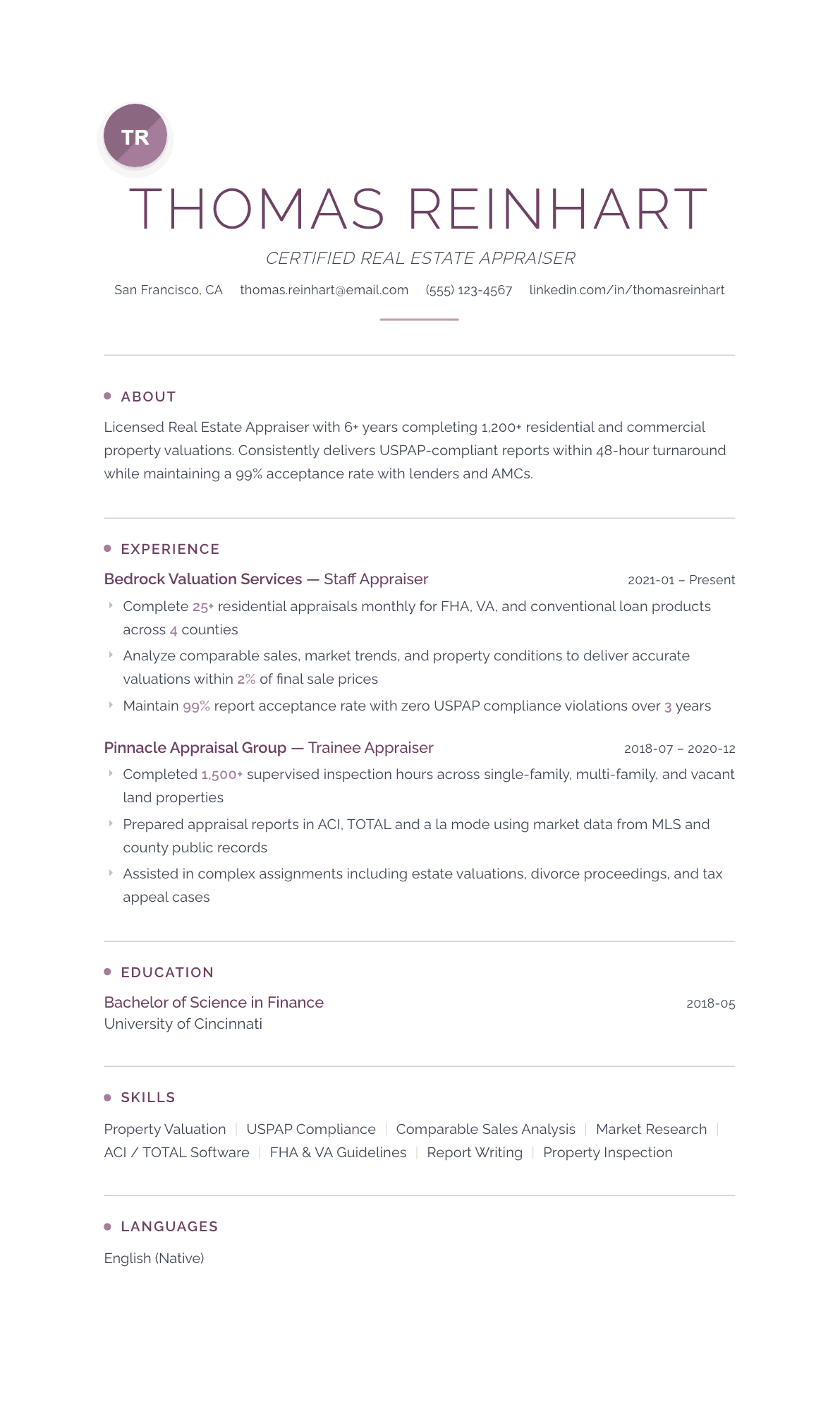
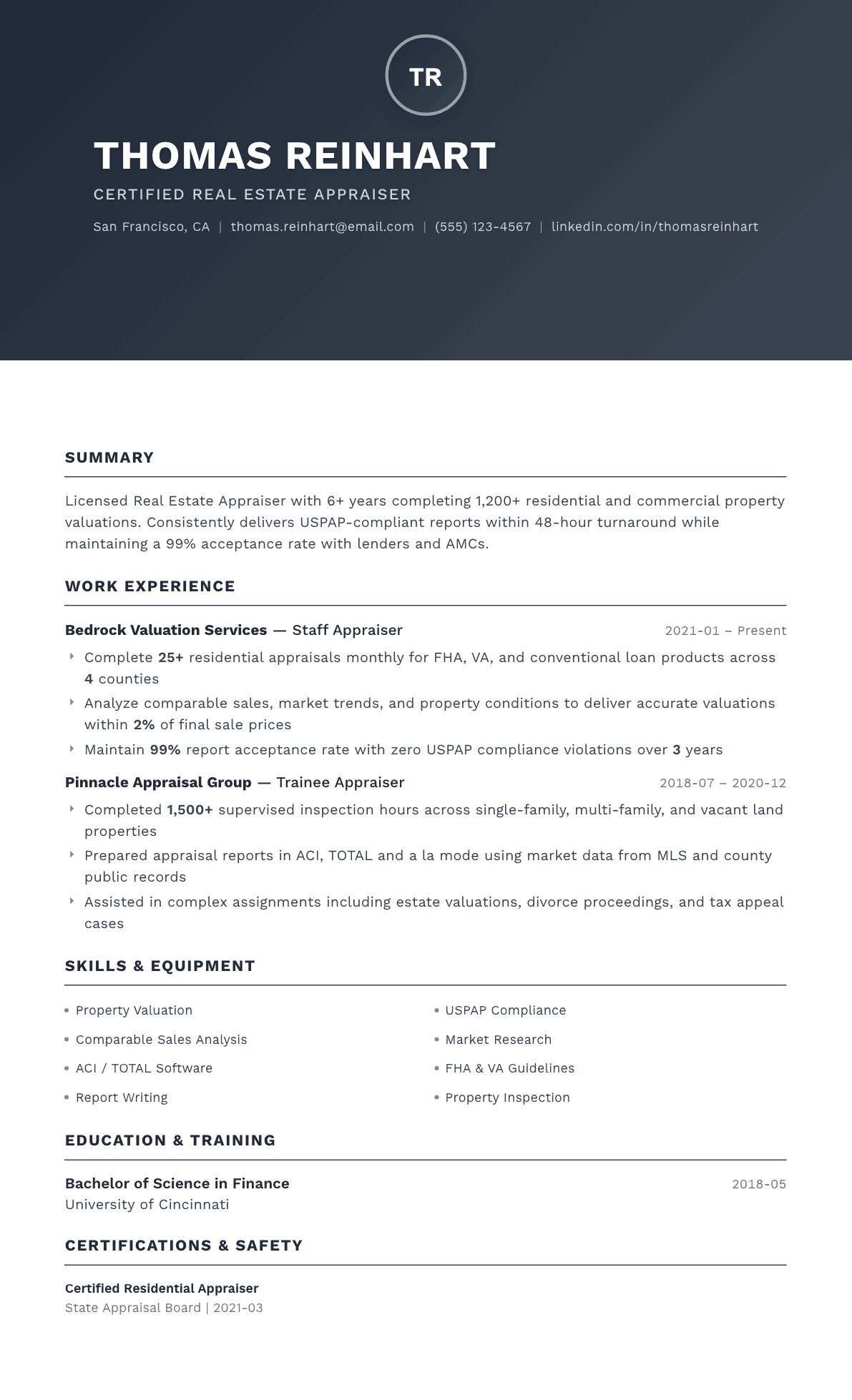
Example Real Estate Appraiser summary
Certified Real Estate Appraiser with 6 years and 1,200+ completed valuations across residential and commercial properties. Known for 48-hour turnaround, 99% lender acceptance, and strict USPAP compliance.
Skills to list on a Real Estate Appraiser resume
- Property Valuation
- USPAP Standards
- Comparable Sales Analysis
- Market Trend Analysis
- ACI / TOTAL / a la mode
- FHA / VA / Conventional
- Report Writing
- Property Inspection
- MLS & Public Records
- Regulatory Compliance
What actually gets this resume read
- State your license level clearly: Trainee, Licensed, Certified Residential, or Certified General.
- Quantify your appraisal volume, turnaround time, and report acceptance rates.
- Highlight USPAP compliance and continuing education hours completed.
- List the appraisal software you produce reports in, such as ACI, TOTAL or a la mode, and the AMC portals you deliver through.
How to write a real estate appraiser resume
An appraiser resume is read as a credential document first and a work history second. The chief appraiser at a lender, the vendor manager at an appraisal management company or the principal of a fee shop wants to know your license level, the states you hold it in, whether you are on any approved panels, and which assignment types you can sign without a supervisor. Everything else waits behind that.
The second thing they check is discipline. Turn time, revision rate, report acceptance by underwriting, and a clean record with the state board are the operational facts that decide whether you get orders. An appraiser who describes valuation work in general terms, without naming the forms, the software and the assignment types, gives a reviewer nothing to act on.
This guide covers the section order the field expects, how to describe license level and scope of competency correctly, summaries for a trainee, a certified residential appraiser and a certified general appraiser, before and after bullets, and the questions that come up when a residential appraiser wants commercial work.
Format: license block above everything else
Reverse chronological, one page for a trainee or licensed appraiser, two once you have review or commercial work. Directly beneath the header, put a license block: credential level, each state, the license number and the status. A vendor manager screening a stack of resumes for a panel opening reads that block and nothing else on the first pass.
Then a scope of competency line. Under the Uniform Standards of Professional Appraisal Practice you are accountable for taking only assignments you are competent to complete, so stating your property types plainly serves you twice: it satisfies a reviewer and it filters out orders you do not want. Single family, condominium, two to four unit, manufactured housing, small residential income, vacant land, and on the commercial side retail, office, industrial, multifamily and special purpose.
- Header: name, credential level, service area or counties covered, phone, email.
- License block: state, credential type, number, status, and any temporary practice permits.
- Section order: summary, licenses, scope of competency, experience, software, education and continuing education, professional membership.
Describing the work: forms, clients, assignment types
Name the forms. Residential lenders think in form numbers, so writing that you complete the uniform residential appraisal report, the individual condominium unit report, the small residential income property report and the exterior only inspection forms is more informative than saying you perform residential appraisals. On the commercial side, describe the report format instead: appraisal report, restricted appraisal report, and whether you complete narrative work.
Name the client channel too. Appraisal management company orders, direct lender panels, credit unions, portfolio lenders, relocation, estate and trust work, divorce, litigation support, tax appeal and eminent domain each carry different expectations for scope, timing and testimony. A reviewer hiring for litigation work is looking for deposition and testimony experience, which almost no candidate mentions.
Show the three approaches to value where you actually apply them. Sales comparison on nearly every residential file, cost approach on new construction and unusual improvements, income approach on rentals and commercial. If you build discounted cash flow models or lease-by-lease analyses, that is the sentence that gets a residential appraiser looked at for commercial work.
Volume, turn time and quality: the operational numbers
Give monthly assignment volume, typical turn time from inspection to delivery, and your revision rate. Those three drive whether a management company keeps sending orders. Add coverage: the counties you serve, whether you handle rural assignments where comparable sales are sparse, and whether you carry complex property competency.
Trainees should report supervised hours and the mix of property types, because the state boards count hours and a supervisory appraiser reading your resume is checking whether your experience log will support upgrade. Say who supervised you and what you did unaided, since inspection versus report writing versus comparable selection are separate skills.
Software, data sources and compliance
List the report writing software by name: ACI, TOTAL by a la mode, ClickFORMS or Apex for sketching, plus the delivery portals you work through. Add the data sources you use for comparables and market analysis: the MLS boards you belong to, public records and assessor data, and any market analytics tools you use to support your trend adjustment.
Compliance belongs on the resume, not in the interview. State that reports comply with the Uniform Standards of Professional Appraisal Practice and, where relevant, with the Federal Housing Administration handbook or Department of Veterans Affairs requirements, plus the Uniform Appraisal Dataset requirements for lender delivery. Note your continuing education status and any national appraiser registry listing.
Keywords the screener is scanning for
Panel and staff postings repeat the same terms: certified residential, certified general, USPAP compliant, comparable sales analysis, highest and best use, market conditions adjustment, cost approach, income approach, reconciliation, scope of work, turn time, revision rate and the software names. Use the ones that are true of you once in the summary and once inside an experience bullet.
Different employers weight different words. A management company weights coverage, capacity and revision rate. A bank staff appraisal department weights review work, complex assignments and independence from production. An assessor office weights mass appraisal, valuation models and appeal defense. Reorder accordingly rather than sending one document everywhere.
Real Estate Appraiser resume summary examples
Trainee appraiser
Appraiser Trainee with 1400 supervised hours across single family, condominium and two to four unit assignments in three counties. Completes inspections, comparable selection and full report drafts in TOTAL under a certified residential supervisor. USPAP course current, seeking upgrade to licensed residential.
Certified residential appraiser
Certified Residential Appraiser with seven years and roughly 30 assignments a month for lender and management company clients. Handles FHA case assignments, complex rural properties and small residential income. Median turn time of 4 days from inspection with a revision rate under 3%.
Certified general appraiser
Certified General Appraiser licensed in two states, valuing retail, office, industrial and multifamily assets with narrative appraisal reports supporting lending, estate and litigation assignments. Builds income approach models with lease-by-lease analysis, and has given deposition testimony in tax appeal matters.
Work experience bullets: before and after
Before: Completed residential appraisals for mortgage lenders.
After: Completed roughly 30 residential assignments a month on the uniform residential appraisal report and condominium unit forms for lender panels and management company clients across four counties.
Volume, form names, client channel and coverage tell a vendor manager whether you fit an open panel seat.
Before: Analyzed comparable sales to determine property value.
After: Selected and adjusted comparable sales with paired sales analysis for site, gross living area and condition, and supported market conditions adjustments with a twelve-month trend study of the subject market area.
Naming the adjustment method and the support behind the time adjustment is what a reviewer looks for in the file.
Before: Wrote USPAP compliant reports.
After: Delivered reports compliant with USPAP and FHA handbook requirements, with scope of work and reconciliation written to survive underwriting review, and closed the year with a revision rate under 3%.
A compliance claim becomes credible once it is tied to a review outcome and a measurable revision rate.
Before: Handled difficult properties.
After: Took complex assignments other panel appraisers declined: rural acreage with limited comparables, mixed use conversions and properties with functional obsolescence, extending the search parameters and documenting why in the scope of work.
Complex competency is a paid differentiator, so it needs the property types and the technique, not the word difficult.
Before: Trained new appraisers.
After: Supervised two trainees through more than 2000 logged hours each, reviewing every inspection and draft before signature and preparing their experience logs for state board submission.
Hours, review practice and the board submission show real supervisory responsibility rather than informal mentoring.
Hard skills
- Sales comparison approach
- Cost approach
- Income approach and direct capitalization
- Highest and best use analysis
- Market conditions and time adjustments
- USPAP compliance
- FHA and VA assignment requirements
- Uniform Appraisal Dataset delivery
- ACI report writing
- TOTAL by a la mode
- Apex and ClickFORMS sketching
- MLS and public records research
- Appraisal review
- Narrative commercial reporting
Soft skills
- Independence and objectivity
- Written clarity for underwriters
- Client communication on scope
- Time management across assignments
- Attention to file detail
- Composure under review or testimony
Certifications worth listing
- Licensed Residential Real Property Appraiser (State appraiser regulatory board)
- Certified Residential Real Property Appraiser (State appraiser regulatory board)
- Certified General Real Property Appraiser (State appraiser regulatory board)
- MAI Designation (Appraisal Institute)
- SRA Designation (Appraisal Institute)
- AI-GRS General Review Specialist (Appraisal Institute)
- National Uniform Standards of Professional Appraisal Practice Course (The Appraisal Foundation)
Mistakes that cost real estate appraiser candidates the interview
- Burying the credential level and license states in the education section instead of putting them under the header where a panel screener looks.
- Writing performed appraisals without naming the forms, the assignment types or the client channel, which leaves a reviewer nothing to evaluate.
- Claiming competency in property types you have never signed, which is both a hiring risk and a standards problem.
- Leaving out turn time and revision rate, the two numbers a management company uses to decide whether to send you orders.
- Omitting supervised hour totals as a trainee, when the supervisory appraiser reading the resume is checking whether the log will support an upgrade.
- Listing software as generic appraisal software rather than ACI, TOTAL, ClickFORMS or Apex, which are the terms recruiters filter on.
Real Estate Appraiser resume questions
Where do I put my appraiser license on the resume?
Directly under the header, before the summary. Give the credential level, each state, the license number and the status. Panel screeners and vendor managers verify the credential before reading anything else, so making them hunt for it costs you the review.
How does a trainee appraiser write a resume with no signed reports?
Lead with supervised hours by property type, name your supervisory appraiser and describe exactly which parts of the assignment you performed unaided: inspection, comparable selection, adjustment analysis or report drafting. Add your qualifying education and current USPAP course.
Should I list every county I cover?
List the counties or the named service area, because coverage is a direct hiring criterion for management companies and lenders filling geographic gaps. If you accept rural assignments where comparable data is sparse, say so, since that capacity is scarce and valued.
How do I move from residential to commercial appraisal?
Show the commercial-adjacent work you already do: small residential income properties, income approach analysis, rent surveys and land valuation. Then state your progress toward the certified general credential, including the qualifying education completed and the hours logged under a certified general supervisor.
Do Appraisal Institute designations belong on the resume?
Yes, and prominently, because the MAI, SRA and review designations carry weight with lenders, litigation clients and institutional users. List them with the Appraisal Institute as the issuing body, and include candidate for designation status if you are working toward one.
Related resume examples
- Property Management Resume example
- Real Estate Agent Resume example
- Mortgage Loan Officer Resume example
- Home Inspector Resume example
- Mortgage Broker Resume example
- Mortgage Underwriter Resume example